Trumps Crypto Empire: One-Fifth Of Family’s $6.8B Fortune Tied To Digital Assets

bitcoinistPublicado a 2026-01-21Actualizado a 2026-01-21

Resumen

President Trump's family fortune remains at $6.8 billion, with a significant shift toward crypto assets now making up one-fifth of their wealth. Despite a 66% decline in Trump Media's stock, crypto ventures generated approximately $1.4 billion. Key projects include World Liberty Financial, which contributed around $390 million, the TRUMP and MELANIA memecoins yielding $280 million, and Eric Trump's stake in American Bitcoin Corp. valued at $114 million. The family's move into digital assets was partly driven by being "canceled by banks," leading them to redefine their financial future through cryptocurrency investments.

A year into his presidency, US President Donald Trump and his family have reportedly seen a notable shift in their wealth distribution, with a growing concentration of crypto ventures linked to the presidential family.

Trump Family’s Wealth Gets Crypto Boost

On Tuesday, Bloomberg reported that the Trump family’s wealth has remained relatively steady over the past year despite the plunging value of their social media company, Trump Media & Technology Group Corp, and the massive gains of their new crypto ventures.

According to the report, the family’s overall net worth has not grown significantly since President Trump’s inauguration, remaining at around $6.8 billion, as data from the Bloomberg Billionaires Index shows.

Notably, the gains from their new projects were offset by the losses of Trump Media, whose shares have declined by around 66% over the past 12 months, despite efforts to diversify into various endeavors.

Nonetheless, “the way the Trumps’ wealth is distributed now — particularly its concentration in virtual assets and public companies, some of which didn’t exist when he left office in 2021 — represents a sea change in how they’ll earn money for years to come,” the report highlighted.

Per Bloomberg, the family’s most notable change has been the growing concentration of their net worth in cryptocurrencies, with one-fifth of their fortune coming from crypto projects for the first time.

As a result, “cryptocurrency projects became the key driver of the Trump family’s wealth last year,” generating around $1.4 billion from the different digital asset-related ventures managed by the President’s eldest sons, Eric and Donald Trump Jr.

In a statement to the news media outlet, Eric Trump reaffirmed that his family’s crypto push was driven by their experience with banks after the President’s first term. “Having been canceled by banks, out of political malice, led us to many incredible opportunities, as we redefine the future of finance,” he asserted.

Digital Asset Fortune Breakdown

Over the past year, various news outlets have estimated the first family’s crypto fortune, with some reports calculating its value at around $1 billion. In October, Eric Trump shared that the real number was “probably more.”

While the Trump family dived into multiple crypto-related projects, Bloomberg analysis highlighted three of their main ventures: World Liberty Financial (WLFI), American Bitcoin Corp., and the official TRUMP and MELANIA memecoins.

World Liberty Financial reportedly sold $550 million worth of tokens, generating $390 million for the presidential family, according to the news media outlet’s calculations. In August, the company announced its partnership with Alt5 Sigma and became an investor in the technology firm, which sought to raise $1.5 billion for its crypto treasury strategy based on WLFI.

According to Bloomberg, “the Trumps netted more than $500 million” from the deal. The company also launched its USD1 stablecoin in March, which has grown to more than $3 billion since its debut. Bloomberg estimated that the business could be worth more than $300 million.

Meanwhile, the official TRUMP and MELANIA memecoins, which launched the weekend before President Trump’s second inauguration, generated gains worth roughly $280 million from the family’s holdings and associated proceeds.

In addition, Eric Trump owns about 7.4% of American Bitcoin, worth roughly $114 million despite the company’s shares declining 82% since their September peak. Donald Jr. reportedly owns a smaller, undisclosed amount.

The report also noted that the Trump family’s fortune could be worth billions more on paper, as they still own founder WLFI tokens, worth $3.8 billion at current prices. Nonetheless, these tokens were not included in the calculations as they remain locked.
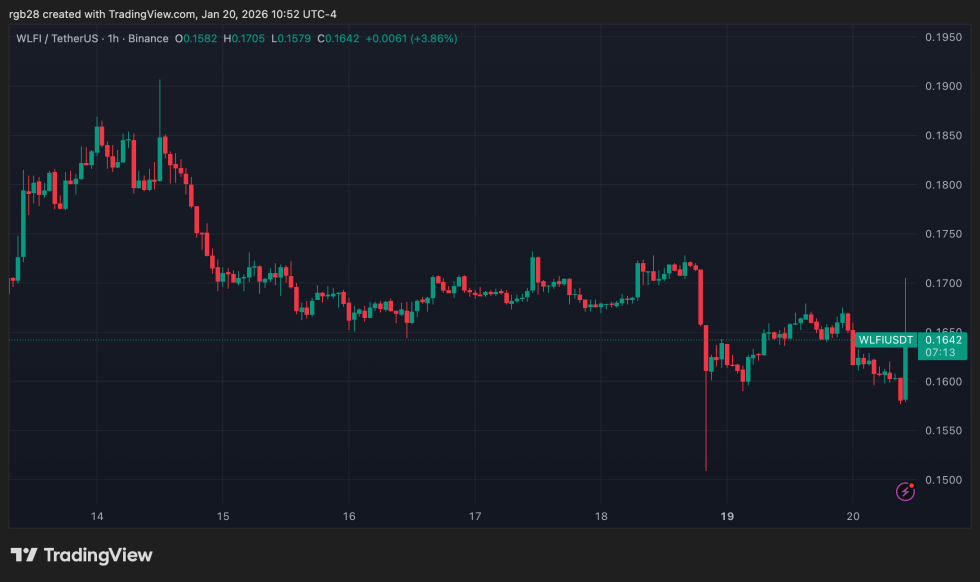
WLFI trades at $0.16 in the one-week chart. Source: WLFIUSDT on TradingView


Criptos en tendencia

Preguntas relacionadas

QWhat percentage of the Trump family's $6.8 billion fortune is now tied to crypto assets?

AOne-fifth (20%) of the Trump family's fortune is tied to crypto assets.

QWhich two of Donald Trump's sons are primarily managing the family's digital asset-related ventures?

AEric Trump and Donald Trump Jr. are primarily managing the family's digital asset-related ventures.

QWhat was the reported total value generated from the Trump family's crypto projects last year?

AThe Trump family's crypto projects generated approximately $1.4 billion last year.

QName the three main crypto ventures that contributed to the Trump family's wealth, as highlighted by Bloomberg.

AThe three main crypto ventures are World Liberty Financial (WLFI), American Bitcoin Corp., and the official TRUMP and MELANIA memecoins.

QAccording to Eric Trump, what was the primary reason the family pursued opportunities in crypto?

AEric Trump stated that the family's push into crypto was driven by their experience of being 'canceled by banks, out of political malice' after the President's first term.

Lecturas Relacionadas

Can Generative Models Finally Be Trained End-to-End? The Core Is a For Loop

This article introduces a novel training paradigm for generative models called Explorative Modeling (XM), which enables true end-to-end training. Traditionally, powerful generative models like autoregressive and diffusion models are not trained end-to-end. They are trained to predict a single small step but require iterative multi-step sampling for inference. This "exposure bias" leads to error accumulation and limits performance. The core challenge XM addresses is "mode blurring." In generative tasks, a single input (e.g., "generate a dog") corresponds to many valid outputs (multiple modes). Standard training objectives like reconstruction loss force the model to average these modes, producing unrealistic, blurry outputs. To avoid this, existing models break generation into many small, almost deterministic steps, sacrificing end-to-end training. XM tackles this by restructuring the training loop itself. Its key insight is to amplify "generative expressivity." For each training input, instead of generating one sample, the model generates K candidate outputs. Only the candidate closest to the real data is used for computing the loss and updating the model via backpropagation. This simple "best-of-K" mechanism is implemented as a short for-loop. By exploring multiple possibilities, the model learns to distribute its guesses across different modes rather than collapsing to their uninformative average. The paper demonstrates that "exploration" acts as a new, powerful scaling axis. Gains from XM increase with model size, data scale, and compute. Experiments show improvements in FID scores for image generation and significant efficiency gains, sometimes outperforming larger models without exploration. When pushed to the limit, XM enables fully single-step, end-to-end generative models. In robotics tasks, an "Explorative Policy" matched the performance of a 100-step Diffusion Policy with a single forward pass, drastically improving inference speed. While the best-of-K concept is not entirely new, the authors' contribution lies in formally understanding it as a direct method to boost generative expressivity without fragmenting the generation process. This work suggests that as models scale, enhancing exploration during training may become crucial for overcoming fundamental performance bottlenecks.

marsbitHace 30 min(s)

Can Generative Models Finally Be Trained End-to-End? The Core Is a For Loop

marsbitHace 30 min(s)

Annual Salary of Millions Competing for Electricians, Meta Rushes to Open Its Own Technical School

The AI boom is facing an unexpected bottleneck: a severe shortage of skilled construction workers and electricians. As tech giants like Meta, OpenAI, and Alphabet race to build massive data centers—such as OpenAI's $16 billion "Stargate" project—they are hitting a critical labor wall. The U.S. needs an estimated 130,000 more electricians, 240,000 construction workers, and 150,000 supervisors by 2030 for AI infrastructure alone, but tens of thousands of electrician jobs go unfilled each year. While AI companies offer high premiums, with electricians earning up to $280,000 annually, worker scarcity still causes massive losses—delays on a single project can cost $14.2 million per month. The complexity of building AI data centers, which require immense power (equivalent to powering hundreds of thousands of homes), sophisticated electrical systems, and advanced liquid cooling solutions, demands highly skilled technicians who are in short supply. To combat this, companies are investing heavily in training. Meta has committed $115 million to a free training school offering tuition, housing, and stipends, targeting 5,000 new workers. OpenAI is partnering with unions to secure skilled labor. These efforts are paying off, with a significant rise in Gen Z interest in trade schools over college. However, the power demands are staggering. AI data centers are driving a rapid surge in electricity consumption, projected to account for up to 12% of U.S. power use by 2028 and raising costs for consumers. Furthermore, the construction boom is project-based, leading to a potential future glut of trained workers once building peaks, which could depress wages industry-wide. The race for AI supremacy now depends as much on skilled hands as on advanced chips.

marsbitHace 2 hora(s)

Annual Salary of Millions Competing for Electricians, Meta Rushes to Open Its Own Technical School

marsbitHace 2 hora(s)

Trading

Spot

Artículos destacados

Cómo comprar ONE

¡Bienvenido a HTX.com! Hemos hecho que comprar Harmony (ONE) sea simple y conveniente. Sigue nuestra guía paso a paso para iniciar tu viaje de criptos.Paso 1: crea tu cuenta HTXUtiliza tu correo electrónico o número de teléfono para registrarte y obtener una cuenta gratuita en HTX. Experimenta un proceso de registro sin complicaciones y desbloquea todas las funciones.Obtener mi cuentaPaso 2: ve a Comprar cripto y elige tu método de pagoTarjeta de crédito/débito: usa tu Visa o Mastercard para comprar Harmony (ONE) al instante.Saldo: utiliza fondos del saldo de tu cuenta HTX para tradear sin problemas.Terceros: hemos agregado métodos de pago populares como Google Pay y Apple Pay para mejorar la comodidad.P2P: tradear directamente con otros usuarios en HTX.Over-the-Counter (OTC): ofrecemos servicios personalizados y tipos de cambio competitivos para los traders.Paso 3: guarda tu Harmony (ONE)Después de comprar tu Harmony (ONE), guárdalo en tu cuenta HTX. Alternativamente, puedes enviarlo a otro lugar mediante transferencia blockchain o utilizarlo para tradear otras criptomonedas.Paso 4: tradear Harmony (ONE)Tradear fácilmente con Harmony (ONE) en HTX's mercado spot. Simplemente accede a tu cuenta, selecciona tu par de trading, ejecuta tus trades y monitorea en tiempo real. Ofrecemos una experiencia fácil de usar tanto para principiantes como para traders experimentados.

406 Vistas totalesPublicado en 2024.12.12Actualizado en 2026.06.02

Cómo comprar ONE

Discusiones

Bienvenido a la comunidad de HTX. Aquí puedes mantenerte informado sobre los últimos desarrollos de la plataforma y acceder a análisis profesionales del mercado. A continuación se presentan las opiniones de los usuarios sobre el precio de ONE (ONE).

活动图片












