Trump urges CLARITY Act passage in honor of ‘big supporter’ Lindsey Graham

ambcryptoPublicado a 2026-07-14Actualizado a 2026-07-14

Resumen

President Donald Trump is urging the Senate to quickly pass the CLARITY Act, a crypto market structure bill, framing it as a race against China to lead in crypto and AI. He linked the push to honoring the late Senator Lindsey Graham, a key supporter. The bill faces a tight deadline before the Senate's August recess. While gaining support from some law enforcement groups, it faces opposition from banks and Democrats. Banks seek clearer stablecoin rules, and Senator Elizabeth Warren is demanding ethics provisions, citing Trump's past crypto gains. With key Republican absences, Trump needs 9-10 Democratic votes, and Warren's ethics demand could decide the outcome. Market prediction odds for passage have fallen to 38%.

President Donald Trump has pressed the Senate to advance the crypto market structure bill, the CLARITY Act. For him, the passage should be ‘in honor’ of the late South Carolina Republican Senator Lindsey Graham, whom he said was a big supporter of the bill.

The president warned that the Senate should act fast to avoid letting China win on crypto and AI.
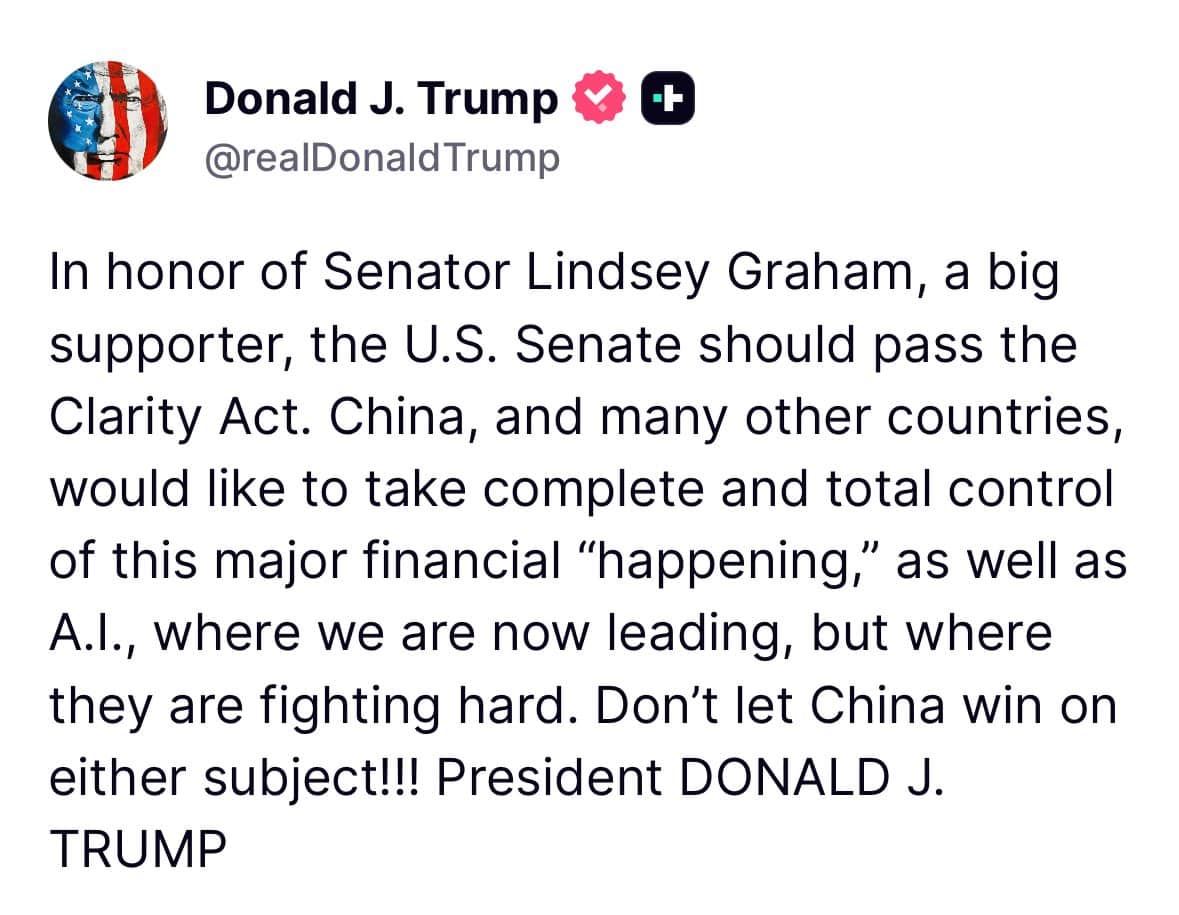
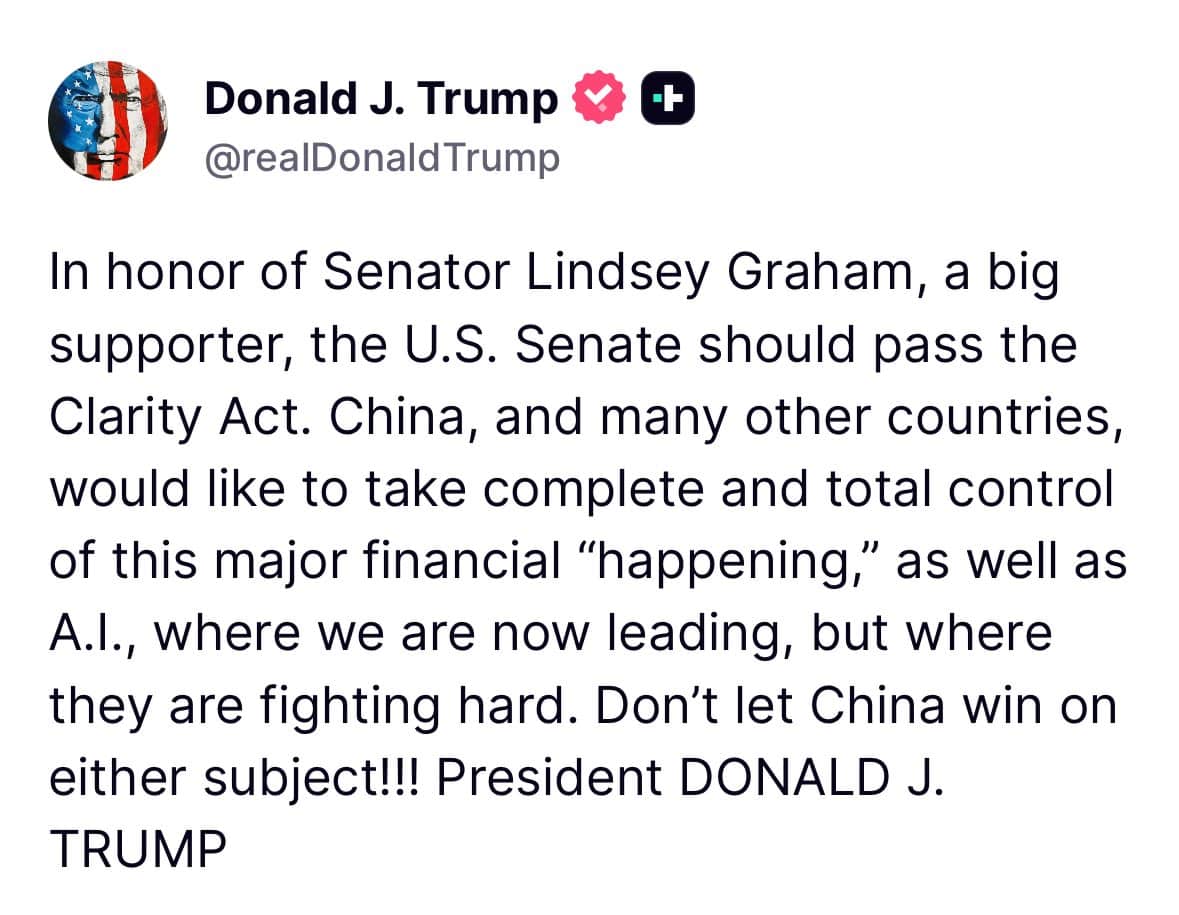
Source: Bluesky

A similar urgency was echoed by White House crypto advisor Patrick Witt, adding that,

Critical week for Clarity, which also happens to be the one-year anniversary of GENIUS. We cannot afford to delay any longer.

The U.S. Senate officially reconvened on Monday, 13th of July, after the Independence Day break. It will go for another recess on the 8th of August. Hence, the only window for the bill’s passage is before the August recess, meaning less than three weeks.

Yet, a Senate floor vote has not been scheduled. Besides, if it passes the Senate floor vote, it must also be approved by the House before it reaches President Trump’s desk for signing into law.

On a positive note, the bill has won the support of another major enforcement group, the Federal Law Enforcement Officers Associations (FLEOA). With recent backing by sheriffs, the bill has cleared a key hurdle initially posed by these groups.

But banks and Democrats’ opposition remained.

Sen. Warren calls for CLARITY Act ethics provisions

In a letter on Monday, the American Bankers Association urged the Senate to strengthen stablecoin yield provisions. The bank lobby group decried ‘ambiguities’ in the bill that could deepen capital flight.

We remain concerned that ambiguities within the bill could encourage stablecoin arrangements to effectively function as substitutes for deposits, despite Congress’s longstanding and clearly stated intent that payment stablecoins should serve as transaction tools rather than store-of-value products.

Worth pointing out that a deal had been reached on the stablecoin yield. In fact, Witt reinforced the same and slammed the group.

Asked and answered. Give it a rest

For her part, Sen. Elizabeth Warren slammed the bill as a ‘sanctions evasion’ ticket last week. This week, she renewed calls for an ethics provision in the bill, citing Trump’s $1.4B crypto windfall in 2025.

To get the 60-vote threshold to pass the bill, Republicans previously needed only seven extra votes. Now, with Sen. Graham gone and Mitch McConnell (R-KY) hospitalized, Trump will need 9-10 Democrats to pass the bill. And the ethics provision could make or break the outcome.

In fact, the market is so pessimistic about the bill’s passage that odds have dropped to an annual low of 38%.
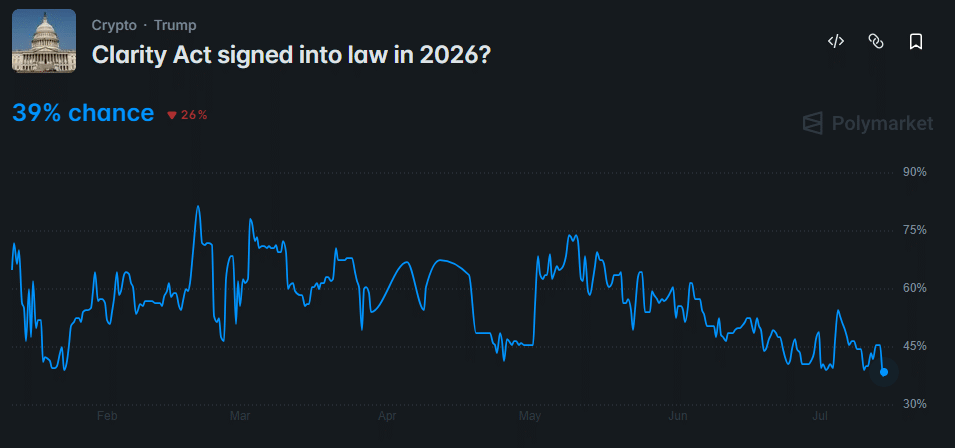
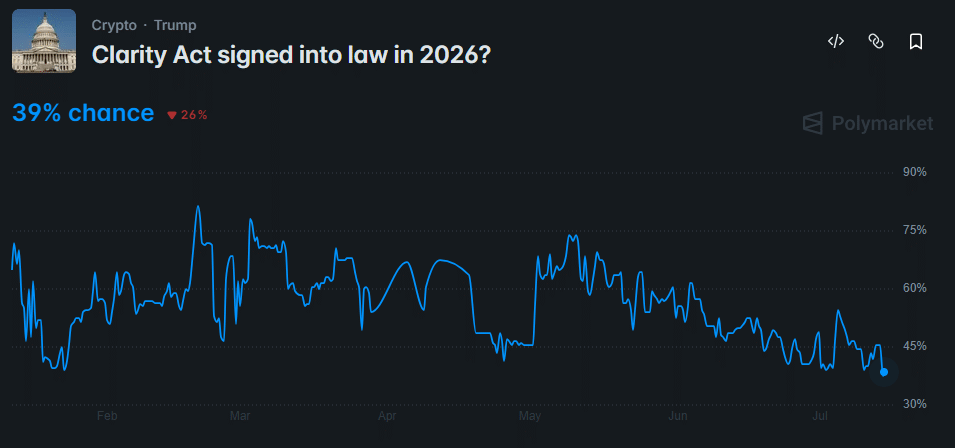
Source: Polymarket

Final Summary

  • Trump has turned the CLARITY Act into a race with China, urging the Senate to pass it.
  • A renewed ethics provision call could stall the bill if the Democratic Party withdraws support.

Preguntas relacionadas

QWhat is the CLARITY Act and why is President Trump urging its passage?

AThe CLARITY Act is a crypto market structure bill. President Trump is urging the Senate to pass it to avoid letting China win on crypto and AI, and to honor the late Senator Lindsey Graham, a big supporter of the bill.

QWhat is the current timeline and challenge for the CLARITY Act to become law?

AThe Senate has less than three weeks before its August recess to vote on the bill. If it passes the Senate, it must also be approved by the House before reaching the President's desk. A floor vote has not been scheduled yet.

QWhat are the main points of opposition to the CLARITY Act mentioned in the article?

ABanks, represented by the American Bankers Association, oppose ambiguities they believe could encourage stablecoins to function like deposits. Senator Elizabeth Warren opposes it, calling it a 'sanctions evasion' ticket and calling for an ethics provision, citing Trump's crypto windfall.

QHow has the political landscape for passing the bill changed, according to the article?

AWith the death of Senator Lindsey Graham and the hospitalization of Senator Mitch McConnell, Republicans now need 9-10 Democratic votes to reach the 60-vote threshold, instead of just seven. The ethics provision demanded by Democrats could be a decisive factor.

QWhat is the market's prediction for the passage of the CLARITY Act?

AThe market is pessimistic, with betting odds on the bill's passage dropping to an annual low of 38%.

Lecturas Relacionadas

Bitcoin Withdrawals Continue: 8 Years of Storage in a Coldcard Cold Wallet Ended in Zero

Coldcard Hardware Wallet Hacked: Losses Mount Due to Vulnerable Seed Generation A critical vulnerability in Coldcard hardware wallets has led to a continued wave of fund thefts. According to Galaxy Research, the total stolen has reached 1,367.05 BTC (approx. $88.6 million) from 4,585 addresses, a significant increase from the initial 594.5 BTC reported on July 30, 2026. Most of the stolen funds remain on the attackers' addresses. The issue is not with the current firmware, which Coinkite has updated, but with seed phrases generated on vulnerable devices between March 2021 and the release of fixed firmware versions. Due to a programmer error, devices switched from using a hardware random number generator to the software-based Yasmarang generator, which was initialized with publicly accessible data like the chip's serial number. This made the seed phrases predictable through offline brute-force attacks, meaning wallets remain at risk until funds are moved to a new wallet generated with the patched firmware. Affected devices include Mk2/Mk3 with firmware 4.0.1–4.1.9 (and up to 5.0.3), Mk4/Mk5 up to version 5.6.0, and Q models up to 1.5.0Q. The only exceptions are seeds created with a high-entropy method like at least 50 independent dice rolls or a strong unique BIP-39 passphrase. All other owners must generate a new seed on the fixed firmware and transfer their assets. A case highlighting the human impact involves a 39-year-old long-term investor who lost 2 BTC (approx. $130,000) in minutes. He had accumulated the Bitcoin over eight years through physical labor, viewing it as a financial lifeline and a retirement plan in a country suffering from hyperinflation. His story underscores that even conservative "buy and hold in cold storage" strategies can be compromised by such underlying technical flaws. From a technical perspective, this incident echoes historical failures where weak random number generators undermined cryptographic security, challenging the assumption that offline storage is automatically foolproof.

cryptonews.ruHace 1 hora(s)

Bitcoin Withdrawals Continue: 8 Years of Storage in a Coldcard Cold Wallet Ended in Zero

cryptonews.ruHace 1 hora(s)

Trading

Spot
活动图片





