Trump Relents on Ethics Provisions, 《CLARITY Act》 Makes Final Push Before Senate Recess

Foresight NewsPublicado a 2026-07-21Actualizado a 2026-07-21

Resumen

U.S. President Donald Trump has reportedly agreed to include ethics provisions in the *CLARITY Act*, a major digital asset market structure bill, resolving a key negotiation obstacle. This paves the way for the bill's text release and a critical Senate vote before the August recess. The legislation aims to establish comprehensive federal digital asset regulation and clarify the regulatory roles of the SEC and CFTC. The ethics clause is designed to restrict federal officials, including the President and Congress members, from profiting from digital assets while in office. A central point of contention involved Trump's own significant crypto holdings. Following this development, prediction market odds for the bill's passage in 2026 saw an uptick. The bill faces a tight timeline for Senate passage before the August 7th recess, with subsequent steps required in the House before reaching the President's desk. Industry lobbyists have emphasized prioritizing the bill's core regulatory framework over the political details of the ethics rules, while some Democratic senators have called for even stronger provisions. Concurrently, market data shows significant Bitcoin accumulation by large holders ("whales") in recent weeks, and a reversal to net inflows for U.S. spot Bitcoin and Ethereum ETFs after an extended period of outflows.


By: Sanqing, Foresight News


July 21 - According to a report by crypto journalist Eleanor Terrett citing sources, U.S. President Donald Trump has agreed to include ethics provisions in the "CLARITY Act" (Digital Asset Market Structure Act). The White House has reached a consensus on the ethics framework for the "CLARITY Act," clearing the last major hurdle for this crypto regulatory legislation that has been debated for months. The bill text could be released as soon as the same day, though it may be slightly delayed; as of the time of reporting, the Democratic side had not yet seen the specific text.



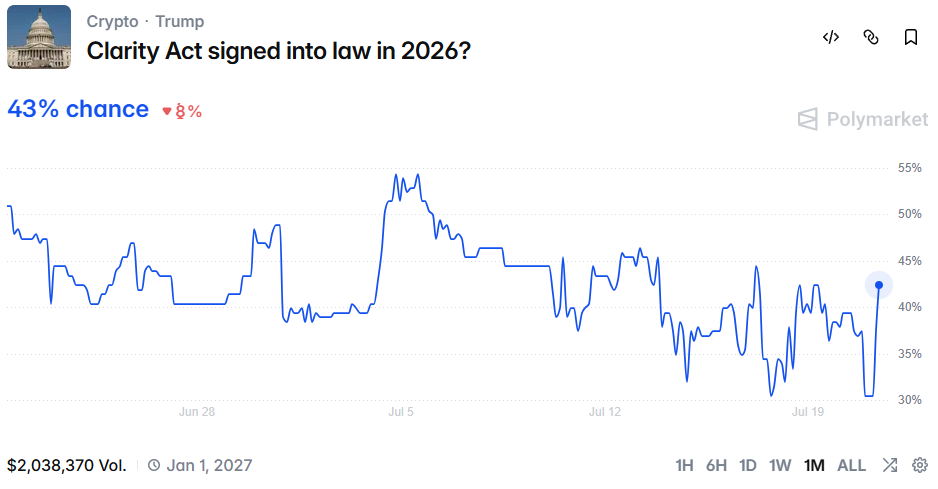
Following the news, the probability of "the 'CLARITY Act' being signed into law in 2026" on Polymarket rebounded to 43%. Research firm Galaxy Research had previously assessed the probability of it passing within 2026 at roughly fifty-fifty.


Previously, on July 16, during a meeting with Republican Senators Bernie Moreno, Cynthia Lummis, and White House crypto advisor Patrick Witt, Trump did not immediately agree. However, the deal was finalized by the President himself on Monday evening. This provision aims to restrict the President, Vice President, members of Congress, and other federal officials from profiting from digital assets during their terms. The core controversy has centered on the Trump family's Meme tokens and World Liberty Financial. Financial documents disclosed last month showed Trump's crypto income was as high as approximately $14 billion, which had once brought negotiations to a standstill.


The Final Stretch Before the August Recess


If ultimately enacted, the "CLARITY Act" would provide the first comprehensive federal-level regulation for the digital asset industry, clarifying the jurisdictional division between the SEC and CFTC.


The U.S. House of Representatives previously passed the bill with bipartisan majority support in 2025 by a vote of 294 to 134. The Senate Banking Committee greenlit it on May 14 this year with a vote of 15 to 9. It is currently stalled in final negotiations before a full Senate vote.


The bill text is expected to be released in the coming days, followed by a full Senate vote. The window only lasts until the recess in the first week of August (the Senate will go into recess on August 7 and return on September 14). If passed, it would need to go back to the House for reconsideration, text reconciliation, etc., before finally reaching the President's desk for signature.


The vote count in the Senate tightened in mid-July. Republican Senator Lindsey Graham of South Carolina died unexpectedly at the age of 71 on the night of July 11 from an aortic dissection after returning from a trip to Ukraine. This temporarily reduced the Republican Senate seats from 53 to 52.


According to the Associated Press, the state's Governor Henry McMaster appointed Graham's sister, Darline Graham Nordone, to succeed him two days later. She was sworn in on July 14, immediately restoring the seat.


However, Republican Senator Mitch McConnell has been absent from votes since being hospitalized on June 14. As of July 12, he himself stated he was not ready to return to the Senate, and there have been no further updates on his potential return since.


According to the cloture procedure under Senate Rule XXII, if Mitch McConnell remains absent at that time, the bill would need at least 8 additional Democratic votes beyond the actual number of Republican votes present to pass.


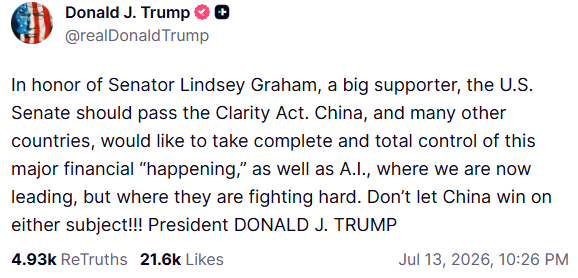
Trump previously posted on Truth Social, urging the Senate to pass the "CLARITY Act" quickly, calling it a tribute to the late Senator Lindsey Graham and emphasizing that it also concerns preventing China from gaining dominance in digital finance and artificial intelligence.


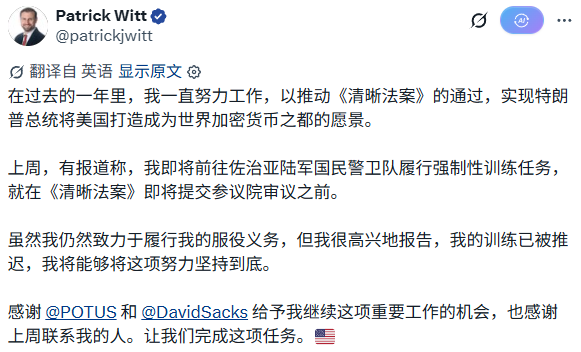
Personnel changes at the White House level also reflect the urgency of the push. Crypto advisor Patrick Witt was originally scheduled to be absent this week due to mandatory training with the Georgia Army National Guard. The training has been postponed, and he will remain in place to advance the legislation. His deputy, Harry Jung, announced his departure in two weeks.


"The Goal Line" or "The Elephant in the Room"?


The stance from industry lobbyists is straightforward. Blockchain Association CEO and former CFTC Commissioner Summer Mersinger said at the Injective Summit in Washington D.C. on July 16 that the core provisions of the bill "are very close to agreement, with only a few details left to iron out." She called the ethics issue "the elephant in the room" and the biggest current obstacle.
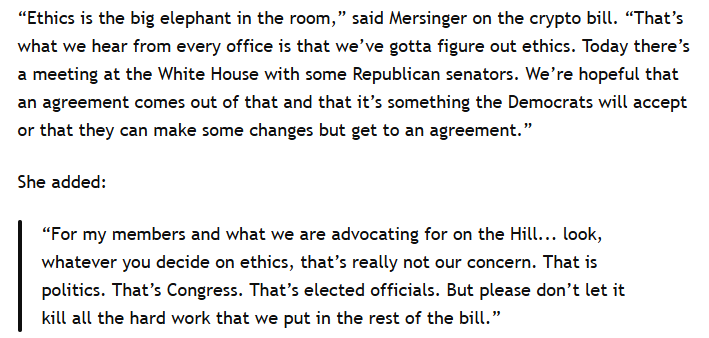


She urged Congress: "Whatever you decide on the ethics provision, that's really not our concern; that's politics, that's Congress, that's elected officials. But please don't let it ruin all the work we've put into the rest of the bill."


Coinbase Vice Chairman and former SEC official Ryan VanGrack was more blunt in a statement on CNBC in mid-July: "The 'CLARITY Act' is at the goal line. The momentum for passage is clear." Senate Majority Leader John Thune offered a more cautious assessment: "There is certainly a path to a deal, but time is running out."


These statements essentially convey the same message: we don't care how the ethics clause is written, just don't let it hinder the rest of the bill.


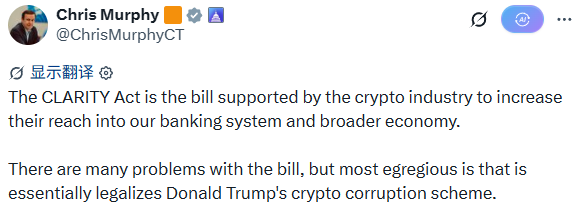
Skepticism comes primarily from the Democratic side and directly targets the inadequacy of the ethics provisions themselves. Senator Chris Murphy criticized in a Facebook post on July 14 that the "CLARITY Act" "is a crypto industry-backed bill designed to expand its influence over the banking system and the broader economy." He explicitly demanded that "the bill must have provisions prohibiting the President and his family members from issuing cryptocurrencies during his term, whether Meme tokens or stablecoins... The ethics provisions must cover the President and his immediate family members."


Senators Warren, Jack Reed, Chris Van Hollen, and others also issued a joint statement in mid-July, stating they "cannot support the current version of the 'CLARITY Act'," citing reasons including the need for stronger consumer protections, stricter conflict-of-interest and ethics rules, and more safeguards against crypto fraud and market manipulation. Senator Mark Warner bluntly said: "I am very pessimistic about the progress."


Whales, ETFs & Crypto Treasury Movements


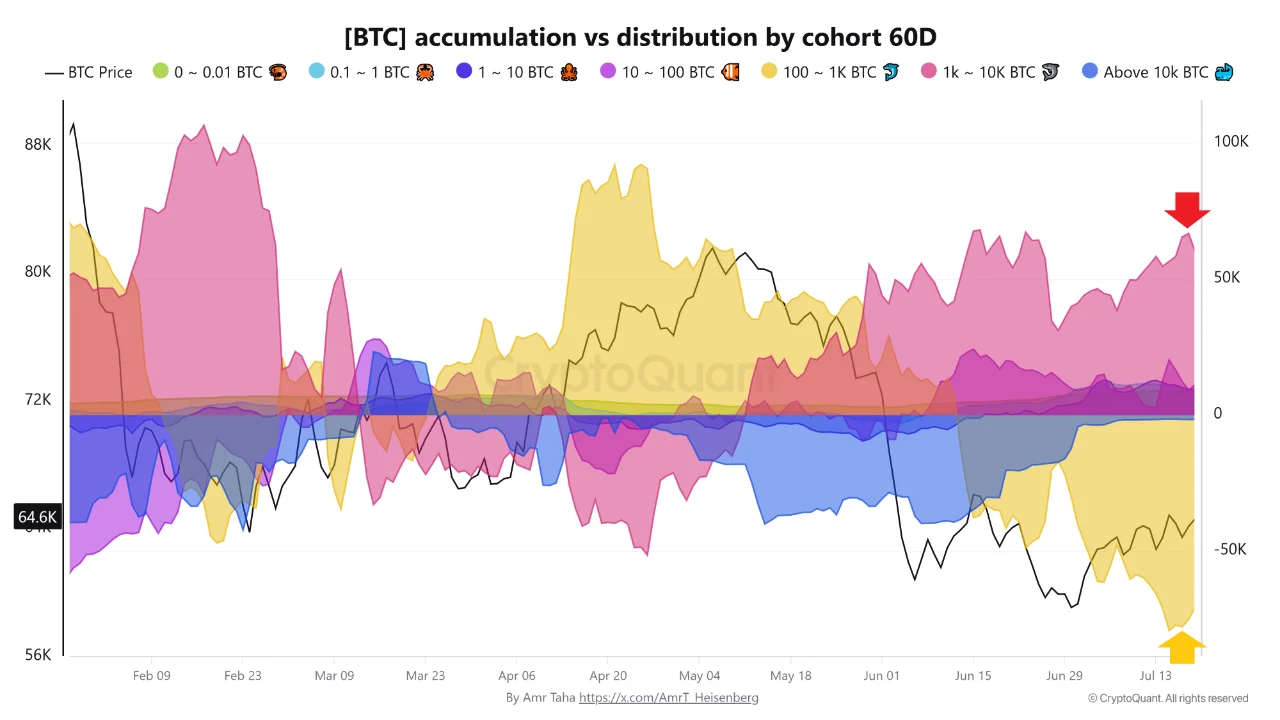
On-Chain Whales: According to CryptoQuant data from July 20, addresses holding 1,000 to 10,000 BTC saw a net increase of approximately 66,700 BTC over 60 days, the strongest wave of buying since mid-February. Meanwhile, addresses holding 100 to 1,000 BTC (medium holdings) sold about 77,800 BTC in the same period. Data provided by Bitfinex analysts to CoinDesk shows that whale addresses collectively added over 270,000 BTC in the first two weeks of July, worth about $16.7 billion.


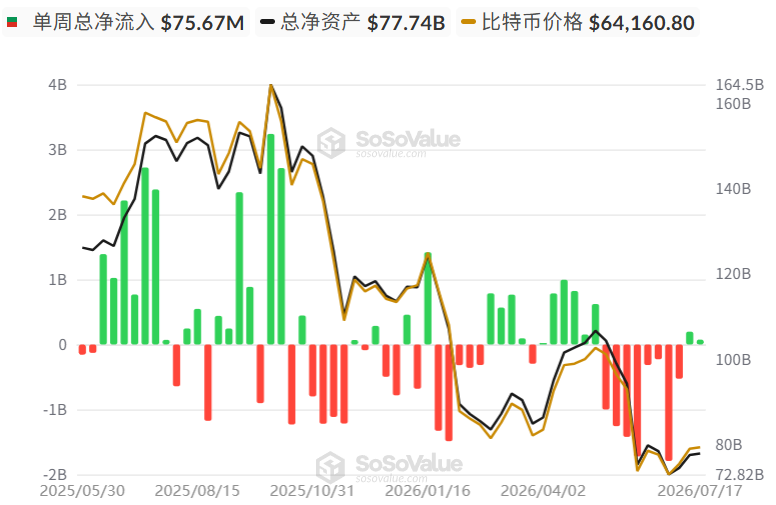
Spot ETFs: According to weekly data from SoSoValue, U.S. spot Bitcoin ETFs saw net outflows for 8 consecutive weeks starting the week of May 15, with the most severe outflow of $1.79 billion occurring the week of June 26. It wasn't until the week of July 10 that flows turned positive with a net inflow of $197 million, followed by another net inflow of $75.67 million the week of July 17.


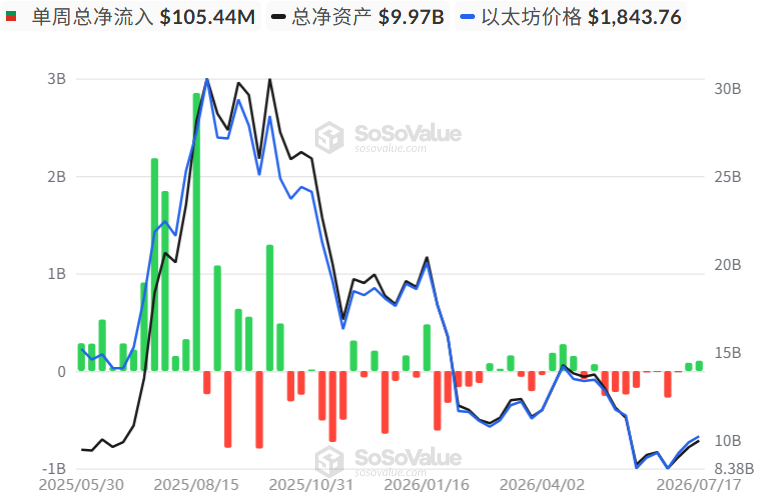
The trend for spot Ethereum ETFs was almost identical: also 8 consecutive weeks of net outflows from May 15 to July 2, turning to net inflows in the weeks of July 10 and July 17, with $84.42 million and $105 million, respectively.


Crypto Treasuries: MicroStrategy's holdings remained at approximately 844,000 BTC, with no Bitcoin purchases for two consecutive weeks. In mid-July, it raised $263.5 million in cash through a stock offering but did not immediately add to its position, instead holding it as a buffer for preferred stock dividends and interest. Japanese-listed company Metaplanet increased its holdings by 2,823 BTC in Q2, bringing its total holdings to 43,000 BTC, ranking third globally among publicly traded companies. Its subsidiary also completed a convertible bond financing of approximately $59.5 million on July 21, with plans to continue buying.


BitMine increased its holdings by 7,430 ETH last week, bringing its total to 5,777,468 ETH, accounting for approximately 4.8% of the total ETH supply. Of this, 85% is staked, with an estimated annual staking yield of about $247 million. The company simultaneously repurchased approximately 5.5 million shares of common stock at an average price of $15.62. Tom Lee stated that the buying pace has slowed due to this, but weekly accumulation has never been interrupted since the reserve strategy was launched on June 30, 2025.


Arthur Hayes: According to monitoring by Yu Jin, BitMEX co-founder Arthur Hayes spent 2.5 million USDC to buy 1,293 ETH at $1,933 on July 15, chasing the rally. On July 20, he bought another 2.5 million USDC worth of ETH via FalconX and Cumberland OTC at $1,876. The two transactions totaled 5 million USDC, purchasing 2,625.7 ETH at an average cost of $1,904. Hayes previously wrote that the AI sector is absorbing market liquidity, putting short-term pressure on BTC, but once liquidity returns, the crypto market still has room for a rebound.


Criptos en tendencia

Preguntas relacionadas

QWhat was the main hurdle for the CLARITY Act that President Trump's agreement on an ethics clause helped to clear?

AThe main hurdle was the inclusion and agreement on an ethics clause. This clause aims to restrict federal officials, including the President, Vice President, and members of Congress, from profiting from digital assets during their terms. A key point of contention was the Trump family's involvement with Meme coins and World Liberty Financial, which had stalled negotiations.

QWhat are the key regulatory roles defined for the SEC and CFTC under the proposed CLARITY Act?

AThe CLARITY Act, if passed, would establish the first comprehensive federal regulatory framework for the digital asset industry. A key provision is to clearly define the jurisdictional division of responsibilities between the Securities and Exchange Commission (SEC) and the Commodity Futures Trading Commission (CFTC).

QWhat challenge does Mitch McConnell's potential continued absence pose for the CLARITY Act's passage in the Senate?

AIf Senator Mitch McConnell remains absent from voting, it affects the procedural math. According to Senate Rule 22 for ending debate (cloture), the bill would need to secure at least 8 additional Democratic votes beyond the number of Republicans present and voting to overcome a filibuster and proceed to a final vote.

QAccording to industry lobbyists, what was the primary concern regarding the ethics clause during the final negotiations?

AIndustry lobbyists, represented by figures like Summer Mersinger of the Blockchain Association, expressed that while they were not directly concerned with the specifics of the ethics clause (calling it 'politics'), their primary worry was that the contentious debate over this clause could jeopardize or 'destroy' the entire broader legislative effort of the CLARITY Act.

QWhat criticism did Democratic Senators level against the ethics provisions in the CLARITY Act?

ADemocratic Senators, such as Chris Murphy, Elizabeth Warren, and others, criticized the ethics provisions as insufficient. They demanded stronger rules, specifically calling for clauses that would prohibit the President and their immediate family members from issuing cryptocurrencies (like Meme tokens or stablecoins) while in office. They also cited a need for stronger consumer protections and safeguards against fraud and market manipulation.

Lecturas Relacionadas

The Encryption Bill Clarity's Challenge: A Thorny Path of Bipartisan Compromise in the U.S.

U.S. lawmakers are attempting to advance the Clarity Act, a significant crypto market structure bill, but its path is fraught with partisan hurdles. The process has been rocky since January, when a prior bipartisan deal in the Senate Banking Committee was upended. A key compromise in May on "yield" issues allowed the bill to move forward in committee, but only with the conditional support of two Democratic senators, Angela Alsobrooks and Ruben Gallego. They emphasized that their final vote depends on reaching an agreement on ethics provisions for elected officials. Ultimately, the Senate Agriculture Committee passed its version along party lines without Democratic support. As Republicans push for a full Senate vote in July, the demand for strong ethics language has expanded beyond Democrats. Additional controversies surround provisions related to yields (aligning some Republicans with large banks) and developer protections (opposed by enforcement agencies). Core concerns about illicit finance and consumer protection remain central to the debate. Despite consensus on the need for legislation, achieving the necessary bipartisan compromise is proving difficult. While momentum exists—including recent meetings between senators and White House officials—a reconciled bill text faces skepticism. Senator Gallego has stated that without ethics terms acceptable to Democrats, they will not provide the needed votes. The immediate goals for the crypto community in Congress are unclear: a symbolic Senate vote before the August recess, eventual passage into law by 2026, or forging a final compromise framework. The arduous, vote-by-vote effort to build bipartisan support continues, mirroring the traditional legislative grind the industry must now navigate.

Foresight NewsHace 20 min(s)

The Encryption Bill Clarity's Challenge: A Thorny Path of Bipartisan Compromise in the U.S.

Foresight NewsHace 20 min(s)

Kalshi and Polymarket Founders at Odds? This Business War Is Far More Brutal Than You Imagine

The New York Times details the fierce, personal rivalry between Kalshi CEO Tarek Mansour and Polymarket founder Shayne Coplan, which has escalated beyond typical business competition into a conflict marked by legal complaints, regulatory battles, and public hostilities. The feud intensified in late 2024 when FBI agents raided Coplan's New York apartment. While Coplan publicly blamed political motives, sources indicate his team privately suspected Mansour, noting that Kalshi's lawyers had previously reported Polymarket's operational model to federal prosecutors, highlighting that U.S. users could still access its offshore platform despite a ban. The animosity extends through their companies' operations. Kalshi positions itself as a compliance-focused, fully licensed U.S. operator, while Polymarket has historically operated its core platform offshore without a U.S. license, offering more anonymity and controversial betting markets. Mansour has publicly called Polymarket's model "illegal and immoral," while Coplan privately dismisses Kalshi as a copycat. Their competition has played out in Washington lobbying, attempts to sabotage each other's major deals (such as Kalshi's efforts to dissuade Intercontinental Exchange from investing in Polymarket), competing sponsorships, and poaching staff. The rivalry continues as both platforms experience massive growth, with Kalshi currently holding a valuation and trading volume edge, but facing ongoing regulatory scrutiny alongside Polymarket.

Foresight NewsHace 50 min(s)

Kalshi and Polymarket Founders at Odds? This Business War Is Far More Brutal Than You Imagine

Foresight NewsHace 50 min(s)

Trading

Spot

Artículos destacados

Cómo comprar PUSH

¡Bienvenido a HTX.com! Hemos hecho que comprar Push Protocol (PUSH) sea simple y conveniente. Sigue nuestra guía paso a paso para iniciar tu viaje de criptos.Paso 1: crea tu cuenta HTXUtiliza tu correo electrónico o número de teléfono para registrarte y obtener una cuenta gratuita en HTX. Experimenta un proceso de registro sin complicaciones y desbloquea todas las funciones.Obtener mi cuentaPaso 2: ve a Comprar cripto y elige tu método de pagoTarjeta de crédito/débito: usa tu Visa o Mastercard para comprar Push Protocol (PUSH) al instante.Saldo: utiliza fondos del saldo de tu cuenta HTX para tradear sin problemas.Terceros: hemos agregado métodos de pago populares como Google Pay y Apple Pay para mejorar la comodidad.P2P: tradear directamente con otros usuarios en HTX.Over-the-Counter (OTC): ofrecemos servicios personalizados y tipos de cambio competitivos para los traders.Paso 3: guarda tu Push Protocol (PUSH)Después de comprar tu Push Protocol (PUSH), guárdalo en tu cuenta HTX. Alternativamente, puedes enviarlo a otro lugar mediante transferencia blockchain o utilizarlo para tradear otras criptomonedas.Paso 4: tradear Push Protocol (PUSH)Tradear fácilmente con Push Protocol (PUSH) en HTX's mercado spot. Simplemente accede a tu cuenta, selecciona tu par de trading, ejecuta tus trades y monitorea en tiempo real. Ofrecemos una experiencia fácil de usar tanto para principiantes como para traders experimentados.

238 Vistas totalesPublicado en 2024.12.13Actualizado en 2026.06.02

Cómo comprar PUSH

Discusiones

Bienvenido a la comunidad de HTX. Aquí puedes mantenerte informado sobre los últimos desarrollos de la plataforma y acceder a análisis profesionales del mercado. A continuación se presentan las opiniones de los usuarios sobre el precio de PUSH (PUSH).

活动图片