Trump "Gets Serious": Powell Faces Investigation, Interest Rate Dispute Escalates

marsbitPublicado a 2026-01-12Actualizado a 2026-01-12

Resumen

US Federal Reserve Chair Jerome Powell has publicly accused the US Department of Justice (DOJ) of threatening criminal charges to pressure the Fed into aligning interest rate policy with former President Donald Trump's demands. In a rare video statement, Powell condemned the action as an unprecedented attack on the central bank’s independence. The investigation, initiated by the Washington DC US Attorney’s office, focuses on allegations that Powell misled Congress regarding a $250 million renovation project at the Fed’s headquarters. The conflict stems from Trump's longstanding criticism of Powell for being too slow to cut interest rates. Since returning to office, Trump has intensified pressure on the Fed to lower rates to stimulate economic growth. Market reactions were immediate, with US stock index futures falling, gold and silver prices rising, and Bitcoin holding near $91,000. Powell reaffirmed the Fed’s commitment to data-driven policy, emphasizing its mandate to ensure price stability and maximize employment, not to yield to political influence. Legal experts suggest the evidence against Powell is weak, but if charges proceed, he could face resignation or even imprisonment. Meanwhile, speculation about his potential replacements includes Kevin Warsh and Kevin Hassett, both seen as favorable to Trump’s economic agenda. The situation has raised concerns about institutional independence and potential constitutional crisis.

On January 11, Federal Reserve Chairman Jerome Powell issued a rare video statement, publicly accusing the U.S. Department of Justice (DOJ) of threatening criminal charges in an attempt to force the Fed to comply with Trump's interest rate policy demands. This incident quickly became a focal point in global financial markets, sparking widespread concerns about the Fed's independence.
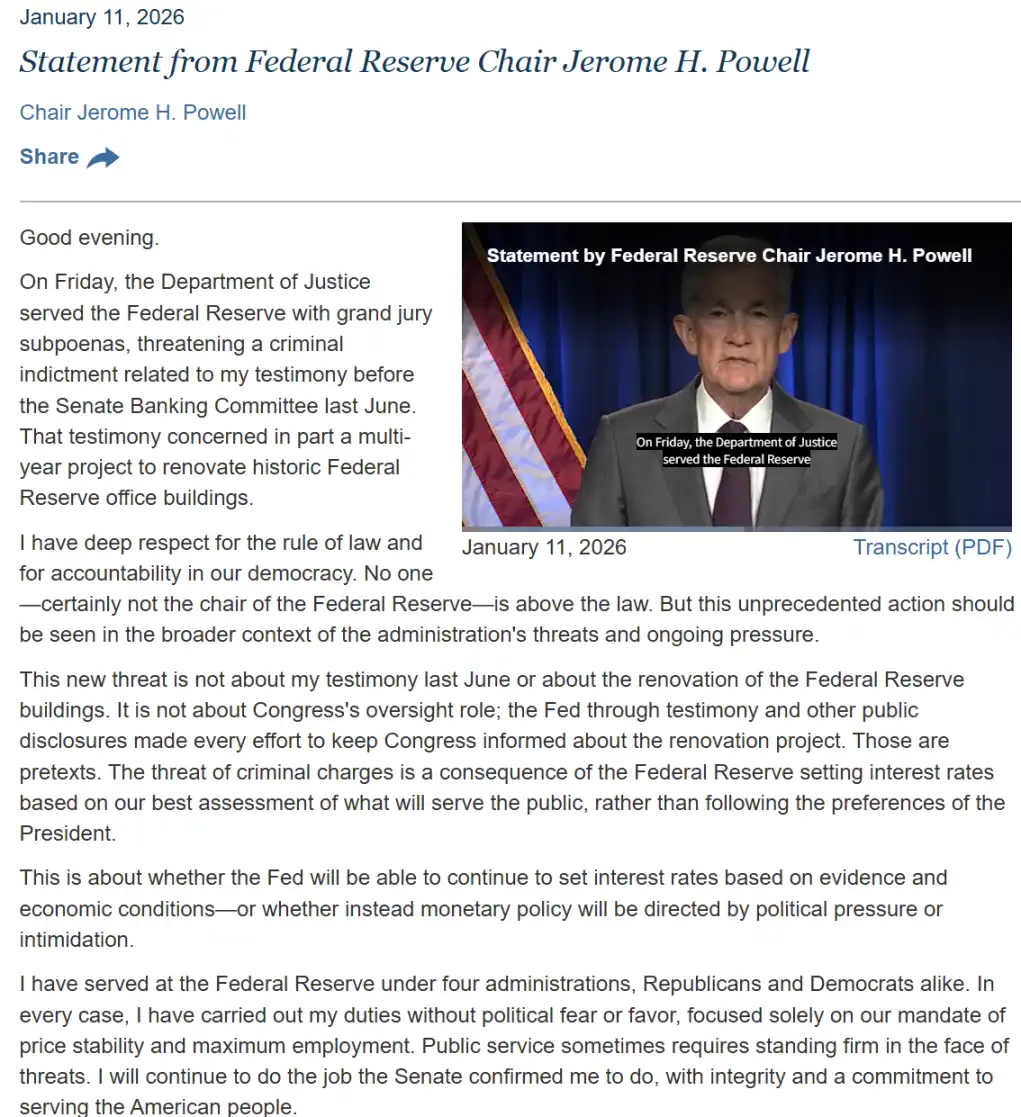
In his statement, Powell emphasized that such threats are a "consequence" of the Fed setting interest rates based on public interest rather than presidential preferences, calling it a blatant attack on central bank autonomy. This event is not isolated but the latest manifestation of the intertwining of politics and economics during Trump's second term.

Following the incident, U.S. stock index futures fell rapidly, with S&P 500 futures dropping over 0.5% and Dow futures declining by 150 points during Asian trading hours. Spot gold rose by 1.88%, spot silver surged by about 4%, and the cryptocurrency market saw BTC hovering around $91,000.

Trump Repeatedly Dissatisfied with Powell's "Slow Rate Cuts"

Powell was appointed as Fed Chair by then-President Trump in 2018 and was reappointed in 2022, with his term originally set to end in May 2026. As the head of the Fed, Powell has led the central bank through the challenges of the COVID-19 pandemic, economic recovery, and high inflation, with policies characterized by data-driven and gradual adjustments.

However, after Trump won the 2024 presidential election and returned to the White House, he quickly turned his focus to the Fed. Trump has long criticized Powell for being "slow to act," particularly on interest rate policy. He has repeatedly publicly demanded that the Fed cut rates significantly to stimulate economic growth and stock market performance, even promising during his campaign to "take control" of the Fed to advance his "America First" economic agenda.

The incident was sparked by a $250 million renovation project at the Fed's Washington headquarters. The project, launched several years ago to update aging facilities, has faced controversy due to cost overruns and transparency issues.
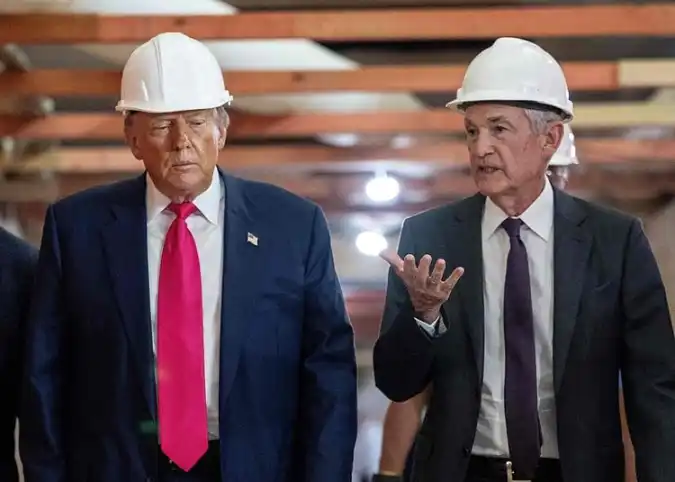
In July 2025, Republican Representative Anna Paulina Luna accused Powell of providing false testimony about the project during a congressional hearing and called for a criminal investigation. This accusation did not immediately escalate at the time, but after Trump took office, the DOJ quickly intervened. On January 11, 2026, multiple media outlets reported that the U.S. Attorney's Office for the District of Columbia had formally opened a criminal investigation into Powell, focusing on whether he misled Congress and whether the project's funds were used improperly. A grand jury has issued subpoenas demanding relevant records from the Fed.

On January 12, NBC reported that Trump, in a phone interview, claimed to know nothing about the investigation and again criticized Powell. "I know nothing about it, but he's obviously not doing a good job at the Fed, and he's not doing a good job with the building either." When asked to respond to Powell's claim that the subpoena was a government attempt to pressure the Fed into cutting rates, Trump said, "No, I wouldn't even consider doing it that way. The real pressure on him should be the reality of interest rates being too high. That's the only pressure he's facing."

In his video statement, Powell directly linked the investigation to interest rate policy. He noted that the DOJ's actions were "unprecedented" and aimed at forcing the Fed to lower interest rates through criminal threats to cater to Trump's demands. In the statement, Powell reiterated the Fed's statutory mission to maintain price stability and maximize employment, not to bow to political pressure. He described the incident as a "blatant violation of the Fed's independence" and suggested it was a continuation of the Trump administration's pressure on the central bank.

During Trump's first term, Powell had already clashed with the White House over his refusal to cut rates sharply, leading Trump to publicly call him an "enemy." The timing of this investigation is particularly sensitive: the Fed's most recent meeting kept the benchmark interest rate in the 4.25%-4.5% range, far higher than Trump's desired level.

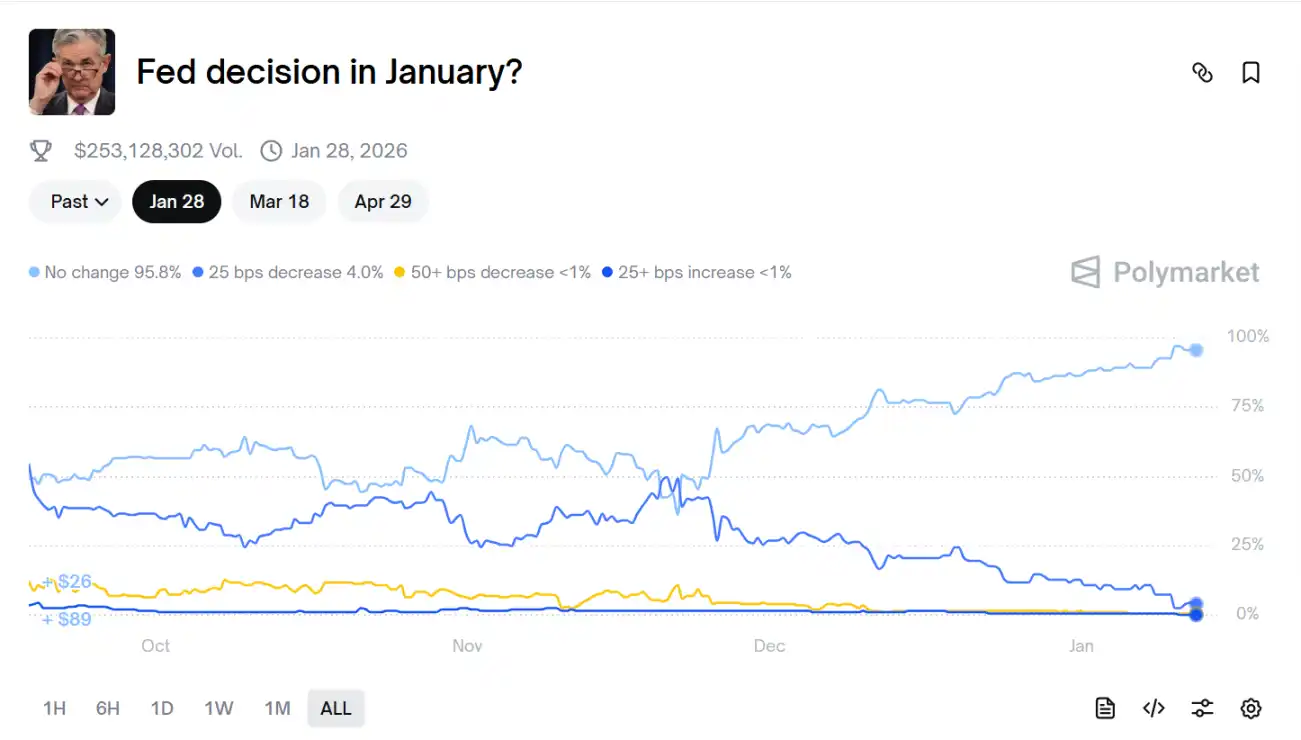
Latest data from Polymarket shows that market bets on the Fed holding rates steady in January have risen to 96%.
On X, supporters see Powell as a hero defending independence, while opponents accuse the Fed of "sabotaging the economy." Some users called for "abolishing the Fed," while others warned that this could trigger a constitutional crisis.
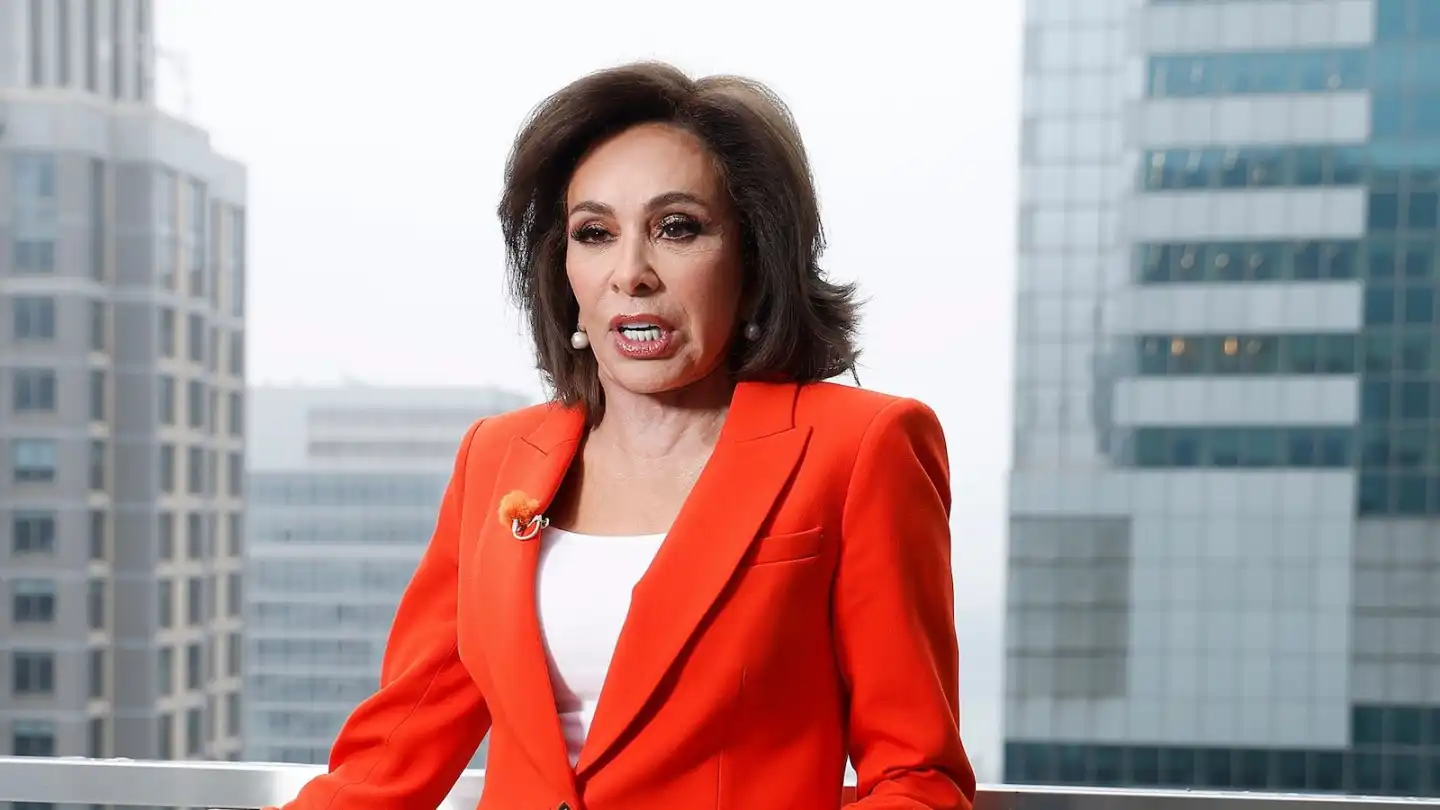
The investigation was authorized by newly appointed U.S. Attorney Jeanine Pirro, a staunch Trump ally, further deepening suspicions of political interference.

Powell responded that he would fully cooperate with the investigation but would not let it influence monetary policy decisions. The roots of this incident trace back to the Fed's institutional design. Established in 1913, the Fed was intended to be independent of politics, but there have been numerous precedents of presidential interference, such as during the Nixon era's Watergate scandal. This event marks an extension of Trump's "deregulation" agenda, as he has already promised to restructure federal agencies, including weakening the Fed's power, since taking office.

As of January 12, the investigation is still in its preliminary stages, with prosecutors repeatedly requesting documents. The White House has not commented. Analysts predict that if the investigation escalates, the Fed may be forced to accelerate rate cuts to alleviate pressure, but this could trigger a rebound in inflation, affecting U.S. economic growth.

Powell himself may face personal risks: if the allegations are substantiated, he could be forced to resign or even face imprisonment, although legal experts consider the evidence weak.

Powell has already responded proactively through his public statement. Moving forward, aside from hiring lawyers to challenge the subpoena's legality, he could also appeal to the courts or seek assistance from bipartisan lawmakers, particularly those concerned about the Fed's independence.

Hassett and Warsh Emerge as Top Contenders for Fed Successor

The criminal investigation into Powell has increased market uncertainty. After the news broke, investors worried that damage to the Fed's independence could lead to policy disorder. Powell's statement emphasized that threatening criminal charges would "undermine" the central bank's credibility, potentially raising risk premiums.

Secondly, this event is seen as a signal of Trump consolidating power, triggering strong backlash from Democrats and social groups. Democratic lawmakers called it a "constitutional crisis," expressing concerns that the DOJ is being weaponized for political retaliation.

Latest speculation about Fed leadership suggests that while Powell's term lasts until May 2026, the criminal investigation has accelerated discussions about his successor. Trump has stated he will announce his nominee by the end of the month.
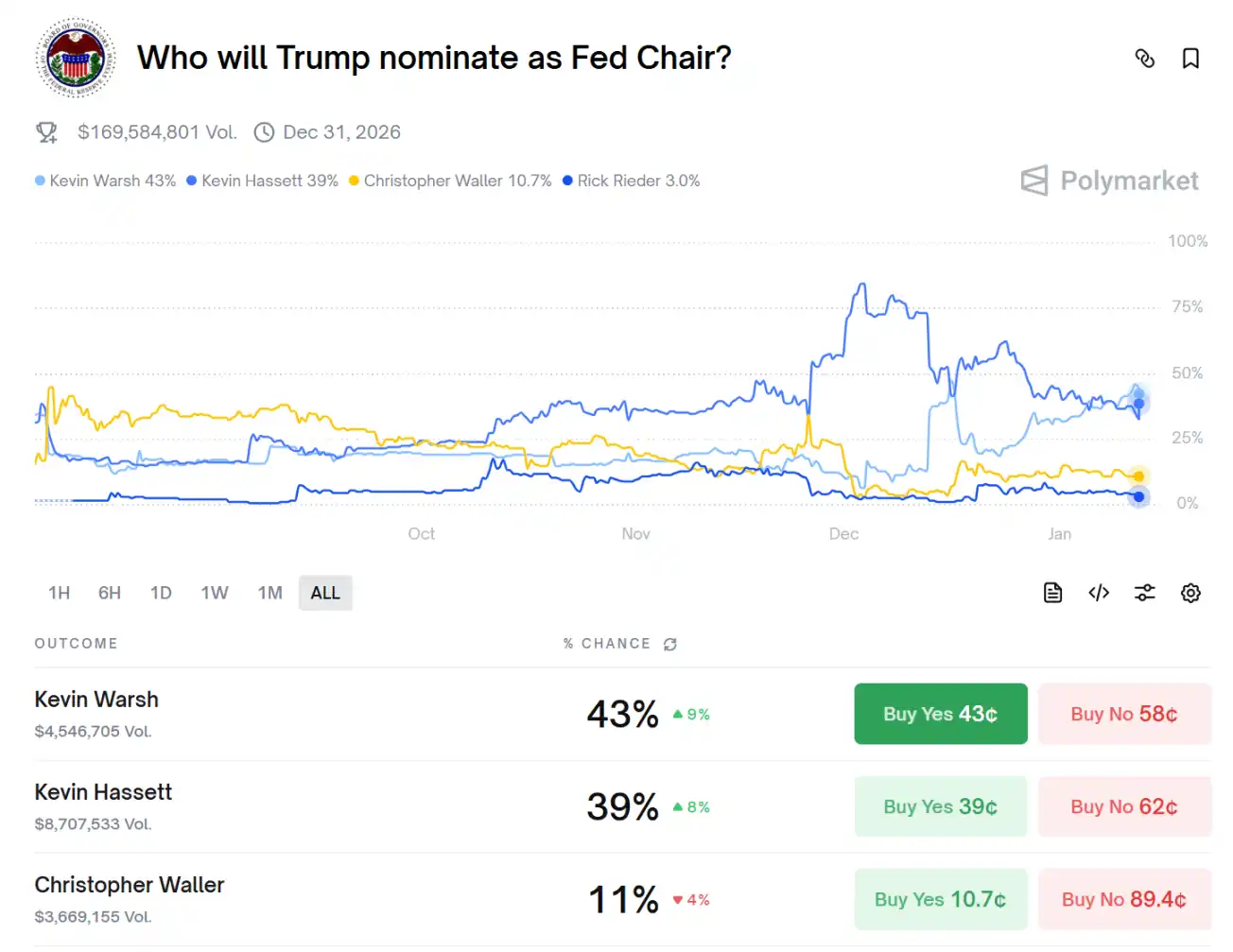
Latest data from Polymarket shows that market bets are highest on Kevin Warsh and Kevin Hassett, at 43% and 39%, respectively. Warsh was nominated as a Fed governor by President Bush in 2006, becoming the youngest Fed governor at the time. He is known for his hawkish stance but is market-friendly. In 2017, Trump considered Warsh for Fed Chair but ultimately chose Powell.

Hassett is a well-known conservative economist in the U.S., currently serving as Director of the White House National Economic Council and previously as Chair of the White House Council of Economic Advisers. He supports low interest rates and Trump's economic agenda. In November 2025, he was seen by Trump and his advisory allies as the top candidate for the next Fed Chair.

Preguntas relacionadas

QWhat is the main reason behind the criminal investigation against Jerome Powell according to the article?

AThe criminal investigation against Jerome Powell is widely perceived as an attempt by the Trump administration to pressure the Federal Reserve into lowering interest rates, as Powell himself stated it is an 'unprecedented' action aimed at forcing the Fed to capitulate to Trump's policy demands.

QHow did financial markets react immediately after the news of the investigation broke?

AFollowing the news, U.S. stock index futures fell rapidly, with S&P 500 futures down over 0.5% and Dow futures dropping 150 points in Asian trading hours. Spot gold rose 1.88%, spot silver surged about 4%, while BTC remained volatile around $91,000.

QWhat was the specific project that served as the pretext for the criminal investigation into Powell?

AThe investigation was formally launched over a $250 million renovation project at the Federal Reserve's Washington headquarters, with prosecutors examining whether Powell misled Congress and if there were irregularities in the project's fund usage.

QWho are the two leading candidates to replace Jerome Powell as Fed Chair according to market speculation on Polymarket?

AAccording to Polymarket data, the two leading candidates to replace Powell are Kevin Warsh, with a 43% probability, and Kevin Hassett, with a 39% probability.

QWhat did Powell emphasize was the Fed's statutory mission in his video statement, in contrast to yielding to political pressure?

AIn his video statement, Powell emphasized that the Federal Reserve's statutory mission is to maintain price stability and maximize employment, not to submit to political pressure, calling the investigation a 'blatant assault on the Fed's independence'.

Lecturas Relacionadas

STRC Hits Historic Low, Saylor's Perpetual Motion Machine Grinds to a Halt

STRC, the perpetual preferred stock issued by MicroStrategy to fund its Bitcoin purchases, hit a historic low of $85.32, a 17% discount to its $100 par value. Designed as a "digital credit engine" to trade stably near par and enable continuous share issuance for buying Bitcoin, its plunge signals a breakdown in this model. Three key factors drove the decline: 1. Bitcoin's price fell over 50% from its peak, trading around $63,000 amid hawkish Fed signals. 2. MicroStrategy's cash reserves were depleted after a $1.5 billion convertible note repayment, slashing the dividend coverage for STRC's 11.5% yield to ~7 months. The company then sold 32 BTC to cover dividends—Michael Saylor's first Bitcoin sale since 2022—damaging the "never sell" narrative. 3. A competing Bitcoin-backed preferred stock, Strive's SATA, offers a higher yield (~13%) and daily dividends, drawing investors away from STRC. The drop triggers a negative cycle: STRC below par halts ATM share issuances, cutting off a key funding source for Bitcoin buys and potentially forcing more BTC sales for dividends, further eroding confidence. While Saylor argues the model is mathematically sound—needing only 2.3% annual Bitcoin growth to sustain itself—the market is testing the resilience of the leveraged Bitcoin treasury strategy in a bear market. The STRC price now reflects rising skepticism about this financial machinery's durability during downturns.

marsbitHace 13 min(s)

STRC Hits Historic Low, Saylor's Perpetual Motion Machine Grinds to a Halt

marsbitHace 13 min(s)

A Guide to Grayscale’s ‘Bottom Fishing’: Using Cash Flow to Assess Cryptocurrency Value

**Title:** Grayscale's Guide to Bottom-Fishing: Valuing Cryptoassets Using Cash Flows **Summary:** This report by Grayscale Research presents a fundamental valuation framework for cryptocurrency assets, moving beyond pure speculation to analyze those with underlying cash flows. It distinguishes between "commodity-like" assets (e.g., Bitcoin) and "cash-flow" assets, primarily within DeFi. Using the leading decentralized lending protocol Aave as a case study, the analysis applies traditional financial methodologies like Discounted Cash Flow (DCF) and Price-to-Earnings (P/E) multiples. Key findings indicate that AAVE tokens are currently undervalued. Despite recent challenges, the protocol's strong revenue growth, ~50% net profit margin, and diversified treasury support a fundamental valuation range of $80-$100 per token (compared to a ~$75 market price at the time of writing). In a base-case scenario driven by stablecoin adoption and regulatory clarity, the fair value could rise to around $175 within a year. The report emphasizes that protocol success does not automatically translate to token value. It critically examines the "value capture" mechanisms—such as buybacks, burns, and staking rewards—that channel protocol profits to token holders. Furthermore, it addresses the legal and governance complexities of Decentralized Autonomous Organizations (DAOs), noting their difference from traditional corporate equity but highlighting how robust, transparent governance can align protocol economics with holder interests. The conclusion is that the crypto market is maturing, with capital increasingly flowing towards projects with demonstrable fundamentals, real adoption, and disciplined capital allocation, creating opportunities for value-based investors.

marsbitHace 1 hora(s)

A Guide to Grayscale’s ‘Bottom Fishing’: Using Cash Flow to Assess Cryptocurrency Value

marsbitHace 1 hora(s)

After semiconductors lead the gains, are funds buying into AI orders or a macroeconomic rebound?

After US-Iran talks led to a temporary ceasefire and framework for reopening the strategic Strait of Hormuz, U.S. stocks rose on June 18, with the Nasdaq gaining 1.9%. The semiconductor and AI hardware sectors outperformed. This rally stemmed primarily from reduced geopolitical risk, which lowered oil prices and inflation expectations, easing discount rate pressure on high-valuation growth stocks like tech. The key question is not whether tech rebounded, but the nature of the rebound. The market appears to be selectively repricing AI infrastructure plays rather than broadly chasing AI narratives. Gains were concentrated in chips, optical interconnects, memory, and domestic manufacturing—segments tied to tangible data center build-outs and capital expenditure. Intel's ~10% surge, fueled by a Trump statement about potential Apple collaboration, exemplifies this mixed dynamic. It reflects policy catalysts and domestic manufacturing sentiment more than confirmed fundamentals. Meanwhile, strong earnings from companies like Astera Labs (revenue up 93% YoY) provided concrete evidence of AI-driven demand in hardware. In essence, the rally represents a risk-premium recalibration. Lower Middle East tensions opened a valuation repair window, and capital flowed first into AI infrastructure segments with visible near-term revenue streams. The sustainability of this move hinges on upcoming Q2 earnings, specifically continued strength in cloud provider capex, AI server orders, and hardware company guidance. Policy hopes alone are insufficient; the cycle needs validation from orders and financials.

marsbitHace 1 hora(s)

After semiconductors lead the gains, are funds buying into AI orders or a macroeconomic rebound?

marsbitHace 1 hora(s)

Trading

Spot
Futuros
活动图片