Trump Family-Linked Crypto Company Faces More Scrutiny Over Auditor Controversy

bitcoinistPublicado a 2025-12-30Actualizado a 2025-12-30

Resumen

Trump-linked crypto treasury company Alt5 Sigma faces intensified scrutiny and potential Nasdaq delisting after appointing an auditor with an expired license and regulatory violations. The firm, which rebranded to hold Donald Trump’s WLFI token, failed to file quarterly reports and has seen high-level departures, including Eric Trump. Its newly hired auditor, Victor Mokuolu CPA, had its license expired in Texas and previously failed a peer review. Alt5 Sigma has since replaced the auditor amid ongoing compliance issues and risks violating audit committee requirements.

Recent reports claim that the internal turmoil of a crypto treasury company backed by the Trump family has deepened as the firm risks being delisted from Nasdaq and has appointed an audit company facing regulatory scrutiny.

Crypto Treasury Company’s Turmoil Intensifies

On Monday, Nasdaq-listed crypto treasury company Alt5 Sigma is facing renewed scrutiny after appointing a new audit company with an expired and inactive license earlier this month, the Financial Times initially reported.

The Las Vegas-based company rebranded from a biotech company to a Digital Asset Treasury Company (DAT) earlier this year, seeking to become the first publicly traded firm to accumulate WLFI, the token of US President Donald Trump’s crypto ventures, World Liberty Financial.

As the report noted, the company’s financial position has turned murky over the past few months due to its failure to file quarterly results on schedule. Now, its recent switch of auditors has deepened its current position as the newly appointed firm, Victor Mokuolu CPA PLLC, was allegedly fined by accounting regulators and failed an inspection under the standard peer review process.

According to the Financial Times, filings in the state of Texas show that the company’s licence expired in August. Meanwhile, the board’s records show that its license has not been renewed by December 26. Therefore, state regulations prohibit the firm from doing any audit work until the licence is renewed.

The audit company has reportedly been working for over two years to address its deficiencies, which previously resulted in a failing grade under the accounting profession’s peer review process in 2023.

This year’s failure to renew its license follows the Texas State Board of Public Accountancy and another US regulator’s actions against the firm for “repeatedly failing to file regulatory paperwork on time.”

In a statement to the news media outlet, Alt5 Sigma affirmed that the auditor is “undergoing a peer review per Texas State Board of Accountancy regulations and will be completed by the end of January 2026, at which point the auditor expects the firm’s licence to be active.”

The Trump-backed crypto treasury firm emphasized that “No reviews or audits of Alt5’s financial statements will be issued by our auditor until the firm’s licence is active.”

In an update, the Financial Times added that Alt5 Sigma fired the audit firm on Christmas Day following its inquiries about the issue. A regulatory filing made on Monday reportedly shows that the company has hired LJ Soldinger Associates as its new accounting firm.

Alt5 Sigma Risks Nasdaq Delisting

The controversial December 8 appointment comes amid a period of turmoil for the company, the report noted, as it already risks being delisted from Nasdaq, where it trades under the ticker “ALTS.”

The company failed to submit its quarterly results for the period ending in late September, blaming the delay on the “timeliness and responsiveness” of its previous auditor, who seemingly quit last month. This has opened the door to a potential delisting from the stock exchange.

In August, World Liberty Financial unveiled its partnership with Alt5 Sigma and became an investor in the technology firm, which sought to raise $1.5 billion for its crypto treasury strategy based on WLFI.

As a result, multiple World Liberty Financial co-founders joined Alt5 Sigma’s board. Notably, Zach Witkoff, son of President Trump’s Special Envoy Steve Witkoff, was appointed as chairman of the crypto treasury firm.

Similarly, Eric Trump joined the company’s board as a director, while Zak Folkman became a board observer. Nonetheless, Trump stepped down from his position in September, just weeks after being appointed, as revealed in a Securities and Exchange Commission (SEC) filing

Jonathan Hugh, Alt5’s Chief Financial Officer (CFO), left the company after just three months, while chief executive Peter Tassiopoulos resigned in October. Meanwhile, board member David Danziger parted ways with the firm in November.

This also puts the company “in violation of a requirement to have an audit committee of a certain size and with accounting experience,” the report concluded.
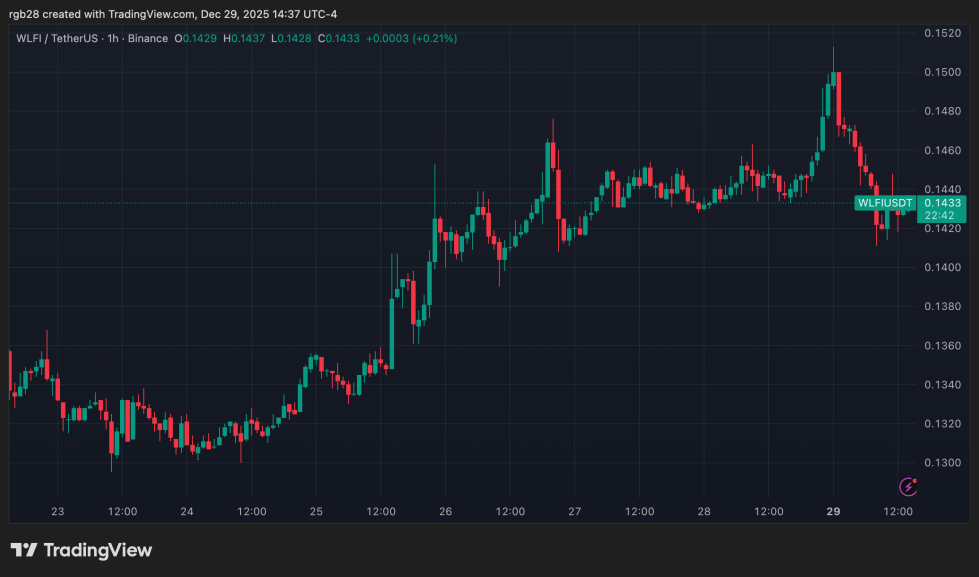
WLFI trades at $0.14 in the one-week chart. Source: WLFIUSDT on TradingView


Preguntas relacionadas

QWhat is the name of the crypto treasury company backed by the Trump family that is facing scrutiny?

AThe company is called Alt5 Sigma.

QWhy is Alt5 Sigma at risk of being delisted from Nasdaq?

AThe company failed to submit its quarterly results for the period ending in late September, which opens the door to a potential delisting.

QWhich audit firm did Alt5 Sigma initially appoint in December, and what was the main issue with it?

AThe company initially appointed Victor Mokuolu CPA PLLC, whose license had expired and was inactive, and the firm had been fined by regulators and failed a peer review.

QWhich member of the Trump family briefly served on Alt5 Sigma's board of directors?

AEric Trump joined the company's board as a director but stepped down from his position in September, just weeks after being appointed.

QWhat is the primary cryptocurrency token that Alt5 Sigma's treasury strategy is based on?

AThe strategy is based on WLFI, the token of former US President Donald Trump's crypto ventures, World Liberty Financial.

Lecturas Relacionadas

Can Generative Models Finally Be Trained End-to-End? The Core Is a For Loop

This article introduces a novel training paradigm for generative models called Explorative Modeling (XM), which enables true end-to-end training. Traditionally, powerful generative models like autoregressive and diffusion models are not trained end-to-end. They are trained to predict a single small step but require iterative multi-step sampling for inference. This "exposure bias" leads to error accumulation and limits performance. The core challenge XM addresses is "mode blurring." In generative tasks, a single input (e.g., "generate a dog") corresponds to many valid outputs (multiple modes). Standard training objectives like reconstruction loss force the model to average these modes, producing unrealistic, blurry outputs. To avoid this, existing models break generation into many small, almost deterministic steps, sacrificing end-to-end training. XM tackles this by restructuring the training loop itself. Its key insight is to amplify "generative expressivity." For each training input, instead of generating one sample, the model generates K candidate outputs. Only the candidate closest to the real data is used for computing the loss and updating the model via backpropagation. This simple "best-of-K" mechanism is implemented as a short for-loop. By exploring multiple possibilities, the model learns to distribute its guesses across different modes rather than collapsing to their uninformative average. The paper demonstrates that "exploration" acts as a new, powerful scaling axis. Gains from XM increase with model size, data scale, and compute. Experiments show improvements in FID scores for image generation and significant efficiency gains, sometimes outperforming larger models without exploration. When pushed to the limit, XM enables fully single-step, end-to-end generative models. In robotics tasks, an "Explorative Policy" matched the performance of a 100-step Diffusion Policy with a single forward pass, drastically improving inference speed. While the best-of-K concept is not entirely new, the authors' contribution lies in formally understanding it as a direct method to boost generative expressivity without fragmenting the generation process. This work suggests that as models scale, enhancing exploration during training may become crucial for overcoming fundamental performance bottlenecks.

marsbitHace 9 min(s)

Can Generative Models Finally Be Trained End-to-End? The Core Is a For Loop

marsbitHace 9 min(s)

Annual Salary of Millions Competing for Electricians, Meta Rushes to Open Its Own Technical School

The AI boom is facing an unexpected bottleneck: a severe shortage of skilled construction workers and electricians. As tech giants like Meta, OpenAI, and Alphabet race to build massive data centers—such as OpenAI's $16 billion "Stargate" project—they are hitting a critical labor wall. The U.S. needs an estimated 130,000 more electricians, 240,000 construction workers, and 150,000 supervisors by 2030 for AI infrastructure alone, but tens of thousands of electrician jobs go unfilled each year. While AI companies offer high premiums, with electricians earning up to $280,000 annually, worker scarcity still causes massive losses—delays on a single project can cost $14.2 million per month. The complexity of building AI data centers, which require immense power (equivalent to powering hundreds of thousands of homes), sophisticated electrical systems, and advanced liquid cooling solutions, demands highly skilled technicians who are in short supply. To combat this, companies are investing heavily in training. Meta has committed $115 million to a free training school offering tuition, housing, and stipends, targeting 5,000 new workers. OpenAI is partnering with unions to secure skilled labor. These efforts are paying off, with a significant rise in Gen Z interest in trade schools over college. However, the power demands are staggering. AI data centers are driving a rapid surge in electricity consumption, projected to account for up to 12% of U.S. power use by 2028 and raising costs for consumers. Furthermore, the construction boom is project-based, leading to a potential future glut of trained workers once building peaks, which could depress wages industry-wide. The race for AI supremacy now depends as much on skilled hands as on advanced chips.

marsbitHace 1 hora(s)

Annual Salary of Millions Competing for Electricians, Meta Rushes to Open Its Own Technical School

marsbitHace 1 hora(s)

Trading

Spot
活动图片