Trump-Era CFTC Rescinds Biden-Era Crackdown on Sports and Election Wagering: $MAXI Set to Dominate

bitcoinistPublicado a 2026-02-05Actualizado a 2026-02-05

Resumen

The CFTC has rescinded a Biden-era proposal to ban event contracts, including political and sports betting, shifting the regulatory landscape toward free markets. This move is seen as a green light for risk assets and speculative trading, creating a liquidity vacuum that benefits platforms like prediction markets. The decision validates high-stakes crypto trading culture, fueling interest in volatile assets. Maxi Doge ($MAXI) is positioned to capitalize on this shift, offering a gamified trading ecosystem with competitions and staking rewards. The project has raised over $4.5M in presale and attracted significant whale investments, aligning with the new deregulatory environment. It aims to serve as a leverage-focused economy for traders embracing high-risk strategies.

The regulatory pendulum in Washington hasn’t just swung; it snapped back toward free markets.

By officially rescinding the Biden-era proposal to ban contracts involving political contests, gaming, and war, the Commodity Futures Trading Commission (CFTC) has fundamentally altered the landscape for high-risk derivatives. This withdrawal, originally spearheaded by former Chair Rostin Behnam, marks a hard stop to the aggressive ‘nanny state’ oversight that characterized the previous administration’s approach to event contracts.

This creates a massive liquidity vacuum. Previously, platforms like Kalshi and Polymarket faced existential threats just for listing congressional control contracts. Now? The rescission (frankly, a surprise to many legal observers) effectively legalizes the financialization of real-world outcomes.

Markets aren’t just seeing this as a win for election betting; they’re interpreting it as a green light for risk assets across the board. When the regulator steps back, volatility steps up.
The psychological impact on retail traders is immediate.

Removing these barriers validates the ‘high-stakes’ culture that crypto natives have been building for years. Capital previously sidelined by regulatory fear is now hunting for assets that embody this renewed spirit of conviction and leverage.

As the traditional financial guardrails come down, traders are rotating into projects that gamify volatility rather than run from it. That is the exact macro environment fueling the rise of Maxi Doge ($MAXI).

Unleashing The Leverage Economy With Gym-Bro Precision

The CFTC’s retreat creates a specific narrative opening: the normalization of ‘degen’ trading culture. While traditional finance builds products for safety, the current crypto zeitgeist demands products for amplification.

Maxi Doge sits right at that intersection. Unlike typical meme coins that rely solely on passive holding, this project identifies as a ‘trading community’ built for the 1000X mindset. The branding isn’t about cuteness.

With a 240-lb canine juggernaut mascot, it’s about the ‘heavy lifting’ required to survive a volatile bull market.
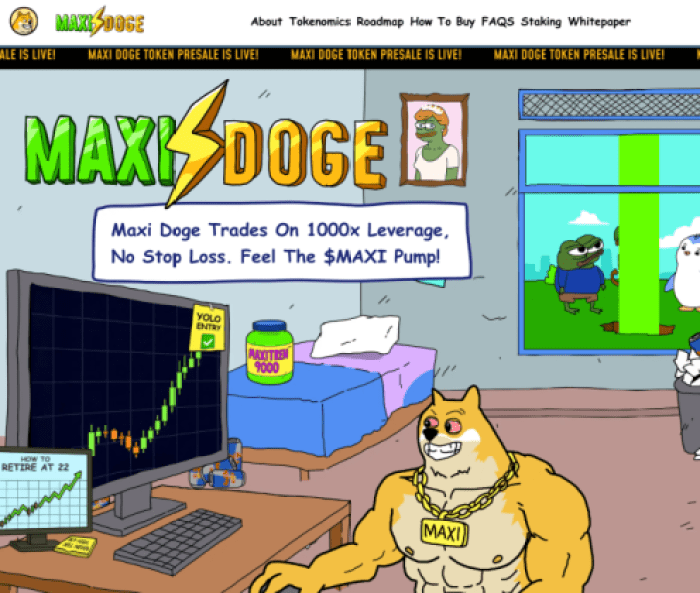

Why does this matter to the post-CFTC news cycle? It comes down to utility. As prediction markets open up, retail traders are looking for arenas to prove their edge. $MAXI plans to integrate ‘Holder-Only Trading Competitions’ directly into its ecosystem, gamifying the very activity regulators tried to suppress.

By offering leaderboard rewards to top ROI hunters, the project creates a synergy with the broader market’s shift toward speculative freedom.

Plus, the ‘Maxi Fund’ treasury introduces a layer of strategic capital management often missing in this sector. (The risk here is usually treasury mismanagement, but the project’s smart contract governance aims to mitigate that).

Rather than just a token, it hopes to function as a localized economy for traders who believe leverage is a feature, not a bug. In an environment where the government has stopped trying to protect traders from themselves, tools empowering aggressive strategies are primed to capture market share.

FIND OUT MORE ABOUT $MAXI

Smart Money Rotates Into High-Octane Assets

While headlines focus on the CFTC’s legal maneuvering, on-chain data suggests institutional capital is already front-running the expected surge in risk appetite. Smart money is moving.

Etherscan data reveals high-net-worth wallets buying $MAXI, up to sums as large as $314K . This specific timing, aligning with the shifting regulatory rumors, suggests sophisticated actors are positioning for a breakout in ‘culture coins’ offering leverage-like returns.

The financial metrics of the Maxi Doge presale back this up. According to the official presale page, the project has already raised over $4.5M, with tokens currently priced at $0.0002802. That level of capital injection during a presale phase indicates a conviction that extends well beyond simple retail FOMO.

Investors are also looking at yield sustainability. The project offers staking rewards with daily automatic distribution, but unlike static yield farms, the dynamic APY is designed to reward long-term conviction. Think of it as the ‘never skip leg day’ philosophy applied to your portfolio.

For traders watching the CFTC clear the runway for speculative markets, the combination of a $4.5M+ raise and significant whale accumulation signals that $MAXI is positioning itself as a primary vehicle for this new, deregulated cycle.

GET YOUR $MAXI BEFORE THE NEXT PRICE INCREASE

This article is for informational purposes only and does not constitute financial advice. Cryptocurrencies are high-risk assets, and presale tokens carry significant volatility. Always conduct your own due diligence before investing.


Lecturas Relacionadas

From Survival to Accelerated Growth: The Journey of Zcash's Three-Year Rise as Told by the Founder of ZODL

**From Survival to Accelerated Growth: Zcash Founder Details the 3-Year Rise** Three years ago, Zcash (ZEC) was a struggling pioneer in privacy technology, with a price near $30, low shielded supply (11%), and a community mired in governance disputes. Today, ZEC trades around $600, with over 31% of its supply (~$3B) in user-controlled shielded pools. This transformation resulted from breaking key constraints. First, **governance shackles were removed**. The old model guaranteed funding to two entities (ECC and ZF) regardless of performance, creating a monopoly. In 2024, ECC rejected further direct funding, forcing a change. The NU6 upgrade ended direct funding, allocating 8% to community grants and 12% to a protocol-controlled treasury for retroactive rewards, expiring in 2028 unless renewed by overwhelming consensus. The entities also relinquished their trademark-based veto power, freeing community governance. Second, the **product focus shifted** from pure cryptography to user growth. Previously, engineering excelled at privacy tech but failed to attract users. In early 2024, the team (later ZODL) pivoted to building products users wanted, like the Zodl wallet (default privacy, hardware support, cross-asset swaps). This drove shielded supply to grow over 400% in ZEC terms, with 86.5% of recent transactions being shielded, representing real user adoption. Third, the **narrative evolved** from the limiting "privacy coin" label to "unstoppable private money." This clarified Zcash's value proposition: a Bitcoin-like monetary policy with verifiable private payments via advanced cryptography. This structural narrative—protocol (Zcash), asset (ZEC), gateway (Zodl)—enabled broader exchange listings, institutional interest, and ETF filings. Finally, **organizational constraints were broken**. In early 2026, the ECC team left its non-profit structure after disputes over control, forming Zcash Open Development Lab (ZODL). ZODL raised $25M from top VCs (Paradigm, a16z, etc.), gaining the capital and agility of a startup to scale consumer products. Current metrics show strong momentum: social discussion volume for ZEC surged 15,245% in a year, with 81% positive sentiment. The focus is now on enhancing user experience (Zodl wallet), scalability (Tachyon project targeting Visa-level throughput with 25-second blocks), and post-quantum security (quantum-recoverable wallets coming soon). Zcash is positioned to become faster, more usable, scalable, and quantum-resistant.

marsbitHace 4 min(s)

From Survival to Accelerated Growth: The Journey of Zcash's Three-Year Rise as Told by the Founder of ZODL

marsbitHace 4 min(s)

Five Counterparty Risk Architectures: A Settlement-Layer Methodology for Classifying TradFi Models in Crypto Exchanges

**Summary:** This companion piece reframes the five TradFi-on-crypto exchange architectures, previously classified by "architectural fingerprint," through the lens of counterparty risk. The core question is: whose balance sheet bears the loss first in a stress scenario, and has it historically done so? Each of the five models corresponds to a distinct risk holder with its own documented failure modes. * **Model 1 (Stablecoin-Settled CEX Perpetuals):** Risk is held by the stablecoin issuer (e.g., reserve composition, bank connectivity) and the CEX's own book. History includes Tether's banking disconnections (2017) and reserve misrepresentations (CFTC 2021 Order). * **Model 2 (CFD Brokers):** Risk resides on the broker's balance sheet (B-book model). Regulatory differences (e.g., ESMA's mandatory negative balance protection vs. Mauritius FSC's lack thereof) define loss allocation rules, as seen in the 2015 SNB event (Alpari UK insolvency). * **Model 3 (Off-Chain Custody & Transfer Agent Chain):** Risk lies with the off-chain custodian/platform. User asset recovery depends on Terms of Use and corporate structure, exemplified by the Celsius bankruptcy ruling (2023) where Earn Account assets were deemed property of the estate. * **Model 4 (DEX Perpetual Protocols):** No single balance sheet bears risk. Loss absorption relies on a protocol's insurance fund and Auto-Deleveraging (ADL) mechanism, as demonstrated in the GMX V1 (2022) and dYdX v3 YFI (2023) incidents. * **Model 5 (Regulated CCP - DCM-DCO-FCM):** The most institutionalized model concentrates risk in the Central Counterparty (CCP). However, history shows CCPs can employ non-standard tools under extreme stress, such as mass trade cancellation (LME Nickel, 2022) or enabling negative price settlements (CME WTI, 2020). The report argues that regulatory choices and counterparty risk structures are co-extensive, not in an upstream-downstream relationship. It concludes with five separate observation checklists (not predictions) for monitoring the structural vulnerabilities of each risk model.

marsbitHace 21 min(s)

Five Counterparty Risk Architectures: A Settlement-Layer Methodology for Classifying TradFi Models in Crypto Exchanges

marsbitHace 21 min(s)

Trading

Spot
Futuros

Artículos destacados

Cómo comprar ERA

¡Bienvenido a HTX.com! Hemos hecho que comprar Caldera (ERA) sea simple y conveniente. Sigue nuestra guía paso a paso para iniciar tu viaje de criptos.Paso 1: crea tu cuenta HTXUtiliza tu correo electrónico o número de teléfono para registrarte y obtener una cuenta gratuita en HTX. Experimenta un proceso de registro sin complicaciones y desbloquea todas las funciones.Obtener mi cuentaPaso 2: ve a Comprar cripto y elige tu método de pagoTarjeta de crédito/débito: usa tu Visa o Mastercard para comprar Caldera (ERA) al instante.Saldo: utiliza fondos del saldo de tu cuenta HTX para tradear sin problemas.Terceros: hemos agregado métodos de pago populares como Google Pay y Apple Pay para mejorar la comodidad.P2P: tradear directamente con otros usuarios en HTX.Over-the-Counter (OTC): ofrecemos servicios personalizados y tipos de cambio competitivos para los traders.Paso 3: guarda tu Caldera (ERA)Después de comprar tu Caldera (ERA), guárdalo en tu cuenta HTX. Alternativamente, puedes enviarlo a otro lugar mediante transferencia blockchain o utilizarlo para tradear otras criptomonedas.Paso 4: tradear Caldera (ERA)Tradear fácilmente con Caldera (ERA) en HTX's mercado spot. Simplemente accede a tu cuenta, selecciona tu par de trading, ejecuta tus trades y monitorea en tiempo real. Ofrecemos una experiencia fácil de usar tanto para principiantes como para traders experimentados.

305 Vistas totalesPublicado en 2025.07.17Actualizado en 2025.07.17

Cómo comprar ERA

Discusiones

Bienvenido a la comunidad de HTX. Aquí puedes mantenerte informado sobre los últimos desarrollos de la plataforma y acceder a análisis profesionales del mercado. A continuación se presentan las opiniones de los usuarios sobre el precio de ERA (ERA).

活动图片








