July 21, according to reporting by crypto journalist Eleanor Terrett citing sources, U.S. President Donald Trump agreed to include ethics provisions in the 'CLARITY Act' (Digital Asset Market Structure Bill). The White House has reached a consensus on the ethics plan for the 'CLARITY Act', clearing the final major obstacle for this crypto regulatory legislation that has been contested for months. The bill text could be released as early as the same day, but may be slightly delayed; as of the report, the Democratic side had not yet seen the specific text.

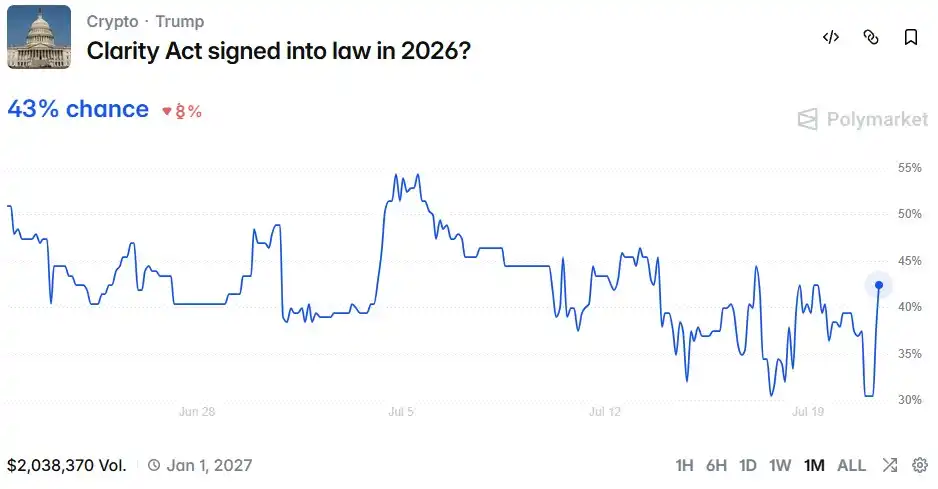
Following the news, the probability on Polymarket for "Will the 'CLARITY Act' be signed into law in 2026" rebounded to 43%. Research firm Galaxy Research had previously assessed its probability of passage in 2026 as roughly 50/50.
Previously, on July 16, a meeting between Trump, Republican Senators Bernie Moreno and Cynthia Lummis, and White House Crypto Advisor Patrick Witt did not result in an immediate agreement, but a deal was finalized by the President himself on the subsequent Monday evening. The provision aims to restrict the President, Vice President, members of Congress, and other federal officials from profiting from digital assets during their terms. The core controversy has centered around the Trump family's meme tokens and World Liberty Financial. Financial documents disclosed last month showed Trump's crypto income reached approximately $1.4 billion, which had once brought negotiations to a standstill.
The Final Stretch Before the August Recess
If ultimately enacted, the 'CLARITY Act' would, for the first time, provide comprehensive regulation for the digital asset industry at the federal level, clarifying the jurisdictional division between the SEC and the CFTC.
The U.S. House of Representatives previously passed the bill with a bipartisan majority of 294 to 134 votes in 2025. The Senate Banking Committee cleared it on May 14 this year with a 15 to 9 vote. It is currently stalled in final negotiations before a full floor vote.
The bill text is expected to be released in the coming days, then submitted for a full Senate vote; the window lasts only until the recess in the first week of August (the Senate will enter recess on August 7, returning on September 14). If passed, it would still need to go back to the House for reconsideration and text reconciliation, before finally reaching the President's desk for signature.
The vote count in the Senate tightened in mid-July. Following a visit to Ukraine, Republican Senator Lindsey Graham from South Carolina passed away suddenly from an aortic dissection on the night of July 11, at the age of 71, reducing the Republican seats in the Senate from 53 to 52 temporarily.
According to AP, the state's Governor Henry McMaster appointed Graham's sister, Darline Graham Nordone, to the seat two days later. She was sworn in on July 14, immediately restoring the seat.
However, Republican Senator Mitch McConnell has been absent from votes since being hospitalized on June 14. As of July 12, he himself stated he was not yet ready to return to the Senate, and there has been no further news about his potential return since.
Under the cloture procedure of Senate Rule XXII, if Mitch McConnell remains absent, the bill would need to secure at least 8 additional Democratic votes beyond the actual number of Republican votes present to pass.
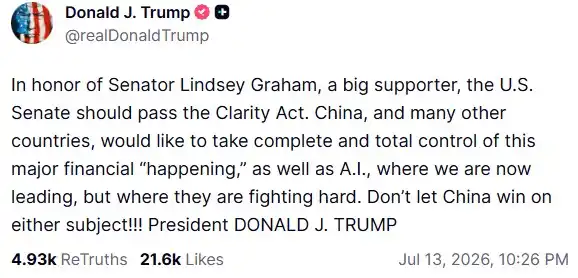
Trump previously posted on Truth Social, urging the Senate to quickly pass the 'CLARITY Act', stating it was in memory of the late Senator Lindsey Graham, and emphasizing it was also about preventing China from gaining dominance in digital finance and artificial intelligence.
Personnel changes at the White House level also indicate the urgency of the push. Crypto Advisor Patrick Witt was originally scheduled to be away this week due to mandatory training with the Georgia Army National Guard; the training has been postponed, and he will remain in place to advance the legislation. His deputy, Harry Jung, announced he would leave in two weeks.

"One-Yard Line" or "Elephant in the Room"?
The industry lobbying side's stance is direct. Blockchain Association CEO and former CFTC Commissioner Summer Mersinger stated at the Injective Summit in Washington D.C. on July 16 that the core provisions of the bill were "very close to agreement, with only a few details left to iron out," and called the ethics issue the "elephant in the room," the biggest current obstacle.
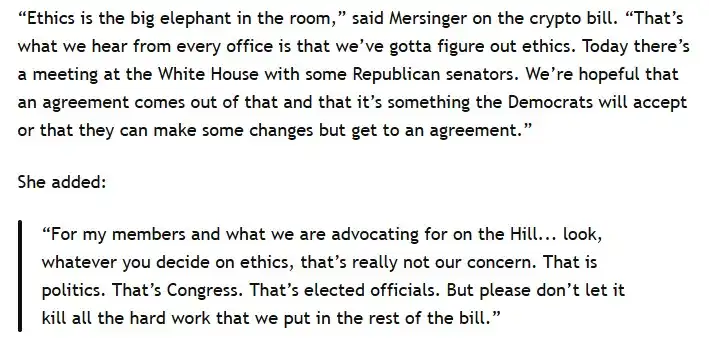
She called out to Congress: "Whatever decision you make on the ethics provision, that's really not what we care about, that's politics, that's Congress, that's elected officials. But please don't let it kill all the work we've done on the rest of the bill."
Coinbase Vice Chairman and former SEC official Ryan VanGrack's statement on CNBC in mid-July was more blunt: "The 'CLARITY Act' is at the one-yard line, the momentum to pass is obvious." Senate Majority Leader John Thune offered a more cautious judgment: "There is a path to a deal, but time is running out."
These statements essentially say the same thing: we don't care how the ethics clause is written, just don't let it derail the rest of the bill.
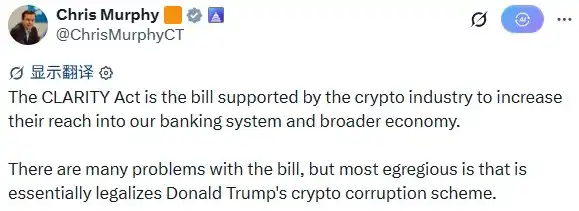
Skepticism comes mainly from the Democratic side, directly targeting the inadequacy of the ethics provision itself. Senator Chris Murphy criticized in a Facebook post on July 14, calling the 'CLARITY Act' "a bill supported by the crypto industry, aiming to expand its influence on the banking system and the broader economy," and explicitly demanded that "the bill must have provisions stating that the President and his family members cannot issue cryptocurrencies during their term, whether meme tokens or stablecoins... The ethics provision must cover the President and his immediate family members."
Senators Warren, Jack Reed, Chris Van Hollen, and others also jointly stated in mid-July that they "cannot support the current version of the 'CLARITY Act'," citing reasons including the need for stronger consumer protection, stricter conflict-of-interest and ethics rules, and more safeguards against crypto fraud and market manipulation. Senator Mark Warner said bluntly: "I am very pessimistic about the progress."
Whales, ETFs & Crypto Treasury Moves
On-Chain Whales: According to CryptoQuant data from July 20, addresses holding 1,000 to 10,000 BTC saw a net increase of approximately 66,700 BTC over 60 days, the strongest wave of buying since mid-February; meanwhile, medium-holding addresses with 100 to 1,000 BTC sold off about 77,800 BTC in the same period. Data provided by Bitfinex analysts to CoinDesk shows that whale addresses collectively added over 270,000 BTC, worth about $16.7 billion, in the first two weeks of July.
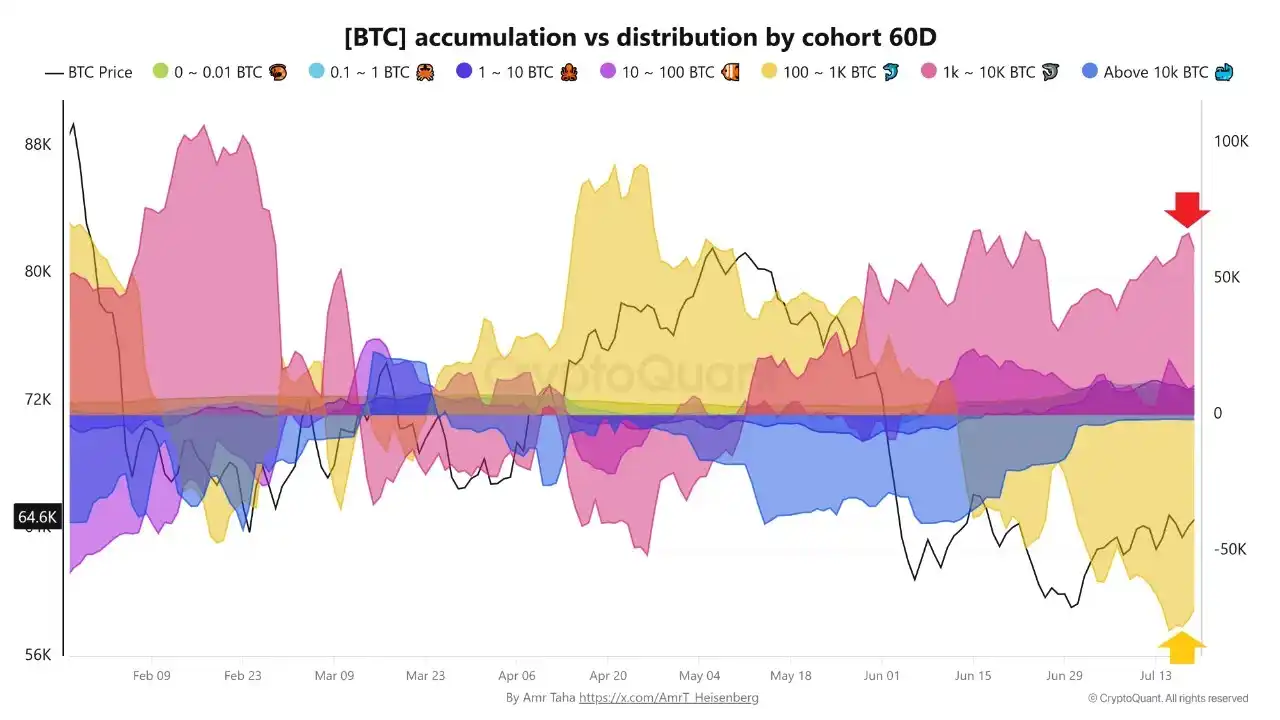
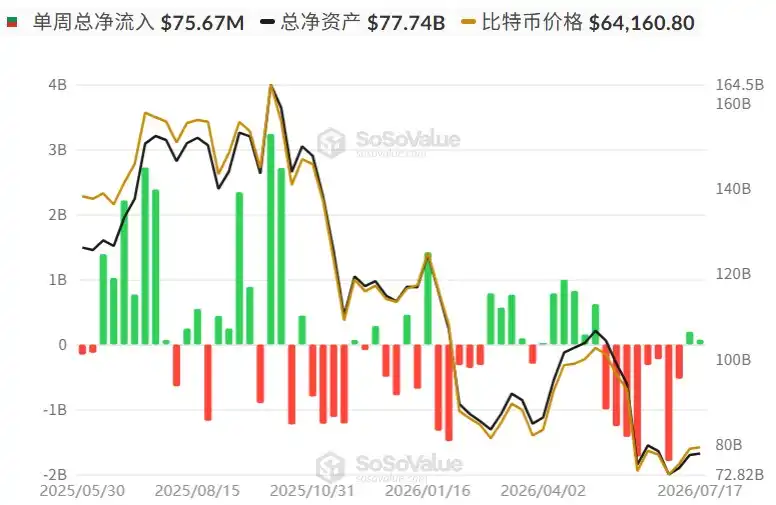
Spot ETFs: According to SoSoValue weekly data, U.S. Bitcoin spot ETFs saw net outflows for 8 consecutive weeks starting the week of May 15, with the week of June 26 experiencing the heaviest outflow at $1.79 billion. It wasn't until the week of July 10 that flows turned positive, with a net inflow of $197 million, followed by another net inflow of $75.67 million the week of July 17.
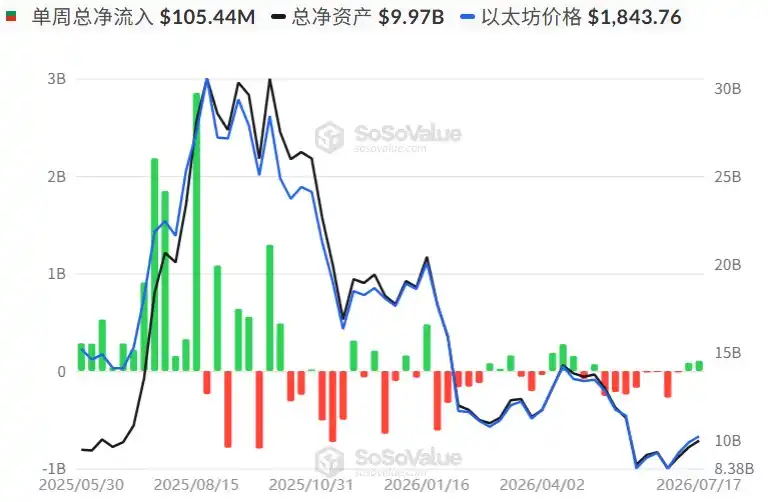
The trend for Ethereum spot ETFs was almost synchronized: also 8 consecutive weeks of net outflows from May 15 to July 2, turning to net inflows for the weeks of July 10 and 17, with $84.42 million and $105 million respectively.
Crypto Treasuries: Strategy holdings remained at approximately 844,000 BTC, having not purchased Bitcoin for two consecutive weeks. In mid-July, it raised $263.5 million in cash through a stock issuance but did not immediately add to its position, instead holding it as a buffer for preferred stock dividends and interest. Japanese-listed company Metaplanet added 2,823 BTC in Q2, bringing its total holdings to 43,000 BTC, ranking third globally among public companies; its subsidiary completed a convertible bond financing of approximately $59.5 million on July 21, planning to continue buying.
BitMine increased its holdings by 7,430 ETH last week, bringing its total to 5,777,468 ETH, accounting for about 4.8% of the total ETH supply. Of this, 85% is staked, generating an estimated annual staking yield of about $247 million. The company concurrently repurchased approximately 5.5 million common shares at an average price of $15.62. Tom Lee stated this slowed the buying pace, but weekly accumulation has never been interrupted since the reserve strategy launch on June 30, 2025.
Arthur Hayes: According to monitoring by Yu Jin, BitMEX co-founder Arthur Hayes spent 2.5 million USDC on July 15 to chase and buy 1,293 ETH at $1,933. On July 20, he bought another 2.5 million USDC worth of ETH via FalconX and Cumberland OTC at $1,876. The two transactions totaled 5 million USDC, purchasing 2,625.7 ETH at an average cost of $1,904. Hayes previously wrote that the AI sector is absorbing market liquidity, putting short-term pressure on BTC, but once liquidity returns, the crypto market still has room for a rebound.