Tron acquires 177K TRX: Why this ‘long-term’ treasury move matters

ambcryptoPublicado a 2026-02-20Actualizado a 2026-02-20

Resumen

Tron has acquired 177,587 TRX tokens, boosting its treasury to over 682.6 million TRX, as part of a strategy to enhance long-term shareholder value and stabilize market trust. This move, combined with a nearly 2% rise in Total Value Locked (TVL) exceeding $4 billion, reinforces investor confidence amid market volatility. The network appears to be executing a classic "buy the fear" strategy, aiming to protect the key $0.27 price floor—a level that previously sparked a 15% rally in late 2025. If TRX breaks past the $0.30 resistance, it could signal a strong buying opportunity and set the stage for a potential breakout rally.

As the market becomes more mainstream, any bear-market triggers have broad ripple effects. With digital assets now held in treasuries and by public investors, even a modest pullback could erode market trust quickly.

Technically, controlling the supply is crucial to stabilizing sentiment. Following this principle, Tron [TRX] executed an acquisition, purchasing 177,587 TRX tokens and boosting its treasury to over 682.6 million TRX. This was aimed at enhancing ‘long-term shareholder value.’

Meanwhile, on-chain liquidity is showing signs of recovery. Tron’s Total Value Locked (TVL) has risen nearly 2% in the past 24 hours, and was exceeding $4 billion as of writing. This suggests that engagement remains healthy despite the FUD.
Taken together, Tron is executing a classic market playbook.

Strong on-chain liquidity, combined with TRX acquisitions, reinforces investor confidence and helps preserve stakeholder value. These moves show a clear focus on maintaining commitment in a volatile environment.

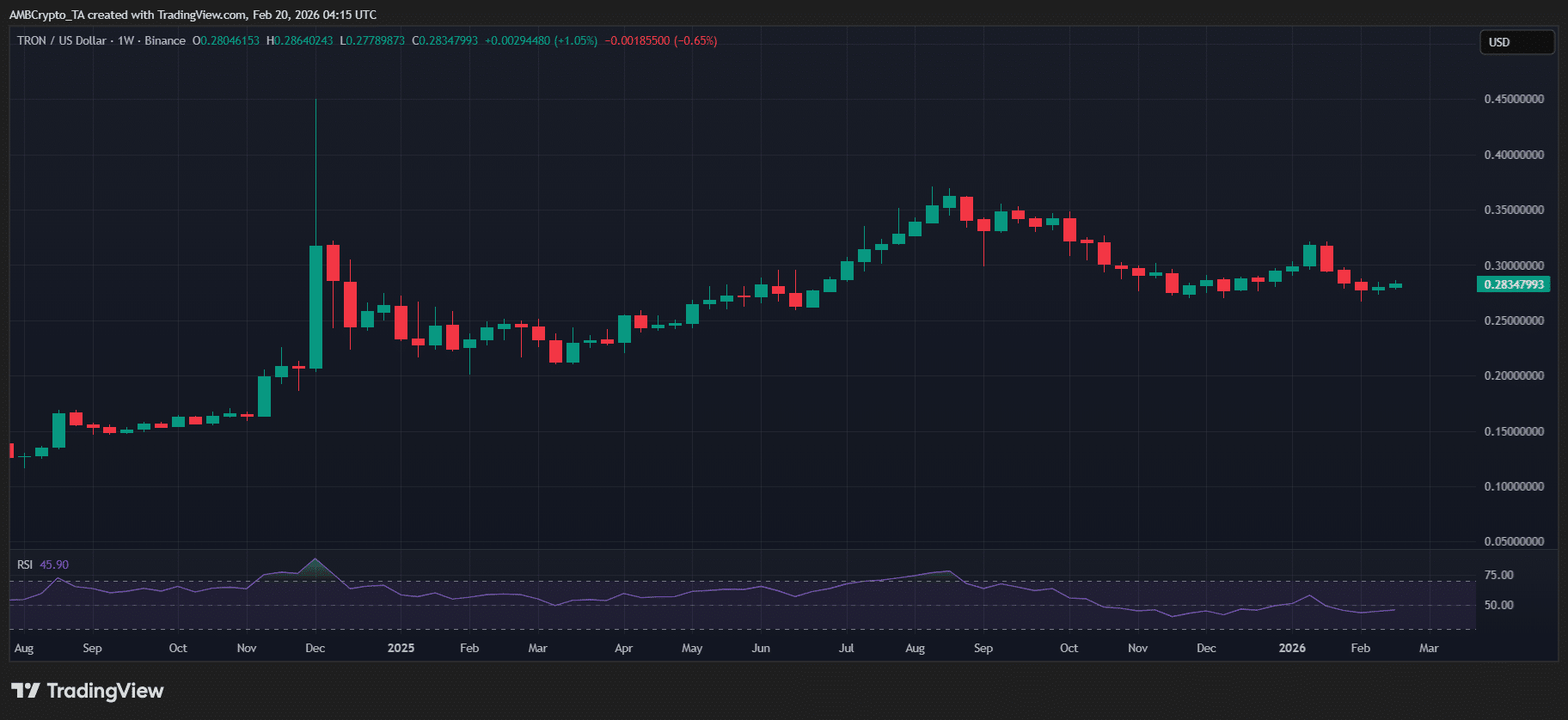
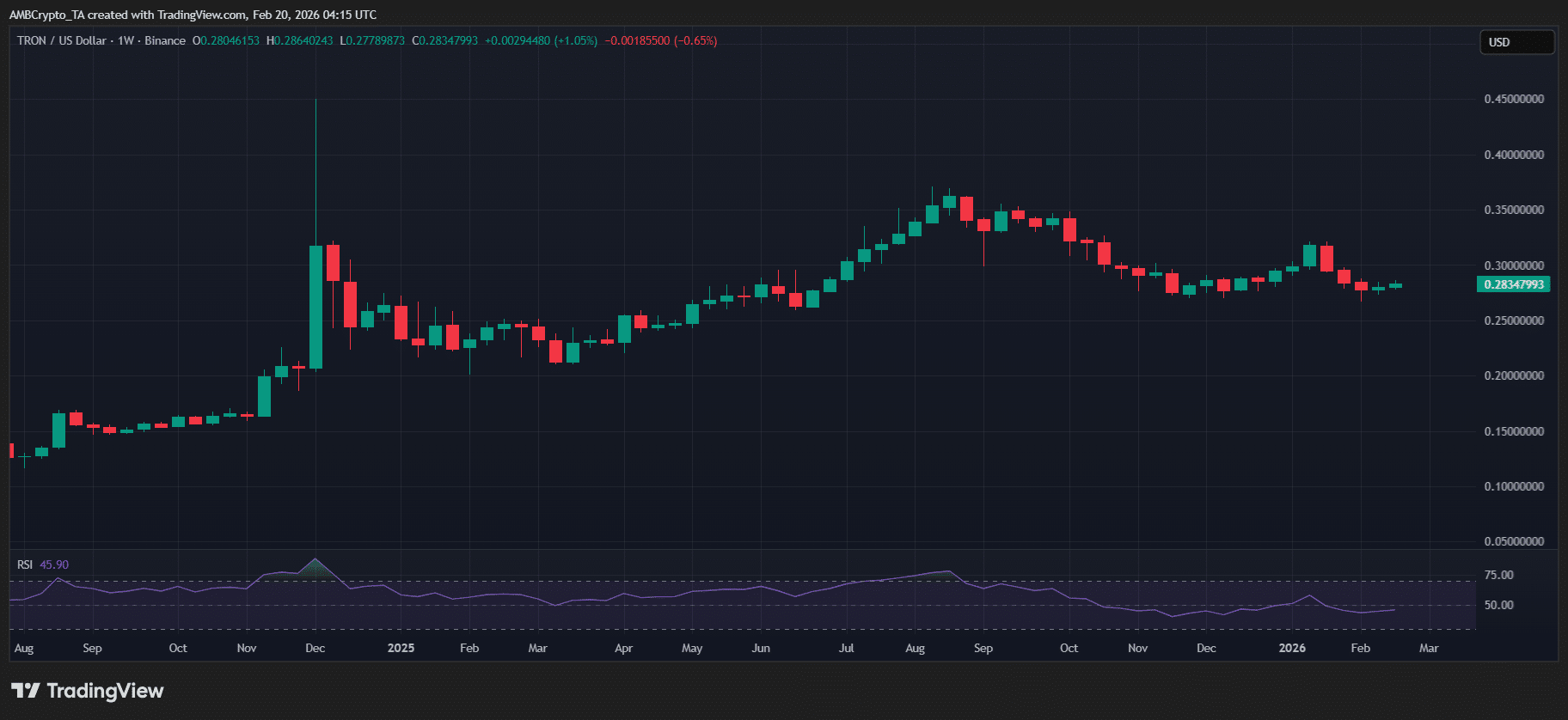
From a technical perspective, this isn’t just a coincidence. Looking at TRX’s price chart, it seems the network is executing a classic “buy the fear” strategy, the kind that often sets the stage for breakout rallies once the market shifts back to risk-on.

Tron’s TRX builds momentum around key support

In today’s market, no move is really a “coincidence.”

With Tron making recent TRX acquisitions and strong DeFi inflows, it’s clear the network is trying to buck risk-off sell-offs by psychologically encouraging HODLing. In turn, keeping investors from offloading.

This strategy is especially notable as TRX trades near a critical support that, back in mid-December 2025, sparked a nearly 15% rally over the month to $0.30, before the market crash wiped out 100% of those gains.

This strategy is especially notable as TRX trades near a critical support that, back in mid-December 2025, sparked a nearly 15% rally over the month to $0.30, before the market crash wiped out 100% of those gains.

Strategically, Tron’s recent moves suggest it’s aiming to protect that floor and set the stage for a potential repeat rally. Strong TVL comes into play here, signaling robust liquidity, active investor participation, and confidence.

Combined with TRX acquisitions, this reinforces $0.27 as a potential price floor. In turn, this supports for a breakout once the market shifts risk-on. If this trend holds and Tron breaks past $0.30 resistance, it could signal a strong buying opportunity.


Final Summary

  • Tron’s TRX acquisitions and rising TVL reinforce $0.27 as a key price floor. In turn, boosting investor confidence and stabilizes sentiment.
  • With TRX trading near critical support, a move past $0.30 resistance could trigger a strong buying opportunity, following a classic “buy the fear” strategy.


Preguntas relacionadas

QWhat was the purpose of Tron's recent acquisition of 177,587 TRX tokens?

AThe acquisition was aimed at enhancing 'long-term shareholder value' and is part of a strategy to control supply and stabilize market sentiment.

QWhat key metric shows that on-chain liquidity for Tron is recovering?

ATron's Total Value Locked (TVL) has risen nearly 2% in the past 24 hours, exceeding $4 billion, indicating a recovery in on-chain liquidity.

QWhat classic market strategy is Tron's network executing according to the article?

ATron is executing a classic 'buy the fear' strategy, which involves acquiring assets during market fear to set the stage for a potential rally when the market sentiment shifts back to risk-on.

QWhat is the critical price floor that Tron's recent moves are aiming to protect for TRX?

ATron's recent moves, including acquisitions and strong TVL, are aiming to protect the $0.27 price level as a critical support floor for TRX.

QWhat potential price level could signal a strong buying opportunity for TRX if broken?

AIf Tron's TRX breaks past the $0.30 resistance level, it could signal a strong buying opportunity, potentially triggering a breakout rally.

Lecturas Relacionadas

Uncovering the Truth About Agent Commerce, Payments, and Infrastructure

Decoding Agent Commerce, Payments, and Infrastructure: The Reality Over the past year, I've been building infrastructure for the Agent economy, engaging with major players like Stripe, Visa, Coinbase, Google, and dozens of startups. A clear conclusion emerges: true, large-scale demand does not yet exist. Startups face structural challenges. Data points illustrate this gap. Stripe's Agent commerce platform has over 1,000 merchants but only single-digit transacting agents. Visa's Agent payment token requires 9-month KYC and a $250M revenue threshold, accessible only to giants like Amazon. On-chain analysis reveals actual daily Agent transaction volume is around $17k, half of which are test transactions. The article analyzes four potential markets: **1. Agent-to-Merchant (A2M):** Current AI shopping UX is often inferior to traditional e-commerce for visual, comparison-heavy purchases (clothing, electronics). Chat interfaces are a step back. Real merchant interest is defensive "Agent Engine Optimization," fearing future obsolescence, not current demand. Potential exists in high-frequency, low-decision purchases (e.g., food delivery) or simplifying terrible UX (complex checkouts, non-native shoppers), but these require massive consumer distribution channels dominated by giants like DoorDash and Amazon. **2. Agent-to-API (A2A):** Developers already have subscriptions and billing for core APIs (compute, data). The argument for micro-payments via crypto for sub-dollar API calls is addressed by pre-paid balances today. The deeper issue is supplier resistance; major SaaS firms rely on enterprise contracts, not fractional cent pricing. Opportunity lies in the long tail of niche services, but this is a smaller market catering to developers, a historically low-paying group. **3. Agent-to-Agent (A2A):** This remains a theoretical long-term vision with near-zero current transaction volume. It involves unique challenges: discovery, trust, negotiation, dispute resolution. When it materializes, it will require a fundamentally new settlement infrastructure for high-speed, variable-value, multi-party transactions. It's a real long-term bet, but not the current market. **4. Agent-to-Finance (A2F):** This is the only category with existing, paying demand. Integrating AI into financial workflows (trading, portfolio management) is a natural evolution and enables new capabilities like autonomous rebalancing. However, competition favors incumbents with regulatory licenses, compliance infrastructure, and existing client relationships. **The Real Issue:** Why is infrastructure still being built? Incumbents can afford long-term bets, and payment companies see every problem as a nail for their payment hammer. However, payment is just one piece. The core challenge is *coordination*—orchestrating work between Agents and humans, verifying outcomes, and settling results. Payment is part of settlement, which is part of coordination. Companies that solve the coordination problem will subsume payments, not the other way around. Startups lack the infinite runway of giants and must find today's real market, which, after a year of exploration, lies outside these four categories—in an area with real, growing, and underserved activity.

marsbitHace 4 hora(s)

Uncovering the Truth About Agent Commerce, Payments, and Infrastructure

marsbitHace 4 hora(s)

Trading

Spot
Futuros

Artículos destacados

Cómo comprar TRX

¡Bienvenido a HTX.com! Hemos hecho que comprar TRON (TRX) sea simple y conveniente. Sigue nuestra guía paso a paso para iniciar tu viaje de criptos.Paso 1: crea tu cuenta HTXUtiliza tu correo electrónico o número de teléfono para registrarte y obtener una cuenta gratuita en HTX. Experimenta un proceso de registro sin complicaciones y desbloquea todas las funciones.Obtener mi cuentaPaso 2: ve a Comprar cripto y elige tu método de pagoTarjeta de crédito/débito: usa tu Visa o Mastercard para comprar TRON (TRX) al instante.Saldo: utiliza fondos del saldo de tu cuenta HTX para tradear sin problemas.Terceros: hemos agregado métodos de pago populares como Google Pay y Apple Pay para mejorar la comodidad.P2P: tradear directamente con otros usuarios en HTX.Over-the-Counter (OTC): ofrecemos servicios personalizados y tipos de cambio competitivos para los traders.Paso 3: guarda tu TRON (TRX)Después de comprar tu TRON (TRX), guárdalo en tu cuenta HTX. Alternativamente, puedes enviarlo a otro lugar mediante transferencia blockchain o utilizarlo para tradear otras criptomonedas.Paso 4: tradear TRON (TRX)Tradear fácilmente con TRON (TRX) en HTX's mercado spot. Simplemente accede a tu cuenta, selecciona tu par de trading, ejecuta tus trades y monitorea en tiempo real. Ofrecemos una experiencia fácil de usar tanto para principiantes como para traders experimentados.

1.8k Vistas totalesPublicado en 2024.12.10Actualizado en 2026.06.02

Cómo comprar TRX

Discusiones

Bienvenido a la comunidad de HTX. Aquí puedes mantenerte informado sobre los últimos desarrollos de la plataforma y acceder a análisis profesionales del mercado. A continuación se presentan las opiniones de los usuarios sobre el precio de TRX (TRX).

活动图片