TRM Labs Hits Unicorn Status With $1B Valuation as $MAXI Explodes

bitcoinistPublicado a 2026-02-04Actualizado a 2026-02-04

Resumen

Blockchain intelligence firm TRM Labs has achieved unicorn status with a $1 billion valuation, signaling a maturation in crypto's "sanitization phase." This development, backed by major institutions like JPMorgan, Visa, and Citi, indicates traditional finance is investing heavily in blockchain compliance infrastructure. Historically, improved compliance leads to increased institutional capital flow, reducing systemic risk and encouraging a rotation into high-beta, speculative assets. Capital is already shifting towards high-volatility opportunities, exemplified by the presale success of Maxi Doge ($MAXI), which has raised $4.5 million. The project leverages a 'leverage culture' narrative, targeting traders with gamified experiences, holder-only trading competitions, and a treasury fund. Built on Ethereum, it offers staking rewards and aims to capitalize on the returning appetite for risk. On-chain activity suggests whale accumulation at the current presale price of $0.0002785, indicating smart money bet on its asymmetric risk-reward potential ahead of a public listing.

Trusted Editorial content, reviewed by leading industry experts and seasoned editors. Ad Disclosure

Quick Facts:

  • ➡️ TRM Labs achieving a $1B valuation signals institutional readiness to enter the crypto market, reducing systemic risk perception.
  • ➡️ Improved compliance infrastructure historically correlates with increased capital flows into risk-on assets and high-beta tokens.
  • ➡️ Maxi Doge ($MAXI) has raised over $4.48 million, capitalizing on this risk rotation with a ‘leverage culture’ narrative.
  • ➡️Smart money accumulation often precedes retail FOMO, suggesting whales are positioning for the next volatility cycle.

Blockchain intelligence firm TRM Labs has officially cemented its status as a ‘unicorn.’

The firm reached a $1 billion valuation following its latest funding round, but the number matters less than the signal. It proves the “sanitization phase” of crypto is maturing.

With heavy hitters like JPMorgan, Visa, and Citi already on the cap table, this valuation spike confirms one thing: traditional finance (TradFi) is paying big money to police the blockchain.

To the average retail trader, forensic firms sound like a buzzkill. More oversight, less Wild West. But history suggests a different outcome (and it’s bullish). When compliance infrastructure solidifies, institutional capital finally feels safe enough to enter.

And when the ‘adults’ enter the room with safety rails, liquidity cascades downstream. Lower systemic risk doesn’t kill volatility; it encourages a rotation into high-beta assets.

Call it the barbell effect. Massive capital flows into boring compliance infrastructure on one end, and high-octane speculative assets on the other. As regulatory fears fade, traders return to the charts hungry. We’re already seeing it happen, capital isn’t just parking in Bitcoin anymore; it’s hunting for volatility.

That rotation is clear in the presale sector, where liquidity is flowing toward projects embracing the aggressive ‘up-only’ culture. This is where Maxi Doge ($MAXI) comes in.

Buy $MAXI here.

Maxi Doge Capitalizes on the Return of ‘Leverage Culture’

While TRM Labs builds the police station, traders are heading back to the casino. Maxi Doge ($MAXI) is catching that wave.

The project diverges from the standard ‘cute animal’ formula by targeting a specific vibe: the gym-bro trader obsessed with leverage, gains, and ‘never skipping leg day.’ It frames the bull market as a physical grind, appealing to the grit needed to survive volatility.

The market response has been loud. According to official presale data, Maxi Doge has raised exactly $4.5M, signaling real demand for a narrative that mixes meme virality with trading utility. The project introduces holder-only trading competitions and a ‘Maxi Fund’ treasury to sustain liquidity, a structure attempting to fix the fragmentation typical in low-cap assets.
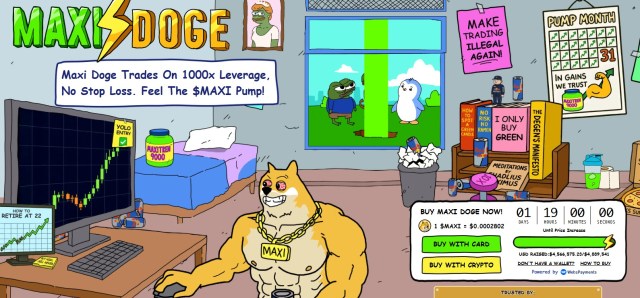
By gamifying the experience, $MAXI positions itself less as a token and more as a derivative of retail conviction.

For traders tired of low-volatility chop, the appeal lies in the project’s unapologetic focus on ‘pump’ mechanics. The tokenomics include a dynamic staking APY from a 5% allocation pool, giving traders yield while they wait for price action.

At the current presale price of $0.0002785, early buyers are effectively betting that the ‘meme supercycle’ will outperform the sanitized infrastructure plays.

Explore the $MAXI ecosystem.

Whale Wallets Signal Accumulation in Pre-Market Rounds

Smart money often moves first. On-chain activity around Maxi Doge ($MAXI) suggests high-net-worth players are positioning before the public listing.

Typically, whales wait for deep liquidity on DEXs to minimize slippage. Jumping in this early suggests a conviction that the $0.0002785 entry price offers an asymmetric risk-reward ratio compared to legacy memes. If TRM Labs represents the institutional ceiling, these whales are betting $MAXI is the retail floor.

Plus, the project’s technical foundation on Ethereum (ERC-20) ensures compatibility for future DeFi integrations. While the ‘Leverage King’ branding is funny, the underlying structure allows for serious capital deployment.

With daily automatic smart contract distribution for stakers, the protocol incentivizes holding through the volatility, a mechanism designed to counteract the ‘jeet’ (rapid selling) behavior that plagues lesser coins.

Buy your $MAXI here.

This article is for informational purposes only and does not constitute financial advice. Cryptocurrencies, particularly presale tokens, are high-risk assets. Always perform your own due diligence.

Editorial Process for bitcoinist is centered on delivering thoroughly researched, accurate, and unbiased content. We uphold strict sourcing standards, and each page undergoes diligent review by our team of top technology experts and seasoned editors. This process ensures the integrity, relevance, and value of our content for our readers.

patrubogdan

Follow

Full Profile

Related Posts

Quale criptovaluta comprare oggi in base alle condizioni di mercato: Il superciclo dei Layer 2 su Bitcoin

El mercado de las criptomonedas a la baja hoy: ¿qué está pasando?

B. Riley Cuts Price Targets Across Digital Asset Treasury Companies as LiquidChain Momentum Builds

Bitcoin in fase di stallo: i movimenti delle balene e il caso Bitcoin Hyper

Meilleure prévente crypto : où le capital se positionne avant le marché

XRP actualité : le marché réagit aux derniers signaux autour de Ripple et à l’émergence de nouveaux acteurs

Preguntas relacionadas

QWhat valuation did TRM Labs achieve in its latest funding round and what does this signify for the crypto market?

ATRM Labs achieved a $1 billion valuation, signifying that traditional finance (TradFi) institutions are heavily investing in blockchain compliance infrastructure. This signals a maturing 'sanitization phase' of crypto, reducing systemic risk perception and encouraging institutional capital to enter the market.

QHow does the article link improved compliance infrastructure to capital flows?

AThe article states that improved compliance infrastructure, as evidenced by TRM Labs' funding, historically correlates with increased capital flows into risk-on assets and high-beta tokens. It creates a 'barbell effect' where capital moves into both compliance tools and high-volatility speculative assets.

QWhat is the name of the meme token mentioned and how much has it raised in its presale?

AThe meme token mentioned is Maxi Doge ($MAXI). It has raised over $4.48 million (approximately $4.5M) in its presale.

QWhat specific market culture is Maxi Doge ($MAXI) attempting to capitalize on?

AMaxi Doge ($MAXI) is capitalizing on the return of 'leverage culture,' targeting a 'gym-bro trader' vibe obsessed with gains and volatility. It frames the bull market as a physical grind and embraces an aggressive 'up-only' narrative.

QWhat on-chain activity suggests 'smart money' or whales are interested in Maxi Doge ($MAXI)?

AOn-chain activity shows whale wallets are participating in the pre-market presale rounds. This early accumulation by high-net-worth players, who typically wait for deeper liquidity, suggests a conviction that the current price offers an asymmetric risk-reward ratio ahead of a public listing.

Lecturas Relacionadas

Super-Rich Hoarded Record Cash in February, Stock Market Hit New Highs Four Months Later: Who's Getting Fooled?

In February, the total assets in US money market funds reached a record high of approximately $8.25 trillion, a trend highlighted by high-net-worth individuals increasing their cash holdings. Notably, Warren Buffett's Berkshire Hathaway amassed a $381.7 billion cash pile ahead of his 2025 retirement, while other prominent figures like Peter Thiel sold tech stocks, fueling narratives of wealthy investors seeking safety. However, by June, the trend reversed. Money market fund assets fell to around $7.87 trillion, indicating a flow of capital back into equities. Concurrently, the S&P 500 and Nasdaq reached all-time highs, with the S&P 500 surpassing 7600 points. This market surge occurred despite the earlier defensive moves, highlighting a potential opportunity cost for those who retreated to cash. Analysis shows that since early 2022, the S&P 500's total return significantly outpaced that of prime money market funds. The capital shifted from equities appears to have been partly reallocated into alternative investments like real estate, art, and private credit, especially among ultra-high-net-worth individuals. Meanwhile, major investment banks like Goldman Sachs and Morgan Stanley have raised their year-end targets for the S&P 500, citing AI-driven earnings growth, while also cautioning about risks including market concentration and economic fragility beneath the surface rally.

marsbitHace 13 min(s)

Super-Rich Hoarded Record Cash in February, Stock Market Hit New Highs Four Months Later: Who's Getting Fooled?

marsbitHace 13 min(s)

Robot Vacuums Have Been Competing for 20 Years, So Why Are 90% of Chinese Households Still Hesitant?

The article explores why over 90% of Chinese households are still hesitant to adopt robotic vacuum cleaners despite two decades of industry development, identifying a core "trust gap" as the primary barrier. The central issue is not a lack of need, but user concerns about reliability in dynamic, real-world home environments. Common anxieties include the robot dragging pet waste, colliding with transparent objects, tangling in cords, scattering cat litter, getting stuck on thresholds, missing corners under furniture, and requiring high-maintenance bases that develop odors. The industry's past focus on competing on technical specs (suction power, mopping functions) has not adequately addressed these practical usability and trust problems. The piece then examines DJI's entry into the market with its ROMO 2 model as a potential new approach. Leveraging its expertise in spatial perception and obstacle avoidance from drones, DJI's solution emphasizes "less intervention" through three key principles: less manual re-cleaning, less user rescue missions, and less maintenance. Specific ROMO 2 features highlighted include advanced obstacle recognition (handling transparent objects and small items), adaptive leg mechanisms for climbing thresholds (up to 8.5cm), an extendable arm for reaching under furniture, AI for identifying and appropriately handling different mess types (e.g., avoiding scattering dry debris), and a self-cleaning base designed to minimize user upkeep. The article argues the next phase of competition should shift from a "parameter race" to a "trust race." It draws a parallel to the iPhone's simplification of the smartphone, suggesting that focusing on a reliable, low-hassle user experience—where people feel confident leaving their floors to the machine—is what's needed to finally convince the vast majority of观望ing families. The ultimate test for products like the ROMO 2 will be long-term user adoption, retention, and口碑, not just technical specifications.

marsbitHace 14 min(s)

Robot Vacuums Have Been Competing for 20 Years, So Why Are 90% of Chinese Households Still Hesitant?

marsbitHace 14 min(s)

The Unclear American Economy: Resilient or Cooling Down?

**U.S. Economic Outlook: Resilient or Cooling Down?** This analysis examines whether the U.S. economy is heading towards a recession. While still growing, the economy shows significant signs of strain. Key data points include Q1 2026 GDP growth of 1.6% and Q1 PCE inflation at 4.5% (annualized), more than double the Fed's target. The labor market remains resilient but is softening, with unemployment at 4.3%. Critical recession indicators present a mixed picture: the yield curve has normalized after a prolonged inversion (historically a late-cycle signal), and the Conference Board's Leading Economic Index has been declining. Current recession probability for 2026 is estimated at 19%, but rises to 41% for 2027, indicating heightened delayed risks. Major pressures are building: a wall of corporate debt refinancing at higher rates, depleted consumer savings, a contracting housing sector, and an energy price shock. The economy exhibits stagflationary characteristics—high inflation alongside slowing growth—which constrains the Federal Reserve's policy options. Historical patterns show recessions are often preceded by Fed tightening and yield curve inversions. If a recession occurs, it is expected to be mild, similar to 2001 rather than 2008. For investors, a defensive portfolio shift toward staples, healthcare, and short-term high-quality bonds may be prudent, while maintaining a long-term, diversified perspective. Key developments to monitor include upcoming GDP, employment, and inflation data, as well as policy signals from the new Fed Chair.

marsbitHace 21 min(s)

The Unclear American Economy: Resilient or Cooling Down?

marsbitHace 21 min(s)

The Most Advanced Large Models Are Now Subject to Export Controls Like Enriched Uranium

In an unprecedented move mirroring the control of enriched uranium, the US Commerce Department has imposed an export control ban on Anthropic's advanced AI models, Fable 5 and Mythos 5, forcing their global shutdown. This marks the first time a purely digital entity—a set of neural network weights—has been subjected to such hardware-like strategic export restrictions, based not on physical scarcity but on its concentrated "capability density." The article draws a direct parallel to the historical control of nuclear technology, arguing that just as uranium ore becomes a controlled substance only when enriched to a critical threshold, AI capabilities become subject to regulation when compressed into a single, potent, and easily accessible interface. This "enriched AI" is seen as crossing a threshold where its aggregated power poses a potential threat. The author predicts three major consequences over the next decade. First, capability auditing will become institutionalized, with governments setting compliance checklists and thresholds for model power, triggering automatic export controls. Second, jurisdictional boundaries will blur as US export controls extend their reach globally, governing any user of American AI services regardless of location, forcing non-US entities to reconsider their AI supply chain dependencies. Third, a technological bifurcation will occur, splitting the AI landscape into a restricted, high-risk track of advanced US proprietary models and a more reliable track of open-source or locally developed alternatives, where guaranteed access may outweigh raw performance. The core crisis exposed is the lack of a legal property rights framework for AI "intelligence." While companies invest heavily in integrating these models into their production systems, legally they only purchase a service that can be revoked at any time, leaving them with no recourse for their sunk investments. The conclusion warns of a permanently fractured digital world where the most capable models may not be the most usable, and clear, unassailable ownership of technology will become paramount.

marsbitHace 34 min(s)

The Most Advanced Large Models Are Now Subject to Export Controls Like Enriched Uranium

marsbitHace 34 min(s)

Trading

Spot
Futuros
活动图片