Treasury’s GENIUS Act Report Backs Mixers, But Wants a New ‘Hold Law’ For Crypto

bitcoinistPublicado a 2026-03-09Actualizado a 2026-03-09

Resumen

The U.S. Treasury's GENIUS Act report acknowledges the legitimate privacy benefits of cryptocurrency mixers for lawful users, such as protecting personal or business transactions. However, it highlights the misuse of these tools by illicit actors like North Korean cyber units and ransomware groups to launder funds. To address this, the report proposes a new "digital-asset-specific hold law" that would allow regulated platforms to temporarily freeze suspicious transactions, giving law enforcement time to act without disrupting legitimate privacy-focused usage. The report is part of a broader effort to balance financial innovation and security under the GENIUS Act framework.

Treasury sent Congress its GENIUS‐Act‐mandated report on “innovative tools” to fight crypto‐enabled illicit finance.

A Crypto’s “Hold Law” And A Privacy Paradox

In a 32-page report submitted to the US Congress this March, the U.S. Treasury Department has endorsed lawful uses of crypto mixers (a service that takes in cryptocurrency from many different users, mixes all those coins together, and then sends each user back an equivalent amount from the pool, but from different addresses than the ones they used to deposit) in favor of privacy.

However, it has also urged lawmakers to create a new “digital‐asset‐specific hold law” so platforms can freeze suspicious funds.

Mixers, Privacy And DPRK

The report notes favorably that mixing and similar tools “can be used by lawful users seeking to enhance financial privacy on public blockchains,” including for “protecting sensitive information about personal wealth, business transactions, or charitable donations from public view. It adds that Treasury “recognizes that privacy‐enhancing technologies, including mixers and other obfuscation tools, may serve legitimate purposes when used by compliant actors in line with applicable AML/CFT requirements.”

On the other side, the same report also stresses that North Korea’s cyber units and major ransomware crews rely on mixers, cross‐chain bridges, and rapid swaps as core infrastructure to launder massive hauls from hacks and fraud. The report cites billions of dollars in stolen digital assets tied to DPRK actors and details how those funds are pushed through mixers and into stablecoins before being bridged and cashed out, using the same tools that ordinary users might pick for privacy.

What The “Hold Law” Would Do

Therefore, to tackle this paradox, the report proposes a “hold law” that would ensure that legitimate, clean, users keep their privacy while unlawful or suspicious activity can be addressed. Under the proposal, crypto exchanges and other regulated platforms would gain a clear and legal “pause button” for suspicious funds. The report recommends that “Congress establish a digital‐asset‐specific statutory ‘hold’ authority” that would allow platforms “to temporarily retain or delay the movement of digital assets associated with suspected illicit activity while appropriate legal process is pursued.” Firms could temporarily hold or delay those assets when strong red flags appear, with statutory cover for doing so.

The idea would be to give law enforcement time to act against ransomware crews, large fraud schemes, or state‐sponsored hackers, while limiting the tool to narrowly defined, high‐risk cases so routine customer flows are not frozen by default.

TradFi and Legacy media have often linked mixers to money laundering, with Tornado Cash as the obvious cautionary tale. Ethereum co‐founder Vitalik Buterin has repeatedly argued that mixers are neutral tools, even saying he used Tornado Cash to make a private donation to Ukraine, and is now backing ‘compliant’ designs like Privacy Pools that aim to protect on‐chain privacy without commingling with known dirty funds.

Another Piece On The GENIUS Act Puzzle

The report is part of the broader GENIUS Act framework, the law Trump signed to create a federal regime for payment stablecoins and push “innovative” tools against illicit finance. It fulfills a mandate for Treasury to spell out how AI, digital identity, and blockchain analytics should be used under a risk‐based AML approach.

The report also proposes a preferred tech stack (AI, digital ID, blockchain analytics, APIs) that regulated platforms should deploy under a risk‐based AML approach.
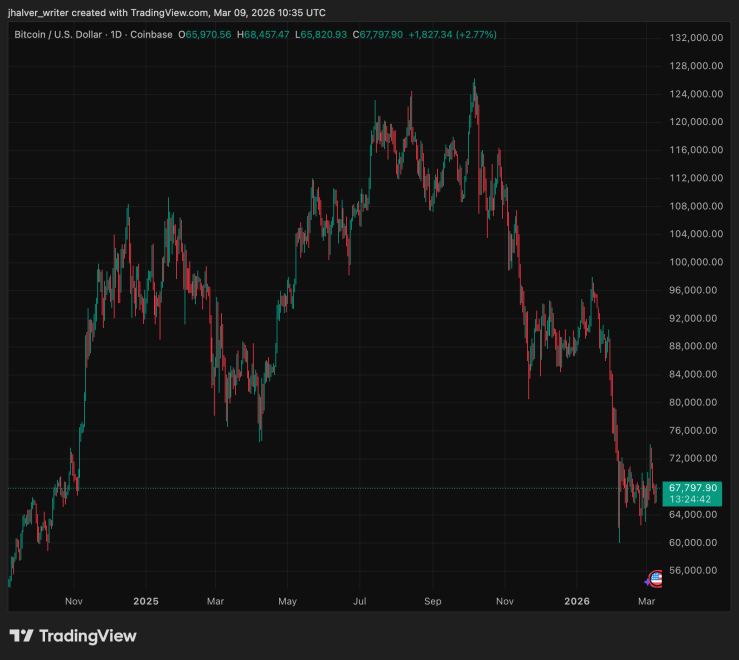
BTC's price trends to the downside on the daily chart. Source: BTCUSD on Tradingview

Cover image from ChatGPT, BTCUSD chart from Tradingview

Preguntas relacionadas

QWhat is the main purpose of the GENIUS Act report submitted by the U.S. Treasury Department?

AThe GENIUS Act report outlines 'innovative tools' to fight crypto-enabled illicit finance, endorsing lawful uses of crypto mixers for privacy while proposing a new 'hold law' to freeze suspicious funds.

QHow does the report view the use of crypto mixers by lawful users?

AThe report recognizes that mixers and other privacy-enhancing technologies can serve legitimate purposes for lawful users seeking financial privacy, such as protecting sensitive information about personal wealth or business transactions, when used in compliance with AML/CFT requirements.

QWhat specific legislative measure does the Treasury Department recommend to address suspicious crypto transactions?

AThe Treasury Department recommends that Congress establish a digital-asset-specific statutory 'hold' authority, allowing platforms to temporarily retain or delay the movement of digital assets associated with suspected illicit activity while legal process is pursued.

QAccording to the report, how do malicious actors like North Korea's cyber units utilize crypto mixers?

ANorth Korea's cyber units and ransomware crews use mixers, cross-chain bridges, and rapid swaps as core infrastructure to launder massive amounts of stolen digital assets, often pushing funds through mixers into stablecoins before cashing out.

QWhat broader framework is this report a part of, and what additional tools does it propose for regulated platforms?

AThe report is part of the GENIUS Act framework, which aims to create a federal regime for payment stablecoins and combat illicit finance. It proposes a tech stack including AI, digital identity, blockchain analytics, and APIs for regulated platforms under a risk-based AML approach.

Lecturas Relacionadas

From South Korea to the United States: Blue-Collar Jobs Are Becoming Increasingly Popular, Thanks to AI

AI is reshaping the labor market's value proposition. The traditional four-year college degree is losing its appeal as a guaranteed career path, while skilled blue-collar trades like electricians, welders, and plumbers are experiencing historic demand and wage premiums. This shift is driven by dual pressures: AI's displacement of certain white-collar roles and a booming need for physical infrastructure and data center construction. Data confirms the trend. In the U.S., vocational school revenue surged, and a significant portion of recent layoffs are AI-related. Surveys show a majority of Gen Z adults plan to pursue blue-collar work, citing better job security against AI automation. Vocational education interest has exploded recently. Experts cite a psychological shift as younger generations seek tangible, AI-resistant careers and avoid high student debt. In many cases, salaries for skilled trades now match or exceed those requiring a bachelor's degree. In South Korea, semiconductor vocational high schools boast near-total employment, with graduates securing high-paying roles at companies like Samsung. The shortage is structural, exacerbated by a retiring baby boomer workforce and massive infrastructure projects. Companies like JPMorgan Chase, Meta, and Lowe's are investing heavily in training programs. However, overcoming historical stigma and a "perception gap" around trade careers remains a key challenge to closing the talent gap.

marsbitHace 49 min(s)

From South Korea to the United States: Blue-Collar Jobs Are Becoming Increasingly Popular, Thanks to AI

marsbitHace 49 min(s)

Qualcomm: AI Hype Subsides, When Will Smartphones Emerge from the Gloom?

Qualcomm reported its Q3 FY2026 results (ending June 2026), with revenue of $9.95B, down 4% YoY but above expectations. Gross margin declined to 53.1%, pressured by rising costs across manufacturing and memory. Key business segments showed mixed performance: Handset revenue fell 19.6% YoY to $5.09B, dragged by an 11% decline in non-Apple Android shipments and weaker high-end mix. Conversely, Automotive revenue surged 61% to $1.59B, and IoT grew 9% to $1.83B. Core operating profit dropped 41% YoY due to margin compression and higher expenses. Management's Q4 FY2026 guidance projects revenue of $9.7B-$10.5B, in line with consensus, but Non-GAAP EPS guidance of $2.05-$2.25 fell short of expectations. Amidst persistent weakness in its core handset market, Qualcomm is pursuing growth in AI, focusing on Edge AI (smartphones, PCs, automotive) and Data Center AI. Its data center strategy includes four pillars: AI accelerators (e.g., AI200), commercial CPUs (Dragonfly C1000), custom silicon, and connectivity solutions. While these initiatives initially boosted its stock, concerns over AI capital expenditure sustainability have since erased those gains. The company targets $5B in data center revenue for FY2027 and $15B for FY2029. The report concludes that with the traditional handset business still under pressure, the data center opportunity is currently viewed as a longer-term option, and a more conservative valuation based on core operations may be warranted until AI contributions materialize.

marsbitHace 54 min(s)

Qualcomm: AI Hype Subsides, When Will Smartphones Emerge from the Gloom?

marsbitHace 54 min(s)

From TPU to Self-Evolving Agents: How Jeff Dean Predicts the Next Step in AI

At the 2026 YC Startup School, Jeff Dean outlined his vision for AI's next phase, shifting focus from simply scaling models to building intelligent, autonomous systems. He believes AI's progress is no longer just about creating smarter models, but about integrating them into systems capable of long-term, iterative work, automated experimentation, and continuous learning. This evolution moves the competition from "who has the bigger model" to "who can best organize intelligence." Dean suggests AI capabilities are now comparable to a junior engineer, enabling the automation of complex workflows. However, the true challenge and opportunity lie in managing these AI "workers" at scale. He emphasizes the importance of **context engineering**—structuring tools, memory, and feedback loops—over raw model power. For startups, this means building deep expertise in niche domains where general models currently fail (near 0-1% success rates), leveraging proprietary data, specialized tools, and domain-specific evaluators. A recurring theme is re-examining fundamental constraints. Dean's past work, like moving Google's search index to memory or creating the TPU, stemmed from questioning outdated assumptions about hardware and cost. He sees similar inflection points today, particularly in **specialized inference hardware** to drastically reduce latency and energy consumption for real-time Agent operation. Notably, he points out that in modern AI systems, the dominant cost is often not computation but **data movement**. Reliable, long-running Agents require robust system design, borrowing concepts from distributed computing like checkpointing, state management, and parallel exploration to handle failures and maintain progress over days or weeks. As AI automates execution, the scarcest human skills will shift to **defining clear specifications**, **judging what problems are worth solving** (taste), and designing effective feedback loops. Ultimately, Dean's framework prioritizes understanding the problem deeply, identifying the true bottlenecks, and systematically building closed-loop systems where AI can not only perform tasks but also improve AI itself.

marsbitHace 54 min(s)

From TPU to Self-Evolving Agents: How Jeff Dean Predicts the Next Step in AI

marsbitHace 54 min(s)

Trading

Spot
活动图片





