Tracing LIT’s road to recovery after whale’s $1.8M loss and revenue troubles

ambcryptoPublicado a 2026-01-13Actualizado a 2026-01-13

Resumen

LIT faces significant challenges following a whale's $1.8 million loss on a long position and alarmingly low revenue of only $8,450 on January 12. These issues have eroded investor confidence and raised doubts about the token's utility and sustainability. Despite these setbacks, there are slight positive signals: Futures Open Interest has increased, indicating ongoing market participation, and liquidity is clustering above the $2.7 level, which could act as a support zone. A break above this level with strong volume might pave the way for recovery, but without decisive upward momentum, LIT remains in a fragile state with an uncertain future.

In a thriving market, high revenue and strong use cases drive investor trust. Unfortunately, LIT’s story is quite the opposite. On 12 January, the project faced some serious setbacks, with a whale’s 1x long position sinking to a $1.8 million floating loss.

Lighter’s revenue of just $8,450 painted a grim picture, raising doubts about its utility while also scaring off potential investors. Liquidity clustering above the $2.7-level could offer support. However, with the market sentiment trending south, it remains uncertain whether this level will hold or not.

Whale’s long struggles in a loss

A whale opened a 1x long position in $LIT, valued at $4.27 million. However, the position quickly went deep into the red as the altcoin’s price continued its downtrend. At the time of writing, the whale’s floating loss had exceeded $1.8 million, highlighting the volatility of the market.

This loss is concerning for LIT as the token has struggled to maintain its previous highs.

With no clear rebound in sight, traders have become increasingly cautious, reflecting broader market pessimism. The question now is whether LIT can recover, or if deeper losses are imminent.

Lighter Chain records meager revenue – Is it dead?

Lighter’s revenue on 12 January was just $8,450, far below expectations. This raises concerns about its ability to generate sustainable income. While early-stage projects face challenges, such a low return from a once-high-profile token casts doubts on its future.

Without a shift in growth, Lighter may be overshadowed by more promising projects. The lack of revenue growth in a competitive market puts its long-term relevance at risk.

LIT Open Interest shows signs of recovery

Further tracking of LIT revealed a hike in Futures Open Interest – A sign that there is still market participation in 2026.

When combined with increasing volume, these factors could mean a potential recovery for LIT. Especially if the price begins to realign positively.

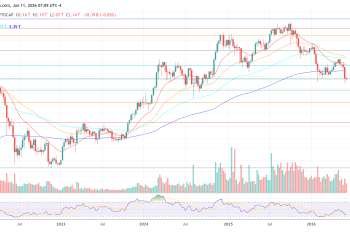
Worth pointing out, however, that the liquidity heatmap revealed that significant liquidity is building and clustering just above the $2.7-level.

This concentration of liquidity could act as a magnet, pulling LIT north if the price manages to break through this level. Market makers often target these areas, and if enough volume pushes LIT to the upside, we could see a potential recovery.

However, until the price breaks through $2.7 with strong momentum, the altcoin will remain in a fragile state. And, its long-term recovery will be far from guaranteed.


Final Thoughts

  • Whale’s floating loss and Lighter’s stagnant revenue raise concerns about LIT’s sustainability.
  • Rising Open Interest and clustered liquidity above $2.7 may provide an opportunity for recovery.

Preguntas relacionadas

QWhat was the value of the whale's long position in LIT and what was the floating loss at the time of writing?

AThe whale opened a 1x long position valued at $4.27 million. At the time of writing, the floating loss had exceeded $1.8 million.

QWhat was Lighter's revenue on January 12th, and why is this figure concerning?

ALighter's revenue on January 12th was just $8,450. This is concerning because it is far below expectations and raises doubts about the project's ability to generate sustainable income and its long-term relevance in a competitive market.

QWhat two positive on-chain metrics were mentioned that could signal a potential recovery for LIT?

AThe two positive metrics mentioned are a hike in Futures Open Interest and significant liquidity clustering just above the $2.7 price level.

QAccording to the article, what key price level does LIT need to break through for a potential recovery, and why?

ALIT needs to break through the $2.7 price level with strong momentum. This is because a significant amount of liquidity is clustered there, which could act as a magnet to pull the price upward if it is breached.

QWhat is the overall market sentiment towards LIT, as suggested by the whale's loss and the project's revenue?

AThe overall market sentiment is pessimistic and cautious. The whale's substantial loss and the project's stagnant revenue have raised serious concerns about LIT's sustainability and have scared off potential investors.

Lecturas Relacionadas

Rubin Ultra Makes Major Cuts, Even Nvidia Can't Handle Memory Price Hikes?

NVIDIA's Rubin Ultra, the top-tier variant of the newly announced Rubin AI accelerators, has reportedly seen significant specification downgrades, according to an industry report from SemiAnalysis. Initially designed with four compute dies (4-die), the Rubin Ultra is now said to be reduced to a 2-die design. Key changes highlighted in the report include: * **No increase in peak theoretical compute performance**, remaining at 35 PFLOPs like the standard Rubin. * **Severe reduction in memory capacity** to 192GB using 8-Hi HBM stacks, which is less than the standard Rubin's 288GB using 12-Hi stacks. * **Negligible memory bandwidth improvement** of only 1 TB/s. * **Slightly higher chip-level power consumption**. * The **primary upgrade is a massive increase in scale-up interconnect capacity**, supporting connections for up to 576 GPUs via NVLink, compared to 72 for the standard Rubin. The report suggests the redesign is primarily a cost-optimization move driven by the sharp rise in HBM (High-Bandwidth Memory) prices. By reducing the expensive HBM content and shifting investment towards enhanced system-scale networking, NVIDIA aims to maintain the platform's value for large-scale AI training clusters while managing soaring material costs. The news reportedly triggered a sell-off in South Korean memory stocks, with SK Hynix and Samsung shares falling around 8%, as markets grew concerned that NVIDIA—a major HBM buyer—might be reducing its reliance on high-capacity memory, potentially capping future pricing power for memory makers.

Odaily星球日报Hace 12 min(s)

Rubin Ultra Makes Major Cuts, Even Nvidia Can't Handle Memory Price Hikes?

Odaily星球日报Hace 12 min(s)

Can Generative Models Finally Be Trained End-to-End? The Core Is a For Loop

This article introduces a novel training paradigm for generative models called Explorative Modeling (XM), which enables true end-to-end training. Traditionally, powerful generative models like autoregressive and diffusion models are not trained end-to-end. They are trained to predict a single small step but require iterative multi-step sampling for inference. This "exposure bias" leads to error accumulation and limits performance. The core challenge XM addresses is "mode blurring." In generative tasks, a single input (e.g., "generate a dog") corresponds to many valid outputs (multiple modes). Standard training objectives like reconstruction loss force the model to average these modes, producing unrealistic, blurry outputs. To avoid this, existing models break generation into many small, almost deterministic steps, sacrificing end-to-end training. XM tackles this by restructuring the training loop itself. Its key insight is to amplify "generative expressivity." For each training input, instead of generating one sample, the model generates K candidate outputs. Only the candidate closest to the real data is used for computing the loss and updating the model via backpropagation. This simple "best-of-K" mechanism is implemented as a short for-loop. By exploring multiple possibilities, the model learns to distribute its guesses across different modes rather than collapsing to their uninformative average. The paper demonstrates that "exploration" acts as a new, powerful scaling axis. Gains from XM increase with model size, data scale, and compute. Experiments show improvements in FID scores for image generation and significant efficiency gains, sometimes outperforming larger models without exploration. When pushed to the limit, XM enables fully single-step, end-to-end generative models. In robotics tasks, an "Explorative Policy" matched the performance of a 100-step Diffusion Policy with a single forward pass, drastically improving inference speed. While the best-of-K concept is not entirely new, the authors' contribution lies in formally understanding it as a direct method to boost generative expressivity without fragmenting the generation process. This work suggests that as models scale, enhancing exploration during training may become crucial for overcoming fundamental performance bottlenecks.

marsbitHace 1 hora(s)

Can Generative Models Finally Be Trained End-to-End? The Core Is a For Loop

marsbitHace 1 hora(s)

Trading

Spot
活动图片