TPS is Just the Entry Ticket, Ordering Decides Success or Failure: On-Chain Transactions Enter a New Era of 'Application-Awareness'

marsbitPublicado a 2025-12-29Actualizado a 2025-12-29

Resumen

The competition between blockchains has shifted from TPS (transactions per second) to transaction ordering, which critically impacts market maker behavior, liquidity depth, and pricing. Transaction ordering refers to how transactions in the mempool are sequenced and included in blocks. This process affects transaction cost, MEV (Maximal Extractable Value), success rate, and fairness. For market makers, the ability to cancel orders quickly during volatility is essential—failure leads to risks like sniping, where high-Gas transactions exploit pending orders, forcing wider spreads and reduced liquidity. Innovations are moving from generic, Gas-based ordering to "application-aware sequencing," where transaction intent and fairness rules take priority. Examples include: - Hyperliquid, which prioritizes cancellations and post-only orders at the consensus layer. - Solana’s Application Controlled Execution (ACE) and BAM nodes, allowing DEXs to set custom ordering rules (e.g., market-maker priority). - Chainlink’s SVR, which uses MEV auctions to redistribute value from liquidations triggered by oracle updates. These developments suggest that tailored transaction sequencing is becoming essential—not just an improvement—for on-chain trading, potentially enabling DEXs to surpass CEXs in efficiency and fairness.

Competition between chains has escalated to the level of "transaction ordering," which directly impacts market makers' bid-ask spreads and depth🧐🧐

The demand for "general-purpose chains" has been disproven. Current chain-to-chain competition focuses on two levels:

1) Building "application chains" on the foundation of existing mature businesses, allowing blockchain to supplement existing operations in areas like settlement;

2) Competition at the level of "transaction ordering."

This article focuses on the second level.

Ordering directly influences the behavior of market makers. This is the core issue.

What is Transaction Ordering?

On-chain, user transactions are not immediately written to a block; they first enter a "waiting area" (Mempool). There may be thousands of transactions simultaneously, and it must be decided by a sequencer, validator, or miner:

1) Which transactions are included in the next block?

2) In what order are these transactions arranged?

The process of "deciding the order" is transaction ordering, which directly affects the transaction costs for on-chain users, MEV conditions, transaction success rate, and fairness.

For example, during network congestion, ordering determines whether a transaction can be quickly added to the chain or waits indefinitely in the mempool.

For high-frequency traders like market makers, whether a cancellation order takes effect is more critical than a placement order succeeding. The priority given to processing cancellation orders directly impacts whether market makers dare to offer deep liquidity.

In the last cycle, everyone pursued TPS, believing that speed alone could improve on-chain transaction settlement. But it has been proven that, besides speed, the risk pricing of market makers is equally important.

On centralized exchanges, trade matching strictly follows the "price-time priority" principle. In this highly deterministic environment, market makers can provide deep order book liquidity with extremely narrow spreads.

On-chain, after transactions enter the Mempool waiting area, nodes select transactions based on Gas fees, which creates room for sniping existing orders by offering higher Gas.

Suppose TRUMP is priced at $4.5, and a market maker places a buy order at $4.4 and a sell order at $4.6 to provide depth. But the exchange price of TRUMP suddenly crashes to $4.

At this point, the on-chain market maker wants to cancel the $4.4 buy order but gets sniped by a high-frequency trader offering higher Gas—buying at $4 and selling to the market maker at $4.4.

Therefore, market makers can only widen their spreads to reduce risk.

The purpose of the new generation of ordering innovations is to transition from "general ordering" to "Application-Aware Sequencing."

The ordering layer can understand transaction intent and order based on preset fairness rules, not just based on Gas fees.

1) Define the ordering method at the consensus layer

A typical case is Hyperliquid. It stipulates at the consensus layer that cancellation and Post-Only transactions take priority, breaking the Gas priority rule.

For market makers, being able to exit is paramount. During sharp price fluctuations, cancellation requests are always executed before others' takers.

Market makers fear being sniped the most. Hyperliquid precisely guarantees that cancellations are always prioritized—when the price drops, market makers cancel their orders, and the system forcibly prioritizes processing the cancellations, allowing market makers to successfully hedge risks.

On the day of the 10.11 crash, Hyperliquid market makers stayed online continuously, with spreads of 0.01–0.05%. The reason is that market makers knew they could get out.

2) Add new ordering methods at the sequencing layer

For example, Solana's Application Controlled Execution (ACE). Jito Labs developed BAM (Block Assembly Marketplace), introducing specialized BAM nodes responsible for transaction collection, filtering, and ordering.

Nodes run in a Trusted Execution Environment (TEE), ensuring the privacy of transaction data and the fairness of ordering.

Through ACE, DEXs on Solana (like Jupiter, Drift, Phoenix) can register custom ordering rules with BAM nodes. For example, market maker priority (similar to Hyperliquid), conditional liquidity, etc.

Additionally, proprietary AMM market makers like HumidiFi represent innovation at the ordering level, using Nozomi to connect directly with major validators to reduce latency and complete transactions.

During specific transactions, HumidiFi's off-chain servers monitor prices across platforms. The oracle communicates with the on-chain contract to inform it of the situation. Nozomi acts like a VIP channel, allowing effective order cancellation before execution.

3) Utilizing MEV facilities and private channels

Chainlink SVR (Smart Value Recapture) focuses on the归属 (belonging) of the value generated by ordering (MEV).

By deeply integrating with oracle data, it redefines the ordering rights and value distribution of liquidation transactions. After generating a price update, Chainlink nodes send it through two channels:

1) Public channel: Sent to the standard on-chain aggregator (serving as a backup, but in SVR mode, there is a slight delay to leave an auction window).

2) Private channel (Flashbots MEV-Share): Sent to an auction market supporting MEV-Share.

This way, the auction proceeds from liquidations triggered by oracle price changes in lending protocols (i.e., the amount searchers are willing to pay) are no longer solely captured by miners; most are captured by the SVR protocol.
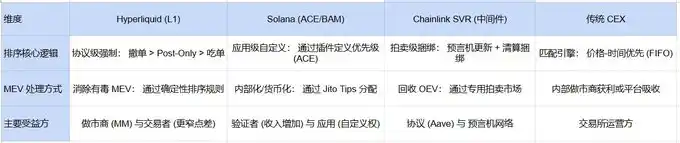
Summary

If TPS is the entry ticket, then having only TPS is completely insufficient now. Custom ordering logic might not just be an innovation but a necessary path for putting transactions on-chain.

It might also be the beginning of DEXs surpassing CEXs.

Preguntas relacionadas

QWhat is the core argument of the article regarding the evolution of blockchain competition beyond TPS?

AThe article argues that competition between blockchains has moved beyond just transaction speed (TPS) and is now focused on the critical layer of 'transaction ordering' (sequencing). Effective and fair transaction ordering directly impacts market maker behavior, liquidity depth, and the overall user experience, making it a decisive factor for success.

QHow does transaction ordering on a blockchain negatively impact market makers, according to the article?

AIn a default 'gas-first' ordering system, market makers are vulnerable to being sniped. When an asset's price moves, a high-frequency trader can pay a higher gas fee to have their 'take order' (e.g., buying the asset at a low price) processed before the market maker's 'cancel order' (e.g., trying to withdraw their offer). This forces the market maker to buy the asset back at their own, now outdated, higher price, leading to losses and causing them to widen their spreads to mitigate risk.

QWhat is 'Application-Aware Sequencing' and can you name a project that implements it at the consensus layer?

A'Application-Aware Sequencing' is an innovative approach where the sequencing logic understands the intent of transactions (e.g., a cancelation vs. a trade) and orders them based on predefined fairness rules, not just gas fees. Hyperliquid is a prime example that implements this at the consensus layer by mandating that cancel and post-only orders are always prioritized over others, ensuring market makers can escape unfavorable positions.

QBesides consensus-layer changes, what other method does the article mention for improving transaction ordering on Solana?

AThe article mentions Solana's Application Controlled Execution (ACE) and the Block Assembly Marketplace (BAM) developed by Jito Labs. This allows decentralized exchanges (DEXs) like Jupiter and Drift to register custom ordering rules (e.g., market maker priority) with specialized BAM nodes, which operate in a Trusted Execution Environment (TEE) for privacy and fairness.

QHow does Chainlink's Smart Value Recapture (SVR) model change who benefits from MEV generated by oracle price updates?

AChainlink's SVR model changes MEV distribution by creating a two-path system for oracle price updates. After generating a new price, Chainlink nodes send it through a public channel (with a slight delay) and a private channel to a MEV auction market (like Flashbots MEV-Share). This allows the value from auctions for liquidation trades triggered by the price update to be captured mostly by the SVR protocol itself, rather than being kept entirely by miners/validators.

Lecturas Relacionadas

Google and Amazon Simultaneously Invest Heavily in a Competitor: The Most Absurd Business Logic of the AI Era Is Becoming Reality

In a span of four days, Amazon announced an additional $25 billion investment, and Google pledged up to $40 billion—both direct competitors pouring over $65 billion into the same AI startup, Anthropic. Rather than a typical venture capital move, this signals the latest escalation in the cloud wars. The core of the deal is not equity but compute pre-orders: Anthropic must spend the majority of these funds on AWS and Google Cloud services and chips, effectively locking in massive future compute consumption. This reflects a shift in cloud market dynamics—enterprises now choose cloud providers based on which hosts the best AI models, not just price or stability. With OpenAI deeply tied to Microsoft, Anthropic’s Claude has become the only viable strategic asset for Google and Amazon to remain competitive. Anthropic’s annualized revenue has surged to $30 billion, and it is expanding into verticals like biotech, positioning itself as a cross-industry AI infrastructure layer. However, this funding comes with constraints: Anthropic’s independence is challenged as it balances two rival investors, its safety-first narrative faces pressure from regulatory scrutiny, and its path to IPO introduces new financial pressures. Globally, this accelerates a "tri-polar" closed-loop structure in AI infrastructure, with Microsoft-OpenAI, Google-Anthropic, and Amazon-Anthropic forming exclusive model-cloud alliances. In contrast, China’s landscape differs—investments like Alibaba and Tencent backing open-source model firm DeepSeek reflect a more decoupled approach, though closed-source models from major cloud providers still dominate. The $65 billion bet is ultimately about securing a seat at the table in an AI-defined future—where missing the model layer means losing the cloud war.

marsbitHace 6 hora(s)

Google and Amazon Simultaneously Invest Heavily in a Competitor: The Most Absurd Business Logic of the AI Era Is Becoming Reality

marsbitHace 6 hora(s)

Computing Power Constrained, Why Did DeepSeek-V4 Open Source?

DeepSeek-V4 has been released as a preview open-source model, featuring 1 million tokens of context length as a baseline capability—previously a premium feature locked behind enterprise paywalls by major overseas AI firms. The official announcement, however, openly acknowledges computational constraints, particularly limited service throughput for the high-end DeepSeek-V4-Pro version due to restricted high-end computing power. Rather than competing on pure scale, DeepSeek adopts a pragmatic approach that balances algorithmic innovation with hardware realities in China’s AI ecosystem. The V4-Pro model uses a highly sparse architecture with 1.6T total parameters but only activates 49B during inference. It performs strongly in agentic coding, knowledge-intensive tasks, and STEM reasoning, competing closely with top-tier closed models like Gemini Pro 3.1 and Claude Opus 4.6 in certain scenarios. A key strategic product is the Flash edition, with 284B total parameters but only 13B activated—making it cost-effective and accessible for mid- and low-tier hardware, including domestic AI chips from Huawei (Ascend), Cambricon, and Hygon. This design supports broader adoption across developers and SMEs while stimulating China's domestic semiconductor ecosystem. Despite facing talent outflow and intense competition in user traffic—with rivals like Doubao and Qianwen leading in monthly active users—DeepSeek has maintained technical momentum. The release also comes amid reports of a new funding round targeting a valuation exceeding $10 billion, potentially setting a new record in China’s LLM sector. Ultimately, DeepSeek-V4 represents a shift toward open yet realistic infrastructure development in the constrained compute landscape of Chinese AI, emphasizing engineering efficiency and domestic hardware compatibility over pure model scale.

marsbitHace 6 hora(s)

Computing Power Constrained, Why Did DeepSeek-V4 Open Source?

marsbitHace 6 hora(s)

Trading

Spot
Futuros

Artículos destacados

Qué es WL

I. Introducción al ProyectoWorldLand es una L2 o cadena lateral de Ethereum, diseñada como una solución de abajo hacia arriba para mejorar el ecosistema de Ethereum.II. Información del Token1) Información BásicaNombre del token: WL (WorldLand)III. Enlaces RelacionadosSitio web:https://worldland.foundation/Exploradores:https://bscscan.com/address/0x8aaB31fbc69C92fa53f600910Cf0f215531F8239Redes Sociales:https://x.com/WorldLand_space Nota: La introducción del proyecto proviene de los materiales publicados o proporcionados por el equipo oficial del proyecto, que es solo para referencia y no constituye asesoramiento de inversión. HTX no se hace responsable de ninguna pérdida directa o indirecta resultante.

139 Vistas totalesPublicado en 2026.03.28Actualizado en 2026.03.28

Qué es WL

Cómo comprar WL

¡Bienvenido a HTX.com! Hemos hecho que comprar WorldLand (WL) sea simple y conveniente. Sigue nuestra guía paso a paso para iniciar tu viaje de criptos.Paso 1: crea tu cuenta HTXUtiliza tu correo electrónico o número de teléfono para registrarte y obtener una cuenta gratuita en HTX. Experimenta un proceso de registro sin complicaciones y desbloquea todas las funciones.Obtener mi cuentaPaso 2: ve a Comprar cripto y elige tu método de pagoTarjeta de crédito/débito: usa tu Visa o Mastercard para comprar WorldLand (WL) al instante.Saldo: utiliza fondos del saldo de tu cuenta HTX para tradear sin problemas.Terceros: hemos agregado métodos de pago populares como Google Pay y Apple Pay para mejorar la comodidad.P2P: tradear directamente con otros usuarios en HTX.Over-the-Counter (OTC): ofrecemos servicios personalizados y tipos de cambio competitivos para los traders.Paso 3: guarda tu WorldLand (WL)Después de comprar tu WorldLand (WL), guárdalo en tu cuenta HTX. Alternativamente, puedes enviarlo a otro lugar mediante transferencia blockchain o utilizarlo para tradear otras criptomonedas.Paso 4: tradear WorldLand (WL)Tradear fácilmente con WorldLand (WL) en HTX's mercado spot. Simplemente accede a tu cuenta, selecciona tu par de trading, ejecuta tus trades y monitorea en tiempo real. Ofrecemos una experiencia fácil de usar tanto para principiantes como para traders experimentados.

224 Vistas totalesPublicado en 2026.03.28Actualizado en 2026.03.28

Cómo comprar WL

Cómo comprar BASED

¡Bienvenido a HTX.com! Hemos hecho que comprar Based (BASED) sea simple y conveniente. Sigue nuestra guía paso a paso para iniciar tu viaje de criptos.Paso 1: crea tu cuenta HTXUtiliza tu correo electrónico o número de teléfono para registrarte y obtener una cuenta gratuita en HTX. Experimenta un proceso de registro sin complicaciones y desbloquea todas las funciones.Obtener mi cuentaPaso 2: ve a Comprar cripto y elige tu método de pagoTarjeta de crédito/débito: usa tu Visa o Mastercard para comprar Based (BASED) al instante.Saldo: utiliza fondos del saldo de tu cuenta HTX para tradear sin problemas.Terceros: hemos agregado métodos de pago populares como Google Pay y Apple Pay para mejorar la comodidad.P2P: tradear directamente con otros usuarios en HTX.Over-the-Counter (OTC): ofrecemos servicios personalizados y tipos de cambio competitivos para los traders.Paso 3: guarda tu Based (BASED)Después de comprar tu Based (BASED), guárdalo en tu cuenta HTX. Alternativamente, puedes enviarlo a otro lugar mediante transferencia blockchain o utilizarlo para tradear otras criptomonedas.Paso 4: tradear Based (BASED)Tradear fácilmente con Based (BASED) en HTX's mercado spot. Simplemente accede a tu cuenta, selecciona tu par de trading, ejecuta tus trades y monitorea en tiempo real. Ofrecemos una experiencia fácil de usar tanto para principiantes como para traders experimentados.

203 Vistas totalesPublicado en 2026.03.30Actualizado en 2026.03.30

Cómo comprar BASED

Discusiones

Bienvenido a la comunidad de HTX. Aquí puedes mantenerte informado sobre los últimos desarrollos de la plataforma y acceder a análisis profesionales del mercado. A continuación se presentan las opiniones de los usuarios sobre el precio de A (A).

活动图片














