Toncoin Fees To Drop 6x As Network Moves Toward Feeless Transactions

bitcoinistPublicado a 2026-04-25Actualizado a 2026-04-25

Resumen

Telegram founder Pavel Durov announced that the Toncoin (TON) network will reduce transaction fees by six times in one week, lowering the cost to just 0.00039 TON (approximately $0.0005). This fee reduction is part of the "Make TON Great Again" (MTONGA) roadmap and will remain fixed regardless of network congestion. The update follows a recent upgrade that made the network 10 times faster and transactions nearly instant. Durov also hinted that future steps aim to make most transactions fully feeless. Although Telegram discontinued formal involvement with TON due to regulatory issues, Durov remains a strong supporter. Currently, Toncoin is trading around $1.30, down over 8% in the past week.

The Telegram founder has revealed that the Toncoin network is set to see its transaction fees drop by sixfold in one week’s time.

Toncoin To Drop Transfer Fees As Part Of MTONGA

In a new post on X, Telegram founder and CEO Pavel Durov has shared that the Toncoin network will undergo a change related to transaction fees in one week. Previously, the blockchain already offered a relatively cheap transfer rate when compared to popular networks like Bitcoin and Ethereum, but the new update will further slash the fee on TON, bringing it down to just 0.00039 TON (worth about $0.0005).

The sixfold reduction in the transaction fees will hold regardless of network congestion. This is unlike many other networks, where the value of the transfer fees is dependent on blockchain conditions. Typically, a high amount of traffic tends to increase network fees, while low activity decreases the metric. On TON, however, the fees will remain fixed at its low value.

The initiative is part of Toncoin’s “Make TON Great Again” (MTONGA) roadmap, which is planned to involve a total of seven steps. Earlier in the month, the first step of the roadmap went into action as the TON blockchain underwent an upgrade. Durov talked about the update in an X post, noting that it made the network 10x faster and increased block rate by 6x. The upgrade also made transactions on the network practically instant.

In the same post, the Telegram founder had teased the next step of the roadmap, which is now finally getting implemented with the transaction fee reduction in one week.

In its early years, TON was developed by the Telegram team, and its full form stood for the Telegram Open Network. After a court order from the US Securities and Exchange Commission (SEC), however, the company was forced to pull its involvement from the network. TON rebranded to The Open Network and has since been supported by independent contributors, including the TON Foundation.

Despite the end of Telegram’s formal involvement, Durov has continued to be a vocal supporter of the blockchain, with the MTONGA roadmap being an example of his continued backing.

In the new X post related to the second step of MTONGA, the Telegram CEO also hinted at what’s coming up for the network once the upgrade is done. “Soon after most transactions go fully feeless,” noted Durov. “Zero commission. MTONGA!”

As mentioned earlier, Toncoin already offers cheaper transactions than other popular blockchains. Below is a chart from BitInfoCharts that puts into perspective the difference by showcasing the level of fees on the Bitcoin network.
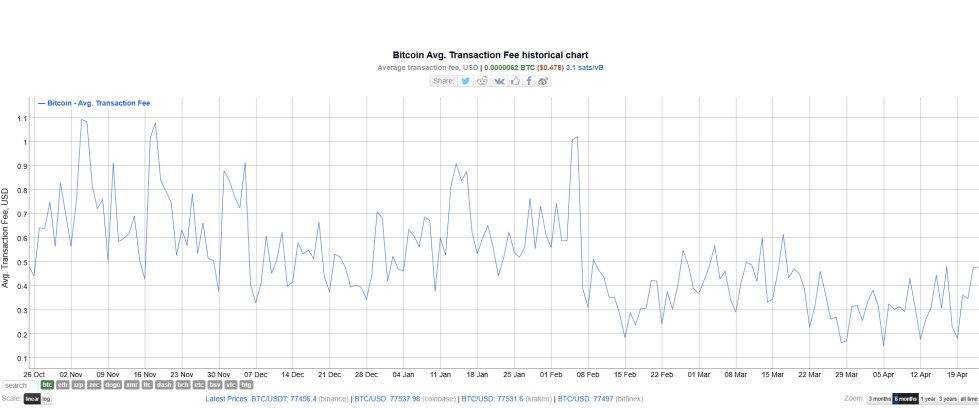
How the transfer fee on the BTC blockchain has fluctuated over the last six months | Source: BitInfoCharts

TON Price

At the time of writing, Toncoin is trading around $1.30, down more than 8% over the past week.

The price of the coin has retraced over the last couple of days | Source: TONUSDT on TradingView

Preguntas relacionadas

QWhat is the expected reduction in Toncoin transaction fees and when will it happen?

AThe Toncoin network is set to see its transaction fees drop by sixfold in one week's time.

QWhat is the new transaction fee amount on the Toncoin network after the reduction?

AThe new transaction fee will be just 0.00039 TON, which is approximately $0.0005.

QWhat is the name of the roadmap initiative that includes this fee reduction?

AThe initiative is part of Toncoin's 'Make TON Great Again' (MTONGA) roadmap.

QHow does the Toncoin fee structure differ from other networks like Bitcoin and Ethereum?

AUnlike many other networks where fees depend on blockchain congestion, Toncoin's fees will remain fixed at a low value regardless of network traffic.

QWhat did Pavel Durov hint at for the future of the network after this fee reduction?

ADurov hinted that soon after the upgrade, most transactions will go fully feeless with zero commission.

Lecturas Relacionadas

Claude Code Introduces Dynamic Workflows: Enabling AI to Form Teams and Collaborate

Claude Code introduces dynamic workflows, enabling AI to coordinate teams of specialized agents for complex tasks. This transforms Claude from a code assistant into a programmable workbench. Workflows address key limitations of single-agent systems: agentic laziness (premature task completion), self-preferential bias (favoring own outputs), and goal drift (losing sight of original objectives). The system allows Claude to dynamically create execution frameworks using JavaScript. It can split tasks, dispatch parallel agents for isolated work (e.g., in separate worktrees), implement adversarial validation, run tournaments, and synthesize results. This multi-agent approach is valuable for tasks requiring deep research, factual verification, code migration, root cause analysis, large-scale triage, and qualitative sorting. Key patterns include: classify-and-route, fan-out-and-synthesize, adversarial verification, generate-and-filter, tournaments, and loop-until-done. While token usage is higher, workflows excel where tasks resemble programming—needing problem decomposition, isolated context, hypothesis testing, and handling many details. They extend Claude Code's utility beyond technical work to areas like business plan review, resume screening, and naming brainstorm. The feature is not a universal solution but points to a future where AI tool competitiveness depends on organizing reliable, reusable, and auditable execution flows for complex goals.

marsbitHace 2 min(s)

Claude Code Introduces Dynamic Workflows: Enabling AI to Form Teams and Collaborate

marsbitHace 2 min(s)

Hyperliquid, Wall Street's 24/7 Trading Convenience Store

Hyperliquid: The 24/7 Trading "Convenience Store" for Wall Street Hyperliquid, a decentralized cryptocurrency exchange, has become a go-to platform for Wall Street traders seeking to trade around the clock, especially during traditional market closures. Founded by Jeff Yan, a former quantitative trader, after the FTX collapse, the platform emphasizes user self-custody of assets. It offers a wide range of perpetual contracts—leveraged derivatives with no expiry—on assets from Bitcoin and crude oil to the S&P 500 and even pre-IPO companies like SpaceX. A notable example involves a hedge fund trader who capitalized on geopolitical news over a weekend, securing a 243% return on oil derivatives before markets reopened. The platform, run by just 11 employees, generated approximately $800 million in revenue last year, and its native token HYPE has seen significant growth. Its rise highlights the merging of traditional finance and crypto. While U.S. users are currently restricted, recent CFTC rule changes could open access. The platform is known for its transparency, having processed $10 billion in liquidations during a market crash while competitors faltered. Regulators warn of the high risks and complexity of perpetual contracts for retail investors. Key to its appeal is a strong community culture, direct engagement with founders, and a simple interface. Despite rules against VPN use, it attracts global users with its permissionless approach. Hyperliquid plans to expand into prediction markets and options, aiming to eventually host all financial activity.

marsbitHace 3 min(s)

Hyperliquid, Wall Street's 24/7 Trading Convenience Store

marsbitHace 3 min(s)

Who Funds the Agents?

**Summary: Who Funds AI Agents?** OpenAI recently shut down a feature allowing AI agents to shop for users, highlighting the challenge of creating a secure and regulated environment for agent-driven transactions. While payment infrastructure exists, a crucial governance layer—defining spending limits, fraud detection, tax handling, and return policies—is largely missing. The potential is enormous: AI agents already processed $73M across 176M transactions last year, with McKinsey forecasting this could grow to $3-5T in global consumer commerce by 2030. The core competition isn't just about processing payments, which can be very cheap (especially with crypto-based settlement), but about controlling the rules that govern agent spending. Key players like Stripe and Coinbase are racing to dominate this governance layer. Stripe's acquisition of wallet provider Privy allows it to set spending policies, identity checks, and human-in-the-loop approvals directly at the wallet level. Similarly, Coinbase's stack, including its x402 protocol and AgentKit, embeds governance rules. This vertical integration across settlement, wallet, and governance layers is becoming the dominant strategy. Control over the governance layer is where significant future value lies. If agents handle trillions in transactions, even a small fee for managing compliance, fraud prevention, and policy enforcement could generate billions in annual revenue. The companies that successfully integrate across the payment stack will capture value from idle agent balances, transaction fees, and governance services, positioning themselves as the foundational banks of the AI agent economy.

marsbitHace 30 min(s)

Who Funds the Agents?

marsbitHace 30 min(s)

Trading

Spot
Futuros

Artículos destacados

Cómo comprar TON

¡Bienvenido a HTX.com! Hemos hecho que comprar The Open Network (TON) sea simple y conveniente. Sigue nuestra guía paso a paso para iniciar tu viaje de criptos.Paso 1: crea tu cuenta HTXUtiliza tu correo electrónico o número de teléfono para registrarte y obtener una cuenta gratuita en HTX. Experimenta un proceso de registro sin complicaciones y desbloquea todas las funciones.Obtener mi cuentaPaso 2: ve a Comprar cripto y elige tu método de pagoTarjeta de crédito/débito: usa tu Visa o Mastercard para comprar The Open Network (TON) al instante.Saldo: utiliza fondos del saldo de tu cuenta HTX para tradear sin problemas.Terceros: hemos agregado métodos de pago populares como Google Pay y Apple Pay para mejorar la comodidad.P2P: tradear directamente con otros usuarios en HTX.Over-the-Counter (OTC): ofrecemos servicios personalizados y tipos de cambio competitivos para los traders.Paso 3: guarda tu The Open Network (TON)Después de comprar tu The Open Network (TON), guárdalo en tu cuenta HTX. Alternativamente, puedes enviarlo a otro lugar mediante transferencia blockchain o utilizarlo para tradear otras criptomonedas.Paso 4: tradear The Open Network (TON)Tradear fácilmente con The Open Network (TON) en HTX's mercado spot. Simplemente accede a tu cuenta, selecciona tu par de trading, ejecuta tus trades y monitorea en tiempo real. Ofrecemos una experiencia fácil de usar tanto para principiantes como para traders experimentados.

487 Vistas totalesPublicado en 2024.12.10Actualizado en 2026.06.02

Cómo comprar TON

Discusiones

Bienvenido a la comunidad de HTX. Aquí puedes mantenerte informado sobre los últimos desarrollos de la plataforma y acceder a análisis profesionales del mercado. A continuación se presentan las opiniones de los usuarios sobre el precio de TON (TON).

活动图片