Toncoin Fees To Drop 6x As Network Moves Toward Feeless Transactions

bitcoinistPublicado a 2026-04-25Actualizado a 2026-04-25

Resumen

Telegram founder Pavel Durov announced that the Toncoin (TON) network will reduce transaction fees by six times in one week, lowering the cost to just 0.00039 TON (approximately $0.0005). This fee reduction is part of the "Make TON Great Again" (MTONGA) roadmap and will remain fixed regardless of network congestion. The update follows a recent upgrade that made the network 10 times faster and transactions nearly instant. Durov also hinted that future steps aim to make most transactions fully feeless. Although Telegram discontinued formal involvement with TON due to regulatory issues, Durov remains a strong supporter. Currently, Toncoin is trading around $1.30, down over 8% in the past week.

The Telegram founder has revealed that the Toncoin network is set to see its transaction fees drop by sixfold in one week’s time.

Toncoin To Drop Transfer Fees As Part Of MTONGA

In a new post on X, Telegram founder and CEO Pavel Durov has shared that the Toncoin network will undergo a change related to transaction fees in one week. Previously, the blockchain already offered a relatively cheap transfer rate when compared to popular networks like Bitcoin and Ethereum, but the new update will further slash the fee on TON, bringing it down to just 0.00039 TON (worth about $0.0005).

The sixfold reduction in the transaction fees will hold regardless of network congestion. This is unlike many other networks, where the value of the transfer fees is dependent on blockchain conditions. Typically, a high amount of traffic tends to increase network fees, while low activity decreases the metric. On TON, however, the fees will remain fixed at its low value.

The initiative is part of Toncoin’s “Make TON Great Again” (MTONGA) roadmap, which is planned to involve a total of seven steps. Earlier in the month, the first step of the roadmap went into action as the TON blockchain underwent an upgrade. Durov talked about the update in an X post, noting that it made the network 10x faster and increased block rate by 6x. The upgrade also made transactions on the network practically instant.

In the same post, the Telegram founder had teased the next step of the roadmap, which is now finally getting implemented with the transaction fee reduction in one week.

In its early years, TON was developed by the Telegram team, and its full form stood for the Telegram Open Network. After a court order from the US Securities and Exchange Commission (SEC), however, the company was forced to pull its involvement from the network. TON rebranded to The Open Network and has since been supported by independent contributors, including the TON Foundation.

Despite the end of Telegram’s formal involvement, Durov has continued to be a vocal supporter of the blockchain, with the MTONGA roadmap being an example of his continued backing.

In the new X post related to the second step of MTONGA, the Telegram CEO also hinted at what’s coming up for the network once the upgrade is done. “Soon after most transactions go fully feeless,” noted Durov. “Zero commission. MTONGA!”

As mentioned earlier, Toncoin already offers cheaper transactions than other popular blockchains. Below is a chart from BitInfoCharts that puts into perspective the difference by showcasing the level of fees on the Bitcoin network.
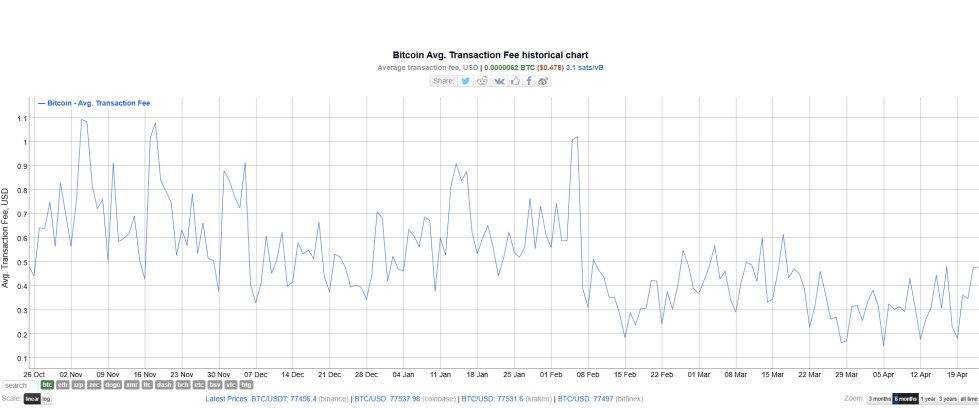
How the transfer fee on the BTC blockchain has fluctuated over the last six months | Source: BitInfoCharts

TON Price

At the time of writing, Toncoin is trading around $1.30, down more than 8% over the past week.

The price of the coin has retraced over the last couple of days | Source: TONUSDT on TradingView


Preguntas relacionadas

QWhat is the expected reduction in Toncoin transaction fees and when will it happen?

AThe Toncoin network is set to see its transaction fees drop by sixfold in one week's time.

QWhat is the new transaction fee amount on the Toncoin network after the reduction?

AThe new transaction fee will be just 0.00039 TON, which is approximately $0.0005.

QWhat is the name of the roadmap initiative that includes this fee reduction?

AThe initiative is part of Toncoin's 'Make TON Great Again' (MTONGA) roadmap.

QHow does the Toncoin fee structure differ from other networks like Bitcoin and Ethereum?

AUnlike many other networks where fees depend on blockchain congestion, Toncoin's fees will remain fixed at a low value regardless of network traffic.

QWhat did Pavel Durov hint at for the future of the network after this fee reduction?

ADurov hinted that soon after the upgrade, most transactions will go fully feeless with zero commission.

Lecturas Relacionadas

Can Japan Buy Growth with AI? Will the Bond Market Believe It?

Japan's cabinet has introduced the 2026 Basic Policy on Economic and Fiscal Management and Reform, shifting its primary fiscal target. The new framework moves away from the traditional annual primary balance goal and instead prioritizes a stable reduction of the debt-to-GDP ratio. This change is tied to a strategy of increased "responsible proactive fiscal" spending, aiming to boost long-term growth through investments in strategic sectors like AI, semiconductors, energy, and robotics. The government estimates total public and private investment in 62 key technologies could exceed 370 trillion yen by 2040. The market reaction has been mixed and cautious. While equity markets may respond to policy signals, bond markets are focused on fiscal credibility. Concerns center on whether the weakening of the clear primary balance anchor could lead to looser fiscal discipline. If investors doubt that these strategic investments will generate sufficient productivity gains, tax revenue, and nominal growth to outpace rising interest costs, they may demand higher yields on Japanese Government Bonds (JGBs). Recent volatility in the yen and JGB yields, with the 10-year yield briefly reaching 2.9%, reflects this skepticism. The success of this new framework hinges on two factors: whether Japan can achieve a nominal growth rate consistently higher than its long-term interest rates, and whether future budgets demonstrate disciplined control over bond issuance. The government's narrative is that strategic investment is essential to break Japan's cycle of low growth, aging, and labor shortages. However, the bond market will continuously assess the credibility of this plan, pricing the risk that it may represent fiscal expansion rather than a viable growth strategy.

marsbitHace 31 min(s)

Can Japan Buy Growth with AI? Will the Bond Market Believe It?

marsbitHace 31 min(s)

Misjudged A-Shares: Resilience, Expectations, and Confidence

China's A-share market recently faced selling pressure, especially in tech sectors, initially triggered by a global tech sell-off that began in South Korea. However, the article argues this is a case of "mistaken injury" and highlights the market's underlying resilience. This resilience stems from three main pillars: **1) Tech Sector Fundamentals:** Unlike Korea's market dominated by a few memory chip stocks, China's tech sector is diversified across computing, communications, electronics, and semiconductors, supported by dual narratives of global AI supply chains and domestic substitution. Core areas like optical modules and fiber optics continue to show strong earnings growth. **2) "National Team" Support:** State-backed institutions and large corporations have made significant market purchases and announced buybacks, providing liquidity and signaling confidence. This is seen as a stabilizing policy signal, often associated with market bottoms. **3) Broader Market Pillars:** Other major sectors are showing endogenous recovery momentum. Consumer stocks benefit from stabilizing CPI and signs of sector recovery (e.g., liquor price hikes). Cyclical sectors like aluminum have high earnings, potential price increases due to tight supply, and low valuations. The financial sector offers stable dividends and low valuations. The conclusion is that the sell-off was driven by external contagion, not a collapse in fundamentals. With strong policy support and recovering momentum across key sectors, the A-share market possesses the toughness to regain stability.

marsbitHace 1 hora(s)

Misjudged A-Shares: Resilience, Expectations, and Confidence

marsbitHace 1 hora(s)

Trading

Spot
活动图片




