Tokenized US Treasurys surge 50x since 2024, marking shift toward on-chain finance

cointelegraphPublicado a 2025-12-22Actualizado a 2025-12-22

Resumen

Tokenized US Treasurys have experienced explosive growth, surging 50x from under $200 million in January 2024 to nearly $7 billion by late 2025. This rapid expansion is driven by rising institutional demand for on-chain yield and marks a significant shift toward blockchain-based finance. BlackRock's USD Institutional Digital Liquidity Fund (BUIDL) leads this market with almost $2 billion in assets, offering daily yield accrual and on-chain settlement. Other key products include offerings from Circle, Superstate, and Ondo Finance. Tokenized Treasury bills are becoming a crucial gateway for institutional DeFi adoption, combining the safety of US government debt with the efficiency of blockchain settlement. They are increasingly used for collateral management, margining, and improving capital efficiency.

Tokenized US Treasurys have emerged as one of the fastest-growing segments of the real-world asset (RWA) market, with data pointing to 50x growth in less than two years amid rising institutional demand for on-chain yield.

Data from Token Terminal shows that the combined market capitalization of tokenized US Treasury products has exploded from well under $200 million in January 2024 to almost $7 billion in late 2025. The growth underscores the rapid acceleration of onchain adoption for government-backed debt instruments.
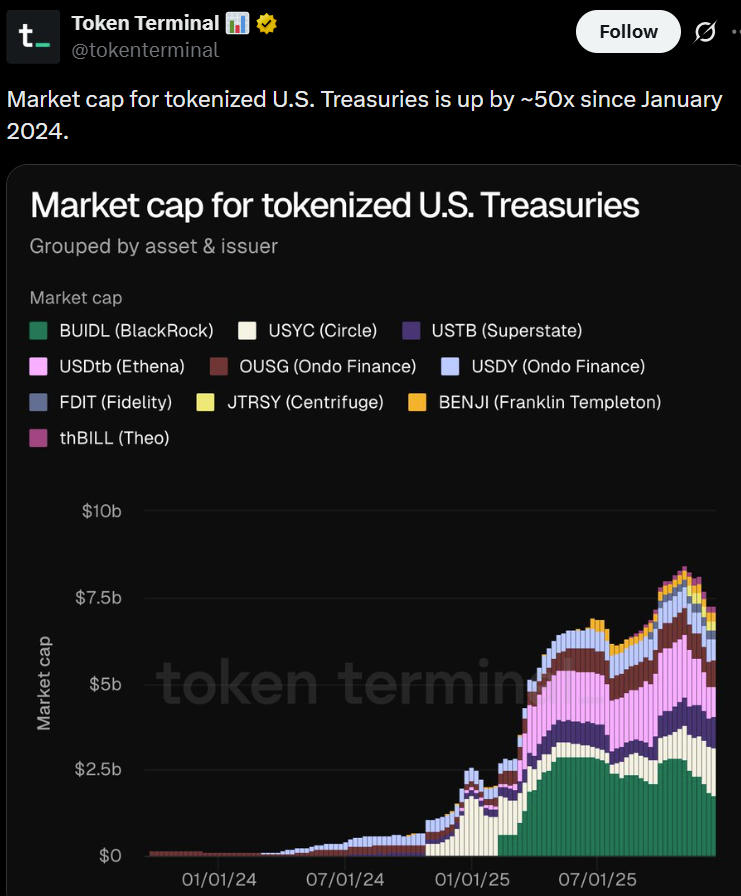
Source: Token Terminal

At the center of this expansion is BlackRock’s USD Institutional Digital Liquidity Fund (BUIDL), which is widely regarded as the flagship product of the tokenized Treasury market.

The blockchain-based fund provides investors with exposure to short-term US Treasurys while offering daily yield accrual and onchain settlement. Industry data shows that BUIDL has amassed close to $2 billion in assets under management.

Other prominent offerings include USD Coin Yield (USYC) from Circle, US Treasury Bill Token (USTB) from Superstate and Ondo Short-Term US Government Bond Fund (OUSG) from Ondo Finance.

Each product offers tokenized access to US government debt through regulated fund structures, reflecting a broader push to bring traditional fixed-income instruments onto blockchain rails.

Related: Goldman Sachs, BNY to offer tokenized money market funds for clients

Tokenized Treasury bills emerge as a key gateway to institutional DeFi

US Treasury bills are particularly well-suited for tokenization, as they combine the safety of US government backing with the efficiency of blockchain-based settlement, creating a regulated gateway into decentralized finance (DeFi) markets.

As Cointelegraph has reported, institutional adoption of tokenized Treasury bills is gaining traction, particularly for use in settlement and margining. Traditional financial institutions are using tokenized government debt to improve capital efficiency while maintaining exposure to low-risk assets.

DBS, Southeast Asia’s largest financial institution by assets, was among the first major lenders to test tokenized funds, including blockchain-based Treasury products. The bank has piloted tokenized money market funds and government securities as part of broader efforts to use onchain assets for collateral management and settlement.

Tokenized Treasury bills have grown in tandem with other onchain assets, contributing to the rapid evolution of the tokenization market. RedStone data shows that private credit has been the fastest-growing segment, buoyed by yields that exceed those of traditional investment vehicles.


Related: New protocol targets redemption delays in $20B tokenized market

Criptos en tendencia

Preguntas relacionadas

QWhat is the reported growth rate of the tokenized US Treasurys market since January 2024, according to Token Terminal?

AThe market has experienced 50x growth, surging from well under $200 million in January 2024 to almost $7 billion in late 2025.

QWhich fund is considered the flagship product of the tokenized Treasury market and how much in assets has it amassed?

ABlackRock’s USD Institutional Digital Liquidity Fund (BUIDL) is the flagship product, and it has amassed close to $2 billion in assets under management.

QName three other prominent tokenized US Treasury products mentioned besides BlackRock's BUIDL.

AThe other prominent products are USD Coin Yield (USYC) from Circle, US Treasury Bill Token (USTB) from Superstate, and Ondo Short-Term US Government Bond Fund (OUSG) from Ondo Finance.

QWhy are US Treasury bills described as being particularly well-suited for tokenization?

AThey combine the safety of US government backing with the efficiency of blockchain-based settlement, creating a regulated gateway into decentralized finance (DeFi) markets.

QWhich major Southeast Asian financial institution was mentioned as an early tester of tokenized funds, including Treasury products?

ADBS, Southeast Asia’s largest financial institution by assets, was among the first major lenders to test tokenized funds.

Lecturas Relacionadas

STRC Major De-pegging's First Financial Report, How Will Strategy Repair Its Capital Flywheel?

Bitcoin treasury company Strategy released its Q2 2026 earnings report on July 31. Despite a 6.9% year-over-year revenue increase to $122 million, the company recorded a net loss of $8.22 billion, largely due to $8.32 billion in unrealized losses from Bitcoin price fluctuations. As of quarter-end, Strategy holds 843,775 BTC with an average cost of $75,000 per coin, and Bitcoin per share increased. The report highlights a critical shift in Strategy's capital model following the de-pegging of its key financing tool, STRC (Strategic Coin), which fell below its $100 target. Management's top priority is restoring STRC to its target value, aiming for a recovery by September 8. They rule out discounted STRC issuances and plan to maintain its dividend yield at 12%, instead focusing on bolstering its $3.75 billion cash reserve. Strategy has moved from a one-way "buy-and-hold" Bitcoin strategy to active capital management. This new approach, part of its "Digital Credit Capital Framework," involves flexibly managing its balance sheet across four elements: BTC, USD cash, common stock (MSTR), and digital credit securities like STRC. This allows for BTC monetization (having sold $218.4 million in BTC so far), strategic repurchases of discounted securities, and debt optimization, as seen with a $1.5 billion convertible bond buyback. The company's future hinges on two key tests: successfully re-pegging STRC to restore market confidence in its digital credit system, and a long-term recovery in Bitcoin's price to ultimately support its growth thesis.

marsbitHace 36 min(s)

STRC Major De-pegging's First Financial Report, How Will Strategy Repair Its Capital Flywheel?

marsbitHace 36 min(s)

STRC's First Financial Report Post-Depegging, How is Strategy Restoring the Capital Flywheel?

On July 31, 2026, Bitcoin treasury company Strategy released its Q2 financial report. Despite a 6.9% year-over-year increase in revenue to $122 million, the company recorded a substantial net loss of $8.22 billion, primarily due to $8.32 billion in unrealized losses from Bitcoin holdings. While Strategy's core Bitcoin strategy remains intact—its holdings grew 11% to 843,775 BTC—the company is undergoing a fundamental shift in its capital model. Following the de-pegging of its key financing tool, the STRCoin (STRC), from its $100 target in May, Strategy has pivoted from a one-directional "raise funds, buy Bitcoin" cycle to a more dynamic, multi-asset capital management approach. A key part of this new framework is the "Monetization Program," through which Strategy has sold approximately $218.4 million worth of BTC to bolster liquidity. The company's top priority is repairing STRC's peg, committing not to issue discounted shares until it returns to its target range. It has initiated a $1 billion buyback program for discounted digital credit securities, having repurchased $28.9 million face value of STRC so far. Management aims to restore the peg around September 8, 2026. Strategy now actively manages a matrix of assets: Bitcoin (for accumulation or strategic sales), USD cash reserves (now at $3.75 billion), common stock (MSTR), and digital credit securities like STRC. This allows for tactical moves like repurchasing discounted debt or equity to capture value. The future success of Strategy's "capital flywheel" hinges on two factors: the short-term ability to successfully re-peg STRC to restore market confidence in its digital credit system, and the long-term price trajectory of Bitcoin, upon which its entire investment thesis ultimately depends.

Odaily星球日报Hace 41 min(s)

STRC's First Financial Report Post-Depegging, How is Strategy Restoring the Capital Flywheel?

Odaily星球日报Hace 41 min(s)

With Two Consecutive Quarters of Losses, Coinbase Must Rely on Paths Beyond Trading

Coinbase posted its second consecutive quarterly net loss of $359 million on $1.22 billion in revenue for Q2, highlighting its vulnerability to crypto market cycles where weaker prices and lower volatility reduce user trading. However, the report also reveals a strategic shift in its business model. Despite a 25% quarter-over-quarter decline in global spot trading volume, Coinbase increased its market share to a company-record 10.3%. This suggests its position as a compliant U.S. on-ramp is strengthening even in a cooler market. A key development is the diversification of revenue streams. Transaction revenue fell to $599 million, nearly equaling subscription and services revenue of $555 million. Stablecoin services, generating $292 million, are becoming a crucial revenue "floor." This income, derived from interest on the $20 billion average USDC balance held on its platform, is less tied to daily trading activity. Furthermore, while spot trading volume dropped significantly, derivatives volume held steady at $1.03 trillion. Coinbase is pushing to integrate spot, stablecoin, and derivatives liquidity to create a more interconnected and sticky ecosystem for users. The GAAP net loss includes non-cash expenses like stock-based compensation and crypto asset valuation changes. Its adjusted EBITDA remained positive at $208 million for the 14th straight quarter, indicating core operations can cover ongoing costs. The company is also reducing expenses to manage the downturn. The central question moving forward is whether Coinbase's growing market share, stablecoin revenues, and expanding product integration can sufficiently offset the inherent cyclicality of its core trading business during future market contractions.

marsbitHace 56 min(s)

With Two Consecutive Quarters of Losses, Coinbase Must Rely on Paths Beyond Trading

marsbitHace 56 min(s)

Trading

Spot

Artículos destacados

Cómo comprar US

¡Bienvenido a HTX.com! Hemos hecho que comprar Talus Network (US) sea simple y conveniente. Sigue nuestra guía paso a paso para iniciar tu viaje de criptos.Paso 1: crea tu cuenta HTXUtiliza tu correo electrónico o número de teléfono para registrarte y obtener una cuenta gratuita en HTX. Experimenta un proceso de registro sin complicaciones y desbloquea todas las funciones.Obtener mi cuentaPaso 2: ve a Comprar cripto y elige tu método de pagoTarjeta de crédito/débito: usa tu Visa o Mastercard para comprar Talus Network (US) al instante.Saldo: utiliza fondos del saldo de tu cuenta HTX para tradear sin problemas.Terceros: hemos agregado métodos de pago populares como Google Pay y Apple Pay para mejorar la comodidad.P2P: tradear directamente con otros usuarios en HTX.Over-the-Counter (OTC): ofrecemos servicios personalizados y tipos de cambio competitivos para los traders.Paso 3: guarda tu Talus Network (US)Después de comprar tu Talus Network (US), guárdalo en tu cuenta HTX. Alternativamente, puedes enviarlo a otro lugar mediante transferencia blockchain o utilizarlo para tradear otras criptomonedas.Paso 4: tradear Talus Network (US)Tradear fácilmente con Talus Network (US) en HTX's mercado spot. Simplemente accede a tu cuenta, selecciona tu par de trading, ejecuta tus trades y monitorea en tiempo real. Ofrecemos una experiencia fácil de usar tanto para principiantes como para traders experimentados.

602 Vistas totalesPublicado en 2025.12.11Actualizado en 2026.06.02

Cómo comprar US

Discusiones

Bienvenido a la comunidad de HTX. Aquí puedes mantenerte informado sobre los últimos desarrollos de la plataforma y acceder a análisis profesionales del mercado. A continuación se presentan las opiniones de los usuarios sobre el precio de US (US).

活动图片