Tokenization will disrupt finance faster than digital disrupted media: Crypto exec

cointelegraphPublicado a 2025-12-21Actualizado a 2025-12-21

Resumen

Tokenization will transform finance faster than digital technology disrupted media, according to MoonPay president Keith Grossman. He argues that real-world asset (RWA) tokenization will force traditional financial firms to adapt, citing examples like BlackRock and Franklin Templeton already offering tokenized funds. Major banks are also exploring onchain settlements. Grossman believes institutions that embrace this shift will succeed, while those resisting will fall behind. Benefits include 24/7 market access, global scalability, lower costs, and near-instant settlements. Regulatory progress, such as the SEC and CFTC working on round-the-clock market frameworks and the DTCC’s approval to launch tokenized U.S. Treasuries by 2026, signals accelerating adoption.

Tokenization will transform the financial industry faster than digital technology disrupted legacy media, such as print newspapers, physical copies of music and other analog formats, according to Keith Grossman, president of crypto payments company MoonPay.

“While many feared digitization would destroy media, what it actually did was force its evolution,” Grossman said, adding that real-world asset (RWA) tokenization, the process of representing traditional assets onchain, will force traditional institutions to adapt. He added:

“This is no longer hypothetical. BlackRock is offering tokenized funds. Franklin Templeton is running tokenized money market funds on public blockchains. Major global banks are piloting onchain settlement, tokenized deposits and real-time asset movement.”
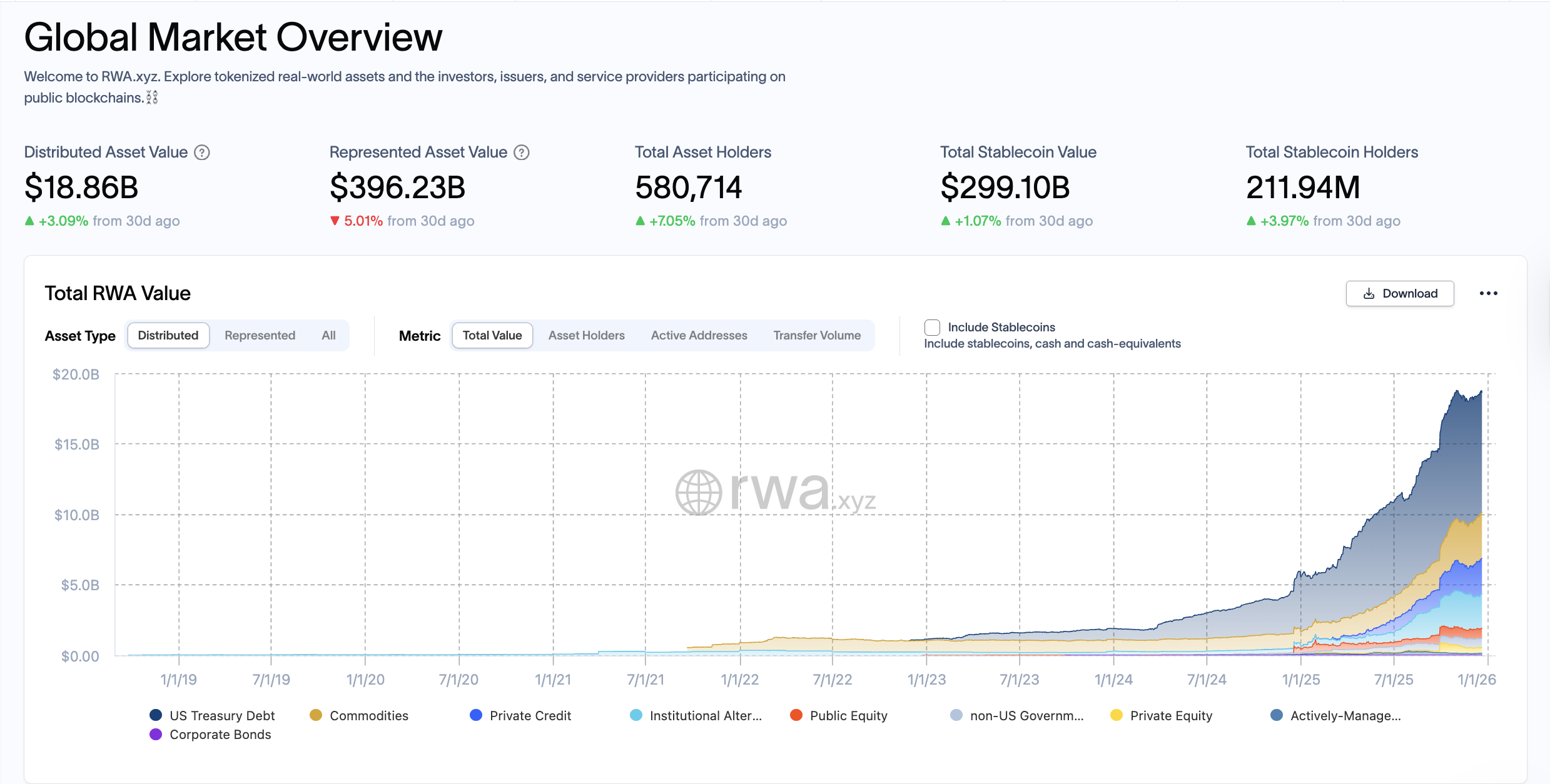
The market capitalization of the RWA sector, excluding stablecoins, is nearly $19 billion at the time of this writing. Source: RWA.XYZ

Financial incumbents like Citi, Bank of America, JPMorgan Chase and others will continue to exist in a different form, Grossman said, much like media companies continued to exist after the shift to digital distribution in the late 1990s and early 2000s, which disrupted business models that worked for decades.

Ultimately, the survivors and winners of the ongoing shift toward tokenized finance will be those companies that get ahead of the change and not those that attempt to stop the inevitable shift to a global financial system powered through blockchain rails, he said.

Related: Wall Street’s $4 quadrillion backbone to roll out tokenized US Treasurys

Why tokenized assets can change the game

Tokenizing real-world assets carries several benefits, including enabling 24/7 access to markets, making asset classes global in scale, cheaper transaction costs through disintermediation, and lowering settlement times to minutes, instead of days.

In September, the United States Securities and Exchange Commission (SEC) and the Commodity Futures Trading Commission (CFTC) issued a joint statement on creating a regulatory framework to enable 24/7 capital markets.
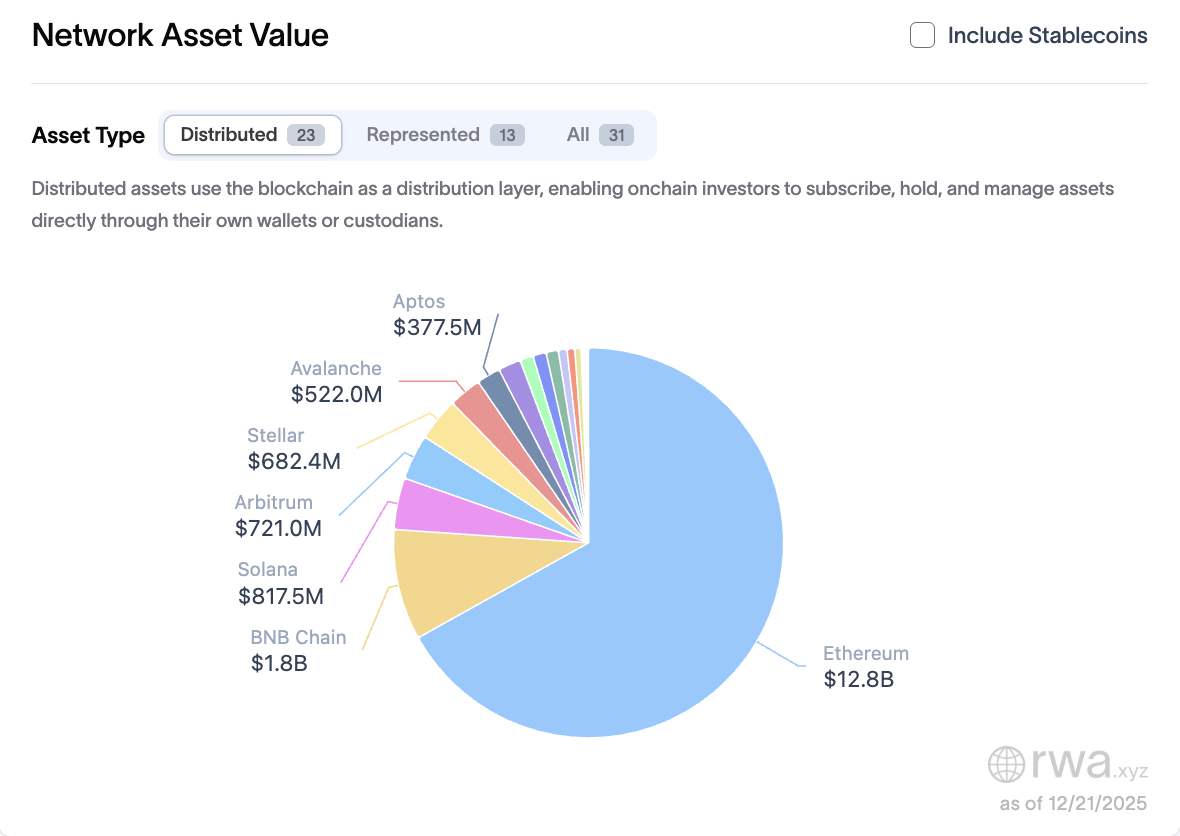
The overwhelming majority of tokenized RWA value has found its home on the Ethereum network. Source: RWA.XYZ

The financial system shifting to 24/7 trading represents a major departure from how traditional markets, which close on nights, weekends and holidays, currently operate.

In December, the Depository Trust and Clearing Corporation (DTCC), a settlement and clearing company that processed about $3.7 quadrillion in settlement volume in 2024, received approval from the SEC to start offering tokenized financial instruments.

The DTCC plans to roll out tokenized assets in the second half of 2026, starting with US Treasuries and stock indexes.

Magazine: Unstablecoins: Depegging, bank runs and other risks loom

Preguntas relacionadas

QAccording to Keith Grossman, how will tokenization impact the financial industry compared to digital technology's effect on media?

AKeith Grossman believes that tokenization will transform the financial industry faster than digital technology disrupted legacy media, such as print newspapers and physical music copies.

QWhat are some examples of major financial institutions already involved in tokenization, as mentioned in the article?

ABlackRock is offering tokenized funds, Franklin Templeton is running tokenized money market funds on public blockchains, and major global banks are piloting onchain settlement, tokenized deposits, and real-time asset movement.

QWhat key benefits does tokenizing real-world assets provide, according to the article?

ATokenizing real-world assets enables 24/7 access to markets, makes asset classes global, reduces transaction costs through disintermediation, and lowers settlement times to minutes instead of days.

QWhich organization, responsible for processing about $3.7 quadrillion in settlement volume in 2024, received SEC approval to offer tokenized financial instruments?

AThe Depository Trust and Clearing Corporation (DTCC) received approval from the SEC to start offering tokenized financial instruments.

QOn which blockchain network is the overwhelming majority of tokenized RWA value located, as per the article?

AThe overwhelming majority of tokenized RWA value is on the Ethereum network.

Lecturas Relacionadas

Why Bitcoin Holds Above $64,000 After Fed's Hard Pause

**Bitcoin Stabilizes Near $64,000 Following Hawkish Fed Pause** The cryptocurrency market, led by Bitcoin, remained stable around $64,000 despite a volatile reaction to the latest U.S. Federal Reserve meeting. The Fed paused interest rates but signaled a hawkish stance, with three committee members voting for an increase—the highest dissent since 2016. This limits risk appetite but hasn't triggered panic selling. Key market highlights include Bitcoin ETFs seeing a net inflow of $32.1 million, breaking a streak of outflows, while Ethereum ETFs experienced outflows of $18.65 million. Liquidations affected about 90,000 traders. Technically, Bitcoin finds support around $63,000-$63,500, with major resistance near $66,000. While its price is about 49% below its all-time high, institutional demand via ETFs and the absence of mass capitulation support a potential recovery scenario in the second half of the year. Major altcoins showed mixed movements, with Solana attracting capital while Ethereum faced selling pressure despite strong on-chain metrics like a growing staking queue. Regulatory news took a pause as the U.S. Senate delayed the CLARITY Act vote until at least autumn. For the final trading day of July, U.S. inflation and consumer spending data will be crucial. Bitcoin's key levels to watch are $63,000 support and $66,000 resistance. Sustained ETF inflows and Bitcoin holding above $63,000 are seen as positive signs for a potential market recovery later in the year.

cryptonews.ruHace 41 min(s)

Why Bitcoin Holds Above $64,000 After Fed's Hard Pause

cryptonews.ruHace 41 min(s)

Participants in XRP Fraud Scheme That Stole $9 Million from 71 Investors Arrested

South Korean police have arrested three individuals accused of operating a fraudulent investment platform that stole approximately 3.4 million XRP (worth about $9 million) from 71 investors between October 16 and 23. The suspects promoted the site Fxrpntwork.com through blogs, online articles, and YouTube videos, promising guaranteed principal and monthly returns of 1.5% to 1.8%. Investors were instructed to transfer XRP from Korean exchanges to overseas platforms and then to wallets controlled by the group before the site was shut down. The scammers copied the branding of legitimate projects Flare Network and FXRP to appear credible. Authorities warn that such impersonation frauds, which use familiar branding and urgent promises of guaranteed profits, are a common red flag. Legitimate companies do not solicit cryptocurrency transfers through unsolicited promotions. Seoul police have issued an Interpol Red Notice for a fourth suspect abroad and are investigating others involved in creating and promoting the fraudulent website. While investigators froze 17.3 billion won in assets, approximately 10 billion won was moved during the probe, with wallet analysis revealing transfers totaling 27.3 billion won, suggesting there may be additional unidentified victims and accomplices. The case underscores the organized, cross-border nature of crypto investment fraud.

cryptonews.ruHace 44 min(s)

Participants in XRP Fraud Scheme That Stole $9 Million from 71 Investors Arrested

cryptonews.ruHace 44 min(s)

Trading

Spot
活动图片





