Author:angelilu,Foresight News
Originally Published on June 2nd
Vitalik wrote an article in May this year supporting The Interfold, a confidential coordination infrastructure. Its token FOLD will officially start auctioning today (July 8th) at 22:00 via the Uniswap CCA (Continuous Commitment Auction) mechanism, lasting for 48 hours until July 10th.
FOLD is the functional token of The Interfold: Ciphernodes can use it to stake and join the network and receive rewards, applications can use it to pay for encrypted computation requests, and holders can participate in protocol governance.
This auction adopts a uniform clearing price mechanism, where all successful bidders transact at the same price. Portions of bids exceeding the clearing price can be withdrawn for rebidding. Participation in the auction requires KYC verification via Predicate, and the pre-registration window closed yesterday. After the auction, there is a 40-day cooling period, during which FOLD can only be used for Ciphernode staking and cannot be freely transferred. The official TGE is expected on August 19th.
Below is the original article:
On-chain voting is one of the most attractive aspects of decentralized protocols—transparent, open, and accessible to anyone. But openness does not guarantee it fully represents community consensus. The existence of 'governance bribery markets' like Votium allows anyone with sufficient funds to directly bid to voters before the voting deadline. The result is: the direction of a protocol is often not decided by community consensus, but by the highest bidder.
A protocol called The Interfold has chosen to tackle this problem at its root.
Confidential Coordination Infrastructure
The Interfold (formerly known as Enclave) positions itself as a 'confidential coordination infrastructure,' aiming to allow multiple independent participants to jointly produce a verifiable result without exposing their respective input data.
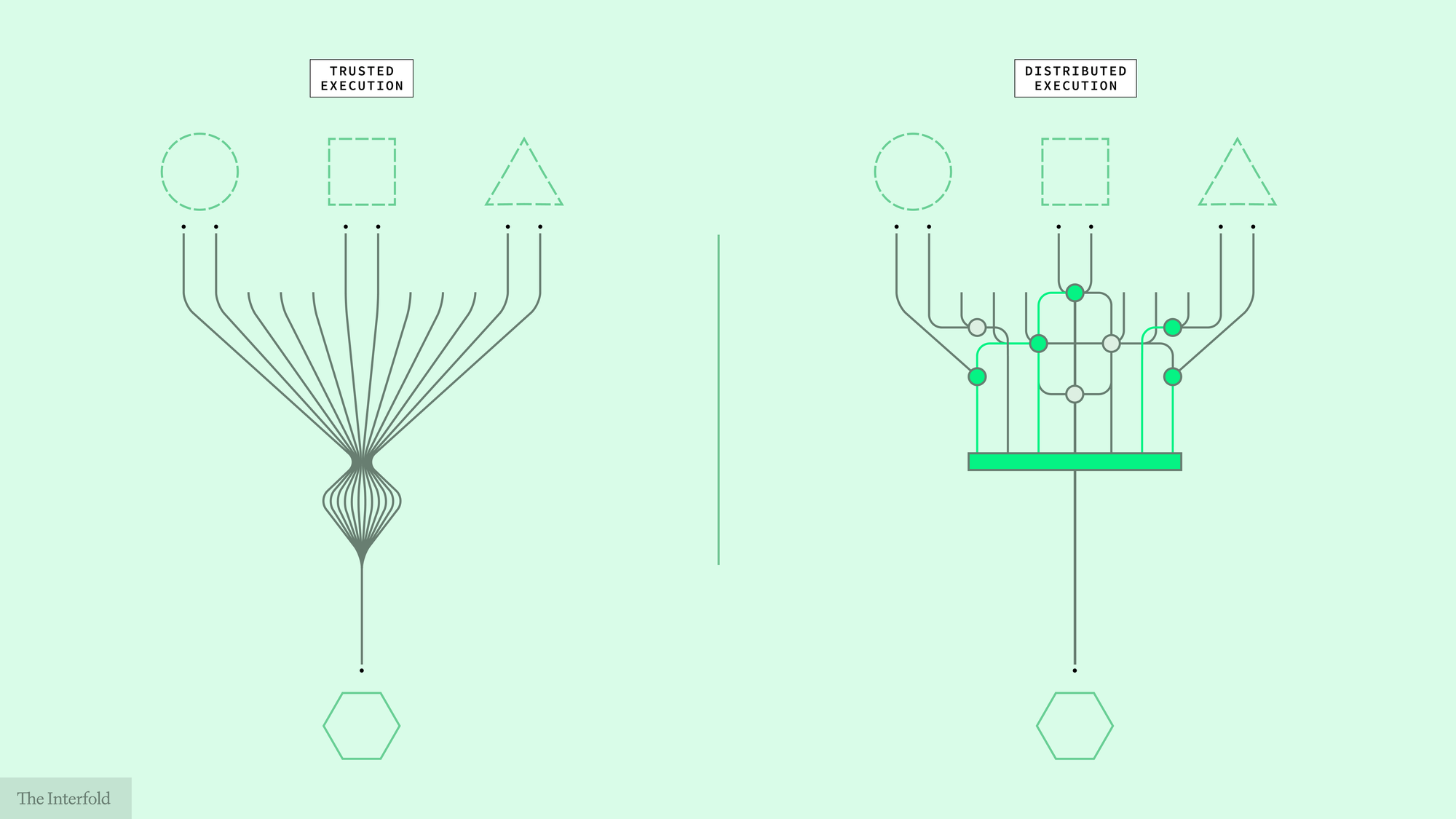
The core concept of The Interfold is E3 (Encrypted Execution Environment). Its principle is: computation tasks are assigned to a distributed network of 'Ciphernodes': user input always remains encrypted, computations are performed directly on ciphertext, and finally, only the aggregated result is decrypted and made public. No party can see anyone else's original data throughout the entire process.
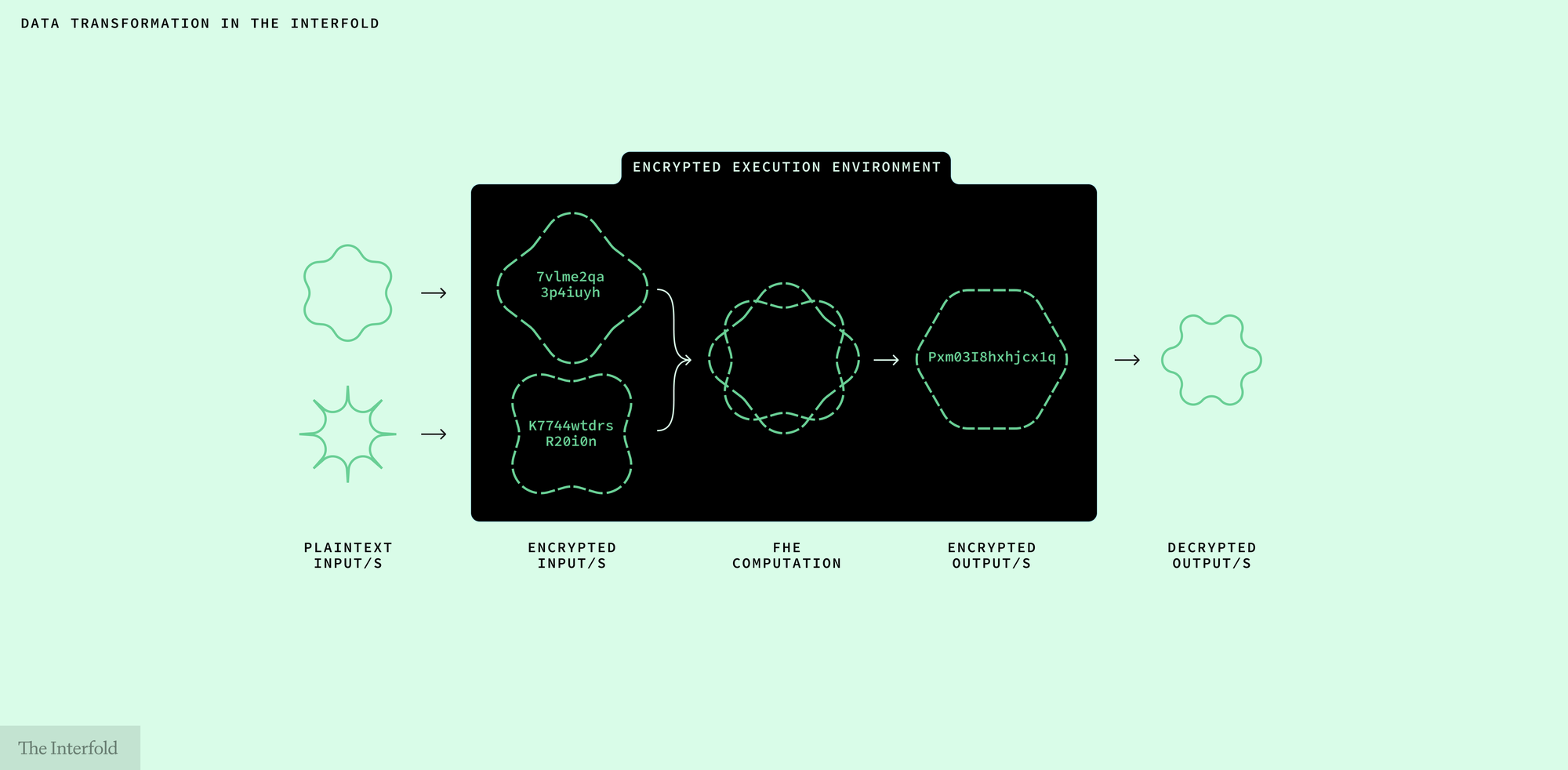
The technology stack supporting this mechanism consists of three layers: FHE (Fully Homomorphic Encryption) allows computations directly on encrypted data; ZK proofs (Zero-Knowledge proofs) verify whether the computation process itself was executed honestly; and DTC (Decentralized Threshold Cryptography) distributes decryption authority across multiple nodes, eliminating single points of trust.
The Interfold's currently promoted application scenario is CRISP (Coercion-Resistant Impartial Selection Protocol), designed for voting scenarios within DAO governance. CRISP achieves three things: the entire voting process is encrypted, and no one can view individual votes before the tally; 'receipt-free voting,' where users cannot prove to a third party how they voted, fundamentally cutting off bribery paths; and ZK proofs ensure the verifiability of tally results.
Two demo versions of CRISP are already live, with the team currently in the system integration and internal testnet validation phase. Confirmed ecosystem partnerships include: Zcash community's private governance tool Zecret Ballots, mobile DAO governance application Goverland, and joint integrations with Aragon and Status App.
Vitalik's Public Endorsement
On-chain governance bribery is not a new problem, but its measurable scale has rapidly expanded since 2024. Within the Curve ecosystem alone, the total value of bribes flowing through platforms like Votium exceeded $120 million in 2024; meanwhile, the median voter participation rate for various DAO proposals remains in the single digits.
The Ethereum community has not been unaware of this issue. In 2019, Vitalik posted a research note on ethresear.ch, proposing the conceptual framework of MACI (Minimal Anti-Collusion Infrastructure), envisioning the use of cryptographic means to eliminate voting bribery. This post has since been frequently cited, but practical implementation progress has been limited—the MACI scheme relies on a trusted 'Coordinator' role, who can see all votes. Once data is leaked, privacy guarantees immediately fail.
On May 28th, 2026, Vitalik publicly endorsed The Interfold on the X platform, stating: 'It basically is the thing I've been yelling for almost a decade for someone to build, and it's now built in a generalized way.'
The Interfold's core bet is: a single trusted coordinator is the fundamental bottleneck of MACI, and distributed threshold decryption is the correct path.
Team Background
The Interfold is developed by Gnosis Guild, a team with long-term expertise in Ethereum DAO infrastructure, previously well-known for its modular DAO toolset Zodiac. Zodiac is one of the most widely used permission and execution frameworks in the Ethereum DAO ecosystem, with partners covering several leading protocols. Specific core member names have not been publicly disclosed through official channels. The project also has no publicly disclosed institutional funding records.
Compared to larger-scale general-purpose privacy protocols like Aztec and Zama, The Interfold is a 'small but beautiful' project. It does not attempt to become a general-purpose privacy infrastructure; instead, it focuses on a specific, long-unresolved problem—making on-chain votes truly un-purchasable. The ambition may not be vast, but the target is precise.
From MACI to The Interfold
The conceptual framework of MACI (Minimal Anti-Collusion Infrastructure), proposed by Vitalik in 2019, has seen deployment in scenarios like Gitcoin but always had a structural flaw: it required a trusted coordinator, and if its private key were leaked, the entire privacy guarantee would fail. The Interfold is a generalized implementation of this framework—replacing a single coordinator with a distributed network of Ciphernodes, turning 'trust in a person' into 'trust in cryptography.'