This Investor Day, SanDisk's 'Stunning Numbers' Shook the Market

marsbitPublicado a 2026-08-14Actualizado a 2026-08-14

Resumen

SanDisk's Investor Day Shocks Market with "Explosive" Long-Term Targets SanDisk stunned the market at its 2026 Investor Day by unveiling an extremely aggressive long-term financial model. The company targets **mid-to-high double-digit revenue growth** for fiscal years 2028-2030. More impressively, it forecasts non-GAAP gross margins of approximately **80%** and operating margins around **75%** during that period, with an adjusted free cash flow margin of about 50%. A key strategic shift is SanDisk's focus on profitability over sheer output volume. The company clarified it will **flexibly adjust salable bit output based on profit optimization needs**, not simply chase bit shipment growth. This approach aims to avoid oversupply, especially during technology node transitions. SanDisk also committed to returning **100% of excess cash to shareholders** after funding business growth. Confidence in these targets is bolstered by new business model (NBM) agreements with eight major clients, covering roughly **50% of FY2027 and two-thirds of FY2028 bit shipments**, aiming to reduce cyclical volatility. The company sees massive tailwinds from AI, particularly the shift from training to inference, which is reshaping data center memory hierarchies. It estimates the enterprise flash TAM could reach **1.2 zettabytes by 2030**. SanDisk is advancing technologies like its CMOS Bonded Array (CBA) strategy and High Bandwidth Flash (HBF) for AI inference workloads. The announcement triggered...

Original Author: Li Dan

Original Source: Wall Street News

While AI inference demand continues to drive up storage needs, SanDisk has presented extremely aggressive long-term financial targets.

On Thursday, Eastern Time the 13th, SanDisk unveiled its long-term financial model at the 2026 Investor Day, outlining a series of financial goals to be achieved between fiscal years 2028 and 2030. This includes maintaining mid-to-high double-digit revenue growth during this period. SanDisk also clarified market doubts regarding bit growth, stating that the quantity of bits available for sale will be adjusted based on profitability optimization needs, while committing to return 100% of excess cash to shareholders after completing business investments.

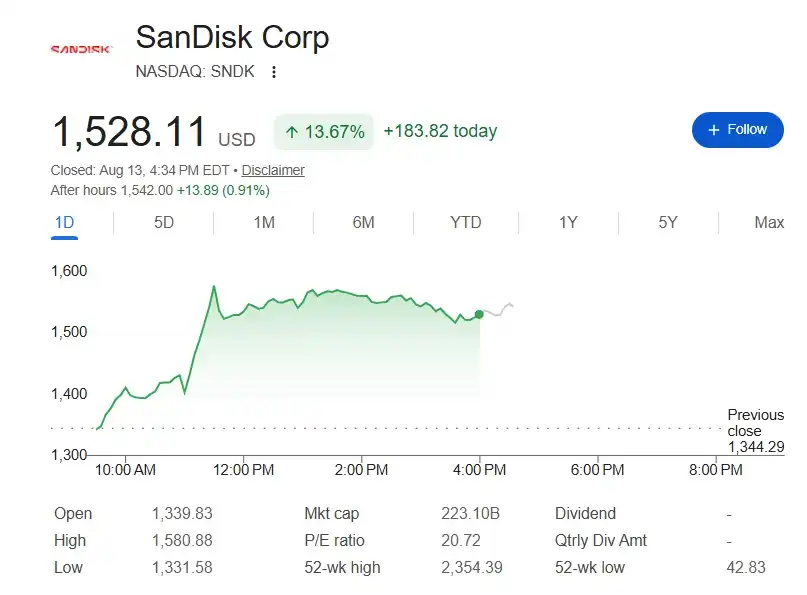
The market quickly voted with its share price following the announcement. SanDisk (SNDK) saw its intraday gain expand to 17.6% on Thursday; the storage sector also strengthened. By the close, SanDisk gained nearly 14%, SK Hynix and Western Digital rose over 7%, Seagate Technology increased nearly 5%, and Micron Technology gained over 4%.
FY2028-30 Goals: Gross Margin 80%, Operating Margin 75%

The long-term financial model presented by SanDisk was undoubtedly the most closely watched aspect of this Investor Day.

The company forecasts that between fiscal years 2028 and 2030, revenue will maintain mid-to-high double-digit growth, matching the pace of bit shipment growth. Simultaneously, on a non-GAAP basis, the gross margin is expected to remain around 80%, and the operating margin around 75%.

The concept of fiscal year timing here requires special attention. SanDisk's fiscal year does not align with the calendar year; its fiscal year ends on the Friday closest to June 30, typically spanning 52 weeks. Fiscal year 2026, the previous fiscal year, ended on July 3, 2026. Early July 2026 has already entered fiscal year 2027. Therefore, the announced period of fiscal years 2028 to 2030 refers not to calendar years 2028 to 2030, but to the future three-fiscal-year period starting around July 2027.

Under this financial model, SanDisk expects operating expenses to account for approximately 5% of revenue, with other income and expenses not having a significant impact. Even after accounting for taxes, capital expenditures, and the working capital required to support business growth, the company still anticipates an adjusted free cash flow margin of around 50%.

For the historically highly cyclical NAND storage industry, this set of targets is particularly aggressive. SanDisk is essentially sending a clear message to the market: AI-driven storage demand growth has the potential to keep the company's revenue growth and profitability at levels far above the traditional storage cycle average for years to come.

Not Blindly Chasing 'Bit Quantity': SanDisk to Flexibly Adjust Salable Production Based on Profitability

Another important signal released by SanDisk is that the company does not plan to simply pursue expanding bit shipments as a growth target, but will actively adjust the quantity of bits available for sale based on profitability.

The market had previously focused on SanDisk's bit growth guidance for FY2027: the company expects input bit growth to reach mid-to-high double digits, while the growth of output bits available for sale might be lower than this level. At the Investor Day, management further clarified that this does not mean the company lacks the capacity to expand output.

According to Lynx Equity Strategies analyst KC Rajkumar's interpretation of management's statements, SanDisk CEO David Goeckeler clearly stated that the long-term input bit growth target is mid-to-high double digits, but the quantity of bits available for sale will be flexibly adjusted based on the need to optimize profitability. In some periods, the actual output bit growth may even exceed mid-to-high double digits.

This signifies that SanDisk places more importance on 'how much money can be made per bit' rather than simply pursuing 'how many bits can be sold.'

Especially during NAND technology node transitions, the company will selectively cut wafer output to avoid an oversupply situation caused by too rapid an increase in bit density brought by new technologies.

Rajkumar points out that each NAND technology node transition at SanDisk brings an average of approximately 54% bit growth. Therefore, if the company were to fully release the new capacity brought by technological upgrades, it could easily recreate a situation of oversupply. By proactively reducing wafer output during node transitions, SanDisk can control the quantity of bits entering the market, thereby better maintaining prices, profit margins, and capital efficiency.

This approach also explains why SanDisk dares to set a long-term gross margin target of around 80%: the bit density increase brought by technological progress does not necessarily have to translate entirely into supply growth; the company can proactively 'hit the brakes,' converting part of the technological dividend into profitability.

Returning More 'Earned Money' to Shareholders: 100% of Excess Cash for Buybacks or Dividends

In addition to revenue and margin targets, SanDisk also gave a very clear capital return commitment.

SanDisk CFO Luis Visoso stated that after completing the investments needed to support business growth, the company expects to return 100% of excess cash to shareholders.

This means SanDisk's future capital allocation framework will revolve around three main lines: first, investing in business and technology to support growth; second, maintaining strong free cash flow generation capability; and finally, returning as much remaining cash as possible to shareholders.

An adjusted free cash flow margin of around 50% implies that if the long-term financial model is realized, SanDisk's future cash generation ability will be very strong, which is also a key reason the market is willing to assign it a higher valuation.

Long-Term Agreements with Eight Major Clients, Covering About Two-Thirds of FY2028 Bit Shipments

One of the key reasons for SanDisk's strong confidence in the above long-term financial model is that the company is changing the traditional NAND industry business model.

The company disclosed that it has currently signed New Business Model (NBM) agreements with 8 clients. These agreements include committed purchase volumes, binding contract frameworks, minimum financial guarantees, and structured pricing mechanisms. They can strengthen the alignment between customer demand and the company's capacity planning and reduce the impact of the traditional storage industry's cyclical volatility.

More importantly, the scale covered by these agreements is already substantial: the currently signed NBM agreements cover approximately 50% of FY2027 bit shipments and about two-thirds of FY2028 bit shipments.

SanDisk believes this model can lead to more predictable revenue, higher cash flow visibility, and more sustainable profit growth.

In other words, SanDisk is not only betting on the storage demand growth driven by AI but also attempting to partially transform the strong cyclical nature of traditional NAND business into more stable and predictable revenue and cash flow through long-term agreements.

AI Inference Spurs Larger Storage Market, Enterprise Flash TAM Expected to Reach 1.2 ZB by 2030

Another major support for SanDisk's high-growth outlook over the next three years is the new demands placed on storage infrastructure as AI expands from training to inference.

SanDisk estimates that the flash memory market could grow from a historical annual revenue base of $60 billion to over $300 billion in 2026 and approach $500 billion in 2027.
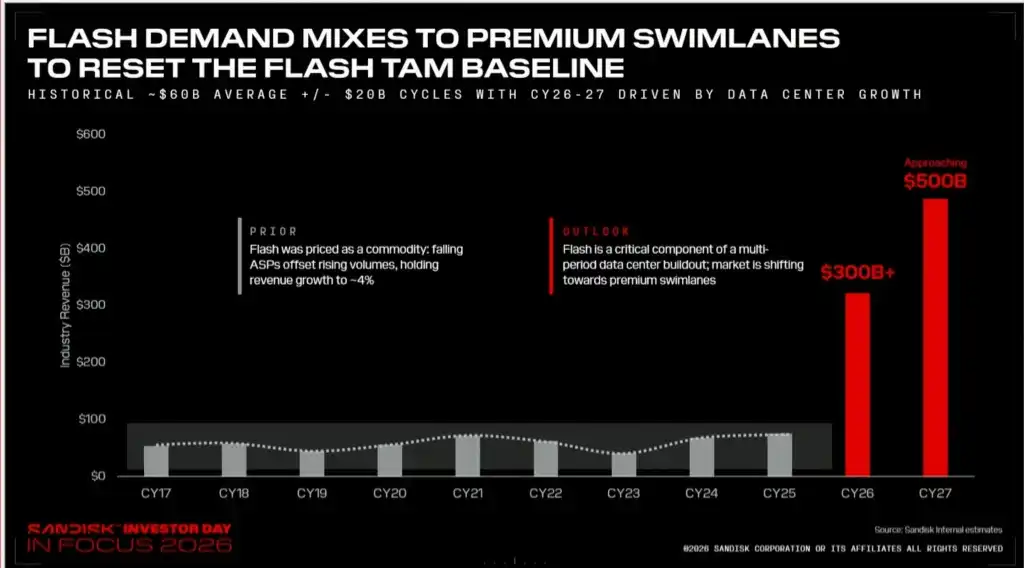
The company stated that AI inference workloads are driving rapid growth in Token usage, and KV Cache is reshaping the memory hierarchy in data centers. As AI inference scales, AI data centers will become increasingly dependent on storage. SanDisk expects that the Total Addressable Market (TAM) for flash memory in enterprise data centers will reach 1.2 Zettabytes (ZB) by 2030.

On the technical front, SanDisk is advancing a two-dimensional scaling strategy based on CMOS Direct Bond Array (CBA) to more flexibly develop customized products that meet the needs of different markets while improving capital efficiency.

The company's latest BiCS9 QLC technology is the first example of this strategy. This technology combines the BiCS8 array with a CMOS wafer based on BiCS10; meanwhile, the new BiCS10 QLC node achieves a 60% increase in bit density compared to BiCS8.

Betting on AI Inference with HBF, Storage Sector Rallies

SanDisk is also advancing a new High-Bandwidth Flash (HBF) technology for AI inference. The company stated that HBF is becoming a key technological solution to meet the storage demands of the AI inference era, and the related industry ecosystem is also forming.

From the market's perspective, this means SanDisk's AI storage logic is no longer limited to 'AI data centers need more SSDs' but has further extended to the demand for higher performance, lower power consumption, and higher storage density inherent to AI inference architecture itself.

This expectation also quickly spread across the entire storage sector. SanDisk's own rally was more pronounced: after announcing its long-term financial targets, its stock price once surged nearly 18% intraday. So far this year, SanDisk's stock price has accumulated a gain of over 530%.

However, SanDisk also emphasized that the aforementioned long-term financial targets are forward-looking indicators based on a series of estimates and assumptions. Actual results may still be affected by factors such as demand, average selling prices, competition, technological iteration, supply chains, and storage industry cycles.


Criptos en tendencia

Preguntas relacionadas

QWhat were the key long-term financial targets that SanDisk announced at its Investor Day, and for which fiscal years?

ASanDisk announced long-term financial targets for fiscal years 2028 to 2030, including revenue growth in the mid-to-high double digits, a non-GAAP gross margin of approximately 80%, and an operating margin of around 75%.

QAccording to the article, how does SanDisk plan to manage its bit output, and what is the strategic reason behind this approach?

ASanDisk plans to actively manage and adjust the number of sellable bits based on profitability optimization needs, rather than focusing solely on increasing bit shipment volume. This approach is to control market supply, maintain pricing and margins, and improve capital efficiency, especially during NAND technology node transitions.

QWhat capital return commitment did SanDisk make to its shareholders?

ASanDisk's CFO, Luis Visoso, stated that after making the necessary investments to support business growth, the company intends to return 100% of its excess cash to shareholders.

QWhat is the significance of SanDisk's new business model (NBM) agreements with customers, and what coverage do they have?

AThe New Business Model (NBM) agreements include commitments on purchase volumes, binding contractual frameworks, minimum financial guarantees, and structured pricing. They are significant as they help align customer demand with SanDisk's capacity planning and reduce the impact of traditional storage industry cyclicality. These agreements currently cover about 50% of bit shipments for FY2027 and approximately two-thirds for FY2028.

QWhat major market trend is SanDisk citing as a key driver for its future growth, and what is its related market size prediction?

ASanDisk cites the expansion of AI from training to inference as a major driver, which creates new demands for storage infrastructure like higher performance and density. The company estimates the enterprise datacenter flash Total Addressable Market (TAM) will reach 1.2 Zettabytes (ZB) by 2030.

Lecturas Relacionadas

Is RWA Still Meaningful Without DeFi?

The article "Would RWA Still Matter Without DeFi?" argues that tokenizing real-world assets (RWA) alone, like putting a barcode on a container, is not transformative. True value emerges when these tokenized assets are integrated into decentralized finance (DeFi) ecosystems, enabling valuation, financing, hedging, trading, and loss management in a programmable, automated manner. Tokenization provides digital representation, but DeFi provides utility through leverage, liquidity, and composability. The core challenge lies in aligning the different "time clocks" of blockchain (fast, 24/7), traditional markets (limited hours), and asset redemption (slow processes), which creates liquidation risks and gaps. Effective RWA integration requires more than a token; it needs a full stack: legally enforceable rights, reliable data oracles, clear transfer rules, executable secondary liquidity, appropriate collateral parameters, and credible loss resolution paths. Liquidity is defined not by total value locked (TVL) but by the ability to exit a position under stress within a required timeframe. Risk management for RWAs must be modeled as a dependency graph, monitoring interconnected nodes like issuers, custodians, oracles, and liquidity pools for early warning signs beyond just price data. While tokenized government bonds serve as an initial "ping test," the future lies in more complex assets like computing power and energy, which require bespoke risk models. Tokenized stocks paired with perpetual futures present a major test, combining global equity ownership with crypto-native leverage, necessitating robust architectural safeguards like isolation and dynamic collateral rules. The conclusion is that without DeFi, RWA tokenization offers limited value—improving distribution and transparency. The significant opportunity arises when tokenized assets become functional components within open, programmable capital markets, where they can be used as collateral and facilitate complex financial strategies. The token is merely the barcode; the market operating system is the real machine.

marsbitHace 10 min(s)

Is RWA Still Meaningful Without DeFi?

marsbitHace 10 min(s)

Government Intervention in the Bond Market: What Does It Mean?

On August 19, 2026, the U.S. Treasury unexpectedly announced it would at least double the size of its long-term Treasury buyback operations, starting September 9. The move triggered an immediate market reaction, with the 30-year yield falling 9 basis points. This intervention came against a backdrop of the 30-year yield hitting a 19-year high of 5.34% the previous day, driven by persistent inflation, high oil prices, deteriorating U.S. fiscal health with public debt surpassing $40 trillion, and a global "buyers' strike" for long-dated bonds. Treasury buybacks involve the government repurchasing older, less liquid bonds from the market via reverse auctions to improve market functioning, not to reduce overall debt. While the action provided tactical relief and signaled the Treasury's willingness to intervene, analysts caution it does not address core structural issues: massive fiscal deficits, high borrowing needs, and fading demand from traditional buyers like foreign central banks. For investors, the announcement offered short-term support for long-duration bond ETFs and boosted assets like gold, which rose 2.7%. However, it's unlikely to significantly lower mortgage rates or alter the challenging environment for long-term bonds. The key takeaway is the distinction between a tactical market operation and the unresolved structural pressures that continue to push yields higher, requiring close monitoring of upcoming economic data, Treasury auctions, and potential signals of more aggressive policy measures.

marsbitHace 14 min(s)

Government Intervention in the Bond Market: What Does It Mean?

marsbitHace 14 min(s)

After 'Bessent Put', How Far Is the U.S. from Restarting QE?

Following an unscheduled announcement from the U.S. Treasury Department on August 19th, investor discussions have intensified regarding the potential for future policy interventions in long-term bond markets. The Treasury increased the maximum size of its regular buyback operations for 10-to-30 year bonds from $2 billion to $4 billion, citing a desire to improve liquidity. This move came shortly after a surge in long-term yields, with the 30-year Treasury yield briefly touching 5.34%. Market analysts, rather than focusing on the modest operational size, have interpreted the timing—outside the normal quarterly communication window—as a significant signal. The move has been dubbed the "Bessent Put," implying the market's growing expectation that Treasury officials, led by Deputy Secretary Josh Bessent, may act to prevent a disorderly rise in long-term borrowing costs. This perception represents a potential shift in the market's view of the government's "policy reaction function." The underlying pressures on long-term bonds are multifaceted, including large fiscal deficits, increased Treasury supply, a rise in corporate debt issuance for AI infrastructure (creating a "crowding out" effect), and uncertainty around foreign holdings, particularly from Japan. Geopolitical risks in the Middle East further complicate the policy landscape, potentially creating conflicting pressures between fighting inflation and managing financing costs. However, the article clarifies that this Treasury buyback program is distinct from Quantitative Easing (QE). It is a debt management operation, not a Federal Reserve balance sheet expansion. While the announcement opens the door for market speculation about more forceful tools like Yield Curve Control (YCC) or a return to QE, analysts note that conditions would need to deteriorate significantly for such measures to be implemented. For now, the "Bessent Put" reflects a change in market expectations about possible policy boundaries, not an imminent launch of new monetary stimulus.

marsbitHace 14 min(s)

After 'Bessent Put', How Far Is the U.S. from Restarting QE?

marsbitHace 14 min(s)

Is Stablecoin Really Necessary for Cross-border Payments?

"Is Stablecoin Truly Necessary for Cross-Border Payments? While stablecoins are often praised as superior for cross-border transfers—especially if the recipient desires crypto—their advantage is less clear in traditional cross-currency scenarios (e.g., USD to Mexican Peso). The existing correspondent banking system is slow and costly (≈15% fees) due to multiple intermediaries. Modern fintech solutions like Wise have dramatically improved this by using a netting model: they hold local currency pools and settle payments domestically, avoiding actual cross-border fund movement. This offers near-instant transfers with low, transparent fees (averaging ~0.52%). The 'stablecoin sandwich' model (convert fiat to stablecoin, transfer on-chain, convert to local fiat) offers similar user experience but doesn't inherently provide major cost or speed advantages over fintech. Its on-chain transfer is cheap, but fiat conversion spreads remain. Stablecoin's real innovation is 'unbundling' the cross-border payment stack. Instead of requiring a proprietary global network like Wise, businesses only need reliable on- and off-ramps in specific corridors. This lowers market entry barriers, fosters competition among local providers, and can drive down costs, particularly for niche or underserved corridors (e.g., US to Africa). While vertical integration may reoccur, the open, permissionless nature of the underlying blockchain layer makes monopolistic pricing difficult. The long-term benefit is the potential redistribution of value—previously captured as intermediary rents—to consumers through lower costs."

marsbitHace 18 min(s)

Is Stablecoin Really Necessary for Cross-border Payments?

marsbitHace 18 min(s)

Ethereum Finally 'Bounces Back'! ETH Returns to the Golden Line, What's Different About This Rally?

Ethereum has surged above $2,300, a level not seen in over three months, marking a significant recovery and technical breakthrough by reclaiming key resistance levels, including the weekly EMA50 for the first time in the current bear market. The rally has been fueled by a combination of factors: improved market risk appetite, positive regulatory sentiment, and a major short squeeze where over 88% of recent ETH liquidations were short positions. The ETH/BTC ratio has also broken its long-term downtrend, indicating renewed strength for Ethereum relative to Bitcoin. Fundamentally, Ethereum spot ETFs have shown strong inflows, outperforming their Bitcoin counterparts in recent months. Wall Street institutions like Morgan Stanley and JPMorgan have notably increased their ETH exposure, while several banks have added or expanded positions in ETH ETFs. On-chain fundamentals remain robust, with the proportion of staked ETH reaching a new all-time high of nearly 33.7%. Data indicates long-term holding sentiment, as small wallet holdings increased while large outflows were often directed towards staking or contracts, not selling. However, potential headwinds include declining staking yields and community debate over proposals to adjust staking rewards at high participation levels. The upcoming Glamsterdam upgrade, featuring improvements to validator exit efficiency, could enhance liquidity and further attract institutional stakers. While the rebound is supported by sentiment, capital flows, and fundamentals, its sustainability hinges on continued positive developments.

marsbitHace 18 min(s)

Ethereum Finally 'Bounces Back'! ETH Returns to the Golden Line, What's Different About This Rally?

marsbitHace 18 min(s)

Trading

Spot

Artículos destacados

Qué es $S$

Entendiendo SPERO: Una Visión General Completa Introducción a SPERO A medida que el panorama de la innovación continúa evolucionando, la aparición de tecnologías web3 y proyectos de criptomonedas juega un papel fundamental en la configuración del futuro digital. Un proyecto que ha atraído la atención en este campo dinámico es SPERO, denotado como SPERO,$$s$. Este artículo tiene como objetivo reunir y presentar información detallada sobre SPERO, para ayudar a entusiastas e inversores a comprender sus fundamentos, objetivos e innovaciones dentro de los dominios web3 y cripto. ¿Qué es SPERO,$$s$? SPERO,$$s$ es un proyecto único dentro del espacio cripto que busca aprovechar los principios de descentralización y tecnología blockchain para crear un ecosistema que promueva la participación, la utilidad y la inclusión financiera. El proyecto está diseñado para facilitar interacciones de igual a igual de nuevas maneras, proporcionando a los usuarios soluciones y servicios financieros innovadores. En su esencia, SPERO,$$s$ tiene como objetivo empoderar a los individuos al proporcionar herramientas y plataformas que mejoren la experiencia del usuario en el espacio de las criptomonedas. Esto incluye habilitar métodos de transacción más flexibles, fomentar iniciativas impulsadas por la comunidad y crear caminos para oportunidades financieras a través de aplicaciones descentralizadas (dApps). La visión subyacente de SPERO,$$s$ gira en torno a la inclusividad, buscando cerrar brechas dentro de las finanzas tradicionales mientras aprovecha los beneficios de la tecnología blockchain. ¿Quién es el Creador de SPERO,$$s$? La identidad del creador de SPERO,$$s$ sigue siendo algo oscura, ya que hay recursos públicos limitados que proporcionan información de fondo detallada sobre su(s) fundador(es). Esta falta de transparencia puede derivarse del compromiso del proyecto con la descentralización, una ética que muchos proyectos web3 comparten, priorizando las contribuciones colectivas sobre el reconocimiento individual. Al centrar las discusiones en torno a la comunidad y sus objetivos colectivos, SPERO,$$s$ encarna la esencia del empoderamiento sin señalar a individuos específicos. Como tal, comprender la ética y la misión de SPERO sigue siendo más importante que identificar a un creador singular. ¿Quiénes son los Inversores de SPERO,$$s$? SPERO,$$s$ cuenta con el apoyo de una diversa gama de inversores que van desde capitalistas de riesgo hasta inversores ángeles dedicados a fomentar la innovación en el sector cripto. El enfoque de estos inversores generalmente se alinea con la misión de SPERO, priorizando proyectos que prometen avances tecnológicos sociales, inclusión financiera y gobernanza descentralizada. Estas fundaciones de inversores suelen estar interesadas en proyectos que no solo ofrecen productos innovadores, sino que también contribuyen positivamente a la comunidad blockchain y sus ecosistemas. El respaldo de estos inversores refuerza a SPERO,$$s$ como un contendiente notable en el dominio de proyectos cripto que evoluciona rápidamente. ¿Cómo Funciona SPERO,$$s$? SPERO,$$s$ emplea un marco multifacético que lo distingue de los proyectos de criptomonedas convencionales. Aquí hay algunas de las características clave que subrayan su singularidad e innovación: Gobernanza Descentralizada: SPERO,$$s$ integra modelos de gobernanza descentralizada, empoderando a los usuarios para participar activamente en los procesos de toma de decisiones sobre el futuro del proyecto. Este enfoque fomenta un sentido de propiedad y responsabilidad entre los miembros de la comunidad. Utilidad del Token: SPERO,$$s$ utiliza su propio token de criptomoneda, diseñado para servir diversas funciones dentro del ecosistema. Estos tokens permiten transacciones, recompensas y la facilitación de servicios ofrecidos en la plataforma, mejorando la participación y la utilidad general. Arquitectura en Capas: La arquitectura técnica de SPERO,$$s$ apoya la modularidad y escalabilidad, permitiendo la integración fluida de características y aplicaciones adicionales a medida que el proyecto evoluciona. Esta adaptabilidad es fundamental para mantener la relevancia en el cambiante paisaje cripto. Participación de la Comunidad: El proyecto enfatiza iniciativas impulsadas por la comunidad, empleando mecanismos que incentivan la colaboración y la retroalimentación. Al nutrir una comunidad sólida, SPERO,$$s$ puede abordar mejor las necesidades de los usuarios y adaptarse a las tendencias del mercado. Enfoque en la Inclusión: Al ofrecer tarifas de transacción bajas e interfaces amigables para el usuario, SPERO,$$s$ busca atraer a una base de usuarios diversa, incluyendo a individuos que anteriormente pueden no haber participado en el espacio cripto. Este compromiso con la inclusión se alinea con su misión general de empoderamiento a través de la accesibilidad. Cronología de SPERO,$$s$ Entender la historia de un proyecto proporciona información crucial sobre su trayectoria de desarrollo y hitos. A continuación se presenta una cronología sugerida que mapea eventos significativos en la evolución de SPERO,$$s$: Fase de Conceptualización e Ideación: Las ideas iniciales que forman la base de SPERO,$$s$ fueron concebidas, alineándose estrechamente con los principios de descentralización y enfoque comunitario dentro de la industria blockchain. Lanzamiento del Whitepaper del Proyecto: Tras la fase conceptual, se lanzó un whitepaper completo que detalla la visión, los objetivos y la infraestructura tecnológica de SPERO,$$s$ para generar interés y retroalimentación de la comunidad. Construcción de Comunidad y Primeras Interacciones: Se realizaron esfuerzos de divulgación activa para construir una comunidad de primeros adoptantes y posibles inversores, facilitando discusiones en torno a los objetivos del proyecto y obteniendo apoyo. Evento de Generación de Tokens: SPERO,$$s$ llevó a cabo un evento de generación de tokens (TGE) para distribuir sus tokens nativos a los primeros seguidores y establecer liquidez inicial dentro del ecosistema. Lanzamiento de la dApp Inicial: La primera aplicación descentralizada (dApp) asociada con SPERO,$$s$ se puso en marcha, permitiendo a los usuarios interactuar con las funcionalidades centrales de la plataforma. Desarrollo Continuo y Alianzas: Actualizaciones y mejoras continuas a las ofertas del proyecto, incluyendo alianzas estratégicas con otros actores en el espacio blockchain, han moldeado a SPERO,$$s$ en un jugador competitivo y en evolución en el mercado cripto. Conclusión SPERO,$$s$ se erige como un testimonio del potencial de web3 y las criptomonedas para revolucionar los sistemas financieros y empoderar a los individuos. Con un compromiso con la gobernanza descentralizada, la participación comunitaria y funcionalidades diseñadas de manera innovadora, allana el camino hacia un paisaje financiero más inclusivo. Como con cualquier inversión en el espacio cripto que evoluciona rápidamente, se anima a los posibles inversores y usuarios a investigar a fondo y participar de manera reflexiva con los desarrollos en curso dentro de SPERO,$$s$. El proyecto muestra el espíritu innovador de la industria cripto, invitando a una mayor exploración de sus innumerables posibilidades. Mientras el viaje de SPERO,$$s$ aún se desarrolla, sus principios fundamentales pueden, de hecho, influir en el futuro de cómo interactuamos con la tecnología, las finanzas y entre nosotros en ecosistemas digitales interconectados.

443 Vistas totalesPublicado en 2024.12.17Actualizado en 2024.12.17

Qué es $S$

Qué es AGENT S

Agent S: El Futuro de la Interacción Autónoma en Web3 Introducción En el paisaje en constante evolución de Web3 y las criptomonedas, las innovaciones están redefiniendo constantemente cómo los individuos interactúan con las plataformas digitales. Uno de estos proyectos pioneros, Agent S, promete revolucionar la interacción humano-computadora a través de su marco agente abierto. Al allanar el camino para interacciones autónomas, Agent S busca simplificar tareas complejas, ofreciendo aplicaciones transformadoras en inteligencia artificial (IA). Esta exploración detallada profundizará en las complejidades del proyecto, sus características únicas y las implicaciones para el dominio de las criptomonedas. ¿Qué es Agent S? Agent S se presenta como un marco agente abierto innovador, diseñado específicamente para abordar tres desafíos fundamentales en la automatización de tareas informáticas: Adquisición de Conocimiento Específico del Dominio: El marco aprende inteligentemente de diversas fuentes de conocimiento externas y experiencias internas. Este enfoque dual le permite construir un rico repositorio de conocimiento específico del dominio, mejorando su rendimiento en la ejecución de tareas. Planificación a Largo Plazo de Tareas: Agent S emplea planificación jerárquica aumentada por la experiencia, un enfoque estratégico que facilita la descomposición y ejecución eficiente de tareas complejas. Esta característica mejora significativamente su capacidad para gestionar múltiples subtareas de manera eficiente y efectiva. Manejo de Interfaces Dinámicas y No Uniformes: El proyecto introduce la Interfaz Agente-Computadora (ACI), una solución innovadora que mejora la interacción entre agentes y usuarios. Utilizando Modelos de Lenguaje Multimodal de Gran Escala (MLLMs), Agent S puede navegar y manipular diversas interfaces gráficas de usuario sin problemas. A través de estas características pioneras, Agent S proporciona un marco robusto que aborda las complejidades involucradas en la automatización de la interacción humana con las máquinas, preparando el terreno para una multitud de aplicaciones en IA y más allá. ¿Quién es el Creador de Agent S? Si bien el concepto de Agent S es fundamentalmente innovador, la información específica sobre su creador sigue siendo elusiva. El creador es actualmente desconocido, lo que resalta ya sea la etapa incipiente del proyecto o la elección estratégica de mantener a los miembros fundadores en el anonimato. Independientemente de la anonimidad, el enfoque sigue siendo en las capacidades y el potencial del marco. ¿Quiénes son los Inversores de Agent S? Dado que Agent S es relativamente nuevo en el ecosistema criptográfico, la información detallada sobre sus inversores y patrocinadores financieros no está documentada explícitamente. La falta de información disponible públicamente sobre las bases de inversión u organizaciones que apoyan el proyecto plantea preguntas sobre su estructura de financiamiento y hoja de ruta de desarrollo. Comprender el respaldo es crucial para evaluar la sostenibilidad del proyecto y su posible impacto en el mercado. ¿Cómo Funciona Agent S? En el núcleo de Agent S se encuentra una tecnología de vanguardia que le permite funcionar de manera efectiva en diversos entornos. Su modelo operativo se basa en varias características clave: Interacción Humano-Computadora Similar a la Humana: El marco ofrece planificación avanzada de IA, esforzándose por hacer que las interacciones con las computadoras sean más intuitivas. Al imitar el comportamiento humano en la ejecución de tareas, promete elevar las experiencias de los usuarios. Memoria Narrativa: Empleada para aprovechar experiencias de alto nivel, Agent S utiliza memoria narrativa para hacer un seguimiento de las historias de tareas, mejorando así sus procesos de toma de decisiones. Memoria Episódica: Esta característica proporciona a los usuarios una guía paso a paso, permitiendo que el marco ofrezca apoyo contextual a medida que se desarrollan las tareas. Soporte para OpenACI: Con la capacidad de ejecutarse localmente, Agent S permite a los usuarios mantener el control sobre sus interacciones y flujos de trabajo, alineándose con la ética descentralizada de Web3. Fácil Integración con APIs Externas: Su versatilidad y compatibilidad con varias plataformas de IA aseguran que Agent S pueda encajar sin problemas en ecosistemas tecnológicos existentes, convirtiéndolo en una opción atractiva para desarrolladores y organizaciones. Estas funcionalidades contribuyen colectivamente a la posición única de Agent S dentro del espacio cripto, ya que automatiza tareas complejas y de múltiples pasos con una intervención humana mínima. A medida que el proyecto evoluciona, sus posibles aplicaciones en Web3 podrían redefinir cómo se desarrollan las interacciones digitales. Cronología de Agent S El desarrollo y los hitos de Agent S pueden encapsularse en una cronología que resalta sus eventos significativos: 27 de septiembre de 2024: El concepto de Agent S fue lanzado en un documento de investigación integral titulado “Un Marco Agente Abierto que Usa Computadoras Como un Humano”, mostrando las bases del proyecto. 10 de octubre de 2024: El documento de investigación fue puesto a disposición del público en arXiv, ofreciendo una exploración profunda del marco y su evaluación de rendimiento basada en el benchmark OSWorld. 12 de octubre de 2024: Se lanzó una presentación en video, proporcionando una visión visual de las capacidades y características de Agent S, involucrando aún más a posibles usuarios e inversores. Estos marcadores en la cronología no solo ilustran el progreso de Agent S, sino que también indican su compromiso con la transparencia y la participación comunitaria. Puntos Clave Sobre Agent S A medida que el marco Agent S continúa evolucionando, varios atributos clave destacan, subrayando su naturaleza innovadora y potencial: Marco Innovador: Diseñado para proporcionar un uso intuitivo de las computadoras similar a la interacción humana, Agent S aporta un enfoque novedoso a la automatización de tareas. Interacción Autónoma: La capacidad de interactuar de manera autónoma con las computadoras a través de GUI significa un salto hacia soluciones informáticas más inteligentes y eficientes. Automatización de Tareas Complejas: Con su metodología robusta, puede automatizar tareas complejas y de múltiples pasos, haciendo que los procesos sean más rápidos y menos propensos a errores. Mejora Continua: Los mecanismos de aprendizaje permiten a Agent S mejorar a partir de experiencias pasadas, mejorando continuamente su rendimiento y eficacia. Versatilidad: Su adaptabilidad en diferentes entornos operativos como OSWorld y WindowsAgentArena asegura que pueda servir a una amplia gama de aplicaciones. A medida que Agent S se posiciona en el paisaje de Web3 y criptomonedas, su potencial para mejorar las capacidades de interacción y automatizar procesos significa un avance significativo en las tecnologías de IA. A través de su marco innovador, Agent S ejemplifica el futuro de las interacciones digitales, prometiendo una experiencia más fluida y eficiente para los usuarios en diversas industrias. Conclusión Agent S representa un audaz avance en la unión de la IA y Web3, con la capacidad de redefinir cómo interactuamos con la tecnología. Aunque aún se encuentra en sus primeras etapas, las posibilidades para su aplicación son vastas y atractivas. A través de su marco integral que aborda desafíos críticos, Agent S busca llevar las interacciones autónomas al primer plano de la experiencia digital. A medida que nos adentramos más en los reinos de las criptomonedas y la descentralización, proyectos como Agent S sin duda desempeñarán un papel crucial en la configuración del futuro de la tecnología y la colaboración humano-computadora.

829 Vistas totalesPublicado en 2025.01.14Actualizado en 2025.01.14

Qué es AGENT S

Cómo comprar S

¡Bienvenido a HTX.com! Hemos hecho que comprar Sonic (S) sea simple y conveniente. Sigue nuestra guía paso a paso para iniciar tu viaje de criptos.Paso 1: crea tu cuenta HTXUtiliza tu correo electrónico o número de teléfono para registrarte y obtener una cuenta gratuita en HTX. Experimenta un proceso de registro sin complicaciones y desbloquea todas las funciones.Obtener mi cuentaPaso 2: ve a Comprar cripto y elige tu método de pagoTarjeta de crédito/débito: usa tu Visa o Mastercard para comprar Sonic (S) al instante.Saldo: utiliza fondos del saldo de tu cuenta HTX para tradear sin problemas.Terceros: hemos agregado métodos de pago populares como Google Pay y Apple Pay para mejorar la comodidad.P2P: tradear directamente con otros usuarios en HTX.Over-the-Counter (OTC): ofrecemos servicios personalizados y tipos de cambio competitivos para los traders.Paso 3: guarda tu Sonic (S)Después de comprar tu Sonic (S), guárdalo en tu cuenta HTX. Alternativamente, puedes enviarlo a otro lugar mediante transferencia blockchain o utilizarlo para tradear otras criptomonedas.Paso 4: tradear Sonic (S)Tradear fácilmente con Sonic (S) en HTX's mercado spot. Simplemente accede a tu cuenta, selecciona tu par de trading, ejecuta tus trades y monitorea en tiempo real. Ofrecemos una experiencia fácil de usar tanto para principiantes como para traders experimentados.

1.6k Vistas totalesPublicado en 2025.01.15Actualizado en 2026.06.02

Cómo comprar S

Discusiones

Bienvenido a la comunidad de HTX. Aquí puedes mantenerte informado sobre los últimos desarrollos de la plataforma y acceder a análisis profesionales del mercado. A continuación se presentan las opiniones de los usuarios sobre el precio de S (S).

活动图片