Original Author: Li Dan
Original Source: Wall Street News
While AI inference demand continues to drive up storage needs, SanDisk has presented extremely aggressive long-term financial targets.
On Thursday, Eastern Time the 13th, SanDisk unveiled its long-term financial model at the 2026 Investor Day, outlining a series of financial goals to be achieved between fiscal years 2028 and 2030. This includes maintaining mid-to-high double-digit revenue growth during this period. SanDisk also clarified market doubts regarding bit growth, stating that the quantity of bits available for sale will be adjusted based on profitability optimization needs, while committing to return 100% of excess cash to shareholders after completing business investments.
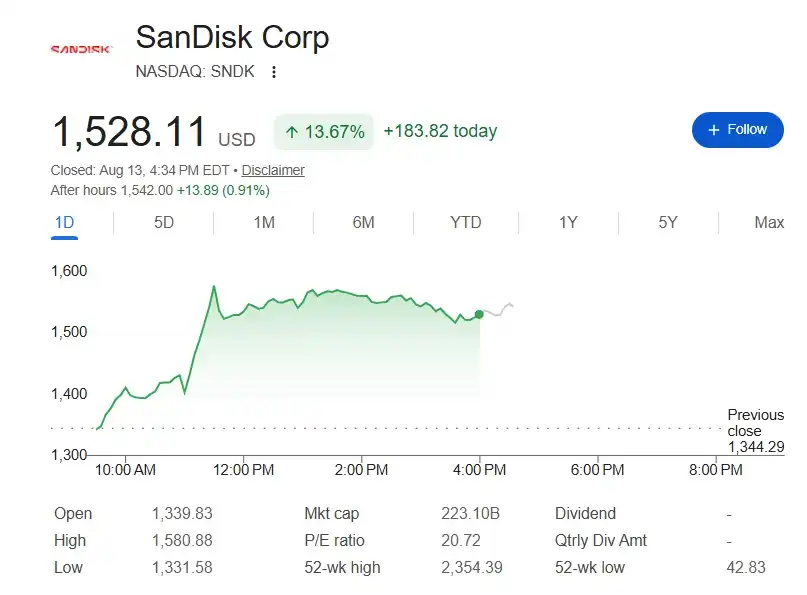
The market quickly voted with its share price following the announcement. SanDisk (SNDK) saw its intraday gain expand to 17.6% on Thursday; the storage sector also strengthened. By the close, SanDisk gained nearly 14%, SK Hynix and Western Digital rose over 7%, Seagate Technology increased nearly 5%, and Micron Technology gained over 4%.
FY2028-30 Goals: Gross Margin 80%, Operating Margin 75%
The long-term financial model presented by SanDisk was undoubtedly the most closely watched aspect of this Investor Day.
The company forecasts that between fiscal years 2028 and 2030, revenue will maintain mid-to-high double-digit growth, matching the pace of bit shipment growth. Simultaneously, on a non-GAAP basis, the gross margin is expected to remain around 80%, and the operating margin around 75%.
The concept of fiscal year timing here requires special attention. SanDisk's fiscal year does not align with the calendar year; its fiscal year ends on the Friday closest to June 30, typically spanning 52 weeks. Fiscal year 2026, the previous fiscal year, ended on July 3, 2026. Early July 2026 has already entered fiscal year 2027. Therefore, the announced period of fiscal years 2028 to 2030 refers not to calendar years 2028 to 2030, but to the future three-fiscal-year period starting around July 2027.
Under this financial model, SanDisk expects operating expenses to account for approximately 5% of revenue, with other income and expenses not having a significant impact. Even after accounting for taxes, capital expenditures, and the working capital required to support business growth, the company still anticipates an adjusted free cash flow margin of around 50%.
For the historically highly cyclical NAND storage industry, this set of targets is particularly aggressive. SanDisk is essentially sending a clear message to the market: AI-driven storage demand growth has the potential to keep the company's revenue growth and profitability at levels far above the traditional storage cycle average for years to come.
Not Blindly Chasing 'Bit Quantity': SanDisk to Flexibly Adjust Salable Production Based on Profitability
Another important signal released by SanDisk is that the company does not plan to simply pursue expanding bit shipments as a growth target, but will actively adjust the quantity of bits available for sale based on profitability.
The market had previously focused on SanDisk's bit growth guidance for FY2027: the company expects input bit growth to reach mid-to-high double digits, while the growth of output bits available for sale might be lower than this level. At the Investor Day, management further clarified that this does not mean the company lacks the capacity to expand output.
According to Lynx Equity Strategies analyst KC Rajkumar's interpretation of management's statements, SanDisk CEO David Goeckeler clearly stated that the long-term input bit growth target is mid-to-high double digits, but the quantity of bits available for sale will be flexibly adjusted based on the need to optimize profitability. In some periods, the actual output bit growth may even exceed mid-to-high double digits.
This signifies that SanDisk places more importance on 'how much money can be made per bit' rather than simply pursuing 'how many bits can be sold.'
Especially during NAND technology node transitions, the company will selectively cut wafer output to avoid an oversupply situation caused by too rapid an increase in bit density brought by new technologies.
Rajkumar points out that each NAND technology node transition at SanDisk brings an average of approximately 54% bit growth. Therefore, if the company were to fully release the new capacity brought by technological upgrades, it could easily recreate a situation of oversupply. By proactively reducing wafer output during node transitions, SanDisk can control the quantity of bits entering the market, thereby better maintaining prices, profit margins, and capital efficiency.
This approach also explains why SanDisk dares to set a long-term gross margin target of around 80%: the bit density increase brought by technological progress does not necessarily have to translate entirely into supply growth; the company can proactively 'hit the brakes,' converting part of the technological dividend into profitability.
Returning More 'Earned Money' to Shareholders: 100% of Excess Cash for Buybacks or Dividends
In addition to revenue and margin targets, SanDisk also gave a very clear capital return commitment.
SanDisk CFO Luis Visoso stated that after completing the investments needed to support business growth, the company expects to return 100% of excess cash to shareholders.
This means SanDisk's future capital allocation framework will revolve around three main lines: first, investing in business and technology to support growth; second, maintaining strong free cash flow generation capability; and finally, returning as much remaining cash as possible to shareholders.
An adjusted free cash flow margin of around 50% implies that if the long-term financial model is realized, SanDisk's future cash generation ability will be very strong, which is also a key reason the market is willing to assign it a higher valuation.
Long-Term Agreements with Eight Major Clients, Covering About Two-Thirds of FY2028 Bit Shipments
One of the key reasons for SanDisk's strong confidence in the above long-term financial model is that the company is changing the traditional NAND industry business model.
The company disclosed that it has currently signed New Business Model (NBM) agreements with 8 clients. These agreements include committed purchase volumes, binding contract frameworks, minimum financial guarantees, and structured pricing mechanisms. They can strengthen the alignment between customer demand and the company's capacity planning and reduce the impact of the traditional storage industry's cyclical volatility.
More importantly, the scale covered by these agreements is already substantial: the currently signed NBM agreements cover approximately 50% of FY2027 bit shipments and about two-thirds of FY2028 bit shipments.
SanDisk believes this model can lead to more predictable revenue, higher cash flow visibility, and more sustainable profit growth.
In other words, SanDisk is not only betting on the storage demand growth driven by AI but also attempting to partially transform the strong cyclical nature of traditional NAND business into more stable and predictable revenue and cash flow through long-term agreements.
AI Inference Spurs Larger Storage Market, Enterprise Flash TAM Expected to Reach 1.2 ZB by 2030
Another major support for SanDisk's high-growth outlook over the next three years is the new demands placed on storage infrastructure as AI expands from training to inference.
SanDisk estimates that the flash memory market could grow from a historical annual revenue base of $60 billion to over $300 billion in 2026 and approach $500 billion in 2027.
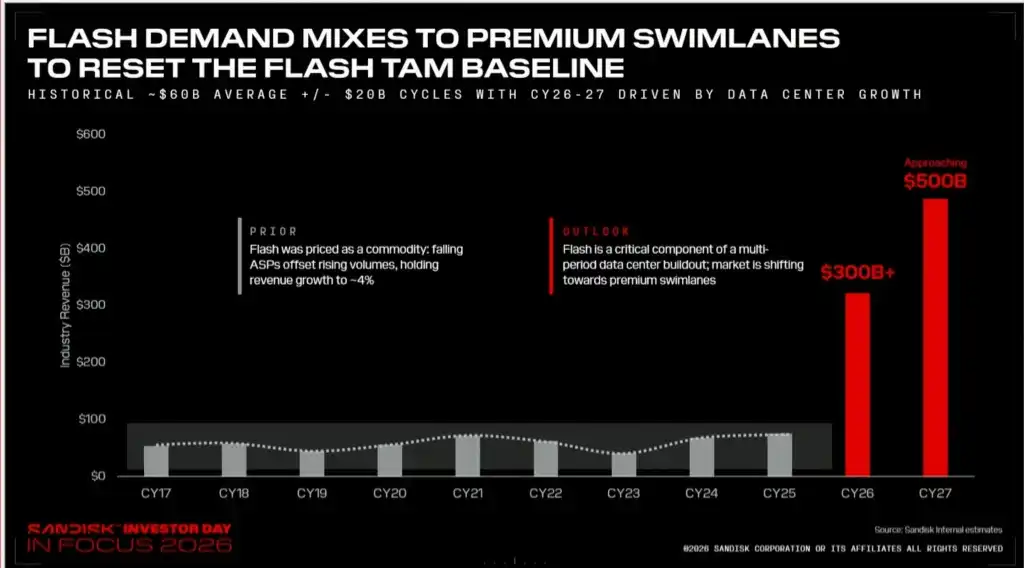
The company stated that AI inference workloads are driving rapid growth in Token usage, and KV Cache is reshaping the memory hierarchy in data centers. As AI inference scales, AI data centers will become increasingly dependent on storage. SanDisk expects that the Total Addressable Market (TAM) for flash memory in enterprise data centers will reach 1.2 Zettabytes (ZB) by 2030.
On the technical front, SanDisk is advancing a two-dimensional scaling strategy based on CMOS Direct Bond Array (CBA) to more flexibly develop customized products that meet the needs of different markets while improving capital efficiency.
The company's latest BiCS9 QLC technology is the first example of this strategy. This technology combines the BiCS8 array with a CMOS wafer based on BiCS10; meanwhile, the new BiCS10 QLC node achieves a 60% increase in bit density compared to BiCS8.
Betting on AI Inference with HBF, Storage Sector Rallies
SanDisk is also advancing a new High-Bandwidth Flash (HBF) technology for AI inference. The company stated that HBF is becoming a key technological solution to meet the storage demands of the AI inference era, and the related industry ecosystem is also forming.
From the market's perspective, this means SanDisk's AI storage logic is no longer limited to 'AI data centers need more SSDs' but has further extended to the demand for higher performance, lower power consumption, and higher storage density inherent to AI inference architecture itself.
This expectation also quickly spread across the entire storage sector. SanDisk's own rally was more pronounced: after announcing its long-term financial targets, its stock price once surged nearly 18% intraday. So far this year, SanDisk's stock price has accumulated a gain of over 530%.
However, SanDisk also emphasized that the aforementioned long-term financial targets are forward-looking indicators based on a series of estimates and assumptions. Actual results may still be affected by factors such as demand, average selling prices, competition, technological iteration, supply chains, and storage industry cycles.