They Missed $2 Million Because Maduro Wasn't Supposed to Be Home for the New Year

marsbitPublicado a 2026-01-04Actualizado a 2026-01-04

Resumen

On the early morning of January 3, 2026, US special forces captured Venezuelan President Nicolás Maduro at his residence and extradited him to the United States. Prior to the raid, several anonymous accounts on the prediction market platform Polymarket placed large bets on the highly unlikely outcome that Maduro would lose power before January 31, 2026, turning a significant profit once the operation succeeded. Three new wallets, with no prior history, collectively gained over $600,000, suggesting possible insider trading based on confidential intelligence. Further analysis revealed that the operation was originally scheduled for December 29, 2025, but was delayed due to severe weather. Two other traders who had placed early large bets on Maduro’s removal in 2025 suffered major losses when the operation was postponed. However, after learning the raid was rescheduled for January 3, they placed new bets and managed to recover some profits. One trader, Chiwawas, missed out on potential earnings of $750,000 due to the delay. The incident highlights how Polymarket has become a platform where individuals with privileged information can exploit timing and knowledge gaps for financial gain.

At 2 a.m. local time on Saturday in Venezuela, while President Nicolás Maduro was still asleep during the New Year holiday, U.S. special forces completed a raid within an hour, apprehending Maduro and transporting him to the United States via aircraft.

This world-shocking "blitzkrieg" seemed to come without warning, but on the leading prediction market platform Polymarket, it appeared to have become a profit-making tool for several insiders well before the operation.

3 Pentagon Employees "Placing Bets While Working Overtime"

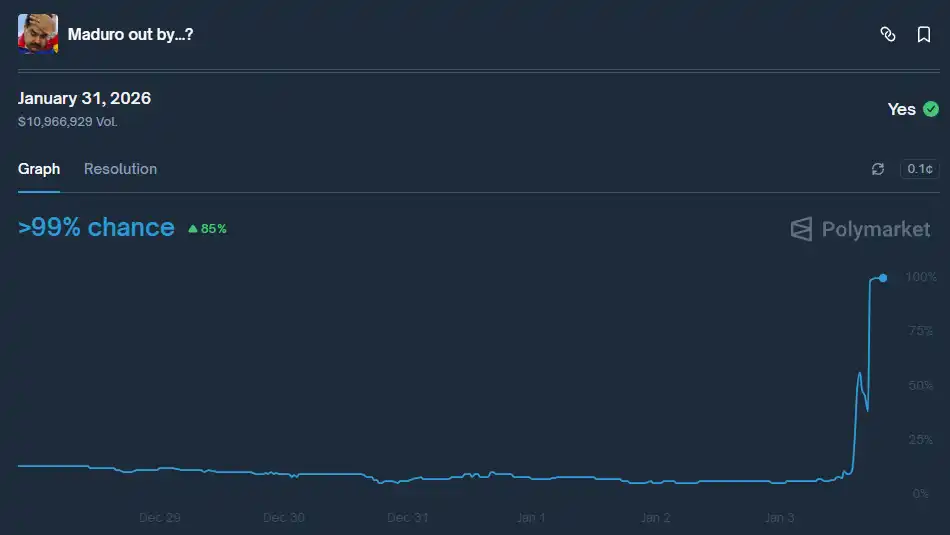
Hours before the operation began, three new wallets with no prior history on Polymarket suddenly started heavily betting "Yes" on the highly improbable market "Maduro loses power before January 31, 2026".

At that time, the mainstream market view was still that Trump would adopt a温和的围城策略 (mild siege strategy) to force Maduro to compromise, and the probability for "Yes" on this market was only 5%. However, as Maduro was loaded onto the plane, these three mysterious accounts instantly reaped profits exceeding $500,000.

It was only after the fact that people began to redefine the trio's purchases hours before the airstrike: only those with reliable intelligence could execute such a "dimensionality reduction strike" with such precise timing using new accounts.

These three insiders were:

0xa72db1749e9ac2379d49a3c12708325ed17febd4, profit $74,982.34;

0x6baf05d193692bb208d616709e27442c910a94c5, profit $145,619.92;

0x31a56e9e690c621ed21de08cb559e9524cdb8ed9, profit $409,882.03.

But the news from Polymarket goes far beyond this.

Maduro's "Flight Delay": The U.S. Operation Was Originally Scheduled for 4 Days Earlier

There are two very representative addresses; although they profited from this event, they actually lost significant potential earnings because they received the information too early.

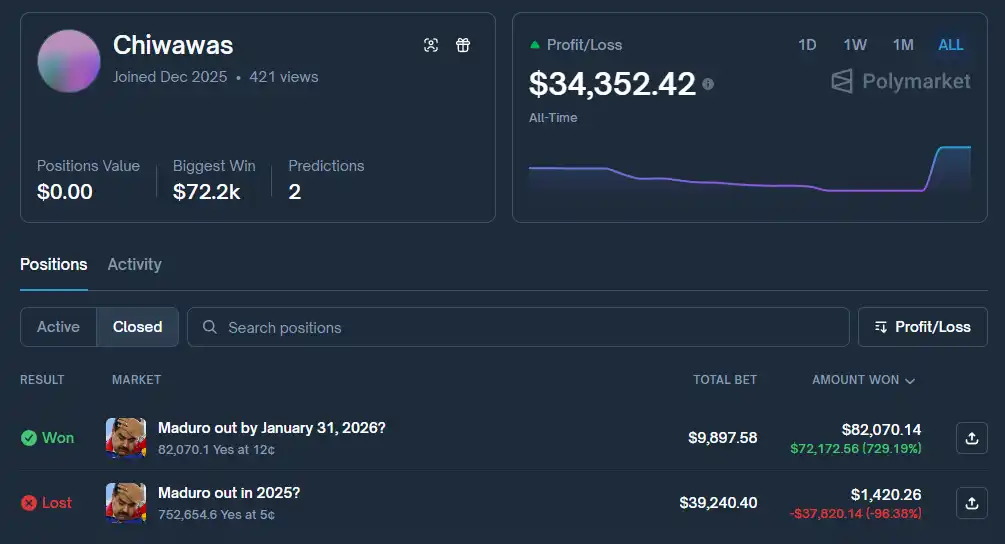
Like the three insiders mentioned above, Chiwawas also placed a precise bet of $10,000 three hours before the airstrike, profiting over $70,000.

But in fact, Chiwawas had already heavily bet nearly $40,000 on the market "Maduro loses power within 2025" on the evening of December 26th.

Assuming he was an insider, he must have received accurate information to make such a heavy bet. Unfortunately, the arrest operation, originally scheduled for December 29th, was canceled due to weather. Thunderstorm clouds over the Caribbean Sea forced the U.S. military to abort for tactical safety reasons.

This was confirmed in Trump's recent speech regarding the operation: "The airstrike against Maduro was originally scheduled for 4 days ago (i.e., the night of December 29 to the early morning of December 30, 2025)."

Therefore, since the market settled as "No" on the last day of 2025, this trade resulted in his account facing huge losses as 2026 arrived.

If everything had gone according to the script Chiwawas possessed, his account should have settled with a whopping $750,000 return on December 30th.

Unfortunately, the weather did not cooperate. The thunderstorm clouds over the sea not only disrupted the U.S. military's original airstrike plans but also shattered Chiwawas's dream of using military intelligence to make a fortune during the Christmas holiday.

Fortunately, upon learning that the U.S. military would restart the operation on the night of January 3rd, he rallied, depositing funds and placing bets again. This final gamble, while unable to make up for the missed $750,000, ultimately brought his total account profit back into positive territory, reaching $34,000.
Besides Chiwawas, another account also missed massive profits due to the weather. Since late last month, he had bet approximately $20,000 across multiple related markets like "Military conflict between US and Venezuela occurs within the year" and "Nothing happens: National leader loses power," convinced that a US-Venezuela conflict would occur in the remaining days of 2025 and that Maduro would fall because of it.

If not for the weather impact, he should have received a huge profit of $1.04 million on the 30th.

Like Chiwawas, after suffering significant losses, he bet on "US-Venezuela conflict occurs before 2026.1.15" three hours before the airstrike and profited over $40,000.

Conclusion

Only three days into 2026, we have already seen that Polymarket is not just a prediction platform but also an automatic teller machine for individuals across various industries with information advantages to疯狂套现 (cash out疯狂ly) using "knowledge gaps" and "time gaps."

As Polymarket's popularity continues to grow, one wonders what other surreal insider stories will play out here this year?
Preguntas relacionadas

QWhat was the outcome of the US special forces operation against Venezuelan President Nicolás Maduro on the early morning of January 3rd, 2026?

AUS special forces conducted a raid, captured President Nicolás Maduro within an hour, and transported him to the United States via a transport aircraft.

QHow did three new wallets on Polymarket profit from the event before it occurred?

AThree new wallets with no prior history placed large bets on the highly unlikely outcome 'Maduro loses power before January 31, 2026' just hours before the raid, when the probability was only 5%. They collectively profited over $500,000 when the event happened.

QWhy did the US military's operation to capture Maduro get delayed from its original date?

AThe operation, originally planned for December 29th, 2025, was canceled due to thunderstorm clouds over the Caribbean Sea, which forced the US military to postpone for tactical safety reasons.

QHow much potential profit did the user 'Chiwawas' miss due to the weather-related delay of the operation?

AChiwawas missed a potential profit of $750,000 because the operation was delayed past the December 31st, 2025 settlement date for his bet on 'Maduro loses power within 2025'.

QWhat does the article suggest about the nature of Polymarket as a platform?

AThe article suggests that Polymarket has become a platform where individuals with insider information or a significant 'knowledge and time advantage' can use it to profit, effectively turning it into an 'ATM' for such actors.

Lecturas Relacionadas

$9.4 Billion: The Largest Robotics Funding This Year Has Emerged

Munich-based humanoid robotics company Neura has completed a $1.4 billion (approximately RMB 94.9 billion) Series C funding round, valuing the company at around $7 billion and positioning it among the global leaders in the sector. The investment round is notable not just for its size—reportedly the largest in robotics this year—but also for its strategic backers, which include tech giants like NVIDIA and Amazon, alongside established industrial players such as German engineering firms Bosch and Schaeffler. This mix of investors signals a significant shift in the industry's focus from technological demonstrations and general-purpose narratives toward practical, industrial deployment and commercialization. Neura's approach centers on developing humanoid robots for defined, high-value industrial tasks rather than pursuing a general-purpose model. Its early validation comes from a partnership with BMW, where its robots are being tested on actual production lines. The involvement of Bosch and Schaeffler, companies deeply embedded in global manufacturing, underscores a growing belief that humanoid robots are transitioning from labs to viable factory-floor solutions. The article highlights two converging trends driving investment: advancements in AI and large language models, which enhance robots' perception and decision-making in unstructured environments, and mounting pressure from labor shortages and rising costs in major manufacturing regions. The funding landscape is now bifurcating between companies like Figure AI, focusing on versatile general-purpose robots, and firms like Neura, targeting specific vertical industrial applications with clearer, shorter paths to ROI. While technical hurdles remain, the core challenges for widespread adoption are increasingly seen as engineering and commercial in nature: managing the high integration and customization costs for different factory environments and establishing robust, localized maintenance and service networks. The record investment in Neura, particularly from industrial capital, indicates the industry's growing confidence in moving from proving feasibility to solving the practical problems of scalability, reliability, and building sustainable business models around humanoid robots in real-world settings like automotive manufacturing and hazardous labor environments.

marsbitHace 32 min(s)

$9.4 Billion: The Largest Robotics Funding This Year Has Emerged

marsbitHace 32 min(s)

"119 to 176 Dollars": Behind SpaceX's Listing, MSX Once Again Successfully Executes the Pre-IPO Closed Loop

Following May's 300% gain on Cerebras, MSX delivered another outstanding performance during SpaceX's listing night. On June 12, SpaceX (SPCX) launched on Nasdaq, reaching a high of $176. This marked the successful culmination of MSX's Pre-IPO project launched in March, where users subscribed at $119, achieving gains of approximately 40-48%. This event validated MSX's complete Pre-IPO mechanism, a crucial advantage in a market where access to top-tier private company equity is typically limited to institutions. MSX's model provides a full cycle for users: subscription (at $119 for SpaceX), real-time on-chain portfolio tracking, optional early redemption, seamless conversion to tradable spot assets (SPCX.M) upon IPO, and final settlement in stablecoins. This end-to-end process distinguishes MSX from platforms that faced settlement issues during the SpaceX IPO, highlighting that the core challenge of Pre-IPO is not just access, but a clear exit and conversion path post-listing. This success with SpaceX is MSX's second major Pre-IPO verification, following the Cerebras listing in May, which yielded ~300% returns for early participants. These back-to-back achievements demonstrate MSX's capability to source, structure, and deliver real assets through a replicable on-chain model. The true barrier for Pre-IPO products lies not in providing an entry point, but in ensuring reliable fulfillment from subscription through to post-IPO liquidity. MSX's proven闭环 (closed-loop) process addresses this, offering Web3 users a structured way to access high-growth, pre-public companies in sectors like AI and frontier tech. MSX plans to continue expanding its Pre-IPO portfolio with this focus on authenticity, transparency, and post-listing execution.

Odaily星球日报Hace 13 hora(s)

"119 to 176 Dollars": Behind SpaceX's Listing, MSX Once Again Successfully Executes the Pre-IPO Closed Loop

Odaily星球日报Hace 13 hora(s)

Trading

Spot
Futuros

Artículos destacados

Cómo comprar HOME

¡Bienvenido a HTX.com! Hemos hecho que comprar Defi.app (HOME) sea simple y conveniente. Sigue nuestra guía paso a paso para iniciar tu viaje de criptos.Paso 1: crea tu cuenta HTXUtiliza tu correo electrónico o número de teléfono para registrarte y obtener una cuenta gratuita en HTX. Experimenta un proceso de registro sin complicaciones y desbloquea todas las funciones.Obtener mi cuentaPaso 2: ve a Comprar cripto y elige tu método de pagoTarjeta de crédito/débito: usa tu Visa o Mastercard para comprar Defi.app (HOME) al instante.Saldo: utiliza fondos del saldo de tu cuenta HTX para tradear sin problemas.Terceros: hemos agregado métodos de pago populares como Google Pay y Apple Pay para mejorar la comodidad.P2P: tradear directamente con otros usuarios en HTX.Over-the-Counter (OTC): ofrecemos servicios personalizados y tipos de cambio competitivos para los traders.Paso 3: guarda tu Defi.app (HOME)Después de comprar tu Defi.app (HOME), guárdalo en tu cuenta HTX. Alternativamente, puedes enviarlo a otro lugar mediante transferencia blockchain o utilizarlo para tradear otras criptomonedas.Paso 4: tradear Defi.app (HOME)Tradear fácilmente con Defi.app (HOME) en HTX's mercado spot. Simplemente accede a tu cuenta, selecciona tu par de trading, ejecuta tus trades y monitorea en tiempo real. Ofrecemos una experiencia fácil de usar tanto para principiantes como para traders experimentados.

221 Vistas totalesPublicado en 2025.06.10Actualizado en 2026.06.10

Cómo comprar HOME

Discusiones

Bienvenido a la comunidad de HTX. Aquí puedes mantenerte informado sobre los últimos desarrollos de la plataforma y acceder a análisis profesionales del mercado. A continuación se presentan las opiniones de los usuarios sobre el precio de HOME (HOME).

活动图片













