They Knew the TGA Game of the Year Winner in Advance and Made Tens of Thousands of Dollars

marsbitPublicado a 2025-12-12Actualizado a 2025-12-12

Resumen

Summary: The 2025 TGA (The Game Awards) ceremony concluded with the indie game "Light & Shadow: Expedition 33" making history by winning both "Best Independent Game" and the coveted "Game of the Year (GOTY)" award, breaking a long-standing TGA curse. Prior to the event, the prediction market platform Polymarket had already listed the topic, with "Light & Shadow's" probability of winning GOTY consistently above 80% for over a month. Several traders, including users DieselDiesel, trumpnogo, and kasae, placed unusually large, concentrated bets on this outcome weeks in advance, a move that would have resulted in massive losses if wrong. Their bets appeared to be "all-in" convictions rather than calculated risks. Just three hours before the GOTY announcement, after the "Best Indie" award was given to the same game, a mysterious user (bobo9997) deposited $10,000 and bet it all on "Yes" for "Light & Shadow" winning GOTY at a price of $0.98 per share—a bet that would yield less than $200 in profit if correct. The final award confirmed the predictions. The early traders realized significant profits, with their winnings from this single event representing a large percentage of their total historical earnings on the platform (e.g., 176% for DieselDiesel). The article suggests these traders likely had insider knowledge of the results, using the prediction market as a anonymous, low-risk method to monetize their confidential information, turning a guaranteed outcome into thousands of d...

Today, the highly anticipated The Game Awards (TGA) ceremony finally concluded.

Let's jump back to 3 hours before the awards ended. At that time, the "Best Independent Game" had just been awarded to the popular title "Light & Shadow: Expedition 33," but this instead made many fans worried: historically, no game has ever won both the "Best Independent Game" and the "Game of the Year (GOTY)" awards at TGA. As a GOTY favorite, "Light & Shadow" now needed to break the curse that had existed since TGA's inception and create an unprecedented moment in gaming history.

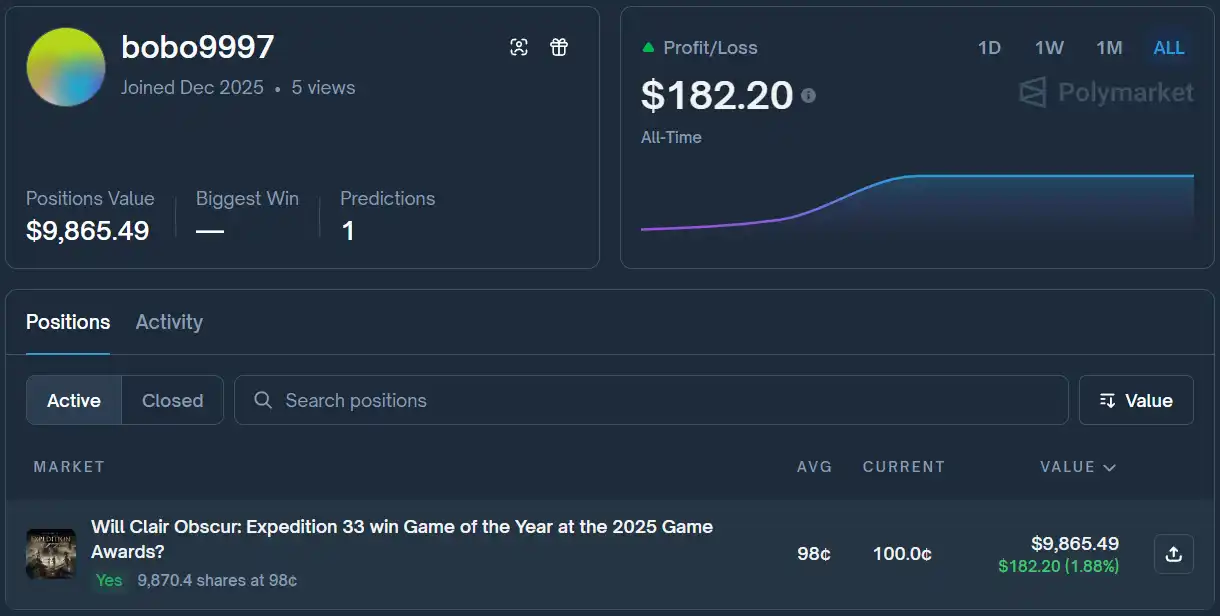
Just as everyone was filled with anxiety, a mysterious individual registered an account on a seemingly unrelated "prediction market" platform and deposited ten thousand dollars. He found the topic "Will Light & Shadow win the 2025 GOTY?" on the platform and bet the entire ten thousand dollars on "Yes." At that time, the price for "Yes" was $0.98 per share, meaning that even if "Light & Shadow" did indeed make gaming history by winning both awards, his ten-thousand-dollar bet would only yield a profit of less than two hundred dollars. However, if "Light & Shadow" failed to break the TGA curse, the probability of the topic would instantly drop to 0, which meant his newly deposited ten thousand dollars would be wiped out. What kind of狂热 fan of "Light & Shadow" would take such a reckless risk? And how do prediction markets attract game fans from around the world to guess the winners in advance?

The "Pre-Determined" Script

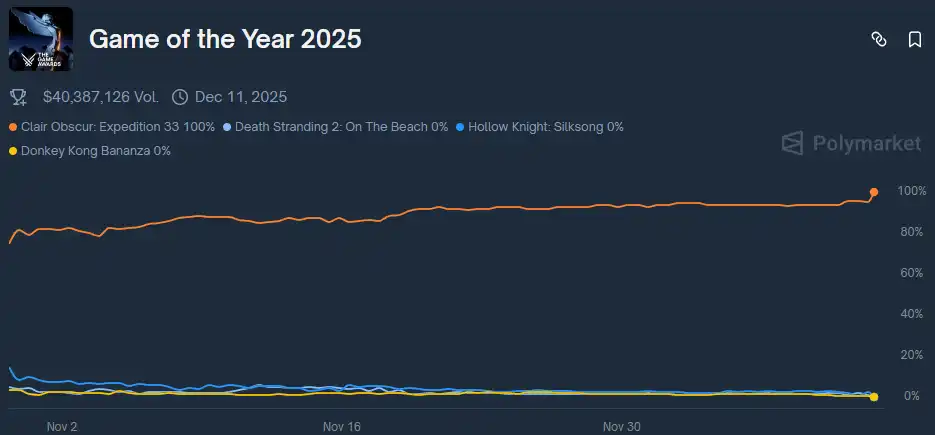
As early as October 30th, a month and a half before the awards ceremony, the prediction market Polymarket had already launched the topic for "2025 Game of the Year." The probability of "Light & Shadow" winning was firmly pinned above 80% from the start, while the probabilities of other highly anticipated AAA titles winning were suppressed below 10%. Because such a one-sided situation usually only occurs in events where the outcome is already certain, this anomaly made many traders smell something unusual: this wasn't just optimism, this was certainty.

Among these traders with a "certain" attitude, a few operated in an extremely unified style, hinting at the possibility of insider trading. DieselDiesel, trumpnogo, and kasae all bet on "Light & Shadow wins TGA 2025 GOTY" when the probability was around 85%, and the amounts they bet were dozens or even hundreds of times larger than their usual bets. This highly concentrated,反常 betting behavior meant they faced enormous risks: if "Light & Shadow" ultimately did not win, they would not only have to give up all past profits but also suffer huge losses.

As time progressed and the probability of "Light & Shadow" winning increased, they did not sell any of their held shares to realize profits. Even 3 hours before the award announcement, after the "Best Independent Game" award had been announced, they, already significantly浮盈, remained motionless as if they knew the future, betting their entire account balance alongside the mysterious individual mentioned at the beginning for that final, tiny profit.

The Historic Award Moment and the Cashing Out of Insiders

Amid doubts and unease, TGA played out exactly like the script these few traders had arranged over a month ago, dispelling the final suspense: the highly anticipated "Light & Shadow," having already won the "Best Independent Game" award, broke the historical curse and won the Game of the Year award.

And while players on one side cheered and celebrated, the mystery was solved in the prediction market on the other side: the three traders who had been convinced since a month ago that "Light & Shadow" would win confirmed their role of "foreseeing the future" and realized huge profits:

DieselDiesel made a profit of $5,357 in this event, accounting for 176% of all his other trading profits;

trumpnogo made a profit of $2,958 in this event, accounting for 62% of all his other trading profits;

kasae made a profit of $1,658 in this event, accounting for 220% of all his other trading profits.

And the mysterious individual (bobo9997) mentioned at the beginning, because he was certain that "Light & Shadow" would make history," used ten thousand dollars to win a "whopping" $200.
"Even Those Who Foresee the Future Need to Eat"

The most noteworthy common point among these four traders is that while many players doubted whether "Light & Shadow" could break the historical curse, they were "willing to risk" nearly $100,000 in positions to "gamble" on this historic moment happening, and this "gamble" brought them less than two thousand dollars in combined profits.

Now, let's assume these "foreseers" are TGA vote auditing staff. As insiders with an annual income of $100,000, if they wanted to monetize the information in a traditional way, they would need to sell the insider information to media platforms, but this represents various potential fines, dismissal, and even imprisonment. However, with the emergence of prediction markets, they can use anonymity to convert information asymmetry into real money equivalent to 1 to 3 months of their disposable income.

When we view them as assumed insiders who already knew the result in advance, everything becomes clear: being 100% sure that "Light & Shadow" would be GOTY, their final "bet" was just using the one-hour wait time before the announcement to换取 seemingly huge risks but实际上毫无变数的 two thousand dollars in profit. This kind of seemingly high-risk but实际上毫无变数的赚钱 "bet" was almost impossible to encounter before platforms like prediction markets appeared.

However, with the popularity of Polymarket, how many people can resist converting information into real money anonymously?
Preguntas relacionadas

QWhat is the name of the prediction market platform mentioned in the article where users bet on the TGA 2025 Game of the Year outcome?

AThe prediction market platform mentioned is Polymarket.

QWhich game won both the 'Best Indie Game' and 'Game of the Year (GOTY)' awards at TGA 2025, breaking a historical curse?

AThe game that won both awards is 'Light and Shadow: Expedition 33'.

QWhat were the usernames of the three traders who made unusually large bets on 'Light and Shadow' winning GOTY and profited significantly?

AThe three traders were DieselDiesel, trumpnogo, and kasae.

QHow much did the mysterious user 'bobo9997' profit from betting $10,000 on 'Light and Shadow' winning GOTY at the last moment?

AThe user 'bobo9997' profited approximately $200 from the bet.

QWhat is the suggested explanation in the article for the traders' confident and large bets on 'Light and Shadow' winning GOTY?

AThe article suggests that the traders likely had insider information, possibly from being involved in the TGA vote auditing process, which they anonymously monetized through the prediction market.

Lecturas Relacionadas

A New Scaling Variable for Text-to-Image Generation, Discovered by ByteDance's Seed Team

ByteDance's SEED team investigated a crucial but often overlooked scaling variable in text-to-image diffusion models: the amount of image-grounded information in training captions. They found that simply increasing caption length with natural language does not improve model performance, as it often adds redundancy without new, usable visual supervision. The core discovery is that the final training loss of a diffusion model can be predicted by the *information content* of its text condition, measured by two complementary metrics: Grounded Perplexity Gain (GPG) and Effective Detailness (ED). This establishes a scaling relationship for text conditioning. To systematically increase information content, the team proposed **Structured Prompt (SP)**, a JSON-based representation that organizes visual variables (global scene, object attributes, spatial relationships) into clear fields, enhancing **Diffusability**—the model's ability to learn from captions. For inference, an LLM **Prompter** is trained to convert user queries into detailed SP instances, defining **Promptability**. The overall generation quality is viewed as a product of Diffusability and Promptability. A three-stage training strategy (SFT, cold-start reasoning distillation, and verifier-guided reinforcement) significantly improves the prompter's capability. The structured format also enables efficient iterative refinement through a *refine-render-judge* loop. In matched-control experiments using the same Qwen-Image backbone, data, and compute, the SP-based system substantially outperformed its natural-language counterpart, demonstrating that gains stem from the structured information interface, not just more training. The work shows that scaling text-to-image models requires scaling the *usable visual information* in conditions, not just model size or data volume.

marsbitHace 18 min(s)

A New Scaling Variable for Text-to-Image Generation, Discovered by ByteDance's Seed Team

marsbitHace 18 min(s)

In Just 6 Months, 4 Rounds of Funding: West Lake University Professor's Venture Takes Off

Westlake Robotics, an embodied artificial intelligence company, has completed its Series A financing round within just six months and a total of four rounds, raising a cumulative 5 billion RMB. The investor lineup includes prominent institutions such as SAIF Partners, Xiaomiao Langcheng, Henan Investment Group Huirong Fund, and Haiyuan Fund, forming a high-quality capital matrix comprising state-owned, industrial, and leading venture capital. The rapid and intensive capital injection reflects strong market confidence in the company's technological approach, product deployment capabilities, and long-term potential. The newly acquired funds will be primarily allocated to the research and development of a unified large model for humanoid robots and the establishment of a talent cultivation base for embodied AI. Founded in 2024, Westlake Robotics originated from the industrial transformation of pioneering achievements in AI and robotics at Westlake University. The founding team is led by Wang Donglin, a leading figure in China's embodied AI and robot learning field, and co-founder Zhang Yue, an expert in natural language processing. The core R&D members hail from top-tier tech companies like Alibaba, ByteDance, Tencent, and Huawei, as well as prestigious global universities. The company follows a fully self-developed strategy integrating a "universal brain + humanoid body-specific cerebellum + proprietary humanoid hardware." It is one of the few domestic enterprises capable of holistically connecting the three core areas of embodied AGI cognitive reasoning, full-body motion control, and humanoid hardware. Its proprietary technologies include the General Motion Model-GAE system for low-latency teleoperation and motion generalization, and a dual pre-trained architecture for general and body-specific processing to bridge cognitive reasoning and physical movement. In 2026, Westlake Robotics launched its self-developed humanoid robot "Westlake o1," completing the full technology chain from underlying algorithms to pre-trained models and hardware. The company has secured nearly 100 million RMB in orders, with applications in scientific research, education, data collection, and power inspection. Future targets include high-risk industrial inspection, post-disaster search and rescue, and remote precision assembly. The company has also partnered with the Longyou County government to establish a county-wide real-scenario training base for humanoid robots, aimed at collecting high-quality motion data and validating technology in authentic environments. With the latest funding, Westlake Robotics plans to further advance its core model development and talent acquisition strategy, accelerating progress toward the "GPT moment" for embodied intelligence in China.

marsbitHace 43 min(s)

In Just 6 Months, 4 Rounds of Funding: West Lake University Professor's Venture Takes Off

marsbitHace 43 min(s)

Volatility Plummets to Historic Lows, When Will Bitcoin's 'Summer Sideways Move' End?

Bitcoin is experiencing a classic summer of stagnant price action, trapped in a tight range between approximately $62,000 and $66,000. Analysts point to historically low implied volatility and thin summer liquidity as key characteristics of the current market. The consensus among traders is that the catalyst for a decisive breakout will come from macroeconomic factors, not internal crypto dynamics. The immediate focus is on upcoming U.S. CPI data, which could influence Federal Reserve policy expectations. A softer inflation print is seen as potentially supportive for risk assets like Bitcoin. Furthermore, the pending *Clarity Act* legislation is identified as a crucial long-term catalyst that could boost institutional participation by providing regulatory clarity. While U.S. spot Bitcoin ETFs, led by BlackRock's IBIT, have seen their strongest inflows since April, providing underlying support, this buying pressure is being offset by selling from miners and other large holders. This has resulted in continued consolidation even as global crypto trading volumes hit multi-year lows. Market participants expect the range-bound, low-volatility environment to persist for several more weeks, at least until there is clearer progress on macro policy or regulatory fronts. Any sustained break above or below the current range is likely to trigger a significant expansion in volatility. Long-term bullish narratives around adoption, institutional demand, and Bitcoin's unique attributes as collateral remain intact, but the short-term path depends on external macroeconomic catalysts.

marsbitHace 46 min(s)

Volatility Plummets to Historic Lows, When Will Bitcoin's 'Summer Sideways Move' End?

marsbitHace 46 min(s)

Trading

Spot
活动图片