These Days, Even Hackers Are Losing Money

marsbitPublicado a 2026-03-25Actualizado a 2026-03-25

Resumen

An article titled "Even Hackers Are Losing Money These Days" details a cyber heist targeting Web3 social platform UXLink’s multi-signature wallet in September 2025. The attacker exploited a delegateCall vulnerability, bypassing security to steal over $11.3 million in assets, including stablecoins, ETH, WBTC, and UXLINK tokens. The hacker then dumped a large amount of UXLINK, causing its price to crash over 70%. Unlike typical hackers who launder funds through mixers like Tornado Cash, this attacker engaged in active on-chain trading, executing 625 transactions on CoW Swap over six months. However, poor trading decisions led to significant losses—at one point, the address was down nearly $4.8 million. The hacker repeatedly bought high and sold low, barely breaking even after six months of activity. Despite the traceability of the funds via platforms like Arkham, recovering the assets remains challenging for UXLink. The project has attempted to rebuild, but its token price has fallen 99% from its peak. The incident underscores that while technical skills enable theft, market volatility affects everyone equally—even hackers aren’t immune to losses.

Author: Chloe, ChainCatcher

In September 2025, the multi-signature wallet of Web3 social platform UXLink was brutally looted. Within just a few hours, the hacker made off with over ten million dollars in assets and maliciously dumped a massive amount of minted tokens, causing the token price to flash crash by over 70% instantly. However, the most absurd part of this disaster was not the attack itself, but the hacker's "amateur" performance afterwards.

Unlike the typical money-laundering playbook, this hacker did not rush to disappear. Instead, they funneled the stolen ETH and stablecoins into DEXs, making frequent trades on CoW Swap. According to on-chain data from Arkham, this address accumulated nearly 625 transactions within just six months, with paper losses once reaching as high as $4.8 million.

Reconstructing the technical path of this attack reveals the hacker's unconventional behavior patterns and the harsh reality behind them: in the face of this bear market cycle, even with the advanced skills to steal money on-chain, once you return to market trading, everyone is on a level playing field.

UXLink Multi-Sig Wallet Security Breach, Losses Exceed Ten Million Dollars

Blockchain security company Cyvers first detected abnormal activity in UXLink's multi-signature wallet on September 22, 2025, and issued an urgent alert. UXLink officials subsequently confirmed that their core multi-sig wallet had been compromised, with losses exceeding $11.3 million.
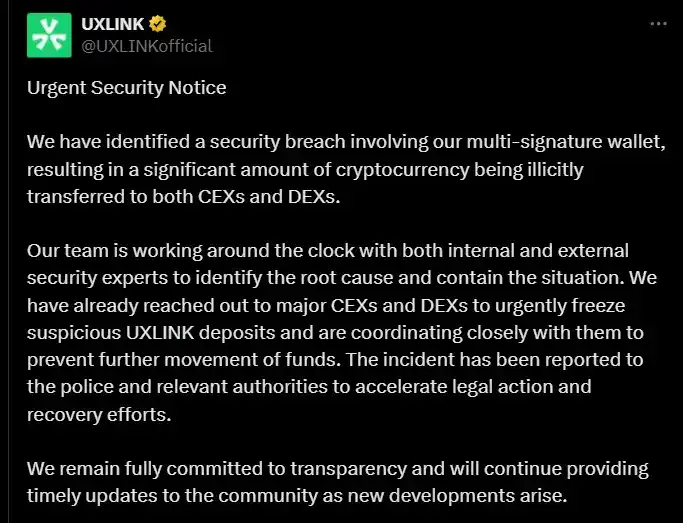
The technical path of this attack was quite clear. The hacker targeted a vulnerability in the multi-sig wallet's delegateCall function, successfully exploiting it to alter the contract logic. The attacker first removed the wallet's original legitimate admin permissions; then, by calling the addOwnerWithThreshold function, they forcibly inserted themselves as a new wallet owner. At this point, UXLink's relied-upon multi-sig security mechanism was completely bypassed, and control of the wallet was entirely transferred.

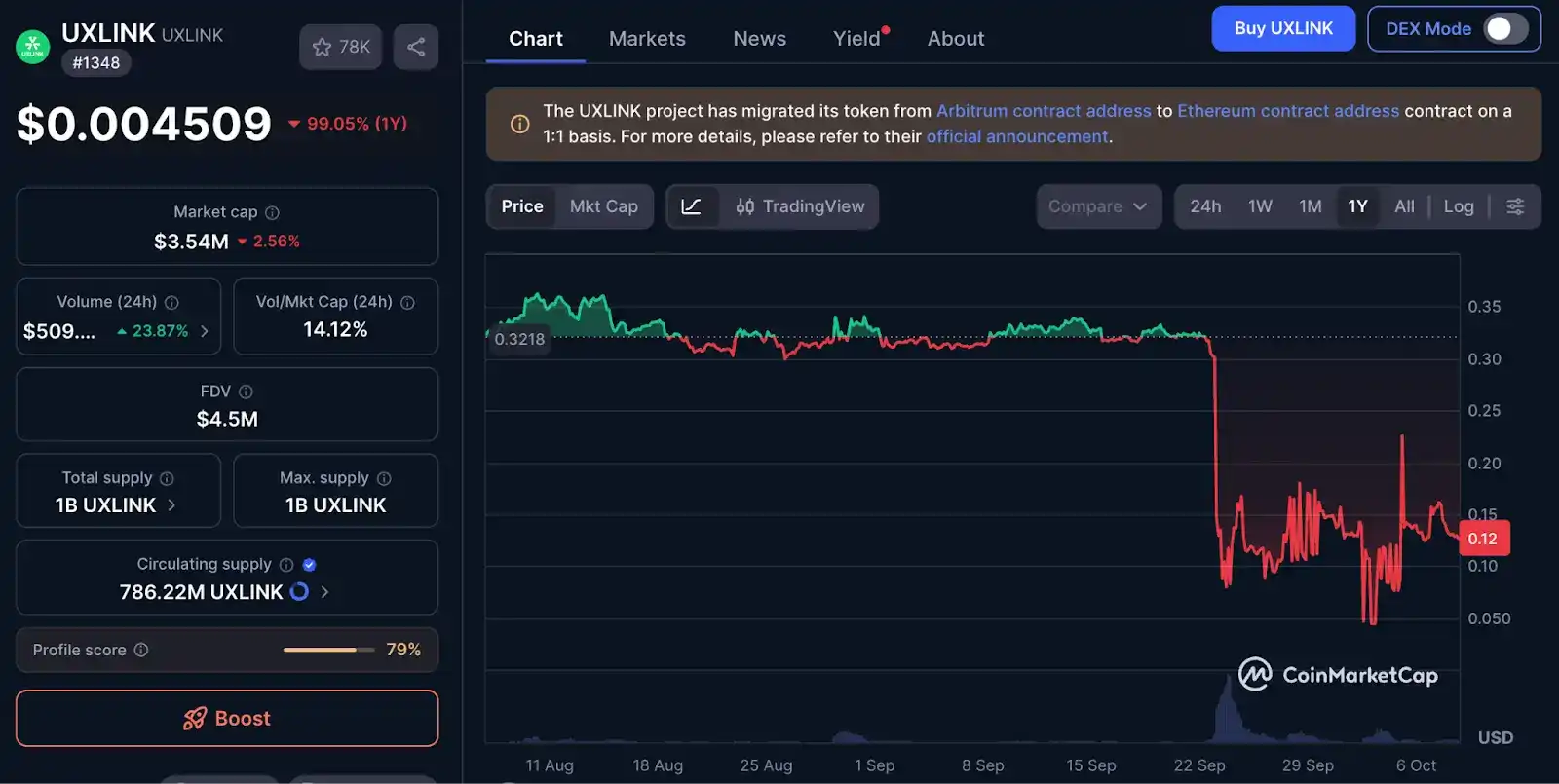
What followed was a frenzied looting of on-chain assets. The stolen assets included approximately $4 million USDT, $500,000 USDC, 3.7 WBTC, 25 ETH, and about $3 million worth of UXLINK native tokens. Simultaneously, the hacker minted a massive amount of UXLINK tokens on the Arbitrum chain and dumped them onto the market. The token price plummeted over 70% in a short time, crashing from around $0.30 to below $0.10, wiping out over $70 million in market capitalization.
An Unconventional Path: Abandoning Mixer Cash-Outs, Staying On-Chain to Trade and Battle

According to the standard script for crypto crime, the next act should have been: the hacker sends the assets into Tornado Cash for anonymization, launders the money in batches through countless hop addresses, and finally completes the entire money laundering and cashing-out process. But this attacker chose an unconventional path.

About 48 hours after the attack, the hacker exchanged 1,620 ETH for approximately 6.73 million DAI. This should have been the first expected signal of "cashing out," and several on-chain analysts promptly locked onto this on-chain behavior. However, over the next six months, this address's behavior pattern completely deviated from the calm and stealth of a professional hacker, instead embarking on a frenzy of on-chain trading.

According to on-chain data tracking by Arkham, this address accumulated a staggering 625 transaction records in just six months, with activity highly concentrated on the decentralized exchange CoW Swap. Its trading frequently switched between WETH and DAI, with an operational frequency far exceeding that of a typical long-term holder. Therefore, rather than a hacker who stole tens of millions, he更像 (more like) a trader, or perhaps a retail investor accustomed to "buying the dip, holding through volatility, and exiting only near the cost basis."

Poor Trading Skills: Paper Losses Once Exceeded $4 Million, Almost Back to Square One After Six Months

According to Arkham's P&L tracking data, from October 2025 to early February 2026, the attacker's address saw paper losses repeatedly exceed $3 million; entering February, the losses hit a record high of $4.8 million. His trading pattern was highly consistent: constantly averaging down at lows, holding on during volatility, and only choosing to exit when the price好不容易 (finally) climbed back near the cost basis.
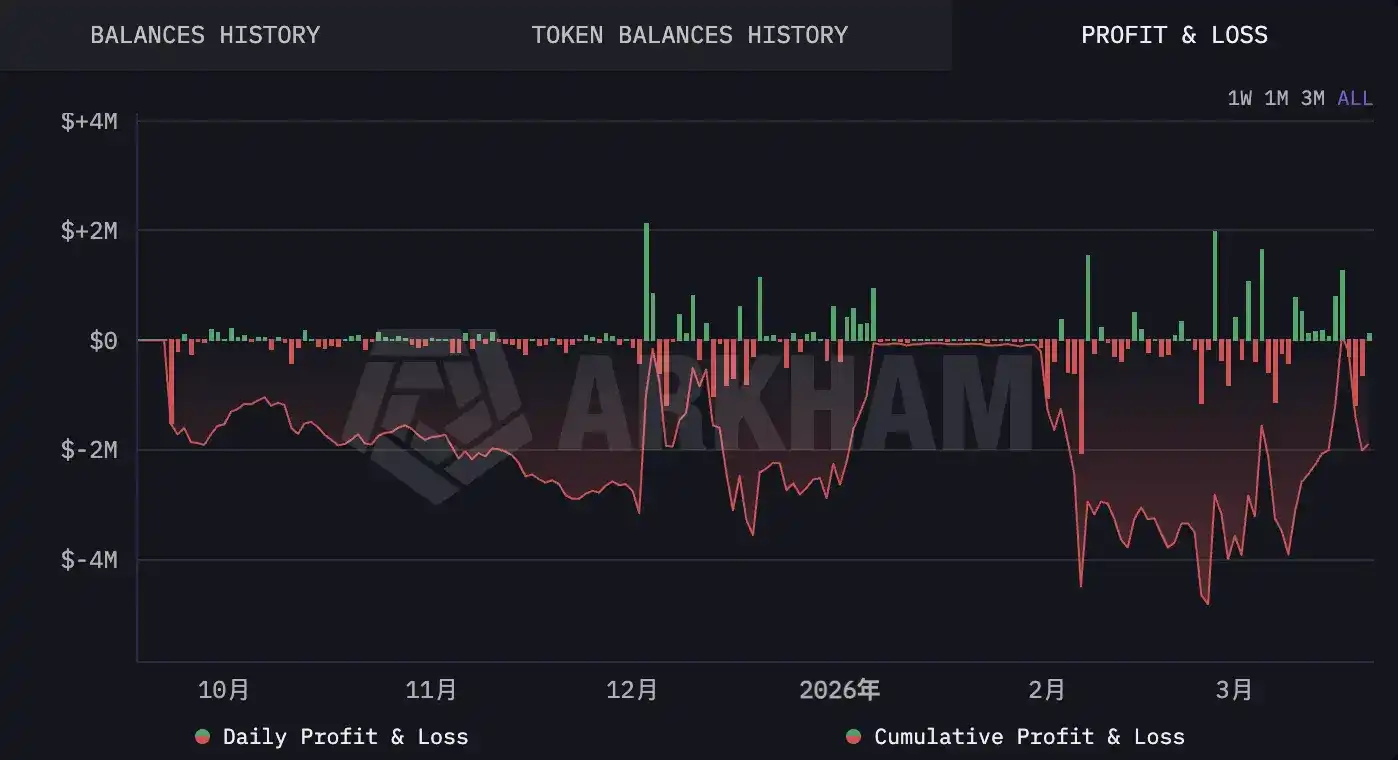
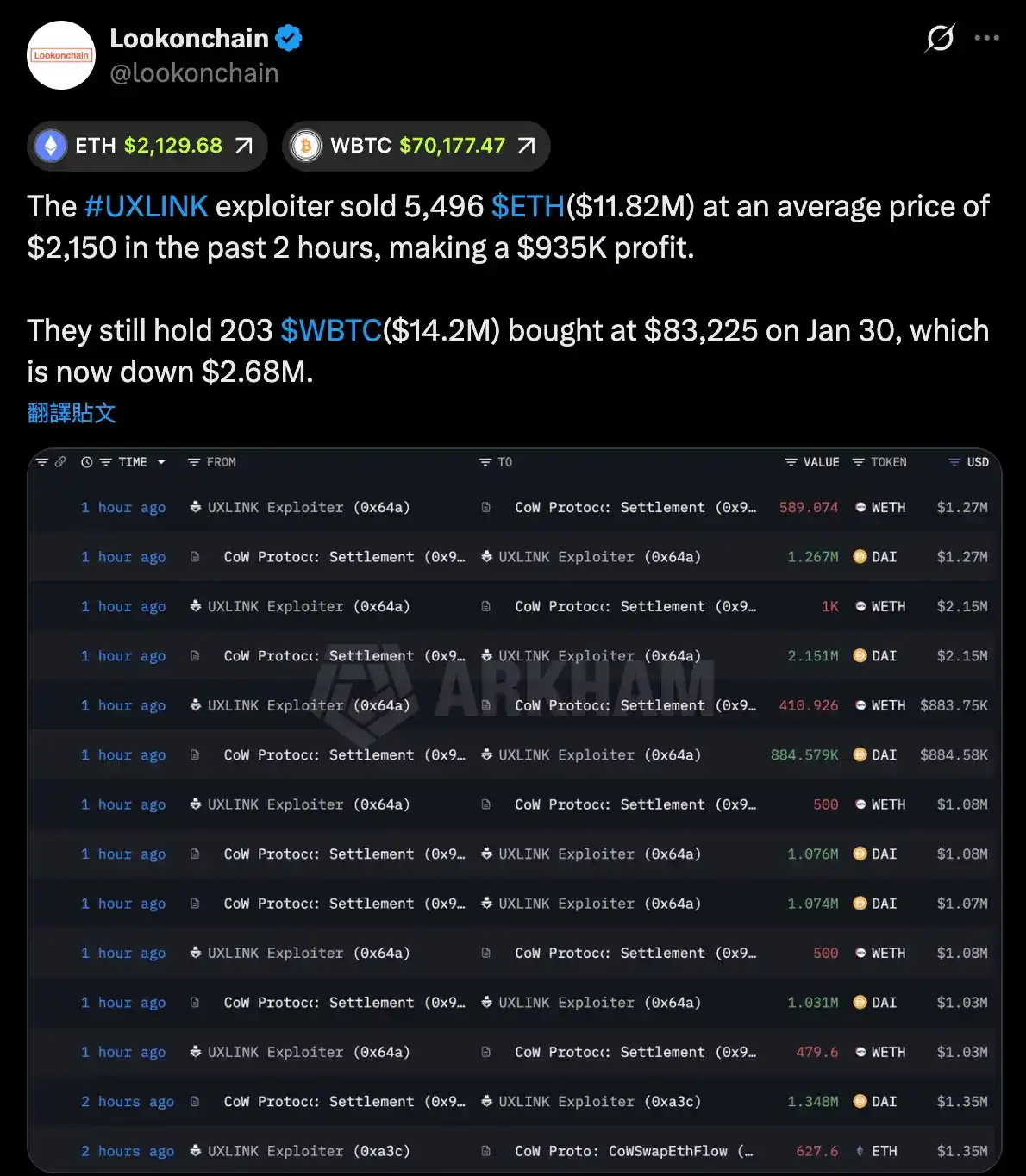
It wasn't until late March that this hacker finally caught a break. On CoW Swap, he exchanged 5,496 ETH for approximately 11.86 million DAI at an average price of $2,150. This operation brought him a paper profit of about $935,000, finally bringing his overall portfolio back to the break-even line. However, his WBTC position was simultaneously eroding these profits. The hacker bought 203 WBTC on January 30, 2026, at an average price of $83,225. As of recently, this position was sitting on a paper loss of about $2.68 million. This entry point恰好 (coincidentally) hit a temporary market rebound high—once again, he bought at a relative peak.
The Transparent Prison and the Long Road to Recovery

The UXLink incident provides a unique perspective in the history of crypto crime: an attacker operating under the spotlight, continuously leaving highly visible transaction trails, allowing global on-chain analysts to fully document their behavioral process.

This likely did not stem from the hacker's negligence, but rather from an outdated perception of "security." He might have believed that as long as the assets were分散 (dispersed) across multiple addresses and operations were conducted on DEXs to avoid the KYC hurdles of CEXs, he could maintain anonymity. However, the rapid evolution of on-chain analysis tools has made this judgment seem overly optimistic. Institutions like Arkham, Lookonchain, PeckShield, and SlowMist almost instantly锁定 (locked onto) every large anomalous movement. Every move the hacker made was laid bare under public scrutiny. This hacker, though sitting on millions, seemed to be in a transparent digital prison.

For the UXLink project team, this situation is both a slight comfort and a significant dilemma. The assets, although not vanished, remain on the traceable blockchain; but in the on-chain world lacking jurisdictional intervention, a vast chasm still lies between "visible" and "recoverable."

Although UXLink quickly completed a new contract audit, token swap, and user compensation plan post-incident to rebuild market confidence, the token price had already fallen from its December 2024 high of $3.75 to around $0.0044, a drop of 99%. For UXLink, patching code vulnerabilities might take only weeks, but rebuilding an ecosystem from near-zero ruins remains a long and arduous journey.

The Bear Market Shows No Mercy, Treating Everyone Equally

The story of the UXLink hacker has become a microcosm of "market reality," rather than just a security incident.

Although he possessed sophisticated skills, able to precisely capture the delegateCall vulnerability and bypass multi-sig defenses, completing a meticulous harvest within hours; however, after the funds were received, he faced the same困境 (dilemma) as any ordinary retail investor: the market doesn't care where the chips came from, ETH still fell during the holding period, and BTC got套牢 (trapped) after the position was built.

This outcome warrants no pity, yet is full of irony. The assets the attacker painstakingly stole were ultimately worn down by market fluctuations, with the paper value six months later almost unchanged from entry. He is not the first ETH holder to suffer losses in a bear market, nor will he be the last speculator反噬 (burned) by the market when trying to buy the dip in WBTC.


Criptos en tendencia

Preguntas relacionadas

QWhat was the main security flaw exploited by the hacker in the UXLink multisig wallet attack?

AThe hacker exploited the delegateCall function vulnerability in the multisig wallet, which allowed them to remove legitimate administrators and add themselves as a new owner, bypassing the security mechanism.

QHow did the hacker's behavior differ from typical cryptocurrency theft patterns after the attack?

AInstead of using mixing services like Tornado Cash to anonymize and cash out the stolen funds, the hacker engaged in frequent on-chain trading, primarily on CoW Swap, accumulating over 625 transactions in six months.

QWhat was the financial outcome of the hacker's trading activities according to Arkham's data?

AThe hacker's trading resulted in significant paper loss,一度浮亏超 400 万美元,一度浮亏超 400 万美元,一度浮亏超 400 万美元,一度浮亏超 400 万美元,一度浮亏超 400 万美元,一度浮亏超 400 万美元,一度浮亏超 400 万美元,一度浮亏超 400 万美元,一度浮亏超 400 万美元,一度浮亏超 400 万美元,一度浮亏超 400 万美元,一度浮亏超 400 万美元,一度浮亏超 400 万美元,一度浮亏超 400 万美元,一度浮亏超 400 万美元,一度浮亏超 400 万美元,一度浮亏超 400 万美元,一度浮亏超 400 万美元,一度浮亏超 400 万美元,一度浮亏超 400 万美元,一度浮亏超 400 万美元,一度浮亏超 400 万美元,一度浮亏超 400 万美元,一度浮亏超 400 万美元,一度浮亏超 400 万美元,一度浮亏超 400 万美元,一度浮亏超 400 万美元,一度浮亏超 400 万美元,一度浮亏超 400 万美元,一度浮亏超 400 万美元,一度浮亏超 400 万美元,一度浮亏超 400 万美元,一度浮亏超 400 万美元,一度浮亏超 400 万美元,一度浮亏超 400 万美元,一度浮亏超 400 万美元,一度浮亏超 400 万美元,一度浮亏超 400 万美元,一度浮亏超 400 万美元,一度浮亏超 400 万美元,一度浮亏超 400 万美元,一度浮亏超 400 万美元,一度浮亏超 400 万美元,一度浮亏超 400 万美元,一度浮亏超 400 万美元,一度浮亏超 400 万美元,一度浮亏超 400 万美元,一度浮亏超 400 万美元,一度浮亏超 400 万美元,一度浮亏超 400 万美元,一度浮亏超 400 万美元,一度浮亏超 400 万美元,一度浮亏超 400 万美元,一度浮亏超 400 万美元,一度浮亏超 400 万美元,一度浮亏超 400 万美元,一度浮亏超 400 万美元,一度浮亏超 400 万美元,一度浮亏超 400 万美元,一度浮亏超 400 万美元,一度浮亏超 400 万美元,一度浮亏超 400 万美元,一度浮亏超 400 万美元,一度浮亏超 400 万美元,一度浮亏超 400 万美元,一度浮亏超 400 万美元,一度浮亏超 400 万美元,一度浮亏超 400 万美元,一度浮亏超 400 万美元,一度浮亏超 400 万美元,一度浮亏超 400 万美元,一度浮亏超 400 万美元,一度浮亏超 400 万美元,一度浮亏超 400 万美元,一度浮亏超 400 万美元,一度浮亏超 400 万美元,一度浮亏超 400 万美元,一度浮亏超 400 万美元,一度浮亏超 400 万美元,一度浮亏超 400 万美元,一度浮亏超 400 万美元,一度浮亏超 400 万美元,一度浮亏超 400 万美元,一度浮亏超 400 万美元,一度浮亏超 400 万美元,一度浮亏超 400 万美元,一度浮亏超 400 万美元,一度浮亏超 400 万美元,一度浮亏超 400 万美元,一度浮亏超 400 万美元,一度浮亏超 400 万美元,一度浮亏超 400 万美元,一度浮亏超 400 万美元,一度浮亏超 400 万美元,一度浮亏超 400 万美元,一度浮亏超 400 万美元,一度浮亏超 400 万美元,一度浮亏超 400 万美元,一度浮亏超 400 万美元,一度浮亏超 400 万美元,一度浮亏超 400 万美元,一度浮亏超 400 万美元,一度浮亏超 400 万美元,一度浮亏超 400 万美元,一度浮亏超 400 万美元,一度浮亏超 400 万美元,一度浮亏超 400 万美元,一度浮亏超 400 万美元,一度浮亏超 400 万美元,一度浮亏超 400 万美元,一度浮亏超 400 万美元,一度浮亏超 400 万美元,一度浮亏超 400 万美元,一度浮亏超 400 万美元,一度浮亏超 400 万美元,一度浮亏超 400 万美元,一度浮亏超 400 万美元,一度浮亏超 400 万美元,一度浮亏超 400 万美元,一度浮亏超 400 万美元,一度浮亏超 400 万美元,一度浮亏超 400 万美元,一度浮亏超 400 万美元,一度浮亏超 400 万美元,一度浮亏超 400 万美元,一度浮亏超 400 万美元,一度浮亏超 400 万美元,一度浮亏超 400 万美元,一度浮亏超 400 万美元,一度浮亏超 400 万美元,一度浮亏超 400 万美元,一度浮亏超 400 万美元,一度浮亏超 400 万美元,一度浮亏超 400 万美元,一度浮亏超 400 万美元,一度浮亏超 400 万美元,一度浮亏超 400 万美元,一度浮亏超 400 万美元,一度浮亏超 400 万美元,一度浮亏超 400 万美元,一度浮亏超 400 万美元,一度浮亏超 400 万美元,一度浮亏超 400 万美元,一度浮亏超 400 万美元,一度浮亏超 400 万美元,一度浮亏超 400 万美元,一度浮亏超 400 万美元,一度浮亏超 400 万美元,一度浮亏超 400 万美元,一度浮亏超 400 万美元,一度浮亏超 400 万美元,一度浮亏超 400 万美元,一度浮亏超 400 万美元,一度浮亏超 400 万美元,一度浮亏超 400 万美元,一度浮亏超 400 万美元,一度浮亏超 400 万美元,一度浮亏超 400 万美元,一度浮亏超 400 万美元,一度浮亏超 400 万美元,一度浮亏超 400 万美元,一度浮亏超 400 万美元,一度浮亏超 400 万美元,一度浮亏超 400 万美元,一度浮亏超 400 万美元,一度浮亏超 400 万美元,一度浮亏超 400 万美元,一度浮亏超 400 万美元,一度浮亏超 400 万美元,一度浮亏超 400 万美元,一度浮亏超 400 万美元,一度浮亏超 400 万美元,一度浮亏超 400 万美元,一度浮亏超 400 万美元,一度浮亏超 400 万美元,一度浮亏超 400 万美元,一度浮亏超 400 万美元,一度浮亏超 400 万美元,一度浮亏超 400 万美元,一度浮亏超 400 万美元,一度浮亏超 400 万美元,一度浮亏超 400 万美元,一度浮亏超 400 万美元,一度浮亏超 400 万美元,一度浮亏超 400 万美元,一度浮亏超 400 万美元,一度浮亏超 400 万美元,一度浮亏超 400 万美元,一度浮亏超 400 万美元,一度浮亏超 400 万美元,一度浮亏超 400 万美元,一度浮亏超 400 万美元,一度浮亏超 400 万美元,一度浮亏超 400 万美元,一度浮亏超 400 万美元,一度浮亏超 400 万美元,一度浮亏超 400 万美元,一度浮亏超 400 万美元,一度浮亏超 400 万美元,一度浮亏超 400 万美元,一度浮亏超 400 万美元,一度浮亏超 400 万美元,一度浮亏超 400 万美元,一度浮亏超 400 万美元,一度浮亏超 400 万美元,一度浮亏超 400 万美元,一度浮亏超 400 万美元,一度浮亏超 400 万美元,一度浮亏超 400 万美元,一度浮亏超 400 万美元,一度浮亏超 400 万美元,一度浮亏超 400 万美元,一度浮亏超 400 万美元,一度浮亏超 400 万美元,一度浮亏超 400 万美元,一度浮亏超 400 万美元,一度浮亏超 400 万美元,一度浮亏超 400 万美元,一度浮亏超 400 万美元,一度浮亏超 400 万美元,一度浮亏超 400 万美元,一度浮亏超 400 万美元,一度浮亏超 400 万美元,一度浮亏超 400 万美元,一度浮亏超 400 万美元,一度浮亏超 400 万美元,一度浮亏超 400 万美元,一度浮亏超 400 万美元,一度浮亏超 400 万美元,一度浮亏超 400 万美元,一度浮亏超 400 万美元,一度浮亏超 400 万美元,一度浮亏超 400 万美元,一度浮亏超 400 万美元,一度浮亏超 400 万美元,一度浮亏超 400 万美元,一度浮亏超 400 万美元,一度浮亏超 400 万美元,一度浮亏超 400 万美元,一度浮亏超 400 万美元,一度浮亏超 400 万美元,一度浮亏超 400 万美元,一度浮亏超 400 万美元,一度浮亏超 400 万美元,一度浮亏超 400 万美元,一度浮亏超 400 万美元,一度浮亏超 400 万美元,一度浮亏超 极值一度达到 480 万美元. Their portfolio eventually returned close to breakeven after a profitable ETH trade, but was still dragged down by a significant loss on WBTC purchased near a market high.

QWhy is the hacker's situation described as a 'transparent prison' in the article?

AThe hacker's situation is described as a 'transparent prison' because their every on-chain transaction was tracked and publicly analyzed by firms like Arkham, Lookonchain, PeckShield, and SlowMist. Despite having the funds, their movements were highly visible, making it difficult to cash out anonymously.

QWhat broader point does the article make about the bear market through this hacker's story?

AThe article illustrates that the bear market is a great equalizer. Regardless of how the funds were obtained (through theft or legitimate means), the market treats all participants the same. The hacker, despite their technical skill, suffered losses and poor trading outcomes just like any other investor during the downturn.

Lecturas Relacionadas

Amidst Capital's Encirclement, Decentralization is the Sole Defense for Public Blockchains

In a landscape dominated by power and profit motives, the author argues that decentralization is not merely one desirable feature among many in blockchain design—it is the singular, non-negotiable defense against corporate and capital capture. The article adopts a Machiavellian, realist perspective on human institutions, positing that businesses will inevitably attempt to co-opt any valuable network to protect their profits and dominance. While external attacks like 51% forks are often discussed, the greater existential risk is internal capture—the gradual erosion of a protocol’s neutrality by vested interests, as seen historically with platforms like Visa and Google. The piece critiques permissioned chains, highly centralized “permissionless” layer-1s, and layer-2s without sufficient decentralization (e.g., single sequencers) as inherently vulnerable. These compromised systems, promoted by established financial players, are framed as delaying tactics to stifle truly open networks that threaten existing high-fee, inefficient business models. Real-world examples, such as closed enterprise consortiums that exclude competitors, illustrate how such systems cement oligopolies rather than foster innovation. The author concludes that while decentralized protocols like Ethereum are imperfect and costly to operate, they represent the only viable long-term equilibrium. In a market where value naturally flows to the most secure and neutral settlement layer, only maximally decentralized public blockchains can resist being subsumed by capital and powerful incumbents.

Foresight NewsHace 1 min(s)

Amidst Capital's Encirclement, Decentralization is the Sole Defense for Public Blockchains

Foresight NewsHace 1 min(s)

Who Decides the Rules of Bitcoin? BIP-110 Ignites Governance Debate

Bitcoin's governance is once again at the center of a heated debate, this time ignited by BIP-110, the "Reduced Data Temporary Softfork." This proposal aims to curb non-monetary data (like inscriptions and Runes) by introducing seven new consensus-layer restrictions over a year, such as limiting new output scripts to 34 bytes and restoring the OP_RETURN cap to 83 bytes. The controversy stems from BIP-110's fundamental shift: it moves the battle against "spam" from node relay and miner policies to the consensus layer, rendering currently valid transactions invalid. Supporters, arguing that default policy governance has failed (highlighted by Bitcoin Core v30's relaxation of OP_RETURN limits), see this as necessary to protect node resources and Bitcoin's monetary focus. Opponents, led by figures like Michael Saylor and Adam Back, warn it dangerously centralizes governance. Saylor listed 110 reasons against it, criticizing its low 55% miner activation threshold and potential for chain splits. Back emphasized Bitcoin's "permissionless" ethos, arguing no single group should impose value judgments via consensus rules. Further complicating matters, technical critiques suggest BIP-110 may be technically circumventable, and a "BlockSlop" vulnerability in its upgrade path poses a consensus risk. The debate has drawn in diverse stakeholders: miners (with pools like Ocean signaling support and Foundry polling clients), node operators (like Bitcoin Knots), and new players like corporate treasury holder MicroStrategy (Saylor), whose market influence adds a novel dimension. Ultimately, BIP-110 acts as a governance stress test, exposing the unresolved question: who decides Bitcoin's rules? It pits the authority of miners, node operators, developers, and capital holders against each other, with each side claiming to defend Bitcoin's core principles of neutrality and security.

marsbitHace 18 min(s)

Who Decides the Rules of Bitcoin? BIP-110 Ignites Governance Debate

marsbitHace 18 min(s)

Who Decides Bitcoin's Rules? BIP-110 Ignites Governance Debate

Title: Who Decides Bitcoin's Rules? BIP-110 Ignites Governance Debate A new technical proposal, BIP-110 (Reduced Data Temporary Softfork), has sparked a fundamental governance debate within the Bitcoin community. It aims to impose new consensus rules for one year to limit non-financial data (like inscriptions and Runes) on-chain, moving beyond simple node and miner policy filters to invalidate currently valid transactions. Supporters argue that default policies have failed due to workarounds, necessitating consensus-layer changes to protect Bitcoin's core monetary function from data spam. Critics, including Michael Saylor and Adam Back, contend this dangerously centralizes judgment, undermines permissionlessness, and sets a risky governance precedent. They advocate for market-based solutions like fees or Layer 2s instead. The debate exposes deeper tensions: miners are divided on activation; node operators assert their sovereignty; Bitcoin Core developers influence defaults without direct accountability; and large corporate holders like MicroStrategy now wield narrative influence. Technically, BIP-110 may not fully block data and carries a disclosed consensus bug risk. Ultimately, BIP-110 acts as a stress test, forcing the community to confront the unresolved question: who legitimately decides what Bitcoin is and how it evolves, amidst competing claims from miners, nodes, developers, and capital holders.

链捕手Hace 30 min(s)

Who Decides Bitcoin's Rules? BIP-110 Ignites Governance Debate

链捕手Hace 30 min(s)

Zcash's New Node Zakura Goes Live: Privacy Payments Can Reach 50,000 TPS, Aiming to Rival Visa and Mastercard

Zcash, a privacy-focused cryptocurrency, has launched a new full node software called Zakura version 1.0.0. Developed by Zcash co-founder Sean Bowe and Dev Ojha, with private ZEC donations, its goal is to enable Zcash to process over 50,000 transactions per second (TPS)—matching the scale of Visa and Mastercard—while maintaining full transaction privacy and verifiability. This addresses a key bottleneck, as Zcash currently handles only about 1 private transaction per second. Zakura is a fork of the Zcash Foundation's Zebra node. It features chain pruning and snapshots, reducing disk usage and allowing new nodes to sync in under two minutes. It also offers compatibility with the legacy `zcashd` client interface. The scalability challenge stems from the large data size of privacy proofs. Bowe's Tachyon project aims to use recursive proofs to reduce consensus-layer data needs from ~500 MB/s to ~100 MB/s. For wallet scalability, Valar Group is researching Private Information Retrieval (PIR) tech to allow wallets to fetch their data privately. Zakura supports fast block propagation and the upcoming "Ironwood" network upgrade (NU6.3), scheduled for activation around July 28th. Ironwood was created to contain a critical inflation bug discovered in the Orchard shielded pool in May 2024. The fix uses "turnstiles" to trap any counterfeit ZEC created during the vulnerability period within the shielded pool, preventing it from entering circulation and restoring supply integrity.

marsbitHace 45 min(s)

Zcash's New Node Zakura Goes Live: Privacy Payments Can Reach 50,000 TPS, Aiming to Rival Visa and Mastercard

marsbitHace 45 min(s)

Trading

Spot

Artículos destacados

Qué es USDC(WORMHOLE)

USD Coin (Wormhole): Un Resumen Completo Introducción En el mundo en rápida evolución de las criptomonedas, USD Coin (Wormhole), conocido como $USDC(Wormhole), se destaca como una solución pionera dentro del paisaje de las finanzas descentralizadas (DeFi). Operando en varias plataformas blockchain, incluido Solana, USD Coin (Wormhole) es más que solo una representación digital del dólar estadounidense. Encapsula el espíritu innovador de las finanzas modernas, habilitando transacciones cruzadas sin problemas y mejorando la interoperabilidad entre diversos ecosistemas blockchain a través del avanzado protocolo Wormhole. ¿Qué es USD Coin (Wormhole)? USD Coin (Wormhole) es una versión tokenizada del dólar estadounidense diseñada para facilitar transacciones sin fricciones a través de diferentes redes blockchain. Su objetivo principal es aumentar la liquidez y mejorar la funcionalidad del ecosistema DeFi. Al aprovechar el protocolo Wormhole, que establece una robusta red de comunicación entre cadenas, los usuarios pueden transferir tokens USDC sin esfuerzo a través de varias plataformas. Esta capacidad entre cadenas marca un avance significativo en el uso de criptomonedas, promoviendo un ecosistema más interconectado y eficiente donde los activos pueden fluir libremente entre diferentes blockchains. La propuesta de valor de USD Coin (Wormhole) radica no solo en su estabilidad, al estar vinculado al dólar estadounidense, sino también en su capacidad para conectar ambientes blockchain dispares. Este enfoque innovador fomenta un mayor nivel de participación entre usuarios y desarrolladores, allanando el camino para nuevas y emocionantes aplicaciones dentro de las finanzas descentralizadas. ¿Quién es el creador de USD Coin (Wormhole)? Los orígenes de USD Coin (Wormhole) están intrínsecamente ligados a la red Wormhole, que fue desarrollada por Jump Crypto. Si bien no se documentan de manera prominente creadores individuales específicos, Jump Crypto es notable por su participación en el avance de la tecnología blockchain y en el apoyo de sus aplicaciones en finanzas. Al crear la red Wormhole, Jump Crypto ha desempeñado un papel vital en la promoción de transferencias de activos inter cadenas, mejorando la eficiencia y diversidad en el uso de criptomonedas. ¿Quiénes son los inversores de USD Coin (Wormhole)? El éxito de USD Coin (Wormhole) cuenta con el apoyo de inversiones de varios fondos y organizaciones notables dentro del ámbito de las criptomonedas. Los inversores clave incluyen: Coinbase Ventures: Un prominente brazo de capital de riesgo respaldado por uno de los intercambios de criptomonedas líderes en la industria, Coinbase Ventures proporciona capital esencial y apoyo estratégico a proyectos blockchain prometedores. Arrington XRP Capital: Especializándose en activos digitales, Arrington XRP Capital reconoce el potencial de proyectos innovadores como USD Coin (Wormhole) y ha invertido en consecuencia para respaldar su desarrollo. Jump Trading: Como la organización matriz de Jump Crypto, Jump Trading aporta no solo inversión, sino también una gran experiencia en tecnología de trading y dinámicas de mercado para fortalecer el proyecto Wormhole. ¿Cómo funciona USD Coin (Wormhole)? El marco operativo de USD Coin (Wormhole) está intrincadamente diseñado para facilitar transacciones efectivas entre cadenas, maximizando la seguridad y eficiencia. Aquí hay un resumen simplificado de cómo funciona: Bloqueo de Activos: Cuando un usuario desea transferir USDC de una blockchain a otra, primero bloquea sus tokens en la blockchain de origen. Este proceso asegura que los activos estén seguros y se preparen para ser quemados o movidos más tarde. Acabado de Tokens: Después de que los tokens se bloquean, se acuña una cantidad equivalente de USDC en la blockchain de destino. Esto proporciona al usuario acceso a sus fondos en una nueva plataforma, reflejando la flexibilidad que permite el protocolo Wormhole. Transferencia entre Cadenas: El protocolo Wormhole facilita eficientemente todo el proceso de transferencia. Asegura que, una vez que se acuñan los USDC en la cadena de destino, los tokens equivalentes se quemen en la cadena de origen. El resultado es una transferencia fluida de valor entre dos entornos blockchain distintos. Esta metodología entre cadenas asegura que las transacciones permanezcan seguras y transparentes, mejorando significativamente la liquidez dentro de los diferentes ecosistemas DeFi. Línea de Tiempo de USD Coin (Wormhole) Comprender la evolución de USD Coin (Wormhole) proporciona un contexto vital para su importancia en el ámbito de las criptomonedas. Aquí hay una línea de tiempo que destaca hitos importantes en la historia del proyecto: 2021: Se lanza el proyecto Wormhole, estableciendo un marco para las transferencias de activos entre cadenas y sentando las bases para el desarrollo de USD Coin (Wormhole). 2022: La red Wormhole experimenta un desafío significativo con una violación de seguridad que resulta en un robo de $325 millones. Sin embargo, el incidente es posteriormente abordado y reembolsado por Jump Crypto, mostrando el compromiso del proyecto con la seguridad y la transparencia. 2023: USD Coin (Wormhole) se integra con el Protocolo de Transferencia entre Cadenas de Circle (CCTP), mejorando sus capacidades para transferencias entre cadenas y solidificando aún más su lugar dentro del ecosistema DeFi. 2024: El desarrollo y expansión continuos de la red Wormhole prosiguen, con el objetivo de aumentar la utilidad y el alcance de USD Coin (Wormhole) así como mejorar su marco operativo. Características Clave El éxito de USD Coin (Wormhole) se puede atribuir a varias características clave que lo diferencian de otras ofertas de criptomonedas: Interoperabilidad entre Cadenas En el núcleo de USD Coin (Wormhole) está su capacidad para facilitar transferencias sin problemas a través de múltiples redes blockchain. Esta interoperabilidad sirve como una piedra angular para las finanzas descentralizadas, permitiendo que varias plataformas interactúen entre sí, acelerando así la evolución de los servicios financieros. Seguridad Wormhole emplea una Red de Guardianes bien diseñada compuesta por validadores de nodos que aseguran transacciones seguras entre cadenas. Esta supervisión colectiva minimiza el riesgo de fraude y proporciona a los usuarios la confianza de que sus activos están protegidos durante las transferencias entre cadenas. Mejora de Liquidez Al permitir que el USDC circule libremente a través de diferentes blockchains, USD Coin (Wormhole) mejora la liquidez en el ecosistema DeFi. Esta mayor liquidez puede fomentar un comercio más eficiente, contribuir a mejores estrategias de precios y mejorar la dinámica del mercado general que abarca varios activos digitales. Conclusión USD Coin (Wormhole) es una innovación pivotal en el espacio blockchain, reforzando las capacidades de las finanzas descentralizadas (DeFi) y estableciendo un ecosistema financiero más conectado. Con su robusto marco para transacciones entre cadenas, características de seguridad y fuerte respaldo de inversores reputados, USD Coin (Wormhole) está posicionado para desempeñar un papel clave en el futuro de las criptomonedas. Conforme el panorama de las finanzas digitales continúa evolucionando, USD Coin (Wormhole) no solo abraza el futuro de la interconectividad entre redes blockchain, sino que también reafirma el poder de la tokenización y la tecnología blockchain en transformar cómo percibimos y utilizamos el valor en un mundo digital. Al navegar las complejidades de la funcionalidad entre cadenas, demuestra un enfoque sofisticado para habilitar la inclusividad financiera y la innovación en el mundo de las criptomonedas.

188 Vistas totalesPublicado en 2024.04.03Actualizado en 2024.12.03

Qué es USDC(WORMHOLE)

Qué es W$C

World$tateCoin ($W$C): Una Exploración Integral del Proyecto de Criptomoneda Emergente Introducción En el panorama en constante evolución de las criptomonedas, World$tateCoin ($W$C) ha surgido como un proyecto que busca aprovechar el poder de las tecnologías web3 para crear un ecosistema digital distintivo. A medida que los modelos tradicionales de interacción en línea sufren una transformación significativa, World$tateCoin busca establecerse en esta incipiente tercera generación de internet. Este artículo profundizará en las complejidades de World$tateCoin, proporcionando una visión general del proyecto, sus objetivos y su potencial impacto en el espacio web3. ¿Qué es World$tateCoin ($W$C)? World$tateCoin ($W$C) está diseñado como una criptomoneda que facilita transacciones sin interrupciones dentro de un entorno web3. Con el objetivo de crear una plataforma descentralizada donde los usuarios puedan interactuar con diversas aplicaciones web3, $W$C pretende optimizar la experiencia del usuario y mejorar la accesibilidad a los servicios digitales. Si bien el proyecto aspira a convertirse en una parte integral del panorama web3, las perspectivas detalladas sobre sus objetivos específicos y casos de uso siguen siendo limitadas, lo que plantea preguntas sobre su posible papel y utilidad en un contexto digital que avanza rápidamente. La esencia de web3 gira en torno a la descentralización y a empoderar a los usuarios con un mayor control sobre sus interacciones en línea. World$tateCoin pretende alinearse con estos principios, aunque aún se están discutiendo dentro de la comunidad aplicaciones y funcionalidades específicas de la moneda. ¿Quién es el Creador de World$tateCoin ($W$C)? Al explorar los orígenes de World$tateCoin, la información sobre su creador sigue siendo elusiva. Hasta ahora, no hay datos disponibles públicamente que identifiquen a las personas u organizaciones detrás del proyecto. Esta oscuridad podría arrojar una sombra de incertidumbre sobre la credibilidad del proyecto, pero el compromiso con la innovación dentro del marco de criptomonedas podría ser una fuerza impulsora para su adopción en el futuro. La falta de liderazgo identificable puede resultar en obstáculos relacionados con la confianza y la transparencia—elementos que son cruciales para establecer una comunidad sólida en el espacio cripto. ¿Quiénes son los Inversores de World$tateCoin ($W$C)? La investigación actual no revela inversores o organizaciones de respaldo específicos involucrados con World$tateCoin. No es infrecuente que los proyectos emergentes de criptomonedas atraigan inversiones discretas o funcionen con una estructura financiera minimalista durante su fase inicial. La ambigüedad en torno a los apoyos de inversión y metodologías de financiación podría afectar la sostenibilidad y las perspectivas de crecimiento del proyecto. Al evaluar nuevos proyectos dentro del dominio de las criptomonedas, los inversores generalmente buscan transparencia respecto a los respaldos financieros y el apoyo de entidades establecidas. La ausencia de esta información podría requerir un enfoque cauteloso por parte de posibles usuarios y partes interesadas interesadas en el futuro de World$tateCoin. ¿Cómo Funciona World$tateCoin ($W$C)? Los mecanismos operativos de World$tateCoin están fundamentados en los principios de descentralización, un sello distintivo de las tecnologías web3. Al facilitar transacciones directamente entre usuarios sin la intervención de intermediarios, $W$C está diseñado para mejorar la confianza y la eficiencia. Sin embargo, la documentación integral que detalla las características únicas y el marco operativo que distinguen a World$tateCoin de otras criptomonedas es notablemente escasa. Esta falta de información complica la comprensión de cómo $W$C funciona dentro del ecosistema web3 más amplio y qué proposiciones únicas ofrece a usuarios y desarrolladores por igual. No obstante, el objetivo fundamental de permitir transacciones descentralizadas promete un paisaje financiero más liberado, si el proyecto cumple con sus aspiraciones de implementar mecanismos robustos e interfaces amigables para el usuario. Cronograma de World$tateCoin ($W$C) Construir un cronograma que encapsule la progresión histórica de World$tateCoin presenta desafíos debido a la ausencia de documentación significativa sobre eventos y hitos clave. Sin embargo, se puede imaginar una secuencia aproximada de fases hipotéticas, constituyendo un camino a seguir para el proyecto: Concepto Inicial (Fecha Desconocida): Conceptualización del marco de World$tateCoin en el contexto más amplio de las tecnologías web3. Fase de Desarrollo (Fecha Desconocida): Inicio de procesos de desarrollo técnico y codificación. Compromiso Comunitario (Fecha Desconocida): Alcance a posibles usuarios y partes interesadas para fomentar el interés comunitario en el proyecto. Meta de Lanzamiento (Fecha Desconocida): Anuncio de una fecha de lanzamiento esperada, condicionada al progreso de las fases de desarrollo y pruebas. Debido a la falta de fechas y detalles comprobables que rodean estas fases, las partes interesadas deberán permanecer atentas y comprometidas con las comunicaciones del proyecto para recibir actualizaciones sobre su trayectoria. Temas Clave sobre World$tateCoin ($W$C) Conforme avanza el proyecto, surgen ciertos temas clave que encarnan el potencial y las aspiraciones de World$tateCoin: Descentralización: La filosofía central que impulsa el proyecto, dirigida a fomentar interacciones directas entre usuarios. Integración Web3: El objetivo de reflejar principios web3 y permitir el acceso fluido del usuario a una variedad de servicios digitales. Criptomoneda Digital: Posicionada como una moneda para facilitar transacciones basadas en internet, World$tateCoin busca inyectar liquidez adicional en el mercado web3. Desafío de la Escasez de Información: La notable ausencia de información detallada sobre los fundamentos del proyecto, sus creadores y métodos operativos, lo que requiere mayor transparencia por parte de los desarrolladores para construir la confianza de la comunidad. Conclusión World$tateCoin ($W$C) se encuentra posicionado en un terreno emocionante pero incierto de la criptomoneda y la integración web3. Si bien aspira a cultivar un entorno descentralizado, la limitada disponibilidad de información respecto a sus creadores, inversores y funcionalidades específicas presenta desafíos para posibles partes interesadas y usuarios. En el dinámico mundo de las criptomonedas, la transparencia, el compromiso y la comunicación bien estructurada son vitales para el éxito de proyectos como World$tateCoin. A medida que el panorama sigue evolucionando, las partes interesadas estarán ansiosas por ver cómo el proyecto puede solidificar su posición dentro de la narrativa web3 y contribuir a la transformación continua del ecosistema digital.

119 Vistas totalesPublicado en 2024.04.05Actualizado en 2024.12.03

Qué es W$C

Cómo comprar W

¡Bienvenido a HTX.com! Hemos hecho que comprar Wormhole (W) sea simple y conveniente. Sigue nuestra guía paso a paso para iniciar tu viaje de criptos.Paso 1: crea tu cuenta HTXUtiliza tu correo electrónico o número de teléfono para registrarte y obtener una cuenta gratuita en HTX. Experimenta un proceso de registro sin complicaciones y desbloquea todas las funciones.Obtener mi cuentaPaso 2: ve a Comprar cripto y elige tu método de pagoTarjeta de crédito/débito: usa tu Visa o Mastercard para comprar Wormhole (W) al instante.Saldo: utiliza fondos del saldo de tu cuenta HTX para tradear sin problemas.Terceros: hemos agregado métodos de pago populares como Google Pay y Apple Pay para mejorar la comodidad.P2P: tradear directamente con otros usuarios en HTX.Over-the-Counter (OTC): ofrecemos servicios personalizados y tipos de cambio competitivos para los traders.Paso 3: guarda tu Wormhole (W)Después de comprar tu Wormhole (W), guárdalo en tu cuenta HTX. Alternativamente, puedes enviarlo a otro lugar mediante transferencia blockchain o utilizarlo para tradear otras criptomonedas.Paso 4: tradear Wormhole (W)Tradear fácilmente con Wormhole (W) en HTX's mercado spot. Simplemente accede a tu cuenta, selecciona tu par de trading, ejecuta tus trades y monitorea en tiempo real. Ofrecemos una experiencia fácil de usar tanto para principiantes como para traders experimentados.

342 Vistas totalesPublicado en 2024.12.10Actualizado en 2026.06.02

Cómo comprar W

Discusiones

Bienvenido a la comunidad de HTX. Aquí puedes mantenerte informado sobre los últimos desarrollos de la plataforma y acceder a análisis profesionales del mercado. A continuación se presentan las opiniones de los usuarios sobre el precio de W (W).

活动图片