The White House Did the Math: How Much More Could Banks Lend If Stablecoin Interest Is Banned?

marsbitPublicado a 2026-04-13Actualizado a 2026-04-13

Resumen

The White House Council of Economic Advisers (CEA) refuted a previous claim that interest-bearing stablecoins could reduce bank lending by $1.5 trillion, estimating the actual impact at just $2.1 billion—nearly 700 times smaller. The key argument centers on where stablecoin reserves are allocated. Most major issuers, like Tether and Circle, hold the majority of reserves in U.S. Treasuries and repurchase agreements, not bank deposits. Only a small portion (around 12% for USDC) is held in bank deposits subject to 100% reserve requirements—the only scenario that meaningfully reduces bank lending capacity. Even if a ban on stablecoin interest payments drove an estimated $54.4 billion back to banks, only 12% of that would affect lending capacity. After accounting for reserve requirements and banks’ existing excess liquidity, the net increase in lending would be minimal. The report also highlights negative side effects: an $800 million annual welfare loss for stablecoin holders and potential reduced foreign demand for U.S. Treasuries, which could raise borrowing costs. The cost-benefit ratio of an interest ban is estimated at 6.6, making it an inefficient policy with clear costs and uncertain benefits.

Written & Compiled by: KarenZ, Foresight News

Last summer, during the debate over the "GENIUS Act" in the U.S. Congress, economist Andrew Nigrinis threw out a number—if stablecoins could pay interest, bank loans could evaporate by $1.5 trillion.

This number spread quickly in Washington. Banking lobby groups used it as an argument, some lawmakers used it as a reason, and ultimately a clear prohibition was added to the bill: any stablecoin issuer is prohibited from paying interest or returns to holders. The logic is straightforward—if you can earn more money on-chain, who would still deposit money in banks? With fewer deposits, banks have no ammunition, and borrowers suffer as a result.

Sounds reasonable, right?

However, the "GENIUS Act" did not explicitly restrict third-party platforms from offering interest-like yields. But parts of the currently proposed "CLARITY Act" attempt to plug this loophole.

In April this year, the White House Council of Economic Advisers (CEA) released a research report saying: wait, this claim might be a bit overblown. The CEA directly responded to this logic using a full set of equilibrium models and reached a possibly unexpected conclusion: banning stablecoins from distributing yields has a very small effect on protecting bank lending.

The number they calculated is: $2.1 billion, not $1.5 trillion—a difference of nearly 700 times.

Where Does a Dollar Go After Entering a Stablecoin?

The statement "stablecoins suck away deposits" sounds very visual, but it skips a key step—what does the issuer do with that money after it's used to buy the stablecoin?

The CEA breaks it down into three scenarios:

Scenario 1: The issuer buys Treasury bonds with the reserves:

A user withdraws $1 from Bank A to buy a stablecoin. The issuer takes this $1 and immediately buys a Treasury bond from a dealer. The dealer, after selling the bond, deposits the received $1 into Bank B. The final result: Bank A has one less deposit, Bank B has one more deposit. The total amount of deposits in the entire banking system remains unchanged; it just changed which bank owns it.

Scenario 2: The issuer deposits the reserves as cash in a bank, but the bank is required to hold 100% reserves:

Again, $1 enters the stablecoin system, and the issuer deposits it into Bank C. The book deposit of Bank C remains unchanged, but regulations require Bank C to back this deposit with 100% central bank reserves—meaning this $1 is "locked up" and cannot be expanded into loans via the credit multiplier. This is the true meaning of loss of bank lending capacity.

Scenario 3: Reserves flow into a money market fund:

If the fund then buys Treasury bonds, the logic returns to Scenario 1.

If the fund deposits the cash into the Fed's overnight reverse repo facility (ON RRP), this money becomes a liability of the Fed and is no longer a commercial bank deposit—but the CEA points out that this phenomenon is common to the entire non-bank financial system, not unique to stablecoins.

Therefore, the core of the issue is not the total amount of deposits, but the structure of the deposits—what proportion of stablecoin reserves actually enter that "100% reserved, un-lendable" pocket?

The CEA breaks this down. The two largest issuers in the current market, Tether and Circle, together account for over 80% of the stablecoin market share. What they do with the USD they receive from users is basically one thing: buying U.S. short-term Treasury bonds. Circle's reserve report for the end of 2025 shows that 88% of USDC reserves are held in Treasury bonds and repurchase agreements, with only 12% held in the form of bank deposits. Tether is even more extreme; out of its $147.2 billion in reserves, bank deposits are only $34 million, not even a fraction.

The only scenario that truly affects bank lending capacity is when the issuer deposits the reserves in a bank, and regulations require that bank to hold 100% reserves against that money. That is, for Circle's USDC reserves, only 12% of the reserves take this path. The remaining 88% continues to circulate within the banking system.

Even If It Leaks Out, It Has to Be Caught by Three Nets

Assume stablecoins no longer pay interest, and users start moving money back to banks. But for this capital to become actual bank loans, it must pass through three checkpoints.

First checkpoint: How much capital would actually flow back to banks? The report, referencing historical elasticity data from money market funds for calibration, estimates that under the baseline scenario, approximately $54.4 billion would shift from stablecoins back to traditional deposits due to the yield dropping to zero. This number itself is already high—a significant portion of stablecoin holders are not in it for the yield at all; they want the speed of cross-border transfers or a dollar account independent of their local banking system. Whether it pays interest or not has little impact on their decision.
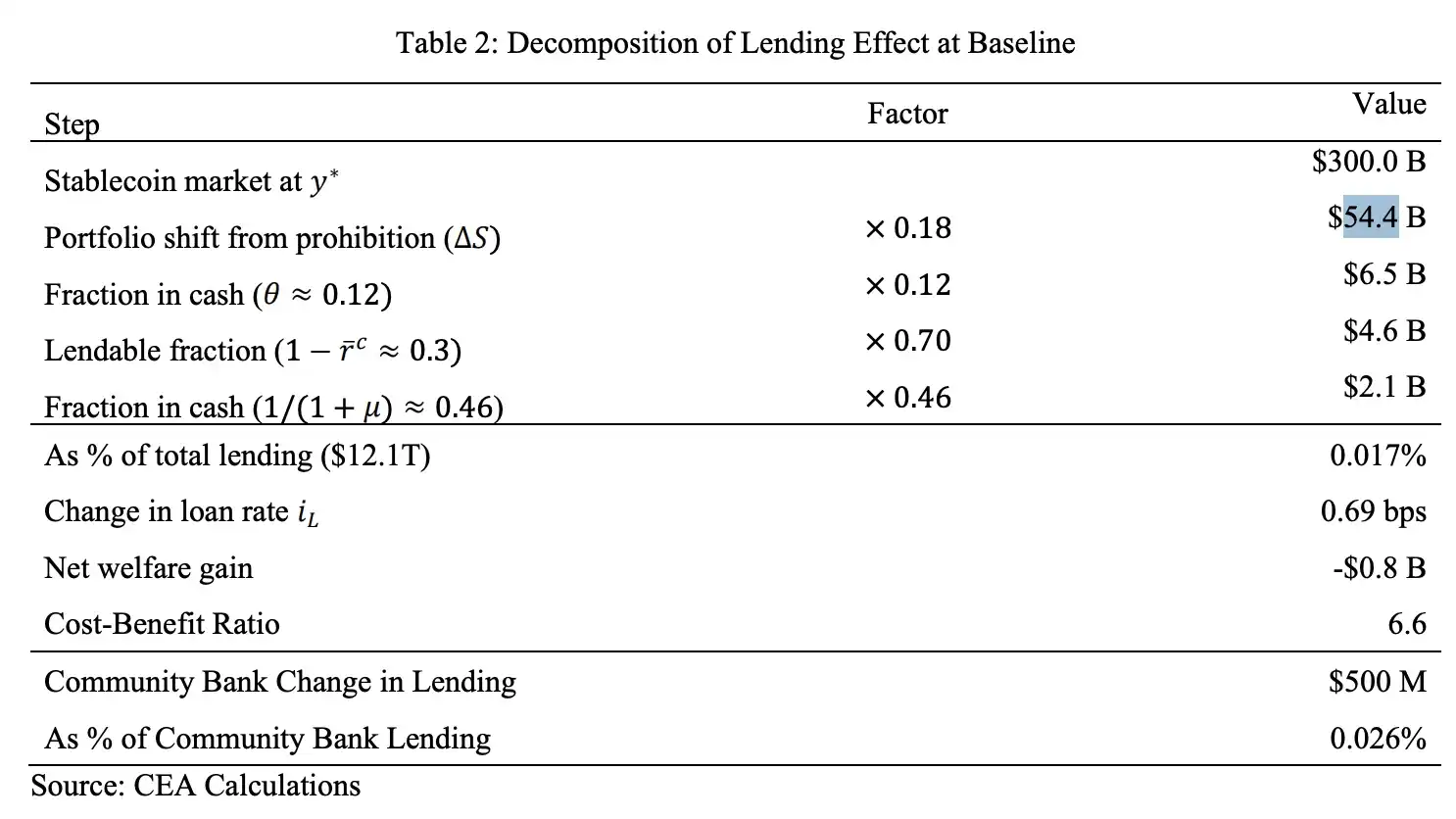
Second checkpoint: Out of this $54.4 billion, how much actually changes bank lending capacity? Only the 12% (in the case of USDC) portion, which is about $6.5 billion. The other 88% was circulating in the Treasury market before and after the ban, having no net impact on bank lending capacity.

Third checkpoint: Can the $6.5 billion entering banks be fully lent out? No. Banks need to hold reserves. The current effective reserve ratio in the U.S. banking system is about 30%, leaving 70% as lendable funds. Moreover, the Fed currently maintains an "ample reserves" framework, with banks collectively holding over $1 trillion in excess liquidity buffers—for every new dollar of lending capacity, ultimately less than 50 cents becomes a real loan, with the rest being actively absorbed by banks into their liquidity buffers.

After passing through these three checkpoints, $54.4 billion becomes $2.1 billion, only 0.02% of total loans (about $12 trillion).

Then calculate the cost on the other side: stablecoin holders lose the approximately 3.5% annualized yield they could have obtained, resulting in a net welfare loss of about $800 million per year.

In the CEA's words, the cost-benefit ratio of this ban is 6.6, meaning the cost is 6.6 times the benefit, making it very inefficient.

How Was That $1.5 Trillion Calculated?

Since the White House model gives $2.1 billion, where did the original $1.5 trillion come from?

The CEA traces its origins in the report. Nigrinis's (2025) estimate directly borrowed the model established by Whited, Wu, and Xiao (2023) for Central Bank Digital Currency (CBDC)—CBDC, as a liability of the Fed, would directly withdraw deposits from the commercial banking system; for every dollar entering, bank loans decrease by about 20 cents. Nigrinis directly applied this multiplier to the stablecoin scenario, while assuming stablecoins would expand massively after offering competitive yields, ultimately推算 (推算 - calculated/derived) the $1.5 trillion loan contraction.

The problem is, there is an essential difference between CBDC and stablecoins: CBDC is a central bank liability; deposits entering it leave the commercial banking system. The reserves of stablecoins mostly flow back to commercial banks through the Treasury market. Nigrinis's model did not track where this money went; it only saw deposits decreasing at one bank, not increasing at another.

This is the fundamental difference between partial equilibrium and general equilibrium. Mistaking the loss of one bank for the loss of the entire system naturally leads to an error of orders of magnitude.

Another Overlooked Account

The report specifically points out an effect not covered by the model but working in the opposite direction: stablecoins' overseas demand for U.S. Treasury bonds.

Over 80% of stablecoin transactions occur outside the U.S.,背后是 (behind which are) ordinary users in countries with unstable currencies using dollar stablecoins as savings tools. This group supports real demand for U.S. Treasury bonds; IMF data shows that the scale of U.S. Treasury bonds held by stablecoin issuers has surpassed that of Saudi Arabia. BIS research shows that every $3.5 billion inflow into stablecoins can depress the 3-month Treasury yield by 5 to 8 basis points. If the ban suppresses stablecoin adoption, this overseas demand channel contracts, U.S. Treasury financing costs rise, and this cost might directly offset that tiny increment on the bank lending side.

So, what does all this actually illustrate?

It's not that stablecoins have no impact on banks, but rather that the source of that impact, to a very large extent, is not "whether they can pay interest." The真正关键的 (truly crucial) thing is what proportion of the stablecoin issuer's reserves are placed in that must-be-100%-reserved lockbox. If regulations push this proportion higher in the future, the impact would才开始变得显著 (begin to become significant).

Regarding the ban on paying interest, for bank lending, the cost-benefit ratio is 6.6; for the stablecoin ecosystem, it cuts off its ability to provide competitive yields to ordinary users; for U.S. Treasury financing, it might even be counterproductive.

One piece of legislation, with no clear beneficiary, but with clear losers. This is what is truly thought-provoking about this report.


Criptos en tendencia

Preguntas relacionadas

QWhat was the original claim made by economist Andrew Nigrinis regarding stablecoin interest and bank lending?

AAndrew Nigrinis claimed that if stablecoins could pay interest, bank loans could be reduced by $1.5 trillion.

QAccording to the White House CEA report, what is the estimated impact on bank lending from banning stablecoin interest payments?

AThe CEA report estimates that banning stablecoin interest payments would only increase bank lending by $2.1 billion, not $1.5 trillion.

QWhat is the key difference between a CBDC and a stablecoin that the CEA report highlights to explain the discrepancy in the estimates?

AThe key difference is that a CBDC is a central bank liability that removes deposits from the commercial banking system, while stablecoin reserves largely flow back into the commercial banking system through the Treasury market.

QWhat percentage of Circle's USDC reserves are held in Treasury bonds and repurchase agreements, according to the article?

A88% of Circle's USDC reserves are held in Treasury bonds and repurchase agreements.

QWhat unintended consequence does the article suggest could result from suppressing stablecoin adoption through an interest ban?

ASuppressing stablecoin adoption could reduce foreign demand for U.S. Treasury bonds, potentially increasing U.S. Treasury financing costs.

Lecturas Relacionadas

From Gold to Bitcoin: Fixed Supply + Institutional Frenzy, Might It Repeat the 'Explosive' Price Trend?

"From Gold to Bitcoin: Fixed Supply and Institutional Frenzy May Lead to 'Explosive' Price Rally Analysts suggest Bitcoin's price action could mirror gold's over the past two decades, following the launch of spot Bitcoin ETFs. Gold ETFs, introduced in 2004, drove gold's price surge to a current market cap near $28 trillion. Both gold and Bitcoin are non-yielding stores of value, with prices driven purely by investor sentiment rather than cash flows or credit. Gold ETFs experienced dramatic cycles: explosive growth, painful drawdowns, and slow recoveries, with each cycle reaching higher peaks. Bitcoin ETFs, approved in early 2024, saw rapid institutional adoption but are now facing similar volatility. Recent warnings highlight the risk of significant ETF outflows disrupting the current rebound. BlackRock's IBIT, a leading Bitcoin ETF, has sold nearly 100,000 BTC to meet redemptions while still holding over 733,000. The core parallel is fixed supply: when demand surges, prices explode, but demand is often volatile and wave-like, not steady. Institutional interest, through ETFs and corporate adoption, remains a key support pillar, helping to cushion sell-offs. If Bitcoin captures even a fraction of gold's role as a store of value, its upside potential is immense, though the path will be marked by high volatility. For investors, focusing on long-term trends and managing risk is crucial as this 'price explosion' narrative unfolds."

Foresight NewsHace 6 min(s)

From Gold to Bitcoin: Fixed Supply + Institutional Frenzy, Might It Repeat the 'Explosive' Price Trend?

Foresight NewsHace 6 min(s)

Why Is AI Agent Shopping Hard to Popularize?

The article argues that the popular narrative of "AI agent shopping" – equipping AI with a wallet to autonomously handle purchases – is fundamentally flawed and oversimplifies the complexity of shopping. It deconstructs shopping into two core actions: **information retrieval** (standardized, easily automated) and **value judgment** (deeply subjective and human-centric). The narrative mistakenly assumes AI can fully handle both. Value judgment itself has two layers: **evaluation** (assessing options against criteria) and **demand definition** (setting the criteria, weights, and values). The latter is inherently human and dynamic, as preferences are not fixed but constructed during the decision-making process ("constructive preferences"). The real dividing line for automation is not product standardization, but whether the **act of choosing** itself holds experiential value. For mundane purchases (e.g., printer paper), full AI delegation works. For experiential goods (e.g., wine, furniture), the joy of selection is core to consumption, so AI should act as an assistant that narrows options, leaving the final choice to humans. The "AI wallet" concept confuses three separate elements: decision-making, execution, and fund custody. Current payment industry solutions (e.g., from Stripe, Mastercard, Google, Visa) show that limited, scoped payment authorization tokens are sufficient for most consumer scenarios, not full fund custody. The true use case for autonomous AI wallets is in **B2B procurement** and **machine-to-machine (M2M) settlements** for standardized, high-frequency, low-value transactions. The real bottlenecks for AI shopping are not payment technology, but **1) the lack of trusted data sources** (e.g., fake reviews, counterfeit goods) and **2) the impossibility of automating human demand definition**. The conclusion is that the focus should be on safely automating the assessment and filtering process while reserving for humans the rights to define their criteria and enjoy the final act of choice. For experiential goods, the platform's competitive advantage shifts to providing a superior selection experience.

Foresight NewsHace 1 hora(s)

Why Is AI Agent Shopping Hard to Popularize?

Foresight NewsHace 1 hora(s)

After Nine Months of Shorting, a Full Turn to Long: Renowned Trader Opens Bitcoin Positions Around 64K, Crypto Market Long-Short Divergence Intensifies

After nine months of being short, prominent crypto trader Doctor Profit has closed all his bearish positions and started buying Bitcoin near $64,000, signaling a complete bullish reversal. He argues that structural market changes—such as impending U.S. regulation (CLARITY Act) and institutional adoption via securities tokenization—are rewriting the traditional four-year cycle script, potentially bringing the market bottom forward from the widely expected September/October timeframe. This view finds some technical support from on-chain analyst gumsays, who notes a bullish divergence on Bitcoin's weekly chart has persisted for 147 days, nearing the 161-day duration seen before the 2022 cycle low. However, cycle researcher Jake Pahor presents a counter-argument based on historical data. Analyzing patterns since 2014, he identifies three common features of past bear market bottoms: a ~12-month duration from peak to trough, a sustained period of extreme fear (with a proprietary risk score below 20), and the price falling below Bitcoin's realized price (~$53,000 currently). The current cycle, only nine months from its October 2025 peak, meets none of these conditions. The debate highlights a market torn between "front-running" a potential early bottom driven by new fundamentals and waiting for confirmation through traditional on-chain and sentiment metrics. While Doctor Profit opts for aggressive buying, Pahor maintains a disciplined, tiered accumulation strategy, continuing weekly buys at current risk levels but reserving larger orders for if more extreme fear emerges.

marsbitHace 1 hora(s)

After Nine Months of Shorting, a Full Turn to Long: Renowned Trader Opens Bitcoin Positions Around 64K, Crypto Market Long-Short Divergence Intensifies

marsbitHace 1 hora(s)

Senior Trader's Confession: How to Trade Market's False Expectations?

Veteran trader's case study: trading the market's "wrong expectations". This trade centered on a textbook "expectation error" after a weak CPI report. While the market initially priced in broad monetary easing (sending Nasdaq to 30,060), the crucial 30-year real yield hit a 20-year high. This signaled a fractured transmission mechanism: short-term rates eased, but long-term funding costs (vital for tech valuations) refused to fall. The trader executed five short positions on the Nasdaq (NQ) as it fell from 30,060 to 28,768. The core methodology: don't just trade the data, but analyze the market's implied causal chain and identify where it breaks. In this case, the chain was: Weak CPI → Policy Easing → Lower Long-Term Funding Costs → NQ Valuation Expansion. The break occurred between policy easing and long-term rates. The "veto variable" – long-term real yields – refused to confirm the bullish narrative. Trades were structured around "fast variables" (price) temporarily repairing while "slow variables" (funding conditions) remained broken. The article outlines a repeatable framework: 1) Map the market's implied causal chain. 2) Identify the veto variable. 3) Observe if it rejects the narrative. 4) Enter when price still follows the old script. 5) Choose the cleanest asset expression (e.g., short NQ, not broad S&P). 6) Define both invalidation and fulfillment exit conditions. The key insight: Alpha often comes not from an information edge, but from a "reaction function edge" – recognizing when the market is applying an outdated causal logic to new data. The critical question: What causal chain is the market's first reaction relying on, and is that chain still valid today?

marsbitHace 1 hora(s)

Senior Trader's Confession: How to Trade Market's False Expectations?

marsbitHace 1 hora(s)

Trading

Spot

Artículos destacados

Cómo comprar HOUSE

¡Bienvenido a HTX.com! Hemos hecho que comprar Housecoin (HOUSE) sea simple y conveniente. Sigue nuestra guía paso a paso para iniciar tu viaje de criptos.Paso 1: crea tu cuenta HTXUtiliza tu correo electrónico o número de teléfono para registrarte y obtener una cuenta gratuita en HTX. Experimenta un proceso de registro sin complicaciones y desbloquea todas las funciones.Obtener mi cuentaPaso 2: ve a Comprar cripto y elige tu método de pagoTarjeta de crédito/débito: usa tu Visa o Mastercard para comprar Housecoin (HOUSE) al instante.Saldo: utiliza fondos del saldo de tu cuenta HTX para tradear sin problemas.Terceros: hemos agregado métodos de pago populares como Google Pay y Apple Pay para mejorar la comodidad.P2P: tradear directamente con otros usuarios en HTX.Over-the-Counter (OTC): ofrecemos servicios personalizados y tipos de cambio competitivos para los traders.Paso 3: guarda tu Housecoin (HOUSE)Después de comprar tu Housecoin (HOUSE), guárdalo en tu cuenta HTX. Alternativamente, puedes enviarlo a otro lugar mediante transferencia blockchain o utilizarlo para tradear otras criptomonedas.Paso 4: tradear Housecoin (HOUSE)Tradear fácilmente con Housecoin (HOUSE) en HTX's mercado spot. Simplemente accede a tu cuenta, selecciona tu par de trading, ejecuta tus trades y monitorea en tiempo real. Ofrecemos una experiencia fácil de usar tanto para principiantes como para traders experimentados.

273 Vistas totalesPublicado en 2025.04.27Actualizado en 2026.06.02

Cómo comprar HOUSE

Discusiones

Bienvenido a la comunidad de HTX. Aquí puedes mantenerte informado sobre los últimos desarrollos de la plataforma y acceder a análisis profesionales del mercado. A continuación se presentan las opiniones de los usuarios sobre el precio de HOUSE (HOUSE).

活动图片