The Unbundling of the Stock Market

marsbitPublicado a 2026-04-06Actualizado a 2026-04-06

Resumen

The article "The Unbundling of Stock Markets" by Prathik Desai argues that traditional financial markets, built on outdated structures like fixed trading hours and centralized exchanges, are being disrupted. Recent developments, such as S&P licensing its 500 index to a new crypto exchange (Hyperliquid), Nasdaq's SEC-approved tokenized stock trading, and Cboe's proposal for near 24/5 US equity trading, signal a shift towards unbundled, efficient, and accessible markets. Capital seeks the fastest path to price information, and new platforms like Hyperliquid's HIP-3, which offers 24/7 trading of traditional assets (e.g., commodities, indices) via perpetual contracts, are gaining traction due to their liquidity, lower friction, and ability to react to global events in real-time. The author concludes that market participants will adopt any structure that reduces the delay between events and price discovery, regardless of whether it originates from traditional institutions or permissionless blockchain platforms.

Author: Prathik Desai

Compiled by: Block unicorn

Preface

Clocks are not a good way to cover up delays. For decades, financial markets have been built around the speed of information transmission. They introduced closing bells, batch settlements, and regional exchanges, which made sense in an era of slow information flow. But all that has changed. Capital does not wait. Just as water always finds a crack, so does capital. Financial gravity pulls it towards the fastest path to obtain price information. This is the law of the market. Market participants will not tolerate inefficiency forever.

This is what I have observed from a macro perspective over the past few weeks as financial markets have evolved.

In today's article, I will help you understand what has broken the old bundled structure of financial markets, transforming it into a more efficient, unbundled structure that spans different venues, wrappers, and times.

Changing of the Guard

I have been studying finance for over a decade. In the early stages of my learning, I always viewed traditional stock exchanges as synonymous with the market. For most of their development, stock exchanges were the place where everyone and everything converged: buyers, sellers, regulators, and the technology that drives the market. It had indices tracking its components, and it had clocks indicating trading hours, telling everyone when they could trade and when they could not.

But this has changed in the past few years. In fact, just in the past few weeks, we have seen several developments that confirm this shift.

On March 18, S&P Dow Jones Indices licensed the S&P 500 index to Trade[XYZ], allowing HIP-3 market deployers to launch the first and only S&P 500 perpetual derivatives contract on the Hyperliquid exchange. The S&P 500 is the world's most followed large-cap U.S. equity index, tracking 500 leading U.S. companies, covering about 80% of the total U.S. market capitalization, with a total market cap of over $61 trillion. The index covers at least half of the global equity market's capitalization.

This is an index with nearly 70 years of history, listed on a market that is only 6 months old.

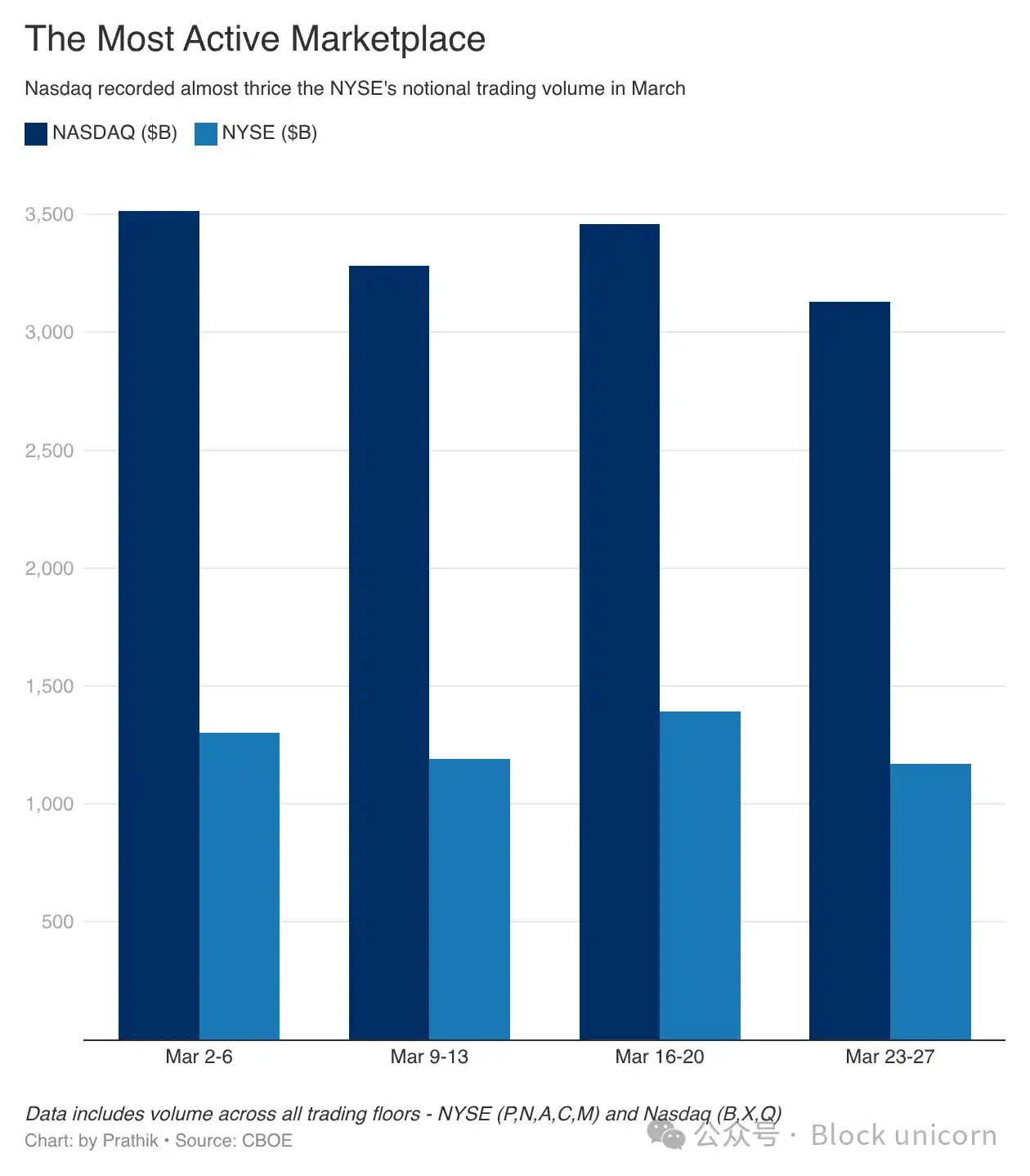
The day after S&P's announcement, the U.S. Securities and Exchange Commission (SEC) approved Nasdaq's application to trade and settle some stocks in tokenized form. Nasdaq is one of the world's most active trading venues, often exceeding the nominal trading volume of the New York Stock Exchange (NYSE), the world's largest exchange by market capitalization.
On March 16, Cboe Global Markets (Cboe Global Markets) filed a proposal with the U.S. Securities and Exchange Commission (SEC) to launch "near 24x5 U.S. equity trading." The largest operating body behind this U.S. financial exchange stated that it is ready to provide 24/5 equity trading services as early as December 2026.

But why? There is growing demand for extended U.S. equity trading hours.

These three initiatives collectively target the outdated bundled trading structure. Hyperliquid's launch of an S&P 500 futures trading market challenges the decades-old convention where investors could only trade traditional indices through traditional markets. It also enables 24/7 global trading of one of the most tracked large-cap indices.

Nasdaq's tokenized stock trading initiative targets infrastructure. It introduces a new form of wrapping, allowing the same stock to be traded in different ways. Previous attempts at tokenizing stocks have been criticized by the industry.

Investors questioned whether these tokens享有 the same rights as the original shares.

But, if I provide the same equity exposure through a token on the blockchain, without losing the voting rights and legal protections attached to the original dematerialized shares, wouldn't you accept it?

Why would you do this? What's in it for you?

Well, if you are an investor outside the U.S. who wants easier access to the stock market of the world's largest economy? What if this tokenized stock makes it easier for you to integrate it with collateral and lending systems?

When you consider 24/7 trading, these advantages multiply.

This is what Cboe is attacking. Its near 24x5 (24 hours a day, 5 days a week) trading proposal aims to acknowledge that capital does not wait for office hours. Traders always want to express their views immediately after receiving information. If Cboe does not provide them with a market to express their views, then traders will flock to other platforms that do.

Nothing I'm talking about is hypothetical, nor is it something that "might happen in the near future." They are happening, right now, as we speak.

An Unbundled Future

The adoption of financial product unbundling is most evident in Hyperliquid's HIP-3 market, which only officially launched in late October 2025.

In the past month alone, the cumulative trading volume on the HIP-3 market increased by $72 billion. The cumulative volume for the previous four months was $78 billion.
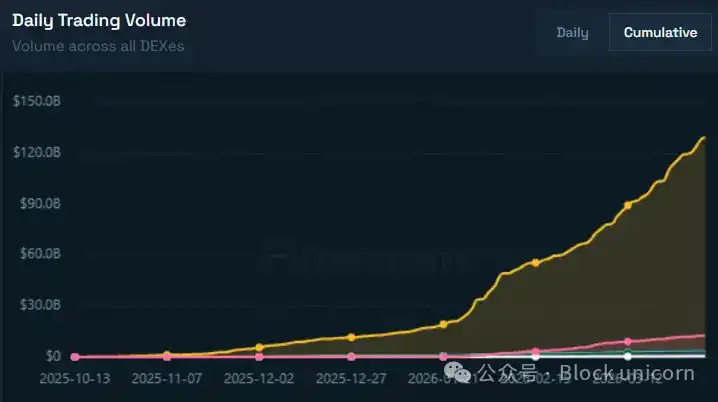
In March, Trade[XYZ] perpetual markets on traditional financial commodities and equities continued to account for 90% of HIP-3's daily trading volume. But this is not the most interesting aspect.

More than half of Trade[XYZ]'s trading volume comes from perpetual contract markets for silver, crude oil, Brent crude, and gold.

Hyperliquid provides a unified trading platform for spot cryptocurrencies as well as perpetual contracts for both cryptocurrencies and traditional assets. This not only simplifies the trading process on a unified platform but also brings higher liquidity, a unified user interface, and tighter bid-ask spreads.

Traders still want to trade some of the largest, hottest assets, spanning commodities, publicly listed companies, large private companies, and indices. You might want to trade silver, gold, crude oil, Tesla, Apple, Amazon, Google, an index tracking the top 100 U.S. non-financial companies, and the S&P 500 index—all of which can be done on the Hyperliquid platform.

HIP-3 unbundles the function of investing in these assets from the existing exchange infrastructure, while still tracking the underlying assets of their original benchmarks. So when you go long on a silver futures contract on HIP-3, the underlying asset it tracks is still pegged to the value of one ounce of silver in the Pyth data feed.

Traders have switched from previous platforms to trading silver on HIP-3 because HIP-3 does not distinguish between U.S. and non-U.S. traders, nor does it follow any specific time. Whenever an event occurs that traders want to express a view on through asset pricing, HIP-3 provides them with a market, regardless of the trader's geographic location or time zone.

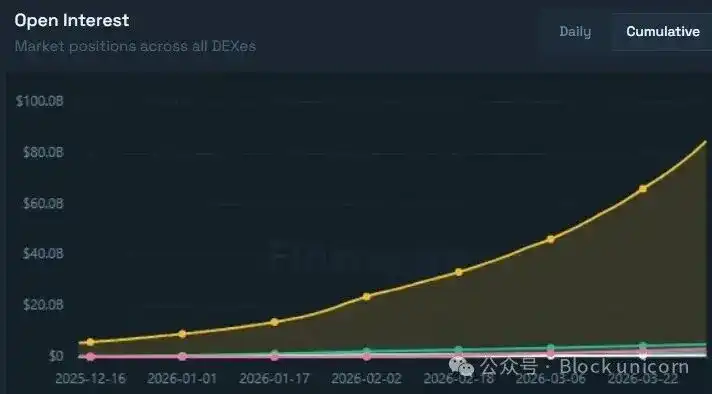
The significant growth in open interest (OI) on the Hyperliquid platform over the past few weeks fully demonstrates the above results. OI measures the total value of outstanding derivative positions. Unlike volume, which reflects trading activity, OI reflects trading commitment.
极

Open interest was $1.13 billion on March 1 and doubled to $2.2 billion on April 1. This shows that traders are confident in Hyperliquid's perpetual contracts and are locking in funds.

These metrics indicate that when market access is easier and there is less friction, traders will not be loyal to a particular platform or asset class. They will choose any platform that offers volatility, convenience, and liquidity.

This is why traditional institutions like S&P, Nasdaq, and Cboe are taking steps to acknowledge this behavior.

At least two recent events have demonstrated the importance of 24/7 trading and market volatility to traders.

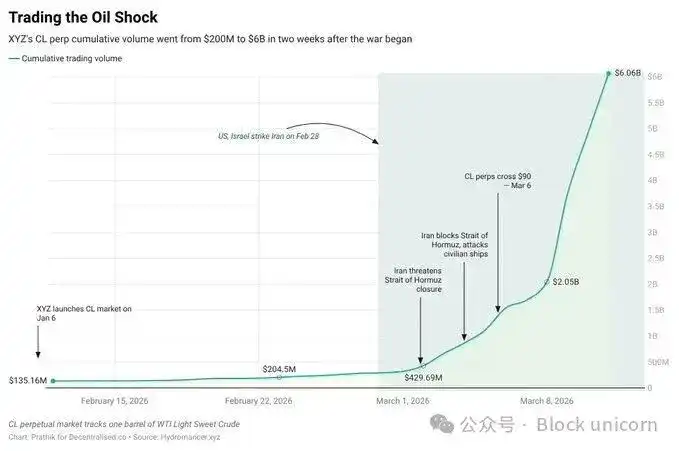
Saurabh wrote in a tweet on Decentralised.Co: "On February 28, the U.S. and Israel attacked Iran during traditional market hours. Within hours, the price of oil-linked perpetual contracts on the Hyperliquid platform surged 5% as traders digested the shock in real time."

Just two weeks after the outbreak of war, the trading volume of oil-linked perpetual contracts surged from $200 million to a cumulative $6 billion.
A major隐患 of emerging platforms is liquidity. If liquidity is insufficient, bid-ask spreads may widen, causing traders to face a pricing disadvantage worse than on other platforms.

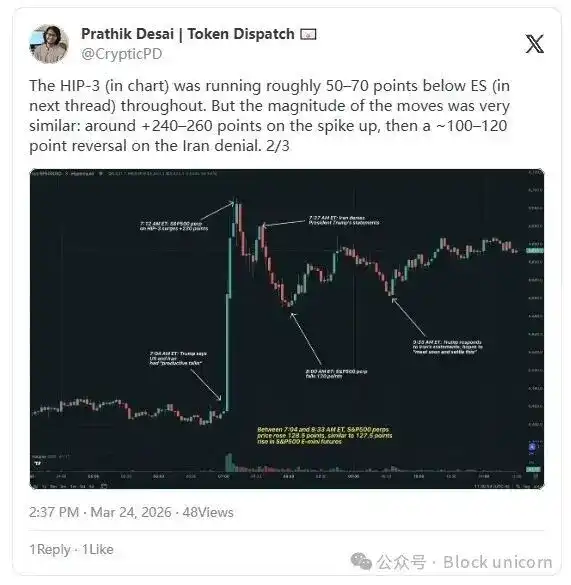
Last week, as U.S. President Trump consulted with Iranian officials on holding "productive talks," the Hyperliquid platform demonstrated its strong liquidity. The newly launched S&P 500 index futures based on the HIP-3 platform were able to accurately track the movement of the CME E-mini S&P 500 futures, down to the minute.

Although the on-chain perpetual contract was about 50–70 points lower than the ES, the magnitude of the price movement was similar.
What This Means

For decades, traditional markets have been bundled and controlled venues (exchanges), time (trading sessions), and products (indices/contracts).

They chose to maintain the status quo because they failed to establish mechanisms to address inefficiencies such as time delays, trading hour restrictions, and regulatory constraints on non-U.S. investors. Instead, they掩盖了 these inefficiencies and packaged them into procedural systems designed to build trusted institutions to attract investors.

People still trade and invest. This is not because they are stupid, or because they believe the rhetoric peddled by traditional financial markets. They do it because they have no choice. This began to change with the advent of blockchain, which provided the world with on-chain markets, making trading and investing easier than ever before.

People saw this choice and seized it.

They didn't care in the past, and they won't care in the future about changes in market structure. They also don't care whether the new structure is bundled or unbundled. As long as traders and investors can more easily express their opinions through financial instruments, they will embrace the new market structure, whether existing institutions like it or not. It doesn't matter if this structure comes from traditional giants like Nasdaq, Cboe, or S&P 500, or from a permissionless platform running on a blockchain.

The financial industry continues to evolve as it always has, and will adopt any structure that narrows the gap between the occurrence of an event and the expression of price opinion.

Important events are happening all over the world, every hour of the day. So why should prices have to wait until a clock starts ticking on a Monday morning in a glass-walled building in New York before they are determined?


Preguntas relacionadas

QWhat is the main argument presented in the article about the traditional structure of financial markets?

AThe article argues that the traditional, bundled structure of financial markets—which includes fixed trading hours, centralized exchanges, and specific product offerings—is becoming obsolete. It posits that capital seeks the fastest path to price information and that market participants will not tolerate inefficiencies, leading to an unbundled future with 24/7 trading across various venues and asset wrappers.

QWhat recent developments does the author cite as evidence of the shift towards an unbundled market structure?

AThe author cites three key developments: 1) S&P Dow Jones Indices licensing the S&P 500 to Trade[XYZ] for a perpetual derivatives contract on the Hyperliquid exchange. 2) The SEC approving Nasdaq's application to trade and settle some stocks in a tokenized form. 3) Cboe Global Markets submitting a proposal to the SEC for near 24x5 trading of U.S. stocks.

QHow does the article use the performance of Hyperliquid's HIP-3 market to support its thesis?

AThe article points to the massive growth of Hyperliquid's HIP-3 market, which saw a cumulative trading volume increase of $72 billion in just one month. It highlights that a majority of this volume is in perpetual contracts for traditional assets like silver, oil, and stock indices, demonstrating that traders are rapidly adopting new, unbundled platforms that offer 24/7 access, lower friction, and unified trading for both crypto and traditional assets.

QAccording to the article, what is a major historical reason traditional markets maintained their bundled structure?

AThe article suggests that traditional markets maintained their bundled structure not because it was the most efficient, but because they failed to build mechanisms to solve inherent inefficiencies like time delays, trading hour restrictions, and regulatory limits for non-U.S. investors. Instead, they masked these inefficiencies by packaging them as procedural rituals designed to create an aura of trust and institutional reliability.

QWhat fundamental force does the author identify as the driver behind the move to unbundle markets?

AThe author identifies 'financial gravity' as the fundamental force. This is the idea that capital, like water, will always find the path of least resistance and fastest access to price information. Market participants will naturally migrate to any structure that minimizes the gap between when an event occurs and when a price opinion can be expressed, regardless of whether it comes from a legacy institution or a new, permissionless platform.

Lecturas Relacionadas

The Largest IPO in History Ignites Heated Debate: Is SpaceX Worth $1.77 Trillion?

SpaceX's potential IPO is priced at $135 per share, aiming to raise $75 billion and valuing the company at approximately $1.77 trillion, which would make it the largest IPO in history. This valuation has sparked intense debate among investors. Bullish analysts, including major underwriters Goldman Sachs and Morgan Stanley, argue the valuation is justified by SpaceX's long-term potential. They see it not just as a rocket company but as a future leader in space infrastructure, with key growth drivers being Starlink satellite internet, low-cost rocket launches, and future AI-related ventures. They project revenues reaching hundreds of billions to trillions of dollars by 2030-2040. ARK Invest's model suggests a 2030 enterprise value could reach $2.5 trillion. Bearish analysts from independent research firms like Morningstar, PitchBook, and New Constructs contend the IPO price is excessively high, already pricing in unrealistic future growth. Using DCF and sum-of-the-parts models, they estimate fair value between $780 billion and $1.7 trillion, significantly below the IPO target. They highlight risks such as the speculative nature of AI projections, over-dependence on Elon Musk, high growth expectations, and corporate governance concerns. Trefis set a target price of just $79 per share. While both sides acknowledge SpaceX's unique position in commercial space, the core disagreement centers on whether the $135 share price offers a reasonable margin of safety or is overly optimistic. Despite the valuation controversy, reported strong demand for the IPO indicates significant market interest.

marsbitHace 45 min(s)

The Largest IPO in History Ignites Heated Debate: Is SpaceX Worth $1.77 Trillion?

marsbitHace 45 min(s)

After the Passage of the GENIUS Act and the CLARITY Act, What Is the Correct Architecture for On-Chain Yield?

The article discusses the evolution of on-chain credit, distinguishing three markets: overcollateralized crypto lending, unsecured lending (largely unsuccessful), and asset-backed credit (ABC). ABC, backed by identifiable real-world collateral with legal recourse, is identified as the fastest-growing category and the only one credibly addressing adverse selection—the core problem in credit where the riskiest borrowers self-select. Current growth in on-chain Real World Assets (RWAs), particularly tokenized private credit funds (e.g., Maple Finance, Centrifuge), is substantial but often merely "wraps" existing fund structures, inheriting their risks rather than solving adverse selection at the protocol level. The regulatory landscape is a key driver, with the US GENIUS Act (prohibiting stablecoin issuers from paying yield) and the proposed CLARITY Act (closing loopholes on indirect yield) set to redefine permissible yield-bearing products. This makes vaults (like ERC-4626) the critical architecture—they become the primary compliant vehicle for delivering yield, functioning as issuance, disclosure, distribution, and recovery mechanisms. The author's thesis is that the correct post-GENIUS/CLARITY architecture involves building ABC solutions where credit assessment, structure, and recovery are encoded directly into the smart contract vault layer, moving beyond mere tokenized fund wrappers to solve adverse selection fundamentally and ensure regulatory compliance.

Foresight NewsHace 1 hora(s)

After the Passage of the GENIUS Act and the CLARITY Act, What Is the Correct Architecture for On-Chain Yield?

Foresight NewsHace 1 hora(s)

TechFlow Intelligence Bureau: Anthropic's New Model Fable Sparks Controversy by Restricting Biosafety Research, US CPI Soars to 4.2%, a Three-Year High

**Summary of TechFlow Intelligence Report:** The newsletter covers several key tech and finance developments. In AI, Anthropic's new Fable model faced backlash for secretly limiting biomedical research capabilities and enforcing a 30-day data retention policy, prompting the company to promise more transparent adjustments. In a related story, Anthropic's founder revealed his departure from OpenAI was due to dishonesty from Sam Altman, not safety concerns. Meanwhile, OpenAI is considering significant price cuts to compete with Anthropic, potentially sparking a price war. In crypto/Web3, BlackRock filed a new amendment for a yield-generating Bitcoin ETF, while Bank of America's CEO warned that stablecoin yields could drain trillions from traditional banks. U.S. Senator Cynthia Lummis advocated for the U.S. to officially accumulate Bitcoin reserves. In hardware, Nvidia released the DiffusionGemma-2-6B image model optimized for efficient inference, and AMD promoted its unified memory architecture to challenge Nvidia's dominance. TSMC's CFO hinted at possible price increases due to soaring AI chip demand. A major legal ruling in Germany held Google legally responsible for inaccurate information generated by its AI Overviews feature. Google Chrome also moved to fully block ad-blocker workarounds like uBlock Origin. Macroeconomic headlines included U.S. CPI rising to 4.2% (a 3-year high) and Iran's complete closure of the Strait of Hormuz, raising oil price and inflation fears. South Korean markets saw continued volatility with massive foreign capital outflow. Other notable stories: Microsoft expanded its Copilot AI assistant "Mico" globally; a study found r/wallstreetbets users' stock picks outperformed Wall Street; a fully autonomous drone killed a human soldier for the first time, raising AI ethics concerns; and a Chinese hospital used brain-computer interface technology to help a blind person "see." The overarching theme connects debates over AI boundaries and responsibility (Anthropic's restrictions, Google's liability, lethal autonomous drones) with real-world economic and geopolitical turmoil (inflation, Strait of Hormuz closure, market instability), highlighting the tense interplay between technological advancement and global chaos.

marsbitHace 1 hora(s)

TechFlow Intelligence Bureau: Anthropic's New Model Fable Sparks Controversy by Restricting Biosafety Research, US CPI Soars to 4.2%, a Three-Year High

marsbitHace 1 hora(s)

Alibaba's Yet Another New Business Division: What Signal Does It Send?

Alibaba has established a new "Token Foundry" business unit, merging its Tongyi large model division and Future Life Lab. Led directly by Group CEO Wu Yongming, this marks the company's third significant AI organizational reshuffle in 2026, following the creation of the Alibaba Token Hub (ATH) and a Group Technology Committee. The move signals a strategic shift from consolidating AI resources to accelerating productization and commercialization. The "Token Foundry" name reflects Alibaba's ambition to become a foundational supplier in the AI era, focusing on model development and commercial application. Key teams, including those behind the high-performing HappyHorse video generation model, have been integrated into the new unit. Concurrently, Zhou Jingren, architect of the Qwen model series, has been appointed Group Chief Scientist to lead a new AI Future Research Institute, focusing on long-term technological breakthroughs like Agent capabilities. This restructuring creates a clear four-layer AI architecture within Alibaba: the research institute for frontier exploration, Token Foundry for core models and commercialization, MaaS for platform services, and business units like Qianwen (C端) and Wukong (B端) for end-user applications. The adjustments align with a global trend among tech giants like Google and Microsoft to centralize AI leadership under the CEO and deeply integrate research with business units. The urgency is driven by a narrowing competitive window. Alibaba has announced its AI business is now entering a commercialization phase, with AI-related revenue seeing triple-digit growth for eleven consecutive quarters. The company faces intense competition in the MaaS (Model-as-a-Service) sector from rivals like ByteDance and Tencent. The Token Foundry initiative represents Alibaba's effort to streamline execution and enhance competitiveness in this critical, fast-evolving landscape.

marsbitHace 2 hora(s)

Alibaba's Yet Another New Business Division: What Signal Does It Send?

marsbitHace 2 hora(s)

Trading

Spot
Futuros
活动图片




