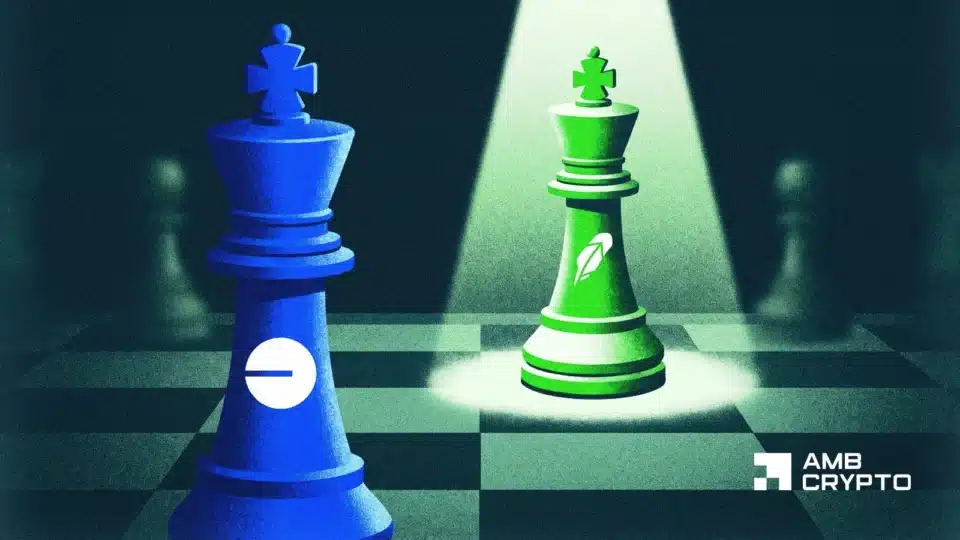
The Trillion-Dollar Stablecoin War: Binance Decides to Re-enter the Fray

marsbitPublicado a 2025-12-24Actualizado a 2025-12-24

Resumen

The stablecoin market, with $27.6 trillion in on-chain transfers in 2024, has surpassed the combined volume of Visa and Mastercard. This marks a shift from a niche crypto product to a critical piece of global financial infrastructure. The article outlines the evolution of stablecoins. The 1.0 era was defined by first-mover advantage and passive monopolies. Tether's USDT dominates with a 60% market share, while Circle's USDC, despite its compliance focus, faced a crisis during the 2023 Silicon Valley Bank collapse, proving that network effect is the ultimate moat. Binance's journey reflects this competitive landscape. Its first stablecoin, the regulated BUSD, was shut down by U.S. regulators in 2023. It then pivoted to supporting FDUSD and has now taken a strategic stake in a new model with the launch of $U. Unlike traditional stablecoins, $U is a "stablecoin ETF" or "套娃" (nesting doll), backed by a basket of existing stablecoins: USDT, USDC, and the politically-connected USD1 from the Trump family. USD1's rapid growth, including a $2 billion investment into Binance from an Abu Dhabi fund, highlights a new dimension: stablecoins. The article argues that stablecoins are no longer just financial tools but vehicles for political capital and a new front in the battle for monetary influence, as evidenced by the U.S. passing the GENIUS Act to establish a federal regulatory framework. The "nesting doll" structure of $U aims to mitigate single-point risks (e.g., USDT's opacity, US...

In 2024, the total on-chain transfer volume of stablecoins reached $27.6 trillion, surpassing the combined total of Visa and Mastercard for the first time.

This figure was $300 billion five years ago and close to zero a decade ago.

On December 18, a project named United Stables launched a new stablecoin, $U, in Dubai. Its reserves are not U.S. dollar cash or treasury bonds but a combination of three stablecoins: USDC, USDT, and USD1. Using stablecoins to collateralize stablecoins is known in the industry as "nesting."

Binance Wallet integrated immediately, with official endorsement from BNB Chain, and full support from PancakeSwap and Four.Meme.

This configuration sends a clear message in the crypto circle: Binance is personally entering the fray.

$U itself may be insignificant. But the trend it represents is clear: stablecoins are moving from wild growth to a state of rival regimes, and a new battle is beginning.

Stablecoin 1.0 Era: The Monopoly of First Movers

The essence of stablecoins is "on-chain dollars." Users deposit $1 with the issuer and receive 1 token, which can circulate on any blockchain globally, 24/7, with second-level settlement and fees of just a few cents.

Compared to Alipay or bank transfers, the core advantage of stablecoins is that they require no real-name verification, no bank account, and no regulatory approval. A wallet address is the only barrier to entry.

When Tether issued USDT in 2014, the entire crypto market's capitalization was less than $50 billion. So Tether seized the opportunity window: traditional banks generally refused to provide services to cryptocurrency companies. The only way to cash out profits after trading cryptocurrencies was to exchange crypto assets for USDT, locking in dollar-denominated gains.

USDT's rise was not just due to a superior product but also because users had no other choice. This "passive monopoly" has continued to this day. As of December 2025, USDT's market capitalization is approximately $199 billion, accounting for 60% of the stablecoin market.

In 2018, Circle, in partnership with Coinbase, launched USDC, emphasizing compliance: monthly reserve audit reports, funds custodied with regulated financial institutions, and adherence to the U.S. securities regulatory framework. The subtext was that Tether's black-box model would eventually cause problems.

By 2022, USDC's market cap once approached 70% of USDT's. Wall Street bet that the compliant faction would ultimately prevail.

In March 2023, Silicon Valley Bank collapsed. Circle had $3.3 billion in reserves deposited there. USDC briefly depegged to $0.87—an asset promised to always equal $1 had lost 13% of its value.

The lesson the market drew was: compliance is a plus, but not a moat. Banks can fail, regulators can change course; the real barrier is network effects—when your user base and liquidity are large enough, you become the de facto standard.

The survival rule of the Stablecoin 1.0 era was simple: first-mover advantage trumps everything.

Binance's Three Pivots

Exchanges are the traffic hubs of the crypto world, and stablecoins are the unit of account for trading. Whoever controls the mainstream stablecoin holds pricing power. Binance cannot afford to give up this position.

In 2019, Binance partnered with Paxos, a New York-licensed trust company, to issue BUSD. This was a compliant stablecoin regulated by the New York Department of Financial Services, with a peak market cap of $16 billion, second only to USDT and USDC.

BUSD once accounted for 40% of Binance's trading volume. It was a core tool for Binance to establish its autonomous "monetary sovereignty."

In February 2023, the SEC issued a Wells Notice to Paxos, alleging that BUSD was an unregistered security. On the same day, the New York Department of Financial Services ordered Paxos to stop minting new BUSD. Nine months later, Binance founder CZ pleaded guilty in the U.S., and Binance paid a $4.3 billion fine.

$16 billion in stablecoin assets was reduced to zero under regulatory pressure.

Binance reacted quickly. Shortly after BUSD was halted, the Hong Kong company First Digital launched FDUSD,恰好 coinciding with the launch window of Hong Kong's virtual asset licensing system. FDUSD quickly became one of the main stablecoins on the Binance platform, although the two parties never publicly confirmed a partnership.

The move from BUSD to FDUSD was passive survival; the move from FDUSD to $U is active positioning.

The design logic of $U is fundamentally different from the previous two: it does not directly compete with USDT, USDC, or USD1 but incorporates them all into its reserve pool. In a sense, $U is a "stablecoin of stablecoins" or a "stablecoin ETF."
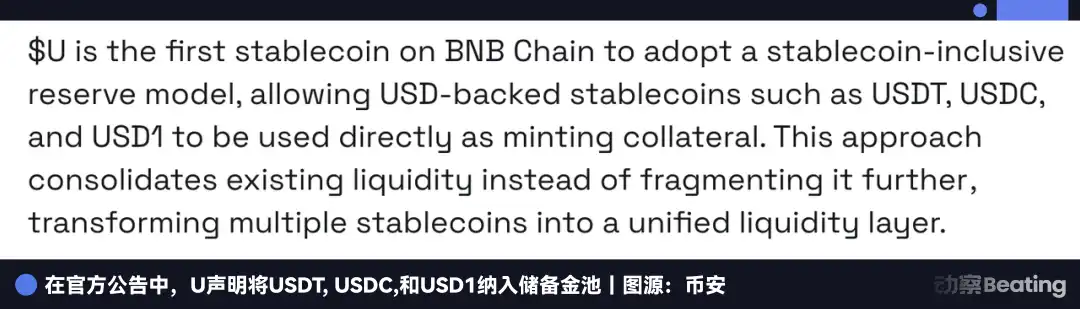
Binance's lesson is: stablecoins reliant on a single regulatory framework always have their lifelines held by others.

The Presidential Family Enters the Fray

The most noteworthy component in $U's reserves is USD1.

In March 2025, the Trump family issued the USD1 stablecoin through World Liberty Financial. According to public disclosures, Trump family-related entities hold 60% of the parent company's equity and receive 75% of the net income share. Trump himself serves as the "Chief Cryptocurrency Advocate," while his sons Eric and Donald Jr. serve as "Web3 Ambassadors."

By December 2025, the Trump family had already profited over $1 billion from the project.

Two months after its issuance, USD1 received its first major order: the Abu Dhabi sovereign wealth fund MGX invested $2 billion in Binance, using USD1 as the payment tool.

This was the largest cryptocurrency payment in history, instantly providing the nascent stablecoin with $2 billion in "practical endorsement."

As of December, USD1's market cap is approximately $2.7 billion, ranking seventh among stablecoins and becoming one of the fastest-growing.

Now, USD1 has been included in $U's reserves. This implies a hidden chain of interests: part of Binance's ecosystem trading volume is converted into usage scenarios for USD1; part of USD1's usage scenarios is converted into income for the Trump family.

The deeper game lies in the monetization of political capital. After Trump returned to the White House, the SEC suspended investigations into several crypto projects, including cases involving Sun Yuchen, a major investor in World Liberty Financial. Treasury Secretary Besant stated clearly at the White House Crypto Summit: "We will use stablecoins to maintain the dollar's status as the world's reserve currency."

Stablecoins are no longer just financial tools; they are becoming carriers of political resources.

The Logic of Nesting

Using stablecoins to collateralize stablecoins might seem redundant. But this design is based on three considerations.

Risk Diversification. USDT's hidden danger lies in its opaque reserves; USDC's隐患在于 its over-reliance on the U.S. banking system, as the Silicon Valley Bank incident warned; USD1's隐患在于 its deep binding with Trump's political fate. Holding any one alone means bearing its specific risk. Combining the three theoretically allows for risk hedging.

Liquidity Aggregation. The pain point of the stablecoin market is fragmented liquidity. USDT has its liquidity pools, USDC has its own, and funds are scattered across dozens of public chains and hundreds of DeFi protocols. $U attempts to connect these isolated pools, providing users with a unified liquidity entry point.

Narrative Upgrade. The competitive dimension of Stablecoin 1.0 was "who is more transparent" and "who is more compliant"—a rhetoric repeated for a decade. $U attempts to provide a new narrative framework: "settlement currency designed for the AI era," "supporting gasless signature transfers."

Of course, gasless transfers are part of the EIP-3009 standard, which existed in 2020, and USDC already supports it. So "AI-native" is more of a universal label; any on-chain stablecoin can be called by smart contracts and enable automatic machine-to-machine payments. $U's real differentiation lies not in technology but in its ecosystem and aggregated architecture.

Naturally, the nested structure also implies risk transmission: if one layer has a problem, the effects ripple through.

If USDT were to collapse one day, $U would not go to zero completely but would certainly承受 the impact: reserves shrinking, redemption pressure surging, depegging risk rising.

所谓 "Risk diversification" is more accurately "diversifying the intensity of impact from a single point of failure," ensuring that holders don't lose everything if any underlying asset fails. It's a bottom-protection mindset, not a risk-free design.

From Gray Zone to Great Power Game

2025 is the first year of stablecoin regulation.

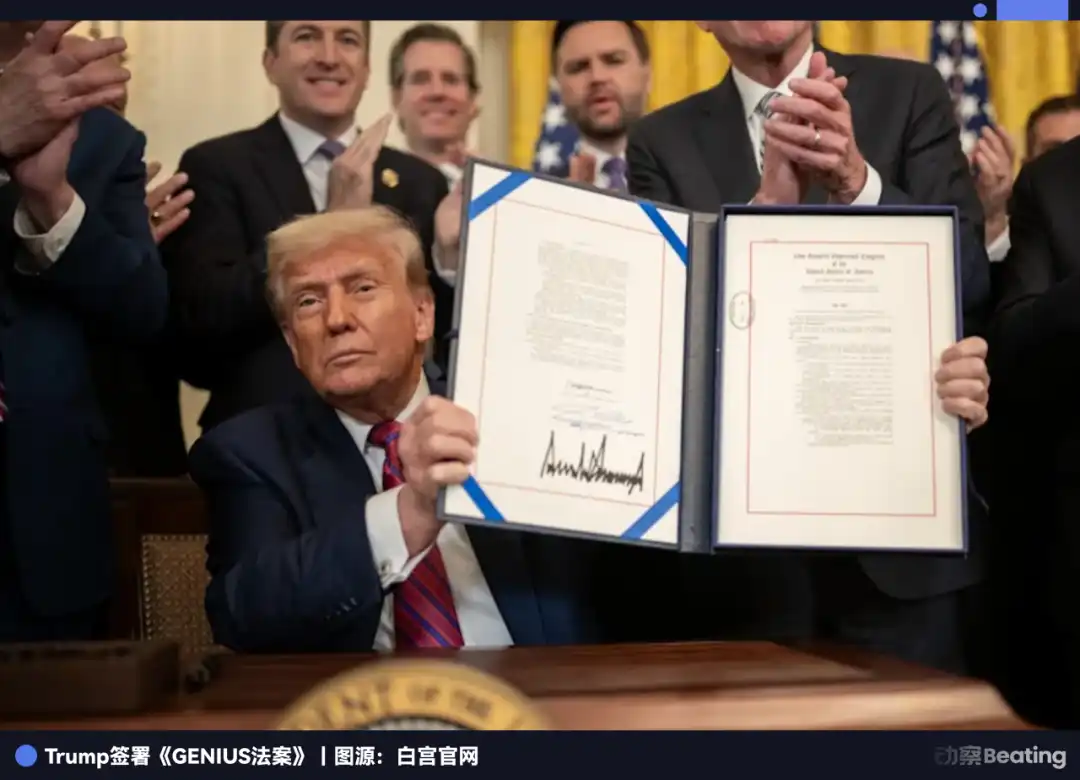
In June, Circle listed on the NYSE, with an IPO price of $31, closing at $69 on the first day, its market cap approaching $20 billion, becoming the "first stablecoin stock." In the same month, the U.S. Senate passed the GENIUS Act with 68 votes in favor, establishing a federal regulatory framework for stablecoins for the first time. The EU's MiCA regulations came into full effect, and Hong Kong, Japan, and Singapore相继 introduced licensing systems.

Over the past decade, stablecoins existed in a gray area, with regulators lacking grounds for intervention. Now, with an annual transfer volume exceeding the world's largest payment network, no government can continue to pretend not to see it.
Data shows: 34% of adults in Turkey hold USDT to hedge against the lira's depreciation; nearly 30% of remittances in Nigeria are completed via stablecoins; tech workers in Argentina普遍 use USDC to receive salaries, bypassing local currency inflation. In these countries, stablecoins are already the de facto "shadow dollar."

The foundation of dollar hegemony is not the Fed's money-printing ability but the inertia of global trade being denominated and settled in dollars. If stablecoins become the next-generation cross-border payment infrastructure, controlling stablecoins means controlling dollar hegemony in the digital age.

This is the underlying logic behind the Trump family's entry and the reason why the GENIUS Act passed with rare bipartisan consensus: in Washington, stablecoins are no longer a小众 issue for the crypto circle but a strategic resource concerning national interests.

The Imminent Battle

Whether $U will succeed is still uncertain. Its current circulating market cap is negligible compared to USDT's nearly $200 billion and USDC's nearly $80 billion.

But it represents a new paradigm in stablecoin competition.

Competition in the 1.0 era was about going it alone: Tether established a monopoly with first-mover advantage, Circle tried to leverage compliance to撬动 the market, and Binance fought for pricing power through BUSD. The core question was "who can survive."

Competition in the 2.0 era is about forming alliances. PayPal issued PYUSD, Ripple launched RLUSD, Robinhood teamed up with Galaxy Digital and Kraken to form the USDG alliance. Traditional financial giants, crypto-native players, sovereign capital, and political forces have all entered the arena.

The new core question becomes "who can tie more players together."

$U's strategy is to achieve aggregation through "nesting": not making enemies with any party, but turning everyone into its "underlying asset." Binance's intention is to build a "decentralized centralization": using an aggregated architecture to分散 regulatory risk while maintaining control over the core ecosystem.

This hundred-army battle has no final outcome. The regulatory balance is still swaying, technological boundaries are still expanding, and political variables are still accumulating.

The only certainty is: stablecoins have moved from being supporting actors in cryptocurrency to key infrastructure in the global financial system. An annual trading volume of $27 trillion is enough to make anyone who underestimates it pay the price.


Preguntas relacionadas

QWhat is the total on-chain transfer volume of stablecoins in 2024, and how does it compare to Visa and Mastercard?

AIn 2024, the total on-chain transfer volume of stablecoins reached $27.6 trillion, surpassing the combined total of Visa and Mastercard for the first time.

QWhat is the unique feature of the new stablecoin $U launched by United Stables, and what is this structure called in the industry?

AThe unique feature of $U is that its reserves are not US dollars or treasury bonds but a combination of three other stablecoins: USDC, USDT, and USD1. This structure is referred to as a 'nested doll' or '套娃' in the industry.

QWhat was the major event in March 2023 that caused USDC to depeg, and what was the market's lesson from this incident?

AIn March 2023, the collapse of Silicon Valley Bank caused USDC to depeg, briefly dropping to $0.87. Circle had $3.3 billion in reserves held at the bank. The market learned that compliance is an advantage but not a moat; the real barrier is network effect—when a stablecoin has enough users and liquidity, it becomes the de facto standard.

QHow did the Trump family get involved in the stablecoin market, and which major transaction significantly boosted the credibility of their stablecoin USD1?

AThe Trump family entered the stablecoin market in March 2025 by issuing USD1 through World Liberty Financial. A major transaction that significantly boosted its credibility was the Abu Dhabi sovereign fund MGX's $2 billion investment in Binance, which was paid using USD1.

QWhat are the three main considerations behind the design of the 'nested doll' stablecoin $U, as mentioned in the article?

AThe three main considerations behind the design of $U are: 1) Risk diversification by combining multiple stablecoins to hedge against specific risks; 2) Liquidity aggregation to connect fragmented liquidity pools across different blockchains and DeFi protocols; 3) Narrative upgrade, positioning it as a settlement currency for the AI era and promoting features like gasless transfers.

Lecturas Relacionadas

OpenAI Post-Training Engineer Weng Jiayi Proposes a New Paradigm Hypothesis for Agentic AI

OpenAI engineer Weng Jiayi's "Heuristic Learning" experiments propose a new paradigm for Agentic AI, suggesting that intelligent agents can improve not just by training neural networks, but also by autonomously writing and refining code based on environmental feedback. In the experiment, a coding agent (powered by Codex) was tasked with developing and maintaining a programmatic strategy for the Atari game Breakout. Starting from a basic prompt, the agent iteratively wrote code, ran the game, analyzed logs and video replays to identify failures, and then modified the code. Through this engineering loop of "code-run-debug-update," it evolved a pure Python heuristic strategy that achieved a perfect score of 864 in Breakout and performed competitively with deep reinforcement learning (RL) algorithms in MuJoCo control tasks like Ant and HalfCheetah. This approach, termed Heuristic Learning (HL), contrasts with Deep RL. In HL, experience is captured in readable, modifiable code, tests, logs, and configurations—a software system—rather than being encoded solely into opaque neural network weights. This offers potential advantages in explainability, auditability for safety-critical applications, easier integration of regression tests to combat catastrophic forgetting, and more efficient sample use in early learning stages, as demonstrated in broader tests on 57 Atari games. However, the blog acknowledges clear limitations. Programmatic strategies struggle with tasks requiring long-horizon planning or complex perception (e.g., Montezuma's Revenge), areas where neural networks excel. The future vision is a hybrid architecture: specialized neural networks for fast perception (System 1), HL systems for rules, safety, and local recovery (also System 1), and LLM agents providing high-level feedback and learning from the HL system's data (System 2). The core proposition is that in the era of capable coding agents, a significant portion of an AI's learned experience could be maintained as an auditable, evolving software system.

marsbitHace 26 min(s)

OpenAI Post-Training Engineer Weng Jiayi Proposes a New Paradigm Hypothesis for Agentic AI

marsbitHace 26 min(s)

Your Claude Will Dream Tonight, Don't Disturb It

This article explores the recent phenomenon of AI companies increasingly using anthropomorphic language—like "thinking," "memory," "hallucination," and now "dreaming"—to describe machine learning processes. Focusing on Anthropic's newly announced "Dreaming" feature for its Claude Agent platform, the piece explains that this function is essentially an automated, offline batch processing of an agent's operational logs. It analyzes past task sessions to identify patterns, optimize future actions, and consolidate learnings into a persistent memory system, akin to a form of reinforcement learning and self-correction. The article draws parallels to similar features in other AI agent systems like Hermes Agent and OpenClaw, which also implement mechanisms for reviewing historical data, extracting reusable "skills," and strengthening long-term memory. It notes a key difference from human dreaming: these AI "dreams" still consume computational resources and user tokens. Further context is provided by discussing the technical challenges of managing AI "memory" or context, highlighting the computational expense of large context windows and innovations like Subquadratic's new model claiming drastically longer contexts. The core critique argues that this strategic use of human-centric vocabulary does more than market products; it subtly reshapes user perception. By framing algorithms with terms associated with consciousness, companies blur the line between tool and autonomous entity. This linguistic shift can influence user expectations, tolerance for errors, and even perceptions of responsibility when systems fail, potentially diverting scrutiny from the companies and engineers behind the technology. The article concludes by speculating that terms like "daydreaming" for predictive task simulation might be next, continuing this trend of embedding the idea of an "inner life" into computational processes.

marsbitHace 28 min(s)

Your Claude Will Dream Tonight, Don't Disturb It

marsbitHace 28 min(s)

Trading

Spot
Futuros

Artículos destacados

Qué es BNB WHALES

Entendiendo a las Ballenas de BNB: Una Inmersión Profunda en el Paisaje de las Criptomonedas Introducción a las Ballenas de BNB En el vibrante mundo de las criptomonedas, nuevos proyectos emergen regularmente, a menudo prometiendo soluciones innovadoras y experiencias únicas. Uno de estos proyectos es Ballenas de BNB, lanzado en 2023 y construido sobre la BNB Smart Chain (BEP20). Ballenas de BNB se propone establecer una presencia distintiva dentro del ecosistema de criptomonedas, enfocándose en crear una plataforma atractiva que combine los beneficios de la tecnología blockchain con interacciones sociales y de juegos. Este artículo tiene como objetivo profundizar en Ballenas de BNB, explorando sus componentes principales, mecánicas y trayectoria de desarrollo. ¿Qué son las Ballenas de BNB? Ballenas de BNB es una iniciativa de criptomonedas que busca proporcionar una amplia gama de características y oportunidades para sus usuarios en el emergente entorno de Web3. Utilizando el estándar BEP20, el proyecto opera con un suministro total de tokens de 100 billones (100,000,000,000,000,000). A pesar de esta cifra significativa, es notable que no hay tokens actualmente en circulación, lo que indica que el proyecto aún puede estar en sus primeras etapas de desarrollo. El objetivo principal de Ballenas de BNB es crear una plataforma donde los usuarios puedan participar en diversas actividades interactivas mientras se benefician de la seguridad y transparencia que brinda la tecnología blockchain. Al fomentar un entorno único y atractivo, Ballenas de BNB busca construir una comunidad sólida de usuarios que estén comprometidos con el proyecto y su desarrollo. ¿Quién es el Creador de Ballenas de BNB? La identidad del creador de Ballenas de BNB sigue siendo desconocida en este momento, lo que presenta un desafío para quienes buscan entender los principios fundacionales y las ideas visionarias del proyecto. Esta ausencia de información públicamente disponible sobre el liderazgo del proyecto puede levantar preguntas entre posibles inversores y usuarios acerca de su estructura de gobernanza y responsabilidad. ¿Quiénes son los Inversores de Ballenas de BNB? A medida que Ballenas de BNB continúa evolucionando, la información sobre inversores específicos o apoyo de fundaciones de inversión actualmente no está disponible. La documentación oficial del proyecto, incluido su libro blanco, no revela patrocinadores financieros individuales o institucionales. La falta de transparencia en este sentido puede a veces generar dudas sobre la legitimidad y sostenibilidad de nuevos proyectos dentro del ecosistema de criptomonedas. ¿Cómo Funciona Ballenas de BNB? Ballenas de BNB opera en la BNB Smart Chain utilizando el estándar BEP20, conocido por su eficiencia y bajas tarifas de transacción, atrayendo a una variedad de desarrolladores y proyectos. El aspecto único de Ballenas de BNB radica en su enfoque en crear una plataforma impulsada por la comunidad. A pesar de que los detalles operativos precisos son escasos, el proyecto enfatiza la interacción y el compromiso, posiblemente incorporando elementos gamificados en sus ofertas. El énfasis en la comunidad es fundamental, ya que se alinea con las tendencias actuales en el espacio de criptomonedas, donde la participación y el aporte de los usuarios a menudo dictan el éxito de un proyecto. Se pueden anticipar más innovaciones, pero en este momento, los mecanismos y características específicos que diferencian a Ballenas de BNB de otras iniciativas cripto aún deben ser completamente elucidado. Sin información detallada sobre su funcionalidad, es un desafío evaluar de manera integral los diferenciadores del proyecto. Cronología de Ballenas de BNB El desarrollo de Ballenas de BNB ha transcurrido en hitos clave, marcando su trayectoria en el paisaje de las criptomonedas. A continuación se muestra una cronología de eventos significativos relacionados con el proyecto: 2023: Lanzamiento de Ballenas de BNB, marcando la entrada del proyecto en el mercado. 2023: Publicación del libro blanco del proyecto, que expone los objetivos generales y el marco operativo. En curso: Ballenas de BNB continúa desarrollando sus características, con el objetivo de construir una base de usuarios sólida y expandir sus ofertas. Puntos Clave Sobre Ballenas de BNB Plataforma: BNB Smart Chain (BEP20) Suministro Total: 100 billones de tokens (100,000,000,000,000,000) Suministro Circulante: 0 tokens (indicando una etapa incipiente) Objetivo del Proyecto: Fomentar una plataforma de criptomonedas atractiva para la interacción y la construcción de comunidad. Creador: Desconocido Inversores: No divulgados Estado Operativo: Activo con desarrollo y expansión en curso Conclusión A medida que Ballenas de BNB navega por el competitivo paisaje de las criptomonedas, ofrece una visión del potencial de los proyectos impulsados por la comunidad construidos sobre los cimientos de la tecnología blockchain. Al enfocarse en la participación y la interacción, la iniciativa se encuentra a la vanguardia de la innovación en el espacio Web3. Sin embargo, el éxito del proyecto depende en última instancia de la claridad de sus mecánicas operativas, la divulgación de su gobernanza y el establecimiento de una sólida comunidad de usuarios. Para posibles usuarios e inversores, Ballenas de BNB representa un estudio de caso sobre la naturaleza en evolución de los proyectos de criptomonedas, uno que ilustra tanto las emocionantes posibilidades como las complejidades asociadas con nuevas iniciativas. A medida que el paisaje continúa evolucionando, será esencial monitorear el progreso de Ballenas de BNB y su impacto en el ecosistema más amplio de criptomonedas.

414 Vistas totalesPublicado en 2024.04.05Actualizado en 2024.12.03

Qué es BNB WHALES

Cómo comprar BNB

¡Bienvenido a HTX.com! Hemos hecho que comprar Binance Coin (BNB) sea simple y conveniente. Sigue nuestra guía paso a paso para iniciar tu viaje de criptos.Paso 1: crea tu cuenta HTXUtiliza tu correo electrónico o número de teléfono para registrarte y obtener una cuenta gratuita en HTX. Experimenta un proceso de registro sin complicaciones y desbloquea todas las funciones.Obtener mi cuentaPaso 2: ve a Comprar cripto y elige tu método de pagoTarjeta de crédito/débito: usa tu Visa o Mastercard para comprar Binance Coin (BNB) al instante.Saldo: utiliza fondos del saldo de tu cuenta HTX para tradear sin problemas.Terceros: hemos agregado métodos de pago populares como Google Pay y Apple Pay para mejorar la comodidad.P2P: tradear directamente con otros usuarios en HTX.Over-the-Counter (OTC): ofrecemos servicios personalizados y tipos de cambio competitivos para los traders.Paso 3: guarda tu Binance Coin (BNB)Después de comprar tu Binance Coin (BNB), guárdalo en tu cuenta HTX. Alternativamente, puedes enviarlo a otro lugar mediante transferencia blockchain o utilizarlo para tradear otras criptomonedas.Paso 4: tradear Binance Coin (BNB)Tradear fácilmente con Binance Coin (BNB) en HTX's mercado spot. Simplemente accede a tu cuenta, selecciona tu par de trading, ejecuta tus trades y monitorea en tiempo real. Ofrecemos una experiencia fácil de usar tanto para principiantes como para traders experimentados.

869 Vistas totalesPublicado en 2024.12.12Actualizado en 2025.03.21

Cómo comprar BNB

Qué es BNB CARD

Entendiendo BNB Card: Revolucionando la Identidad Digital en Web3 En el paisaje en rápida evolución de la tecnología blockchain y las criptomonedas, la BNB Card o $BNBCARD se destaca como un proyecto notable. Este token meme de utilidad impulsado por la comunidad aprovecha la BNB Smart Chain (BSC), con el objetivo de integrar la cultura meme con soluciones innovadoras de identidad digital. A medida que más usuarios se sumergen en los reinos de la descentralización, es crucial desglosar lo que BNB Card ofrece, sus matices operativos y su potencial impacto en el mercado. ¿Qué es BNB Card ($BNBCARD)? En su esencia, BNB Card representa un token meme con una utilidad sustancial. Está diseñado para empoderar a los usuarios al permitir la creación de tarjetas de identidad digital personalizadas que son tanto expresivas como funcionales. El proyecto encapsula varias características clave: Tarjetas de ID Personalizables: Los usuarios tienen la capacidad de diseñar tarjetas de ID digitales con temática de Binance, proporcionándoles una plataforma para la autoexpresión y una interacción comunitaria mejorada. Marco Descentralizado: Desarrollado en la BSC, BNB Card enfatiza atributos clave como seguridad, transparencia y soberanía del usuario. La naturaleza descentralizada del marco permite transacciones que son tanto eficientes como seguras. Modelo Centrado en la Comunidad: El énfasis en la participación de base en lugar de modelos financieros impulsados por laboratorios crea un entorno atractivo para sus usuarios. Al aprovechar la viralidad inherente de la cultura meme, BNB Card fomenta un movimiento comunitario robusto. El objetivo principal de BNB Card es democratizar las herramientas de identidad digital en Web3, ofreciendo soluciones accesibles que benefician a los usuarios sin las cargas típicamente asociadas con los sistemas de gestión de identidad tradicionales. Creador e Inversores Al explorar la identidad detrás de BNB Card, es importante notar que no se acredita explícitamente a un creador singular. En cambio, el proyecto parece ser impulsado por la comunidad, sugiriendo un esfuerzo colectivo inspirado en la noción de la “Tarjeta de Constructor Temprano” de Binance. Este enfoque de desarrollo orgánico es común entre los proyectos dentro del espectro de tokens meme, donde el desarrollo a menudo está influenciado por la pasión de la comunidad en lugar de una autoridad central. En términos de inversión, la ausencia de patrocinadores institucionales divulgados públicamente destaca aún más la base comunitaria del proyecto. Se nutre del apoyo orgánico de la comunidad, reflejando una característica habitual de los proyectos impulsados por memes que a menudo involucran a su audiencia a través de canales sociales en lugar de rutas de inversión formales. Cómo Funciona BNB Card emplea varios mecanismos que delinean su funcionamiento y espíritu innovador: Utilidad del Token: El token BNBCARD permite a los usuarios acceder a un conjunto de herramientas para la creación de ID, al mismo tiempo que proporciona una plataforma para la gobernanza comunitaria. El token sirve como el eje que habilita estas funcionalidades. Integración Blockchain: Al utilizar la BSC, BNB Card asegura compatibilidad con aplicaciones basadas en la Máquina Virtual de Ethereum (EVM). Esta integración proporciona a los usuarios los beneficios de bajas tarifas de transacción mientras mejora la accesibilidad. Ecosistema DIY: Central al atractivo de BNB Card es su enfoque de hazlo tú mismo (DIY) para la generación de tarjetas de identidad digital. Este elemento participativo anima a los usuarios a involucrarse en la expresión creativa, fomentando una cultura inclusiva que prospera en la contribución y colaboración. Cronología La cronología es vital para entender la trayectoria de BNB Card. Los hitos importantes en la historia del proyecto incluyen: 18 de marzo de 2025: BNB Card fue listado en LBank, marcando un paso significativo en su trayectoria de intercambio y abriendo puertas para la liquidez y la accesibilidad de los usuarios. 19 de marzo de 2025: Ocurrió un momento pivotal cuando el token experimentó un aumento astronómico del 26,000% en 24 horas, captando la atención por su potencial y el entusiasmo de la comunidad. Desarrollos en Curso: El proyecto está expandiendo continuamente sus asociaciones con intercambios descentralizados (DEXs) como PancakeSwap, mejorando aún más la liquidez y el compromiso de los usuarios. Innovación y Diferenciación Entender qué distingue a BNB Card implica una exploración más profunda de su marco innovador: Híbrido de Meme y Utilidad: BNB Card fusiona con éxito el atractivo lúdico de la cultura meme con aplicaciones prácticas en la gestión de identidad digital. Este enfoque de nicho atiende de manera efectiva a una amplia demografía, atrayendo tanto a usuarios expertos en tecnología como a aquellos nuevos en cripto. Gobernanza Descentralizada: Operar sin control centralizado permite al proyecto aprovechar directamente la opinión de la comunidad. El proceso de toma de decisiones colectivas impulsado por la participación comunitaria empodera a los usuarios, asegurando que sus voces contribuyan al desarrollo y dirección del proyecto. Escalabilidad: BNB Card se beneficiará enormemente de las mejoras en la hoja de ruta de 2025 para la BNB Chain, que incluyen mejoras como el aumento de la velocidad de transacciones y la integración de herramientas de inteligencia artificial. Estas mejoras posicionan al proyecto de manera ventajosa dentro de un entorno altamente competitivo. Conclusión BNB Card es emblemático de una nueva ola de soluciones de identidad digital dentro del ecosistema Web3. Al mezclar diversión, participación comunitaria y utilidad práctica, invita a los usuarios a participar activamente en la formación de sus personas digitales. A medida que el proyecto navega por el dinámico paisaje de las criptomonedas, su éxito probablemente dependerá de mantener un fuerte apoyo comunitario mientras se adapta a los avances tecnológicos y las necesidades de los usuarios. La integración de la descentralización con la cultura meme no solo sirve como un medio para el compromiso impulsado por los usuarios, sino también como una base para la narrativa en evolución en torno a la identidad digital en la era de blockchain. En resumen, BNB Card no solo ejemplifica la convergencia de creatividad y utilidad dentro del espacio cripto, sino que también subraya la importancia de la comunidad en la dirección del futuro de las tecnologías descentralizadas.

289 Vistas totalesPublicado en 2025.03.26Actualizado en 2025.03.26

Qué es BNB CARD

Discusiones

Bienvenido a la comunidad de HTX. Aquí puedes mantenerte informado sobre los últimos desarrollos de la plataforma y acceder a análisis profesionales del mercado. A continuación se presentan las opiniones de los usuarios sobre el precio de BNB (BNB).

活动图片