The 'Trading Prodigy' Who Made $15 Million, Now Laments Contemplating Self-End

Foresight NewsPublicado a 2026-06-22Actualizado a 2026-06-22

Resumen

The title "The 'Trading Genius' Who Made $15 Million Laments Wanting to End It All" introduces an article about a crypto trader known as Spider. A screenshot of his personal journal, expressing suicidal thoughts after massive consecutive losses, recently spread online, sparking widespread discussion on crypto speculation, risk management, and mental health. Reactions were mixed, with some criticizing his public sharing of despair and others offering support. Spider, active in DeFi and meme coin trading since 2020, gained a following by sharing aggressive, high-leverage strategies. His publicly shared wallet address once peaked at around $12 million, fueled largely by gains from tokens like TRUMP, but its value drastically declined afterwards. He has openly reflected that past success bred overconfidence, leading to significant losses and even a major tax debt in 2022, which he later repaid. Community observers note his pattern of rapid wealth accumulation in bull markets followed by complete loss in downturns, highlighting the thin line between strategic trading and gambling addiction. The article concludes that the current crypto environment is far more challenging than previous cycles, emphasizing the importance for traders to secure profits, diversify, and build an identity beyond trading to survive long-term.


Author: Ma He, Foresight News


Recently, a screenshot of Spider's journal spread rapidly on the X platform. In the log, this trader long active in the DeFi and meme coin fields described in detail the suicidal thoughts arising from consecutive heavy losses, attributing them to a gambling mentality, following wrong chat rooms, and blindly copying trades, while expressing fear over the idea that "death is a release."


The incident quickly gained traction, sparking intense community discussion on crypto speculative culture, risk management, and mental health.
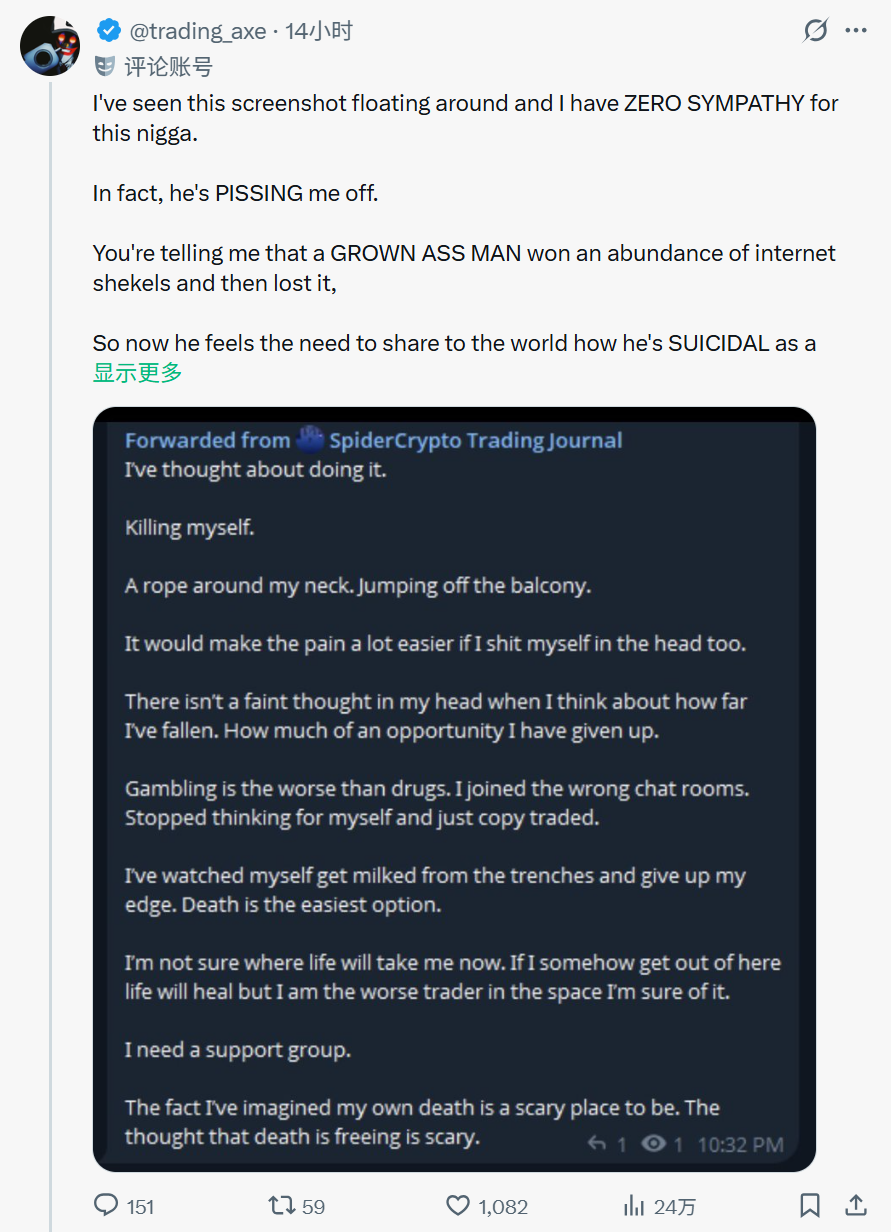


The Twitter account Trading axe expressed no sympathy whatsoever for the individual, even angrily commenting, "You're telling me a grown man made a fortune from virtual money on the internet, then lost it all, and now feels the need to share 'I want to kill myself' with the whole world? Alexander Wice lost $1 billion in 2021 due to over-leverage, didn't complain, didn't make excuses, and just moved forward."


However, some community members offered comfort, saying, "SBF also suffered major setbacks and was even sentenced to 25 years, but he's still alive, so it shouldn't come to this."


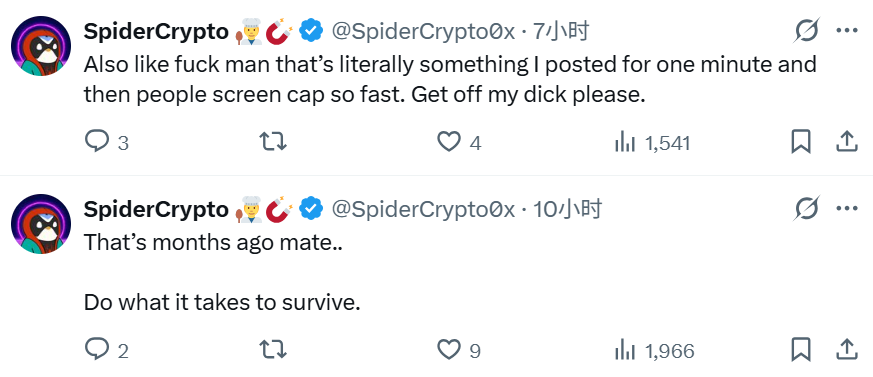
The protagonist, Spider, soon responded in the comments section of his tweet, stating, "It was literally something I posted for one minute before someone screenshotted it. Furthermore, it added that this text was actually posted several months ago." He also offered himself words of encouragement.


So who exactly is Spider? What happened in the past?


Single Address Peaked at $15 Million


Spider's X account is @SpiderCrypto0x. He operates the Telegram channel SpiderCrypto Trading Journal (with approximately 33,000 subscribers). His content primarily shares insights on DeFi, NFT, and meme coin trading, with a style emphasizing on-chain data verification. His bio often mentions collaborations with platforms like Rainbet. His X account joined around August 2020, initially being active in the DeFi space.



Spider was already active in trench trading during the DeFi Summer of 2020. Long-term observers like Twitter user CryptoCaligh recalled in a post dated June 22, 2026: "I was one of those in the trenches with Spider, frantically buying DeFi coins. I've been watching his play since 2020, it's been almost 7 years now." His style is characterized as aggressive and high-leverage, often capable of rapidly scaling positions in bull markets. During the same period, he gradually built influence by sharing trading views through TG logs and X posts.


During the 2021 bull market, Spider achieved significant profits (users mention gains in the $6-7 million range within short periods). In the 2022 bear market, he nearly lost his entire net worth (community estimates close to $10 million). More seriously was the tax issue—due to publicly flaunting gains, he attracted attention from tax authorities, resulting in a debt of about $4 million.


According to CryptoCaligh's recollection, he later negotiated a payment plan with the government and received help from old friends, gradually paying off the debt through further trading. This phase exposed the fragility of his high-risk strategy in bear markets and became a starting point for his reflection on "false confidence."


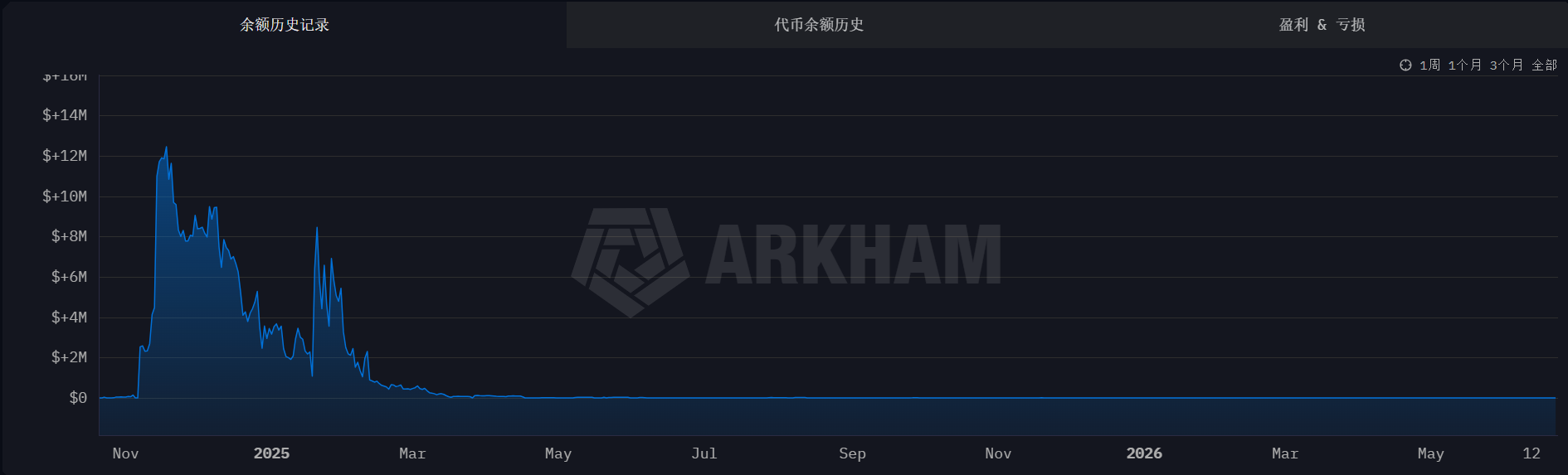
Spider himself has publicly shared his main TRUMP holding wallet address (J9HqxT4U39B45YcXxL4B1GZzdhSrXFr2N2Lam4bXrQeB) in an X post. According to Arkham data, the disclosed address peaked at around $12 million in December 2024 before declining. On January 20, 2025, due to the TRUMP coin, the account balance surged from around $1.5 million to $8.5 million. The funds remained at high levels for a few months before beginning a steady decline. After March of that year, the balance was nearly depleted.


He reflected: "Past success gives you false confidence, making you believe you can do it again. That was one of the reasons for my disastrous loss."


Arkham data shows this wallet address made transfers to over 36 addresses on Pump.fun alone. It is speculated that he likely ended up suffering heavy losses in PvP (player vs. player) trading.
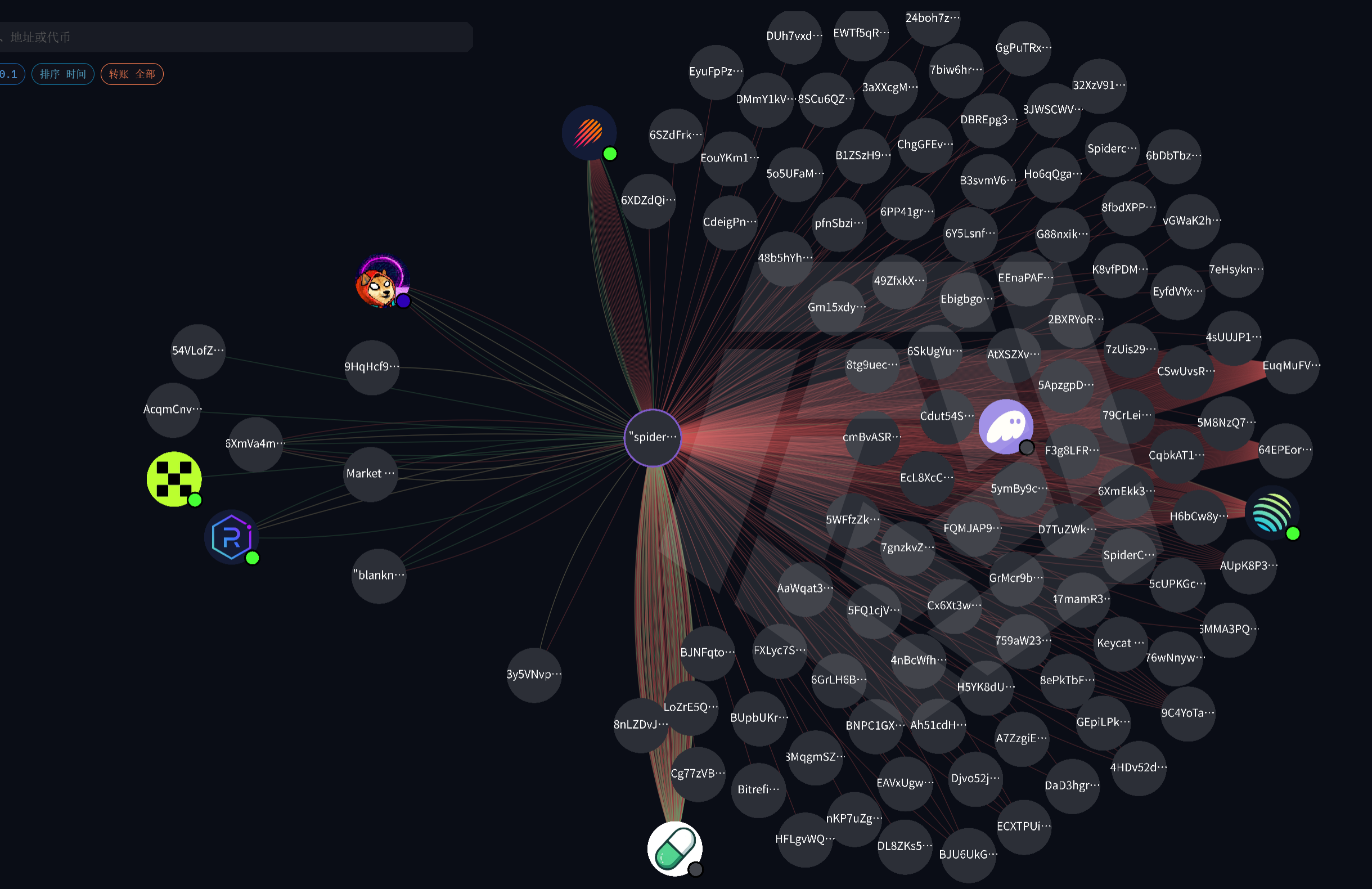


Currently, his Twitter homepage continues to post trading-related content on X, indicating he remains active in the market.


From Big Gains to Big Losses, Gambling and Trading Are Often Separated by a Thin Line


It's often easier to see clearly from the outside. User CryptoCaligh pinpointed his real issue.


"He once threw $40,000 into a coin at its peak, and it could turn into $500,000 in a day. This kind of operation indeed works in crazy bull markets, but when the tide recedes, you lose all the money you made just as quickly. There's only a thin line between gambling and trading, and many people get deeply entangled. Once addicted, it will ruin you."


Furthermore, he added, "What's the point of making millions and losing it all? That's just a dream. You need to think clearly: Are you here to invest and try to make millions, or are you already an addicted gambler?"


In crypto cycles, similar cases of "sudden wealth - back to zero - psychological breakdown" recur repeatedly. During the 2021 bull cycle, massive liquidity inflow made earning relatively easy. However, the crypto space of 2025-2026 is no longer an era of easy money. Many concepts have been debunked, VC coins have been abandoned by communities, and meme coins have grown tiresome in endless PvP, with market trading difficulty increasing exponentially.


Those who survive long-term typically preserve profits during bull markets, establish diversified allocations, and cultivate a non-trading identity.


Preguntas relacionadas

QWhat triggered the widespread discussion about Spider's situation on social media?

AA log screenshot from Spider was rapidly disseminated on the X platform. In the log, this active DeFi and meme coin trader detailed his suicidal thoughts following consecutive massive losses, blaming a gambling mentality, misleading chat rooms, and blind copy-trading, while expressing fear over the idea that 'death is a release.'

QAccording to the article, what is the main difference between Spider's success during the bull market and his subsequent failure?

ADuring the bull market, Spider's aggressive, high-leverage style allowed him to rapidly amplify his positions and achieve significant profits (e.g., turning $40k into $500k in a day). However, when the bull market receded, this same strategy led to equally rapid losses, exposing the fragility of his high-risk approach in a bear market. He reflected that past success gave him false confidence, leading him to believe he could repeat it, which contributed to his惨败.

QWhat significant financial and legal challenge did Spider face after the 2022 bear market, according to the article?

AAfter the 2022 bear market, Spider lost nearly his entire net worth (estimated by the community to be close to $10 million). Additionally, he faced a significant tax problem. Due to publicly炫耀 his earnings, he attracted attention from tax authorities and incurred a debt of approximately $4 million.

QWhat point does the user CryptoCaligh make about the nature of Spider's activities in the crypto market?

ACryptoCaligh指出 that there is a very thin line between gambling and trading, and many people become deeply addicted to it. He questions whether one is in the market to invest and make millions or is already an addicted gambter. He emphasizes that making and then losing millions is meaningless—it's just a dream—and that such addiction can destroy a person.

QBased on the article, what are some characteristics of traders who can survive long-term in the volatile crypto market?

AAccording to the article, those who can survive long-term in the crypto market typically manage to secure profits during bull markets, establish diversified asset allocations, and cultivate a non-trading identity or sense of self outside of their trading activities.

Lecturas Relacionadas

Bitmine Increases Holdings to 5.7 Million ETH, Included in Russell 1000 Index, Tom Lee Says Only One Step Away from '5% Target'

Bitmine Increases Ethereum Holdings, Nears 5% Supply Target and Joins Russell 1000 Bitmine Immersion Technologies (BMNR) acquired an additional 27,084 ETH last week, bringing its total holdings to 5,700,040 ETH, which represents 4.7% of Ethereum's total supply. This puts the company at 94% of its goal to own 5% of ETH's circulating supply. Despite a challenging week where ETH price fell 8% and BMNR's stock dropped 13%, Bitmine continues its accumulation strategy, with Chairman Tom Lee attributing the market weakness to quarter-end "window dressing" by investors. In a significant development, Bitmine was added to the Russell 1000 large-cap index on June 26. Lee expects this inclusion to attract hundreds of institutional investors, as passive funds and ETFs rebalance to match the index. The company's total assets, including crypto, cash, and securities, stand at $9.8 billion. Of its ETH holdings, 4,879,157 are currently staked, generating an estimated annualized revenue of $211 million. Lee projects this could rise to $246 million once all ETH is staked through its MAVAN network. Bitmine remains the world's largest corporate Ethereum treasury and the second-largest overall corporate crypto treasury, behind Strategy's substantial Bitcoin holdings. Lee reaffirmed the company's commitment to steady buying throughout 2026, expressing belief that the crypto market is still in the early stages of a spring cycle. At the time of writing, ETH was trading around $1,565, while BMNR stock was near $13.56, down over 90% from its 52-week high.

marsbitHace 12 min(s)

Bitmine Increases Holdings to 5.7 Million ETH, Included in Russell 1000 Index, Tom Lee Says Only One Step Away from '5% Target'

marsbitHace 12 min(s)

AGI Countdown: OpenAI's Chief Research Officer Makes Major Statement — The Window for Humanity is 'Very Small'

The countdown to AGI has begun, according to OpenAI's Chief Scientist Mark Chen, who states the window for human-centric progress is "very small." Chen argues that AI is reaching a point where models can perform "self-sustaining research," autonomously driving innovation in fields from mathematics to programming. He points to the proliferation of AI's "superhuman" insights—akin to AlphaGo's legendary "Move 37"—across disciplines as evidence of this shift. Chen firmly dismisses claims that scaling laws are plateauing or that pre-training is dead, asserting the field remains on an exponential curve. He cites OpenAI's successful bet on reasoning models like o1 as proof that fundamental breakthroughs are still possible. The future of research, he suggests, lies with "Vibe Researchers"—humans who provide high-level direction and "taste" while AI handles execution and orchestration of complex, long-horizon tasks. However, significant hurdles remain. Chen highlights a "benchmarking crisis," where models can overfit to existing tests without gaining true generalization. He also notes the "jagged frontier" of AI capabilities, where systems excel at advanced reasoning but struggle with contextual, continual learning from everyday experiences. Despite these challenges, he expresses confidence that these gaps will be closed. In a personal reflection, Chen shares that post-AGI, his wish is to open a noodle shop—a metaphor emphasizing that when AI masters knowledge and innovation, uniquely human experiences, warmth, and storytelling will become the ultimate form of value.

marsbitHace 27 min(s)

AGI Countdown: OpenAI's Chief Research Officer Makes Major Statement — The Window for Humanity is 'Very Small'

marsbitHace 27 min(s)

China's No.1, Closing in on OpenAI, Mysterious "Sweeping Monk" Rises to Top Seven Globally

A mysterious Chinese AI project named "MopMonk" (meaning "Sweeping Monk") has achieved a top-ranking result on the globally recognized CyberGym cybersecurity benchmark. With a 73.1% success rate, it ranks seventh worldwide and first among Chinese entries, performing closely behind OpenAI. The significance lies in the benchmark itself. CyberGym, created by UC Berkeley, is considered a premier "Olympics" for AI security. It tests models on over 1500 real-world software vulnerabilities, requiring them to not just identify but actually generate working exploits (PoCs) in a complex, offline environment. This moves beyond simple knowledge to testing an AI's practical "execution" capabilities. MopMonk's approach is notable. It uses the open-source MiniMax M3 model from Shanghai as its powerful reasoning "brain," leveraging its strong coding skills and long context window. However, the key to its performance is a custom-built, multi-agent security framework—its "Harness." This system uses structured "vulnerability memory" to efficiently guide the search for exploits, allowing multiple agents to explore in parallel while sharing lessons learned from failures. This engineering layer effectively translates the model's intelligence into actionable, iterative testing steps. The project remains highly secretive, with no official website or team information, embodying the "dark horse" spirit of its literary namesake. Its success highlights a potential industry shift: beyond simply scaling model size, the engineering of specialized agent systems (the Harness) is becoming a critical differentiator for real-world AI application performance, especially in complex domains like cybersecurity.

marsbitHace 56 min(s)

China's No.1, Closing in on OpenAI, Mysterious "Sweeping Monk" Rises to Top Seven Globally

marsbitHace 56 min(s)

Will History Repeat Itself? Fidelity Lists Five Catalysts to End the Crypto Winter

Fidelity's new report suggests that the current crypto winter for Bitcoin may be nearing its end, identifying five potential catalysts that could drive a market turnaround based on historical patterns. First, Bitcoin's approximately four-year cycle, driven by its halving mechanism, historically marks peaks and troughs. The last bottom was in November 2022, potentially pointing to the next around November 2026, though cycle length can vary. Second, clearer regulation has often preceded past bull markets. The focus is now on the CLARITY Act, which aims to clarify US digital asset oversight between the SEC and CFTC. Its passage could unlock domestic activity currently held back by legal uncertainty. Third, Federal Reserve monetary policy plays a role. A shift to lower interest rates tends to correlate with rising crypto prices by reducing borrowing costs and boosting risk appetite, though markets may price this in well ahead of any official change. Fourth, the emergence of breakthrough applications can fuel investor interest. Current trends like real-world asset tokenization, AI-related crypto infrastructure, and stablecoins are being watched, but history shows the biggest catalysts are often unexpected. Fifth, a new wave of institutional adoption could be a trigger. While ongoing adoption in 2026 hasn't sparked a new bull run, a major unexpected move—like a significant purchase by a tech giant or adoption as a hedge in a global crisis—could create a powerful new narrative. Fidelity concludes that while the market is in a downturn, historical turning points have often resulted from a combination of such factors, and the next phase for Bitcoin may depend on which of these catalysts materializes first.

Foresight NewsHace 1 hora(s)

Will History Repeat Itself? Fidelity Lists Five Catalysts to End the Crypto Winter

Foresight NewsHace 1 hora(s)

Trading

Spot
活动图片