The Strongest Whale in the World Cup Prediction Market? Trades 380 Times a Day, Rakes in $10.32 Million

marsbitPublicado a 2026-07-13Actualizado a 2026-07-13

Resumen

A user nicknamed "swisstony" has emerged as a dominant "whale" on the prediction market platform Polymarket, reportedly earning $10.32 million in just one month, with total historical profits reaching $18.62 million. The account, active since July 2025, has gained significant attention, amassing over 922,000 profile views. Analysis reveals an exceptionally high-frequency, algorithmic trading strategy. The account has executed 139,617 predictions, averaging roughly 380 trades per day, suggesting API-driven automation. Its overall win rate is a modest 52.9%, but through massive scale and position management, it amplifies a positive expected value (EV). The core strategy appears dual-tracked. First, it places large bets (often $400k-$1M) *against* (betting "NO") heavily favored teams like Germany or England when their implied market probability is perceived as too high, yielding substantial returns when these teams lose. Second, it allocates small amounts ($thousands) to extreme long-shot outcomes with very low implied probabilities (0.2%-1.2%). While most of these "lottery" bets fail, the occasional huge payoff (sometimes over 100x return) significantly boosts overall profits. The account's bio, "trash panda," aptly describes this approach of profitably sifting through market inefficiencies and tiny price discrepancies.

While teams fiercely compete for the World Cup trophy on the field, a hidden whale is quietly making a fortune in the prediction market.

An account with the nickname swisstony on Polymarket has a total historical profit of $18.62 million, with $10.33 million earned just in the last month. The account was first registered in July 2025, a relatively short time, but due to its astonishing profits, its profile page views have now surged to 922,200.
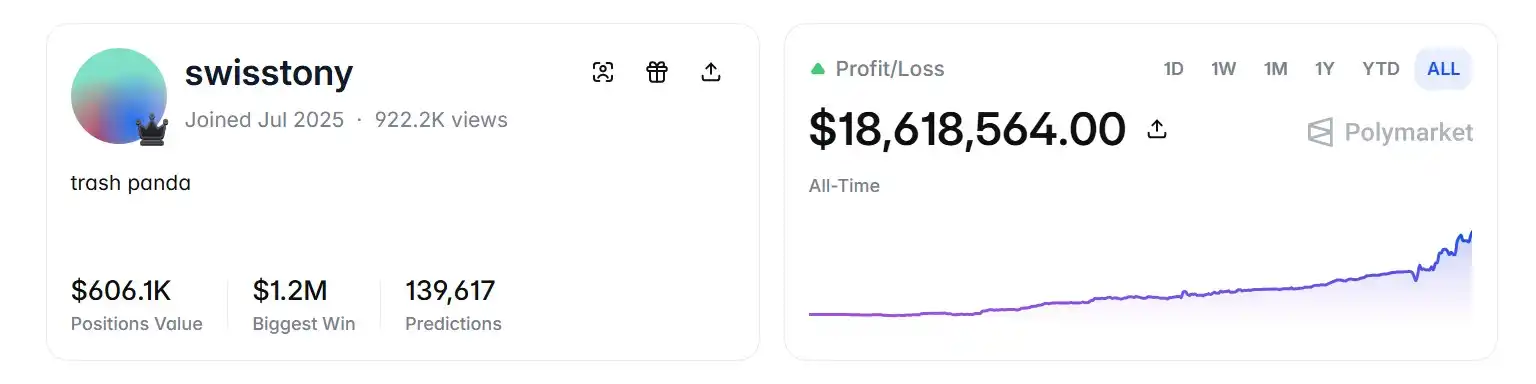
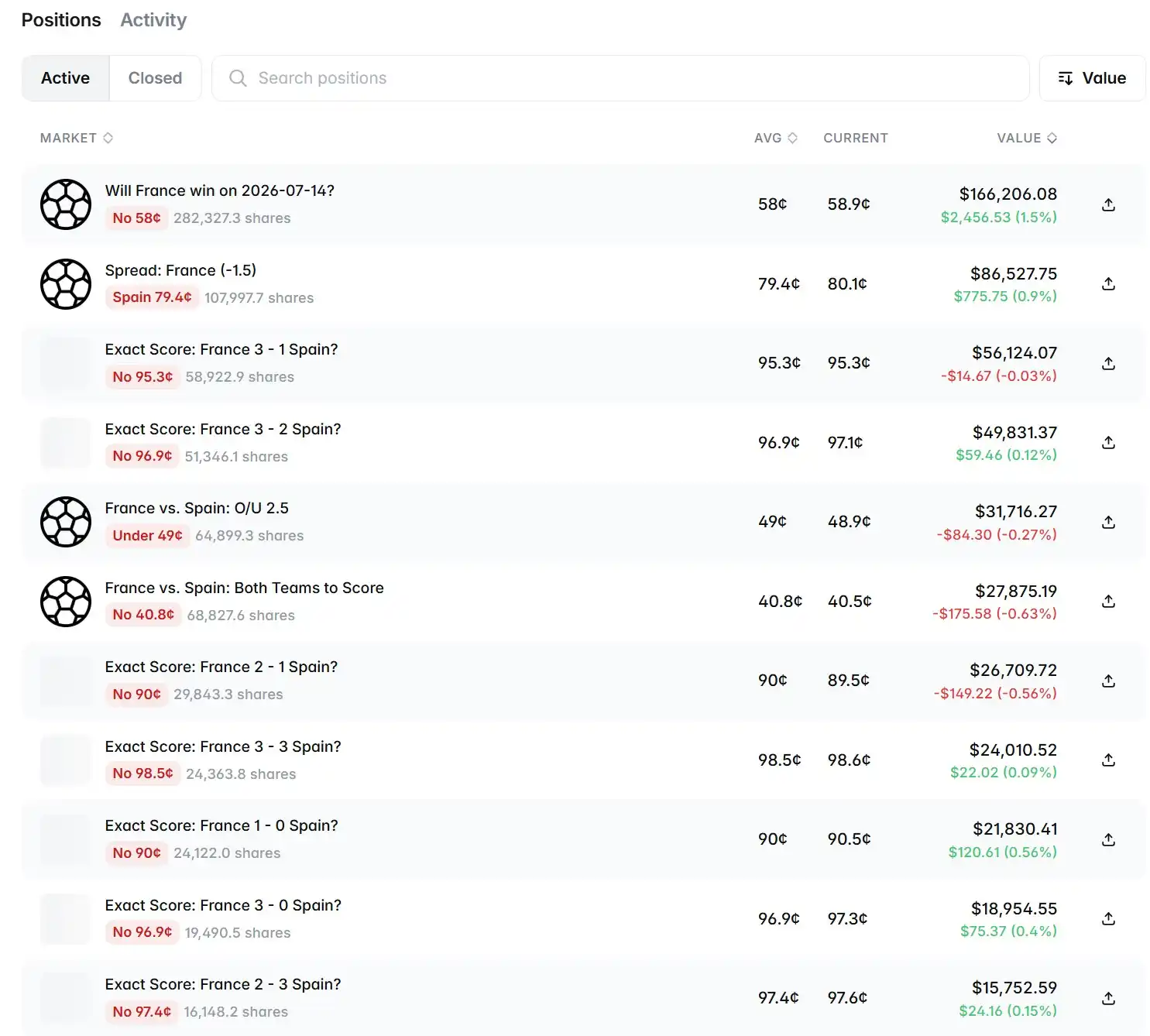
As of July 13, the account has made a total of 139,617 predictions, with a current portfolio value of approximately $606,100. Notably, its current holdings are almost entirely concentrated on the FIFA World Cup semi-final between France and Spain on July 14, 2026. This includes a bet of about $160,000 on France losing the match. Furthermore, it has placed numerous bets, primarily on NO for specific score details, seeking returns of 5%-10%.
The address maintains a win rate around 52.9%, with a total of over 245,000 trading positions and transaction volumes reaching hundreds of millions of dollars. These figures place it in the top tier within the overall Polymarket ecosystem. Public research shows that most retail addresses incur long-term losses, while a few high-frequency, systematic accounts achieve significant positive returns through scaled execution. swisstony's win rate isn't extremely high, but combined with extremely high trading frequency and position management, it amplifies the positive EV (Expected Value) edge.

Since creating the account about a year ago, this address has completed 139,617 prediction operations. This translates to an average of about 380 trades per day, 16 per hour, operating 24/7 without rest. It is highly likely an ultra-high-frequency quantitative trading bot driven by an API.

Its profile description reads "trash panda." In North American culture, the raccoon is a survival master that rummages through trash bins. This signature perfectly captures its core strategy: making money from the vast data garbage and tiny price discrepancies on Polymarket, ultimately building a multimillion-dollar empire.

Over 17 Profits Exceeding $1 Million

Looking at the address's profit history, what's astonishing is that it has recorded over 17 instances where a single profit exceeded $1 million. The largest of these was a bet on Germany's match on June 25th. The whale bet NO, earning $2,221,241, a profit of 111.67%.
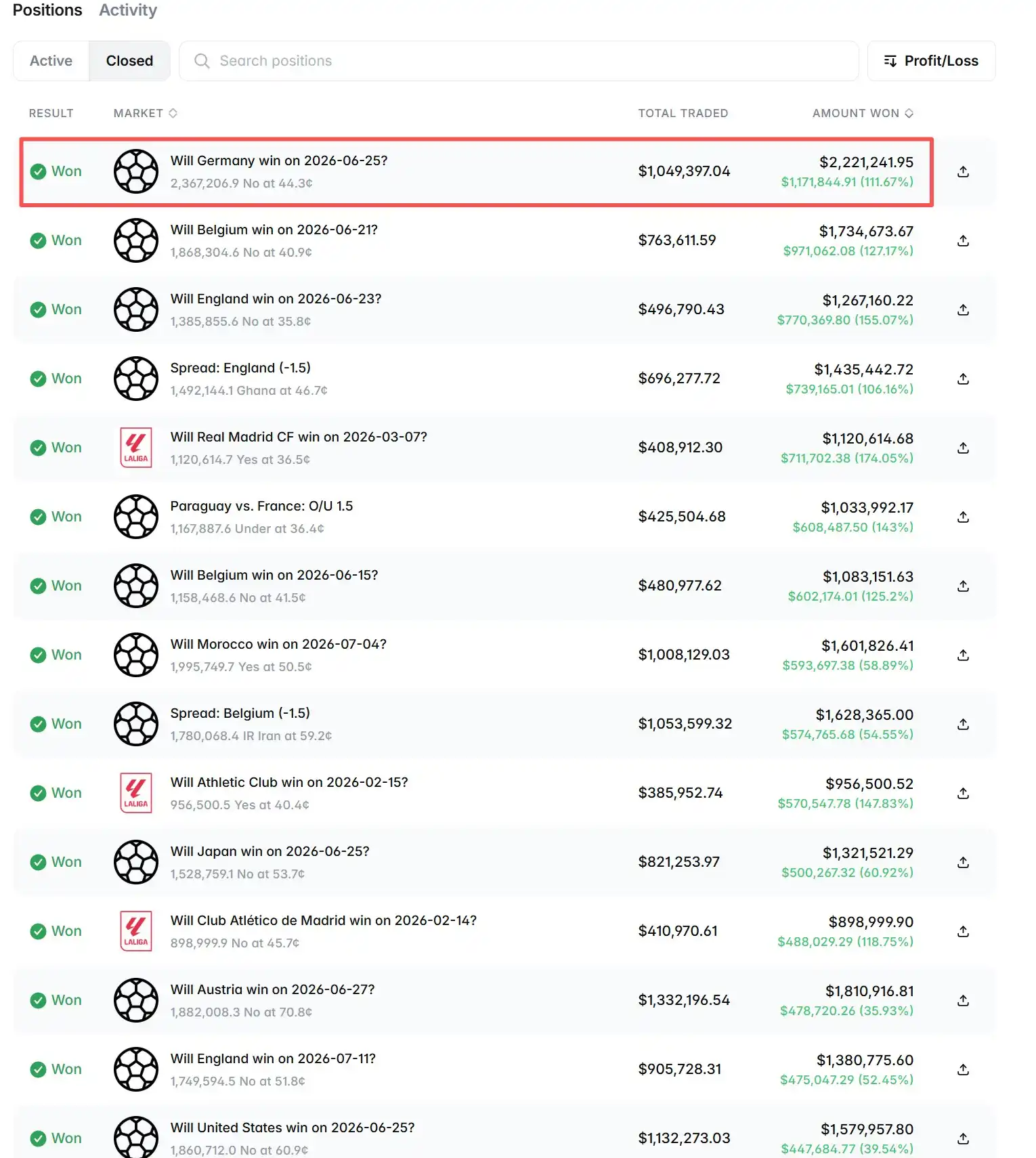
The ROI shown in this screenshot is generally very high, with clear advantages in entry prices. The investment scale is large, with single bets often in the range of $400,000 to $1 million.

This whale likes to place large bets on NO (not winning), targeting strong teams overvalued by the market: Germany, Paraguay (appearing multiple times), England, and Japan. Entry prices were mostly between 35.8¢ and 53.7¢, while the market's implied win probability for these favorites at the time was around 46%-64%. However, the actual result was that they lost or didn't win. This is a typical anti-favorite strategy.

100x Returns

In prediction markets, when events the market deems nearly impossible actually happen, the profit returns are extremely exaggerated. This whale is not only skilled at betting big to win big but also excels at betting small to win big.

Taking the matches in the chart as an example, the entry prices were extremely low: 0.2¢–1.2¢ (market implied probability only 0.2%-1.2%). The invested capital was mostly only a few thousand dollars per bet, yet each contributed profits exceeding $100,000.
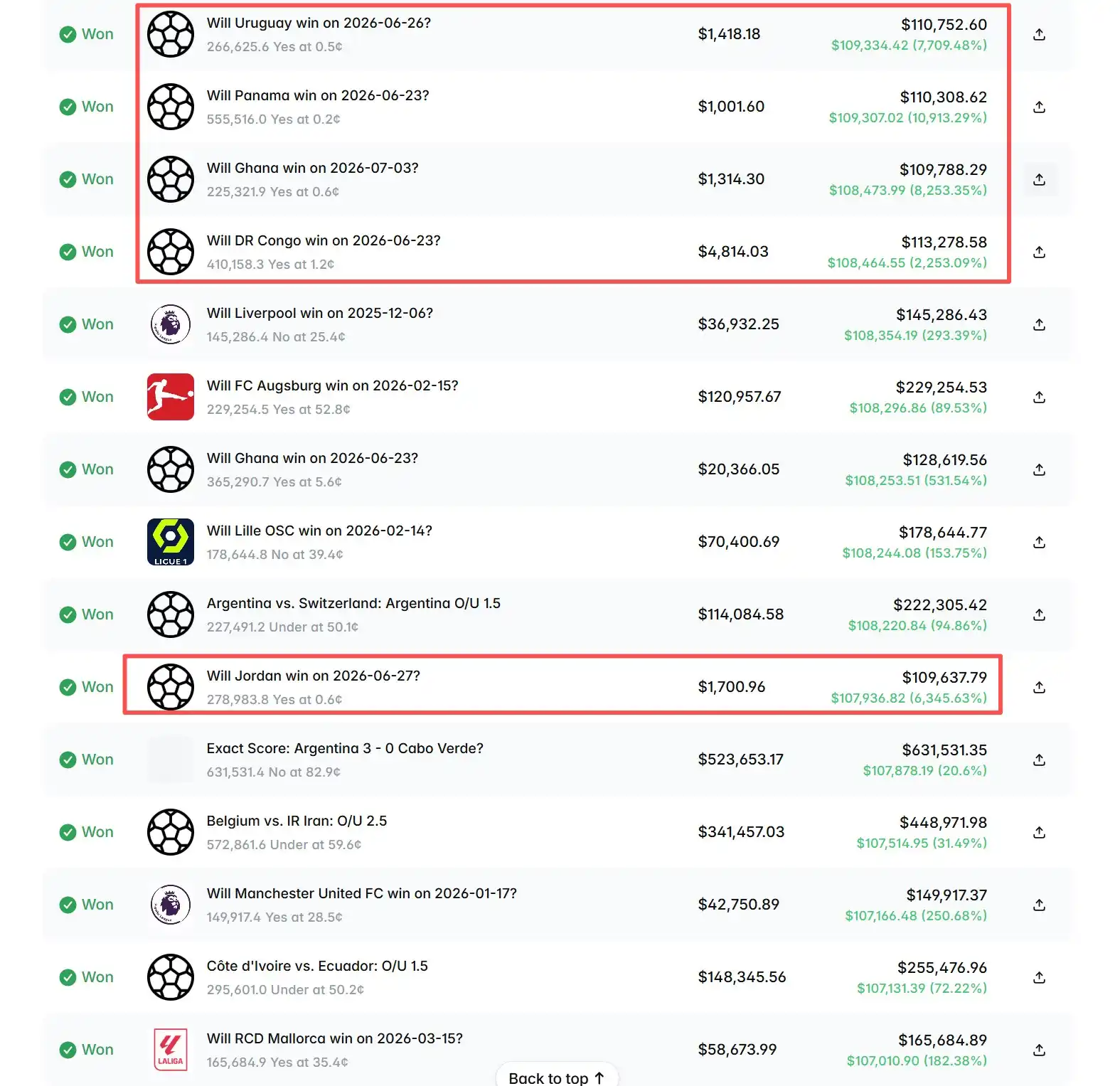
These events, originally considered almost impossible by the market, actually occurred. The account used minimal cost to secure high returns.

Deploying small capital on extremely low-probability events is akin to a systematic "lottery ticket" strategy. When it hits, it can contribute profits of $100,000+ at an extremely low cost, serving as an excellent supplement to overall profitability. Although the risk capital per trade in such high-multiple trades is low, the win rate is extremely low. Most similar bets lose everything.

Even though most such bets will lose (because the probabilities are indeed very low), hitting just a few occasionally can significantly boost total profits without dragging down much principal.

Overall, it's highly likely that this account's automated system covers a large number of niche, low-liquidity markets where severe mispricing is more common. It then executes a dual-track strategy to profit.

Large capital bets against popular favorites, small capital bets on extreme underdogs. The combination ensures stable, substantial profits while also enhancing overall returns through high-multiple trades.


Preguntas relacionadas

QWho is swisstony on Polymarket, and why is this account notable?

ASwisstony is a notable account (or 'whale') on the Polymarket prediction platform. It is notable for achieving a total historical profit of $18.62 million, with $10.33 million earned in just the last month. Despite being registered only around July 2025, its profile has garnered over 922,000 views due to its extraordinary profitability. The account is likely an automated, high-frequency trading bot, executing an average of 380 predictions per day.

QWhat is the core trading strategy employed by the swisstony account according to the article?

AThe swisstony account employs a dual-track, systematic strategy. The primary strategy involves using large capital to bet 'NO' (against) heavily favored teams (like Germany, England, Japan), exploiting market overestimations of their win probability—a classic contrarian or 'fade the favorite' approach. The secondary strategy allocates small amounts of capital to bet on extreme long-shot outcomes with very low implied probabilities (e.g., 0.2%-1.2%), akin to buying systematic lottery tickets, which can yield 100x returns when they hit.

QWhat does the account's profile description 'trash panda' signify in the context of its trading?

AThe profile description 'trash panda' (a colloquial term for a raccoon) is a metaphor for the account's core strategy. In North American culture, raccoons are survival experts known for scavenging valuable items from garbage. This signature accurately summarizes the bot's operation: it sifts through the vast amount of data and tiny price inefficiencies on Polymarket to find valuable trading opportunities, ultimately building a multi-million dollar profit.

QHow many predictions has the swisstony account made, and what does this frequency imply?

AThe swisstony account has made a total of 139,617 predictions. This translates to an average of approximately 380 predictions per day, or about 16 predictions per hour, operating 24/7. This extremely high frequency strongly implies that the account is not manually operated but is instead driven by an API-powered, ultra-high-frequency quantitative trading bot.

QWhat is the significance of the account having over 17 individual profits exceeding $1 million?

AThe fact that the swisstony account has recorded over 17 individual profits each exceeding $1 million demonstrates the scale, consistency, and effectiveness of its large-capital strategy. It highlights the bot's ability to systematically identify and exploit significant mispricings in major markets (like popular team matches), deploying large sums (often $400k-$1M per bet) to generate substantial and repeated windfalls, with its single largest profit being over $2.2 million.

Lecturas Relacionadas

Bitcoin Consolidates to Sustain Uptrend, HYPE Momentum Divergence Test Looms|Guest Analysis

Bitcoin continues its upward trend that began from the July 1st low, having formed its first ascending pivot zone (Zone A) on the daily chart. The market is currently in a correction and rebound phase following the confirmation of 'Endpoint 5'. Quantitative models indicate overbought conditions, suggesting a high probability of a 2-3 week consolidation within a high-range trading box. This phase is expected to build momentum for the formation of a second ascending pivot zone (Zone B). Medium-term positions should remain观望 until trend validity is confirmed. Short-term trading should utilize 30%仓位, relying on the synergy between Chan Theory structure and proprietary quantitative signals to flexibly execute two sets of plans (A/B) for testing long or short positions around defined support and resistance levels. For HYPE, the rally from the August 2nd low on the 4-hour chart has extended into the exit segment of its second pivot zone (Zone B). The key focus is whether动能背驰 (momentum divergence) appears between this exit segment and its corresponding entry segment, which will determine if the current uptrend is concluding. Technical indicators show overbought signals, warranting caution against chasing the rally. Last week, a short-term Bitcoin long position was successfully executed according to plan, yielding approximately 4.45% profit. This trade validated the effectiveness of the combined signals from the 'Price Differential Trading Model' and the 'Momentum Quantitative Model' in live trading.

marsbitHace 20 min(s)

Bitcoin Consolidates to Sustain Uptrend, HYPE Momentum Divergence Test Looms|Guest Analysis

marsbitHace 20 min(s)

Shutting Down the Mainnet to Bet on AI Video: Can Harmony's Drastic Move Bring Renewal?

Public blockchain Harmony is shutting down its mainnet after nearly seven years of operation and shifting its focus entirely to the AI video sector. The project cited escalating security threats, including a recent major exploit where an attacker fabricated 3.01 trillion ONE tokens, as a key reason for the move. Harmony's native token, ONE, will be migrated to the Ethereum blockchain as an ERC-20 token, preserving its total supply and emission schedule. The team proposes building an AI-driven "remix economy" for video content, where users can upload, remix, and extend videos using AI agents. The ONE token is intended to serve as the incentive, staking, and governance asset within this new ecosystem. The transition involves compensating existing network validators and aims to repurpose the community and brand for the new venture. However, the plan faces significant challenges. Harmony's core competencies lie in blockchain infrastructure, not AI model development, content distribution, or consumer product growth. Furthermore, the necessity of the ONE token within the proposed AI video business model remains unproven, as users and service providers could potentially transact using fiat or stablecoins instead. The proposals are currently non-binding and subject to change based on community governance. The success of this radical pivot hinges on whether Harmony can demonstrate that its blockchain and token are indispensable to its new AI video platform, creating genuine demand beyond mere narrative.

marsbitHace 25 min(s)

Shutting Down the Mainnet to Bet on AI Video: Can Harmony's Drastic Move Bring Renewal?

marsbitHace 25 min(s)

Survey of China's Embodied Intelligence Lineage: Professor Li Ze Xiang is Building a Robot Army

**Summary: The Li Zexiang Ecosystem – Three Decades of Building a Robotics Army in China** Professor Li Zexiang, a professor at the Hong Kong University of Science and Technology (HKUST), has spent thirty years cultivating a formidable ecosystem of robotics and hardware startups in China, producing a "pipeline" of IPOs. This system evolved through two distinct phases. **Phase 1: The HKUST Era (1992-2014).** Li returned to Hong Kong in 1992, establishing his "3126 Lab" with a hands-on, student-driven ethos. This "master-apprentice" model birthed foundational companies like *DJI* (consumer drones, founded by student Wang Tao) and *Googol Technology* (motion controllers, founded with colleagues). This phase was driven by direct teacher-student relationships and laboratory incubation, creating companies with "pure academic lineage." **Phase 2: The Songshan Lake Era (2014-Present).** Li co-founded the XbotPark Songshan Lake International Robotics Industry Base. This marked a shift from relationship-driven to platform-driven incubation. XbotPark provides a complete ecosystem—workshops, dorms, funding—and opens its doors to external talent, not just his direct students. Founders like Zhang Junbin of *Yunjing Intelligent* (smart floor cleaners) and Chen Yuqi of *Hairobotics* (warehouse robotics) joined this "university" after applying, forging their "teacher-student" bond with Li upon entry. **The Financial Engine.** The platform is supported by dedicated investment funds. The *XBOTPARK Fund* provides the critical first seed or angel investment, typically taking 5-13% equity. The *Qingshuiwan Capital* fund then follows these promising companies through subsequent funding rounds (Series A to D), shepherding them toward IPO. Major VCs like Sequoia China and Hillhouse Capital enter later, buying into proven traction. **A Prolific Output.** The ecosystem has incubated over 280 companies with a total valuation exceeding 500 billion RMB. The "IPO assembly line" includes listed firms like Googol Tech (2023), *Whale Dynamic* (2025 - smart driving for commercial vehicles), and *Wo'an Robotics* (2025 - home robots). It also boasts unicorns like Yunjing and Hairobotics, and a pipeline of potential独角兽 across robotics components, industrial automation, and smart home devices. **Core Philosophy: "The Victory of Craft."** Beyond any single technology, the ecosystem's deepest moat is thirty years of accumulated "craft": a talent funnel from robotics competitions (e.g., RoboMaster), a self-reinforcing education chain, and the physical integrated base at Songshan Lake. When the "embodied AI" wave arrived, these companies were already positioned with scalable hardware, real-world data from millions of deployed devices, and global channels—they simply needed to add an AI "brain" to their existing foundation.

marsbitHace 29 min(s)

Survey of China's Embodied Intelligence Lineage: Professor Li Ze Xiang is Building a Robot Army

marsbitHace 29 min(s)

Trading

Spot
活动图片