The Stock Tokenization Revolution: A Panoramic Report on Market Dynamics, Product Architecture, and Regulatory Moats

marsbitPublicado a 2026-03-10Actualizado a 2026-03-10

Resumen

Tokenized stocks are emerging as a breakthrough sector in the real-world asset (RWA) market, with a total value exceeding $800 million—a 30x increase since the start of the year—and monthly trading volume reaching $1.8 billion. The core value proposition is enabling global, 24/7 access to U.S. equities with near-instant settlement, bypassing geographic restrictions and delays inherent in traditional finance. Three primary architectures are competing for dominance: 1. Instant execution (e.g., Ondo, CyberAlpha): maximizes capital efficiency. 2. Inventory model (e.g., xStocks, Backed): uses Swiss debt structures for superior DeFi composability. 3. Direct ownership (e.g., Securitize): offers full legal rights but limited on-chain flexibility. The market is dominated by two players: Ondo (53% share) leverages liquidity engineering, while Backed/xStocks (23%) uses regulatory arbitrage via Swiss law. Regulatory licensing—not technology—is the key moat, with complex cross-jurisdictional compliance (U.S., EU, offshore) forming the highest barrier to entry. The sector faces a trilemma between liquidity/speed, regulatory safety, and DeFi composability, and is diverging into two paths: incremental integration with traditional systems (e.g., DTCC) and revolutionary on-chain issuance for full disintermediation. The convergence of the $150 trillion global equity market with blockchain infrastructure is already underway.

Authored by: Foresight Ventures

TL;DR

  • Tokenized stocks are the breakthrough sector in the current Real World Asset (RWA) cycle—the market has hit a new all-time high of $800 million, growing 30x year-to-date, with a monthly trading volume of $1.8 billion.
  • Core value proposition: Bypass geographical restrictions and settlement delays of traditional brokers, enabling 24/7 global access to US stocks with near-instant settlement.
  • Three architectures are vying for dominance:
  1. Instant Execution Model (Ondo, CyberAlpha)—leads in capital efficiency.
  2. Inventory Model (xStocks, Backed)—excels in DeFi composability through debt structures under Swiss law.
  3. Direct Ownership Model (Securitize)—offers the most complete legal rights but is constrained by transfer restrictions and has limited on-chain composability.
  • The market has effectively formed a duopoly: Ondo leads with a 53% share, driven by liquidity engineering; Backed/xStocks hold a 23% share, leveraging regulatory arbitrage.
  • Technology is no longer the moat—regulation is. Building a cross-border licensing system across the US, EU, and offshore jurisdictions is currently the most difficult-to-replicate competitive barrier.
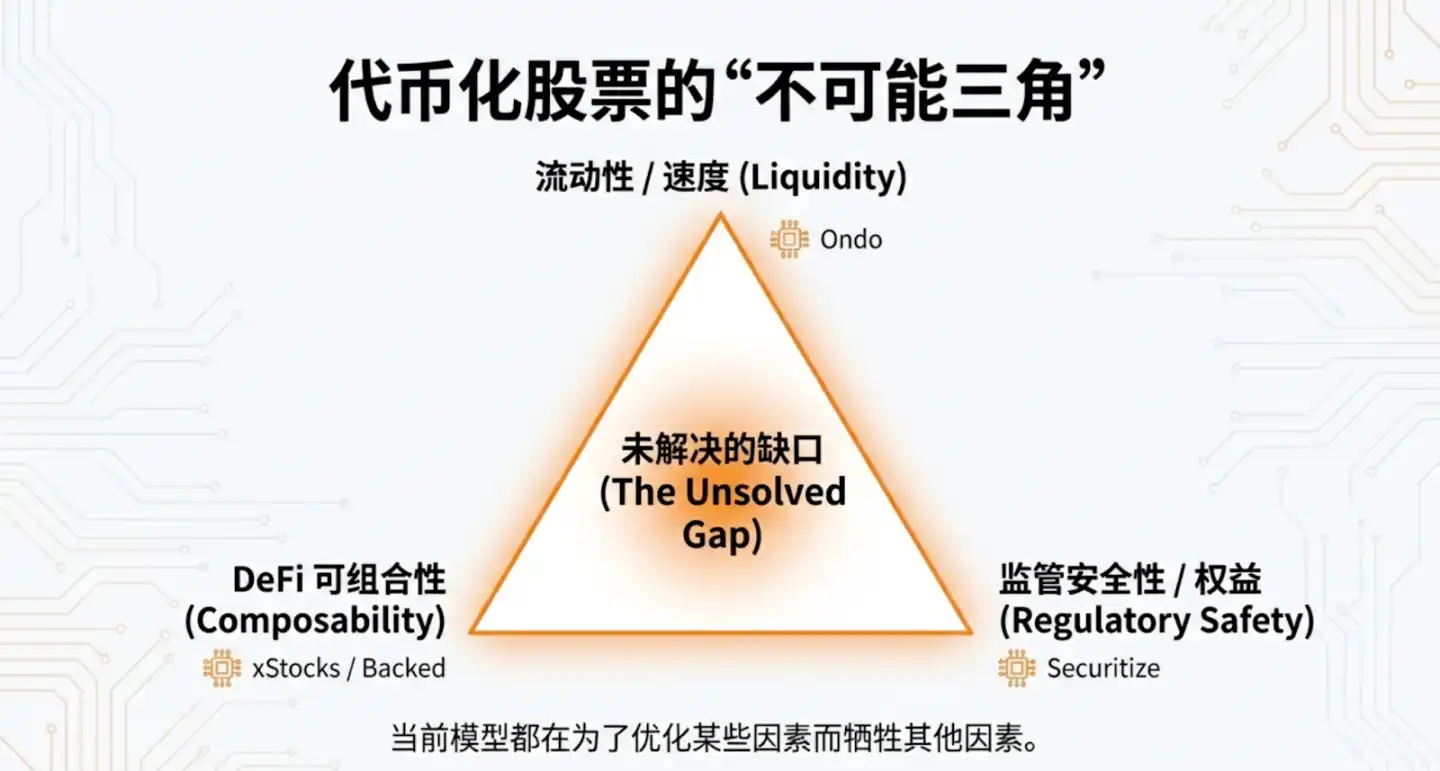
  • Platforms face a fundamental trilemma: they can only optimize two of the following three aspects simultaneously—Liquidity/Speed, Regulatory Security/Shareholder Rights, DeFi Composability.
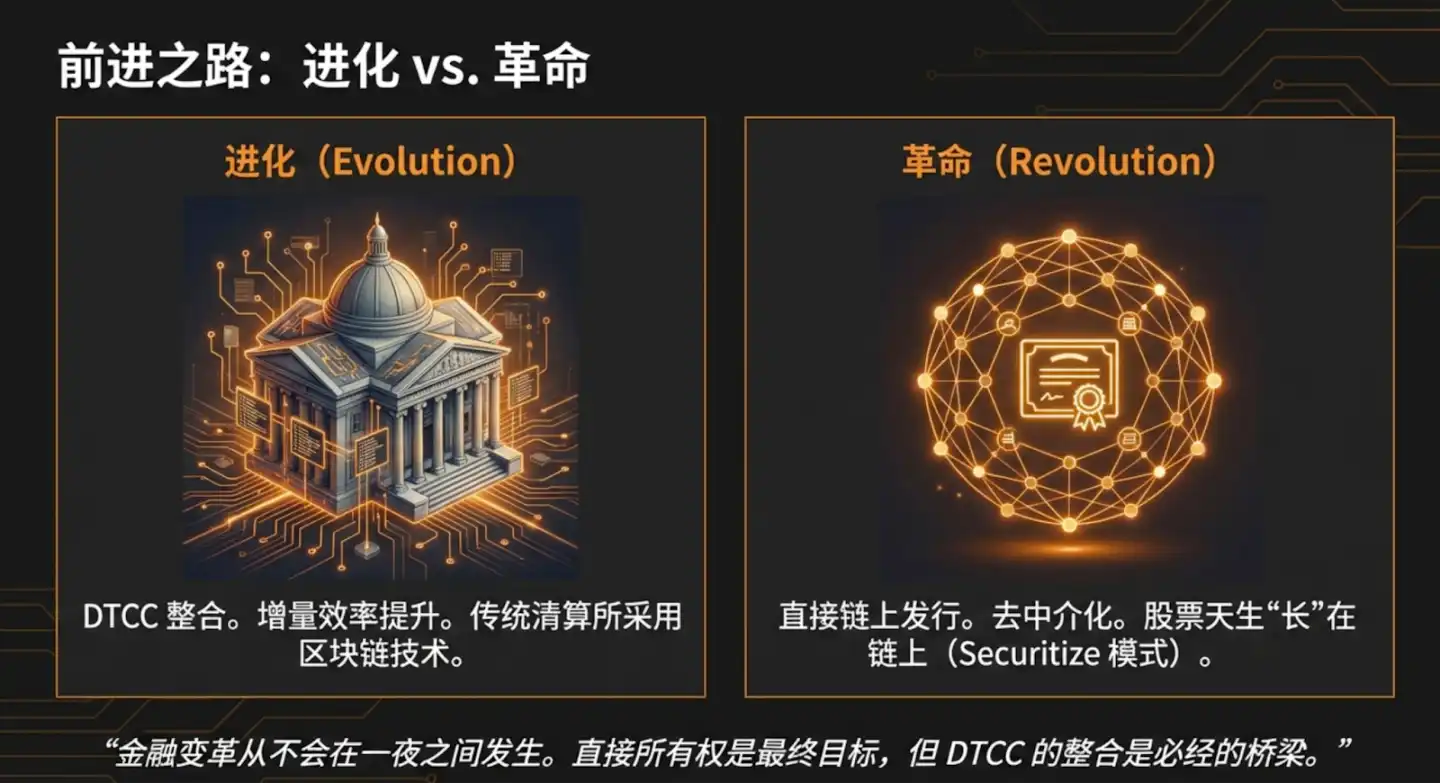
  • The industry is bifurcating into two paths: Incremental (DTCC integration, increasing efficiency) and Revolutionary (direct on-chain issuance, full disintermediation).
  • Conclusion: The fusion of the $150 trillion global stock market with blockchain infrastructure is no longer just a thesis—it is happening.

1. Market Status Analysis: Deciphering the 'Silent Boom'

The Real World Asset (RWA) sector is undergoing structural transformation, with tokenized stocks emerging as the breakthrough sector of this cycle. The overall RWA ecosystem market cap has surpassed $800 million, growing 30x year-to-date. The integration of traditional equity assets with blockchain infrastructure signifies a fundamental shift in capital market design. This 'silent boom' is not merely an asset migration but a modernization of global liquidity—replacing fragmented traditional systems with a unified, programmable financial layer.

The following core data confirms this leap from experimental to institutional grade:

  • Market Cap Achievement: As of December 2025, the sector's market cap has reached a historic high of approximately $800 million.
  • Liquidity Velocity: Monthly trading volume has surged to $1.8 billion, indicating an active secondary market.
  • Adoption Density: The network currently supports 50,000 monthly active addresses and 130,000 total holding addresses.

This growth trajectory is fundamentally supported by blockchain eliminating the settlement friction and access barriers that have long plagued traditional finance (TradFi).
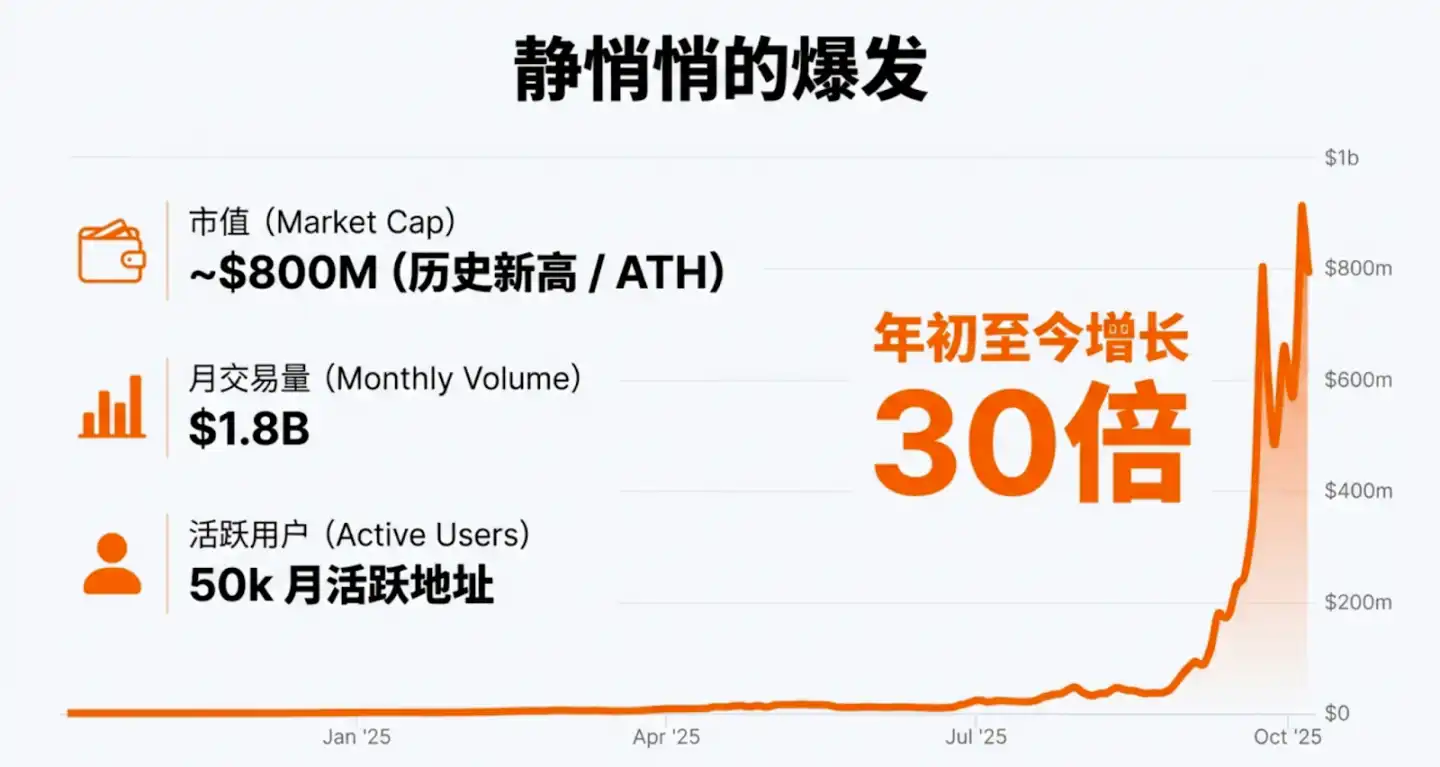
As the capital market's need for settlement efficiency becomes increasingly urgent, how tokenization addresses the chronic problems of TradFi through technological means has become the core of strategic competition in the industry.

2. Strategic Value Drivers: Solving TradFi's Friction Points

Traditional equity markets have long been constrained by the physical boundaries of legacy systems: geographical silos, restricted trading hours, and lengthy settlement cycles. The failure of the T+2 settlement system during the 2021 Robinhood/GME event, which forced brokers to restrict trading due to margin shortfalls, is a classic case study of TradFi's 'efficiency短板' (efficiency shortcoming).

Tokenization offers strategic premium through an 'Efficiency Triple-Threat':

  • 24/7 Trading: Traditional markets operate only 6.5 hours a day. Tokenization eliminates 'opening gap' risk, allowing investors to react in real-time to global macro events.
  • Global Accessibility: Completely breaks down geographical and broker barriers, providing non-US retail investors seamless access to high-demand US stock exposure, achieving 'borderless capital'.
  • Capital Efficiency: Enables T+0 settlement through digital infrastructure, reducing collateral tie-up and operational costs caused by settlement delays.
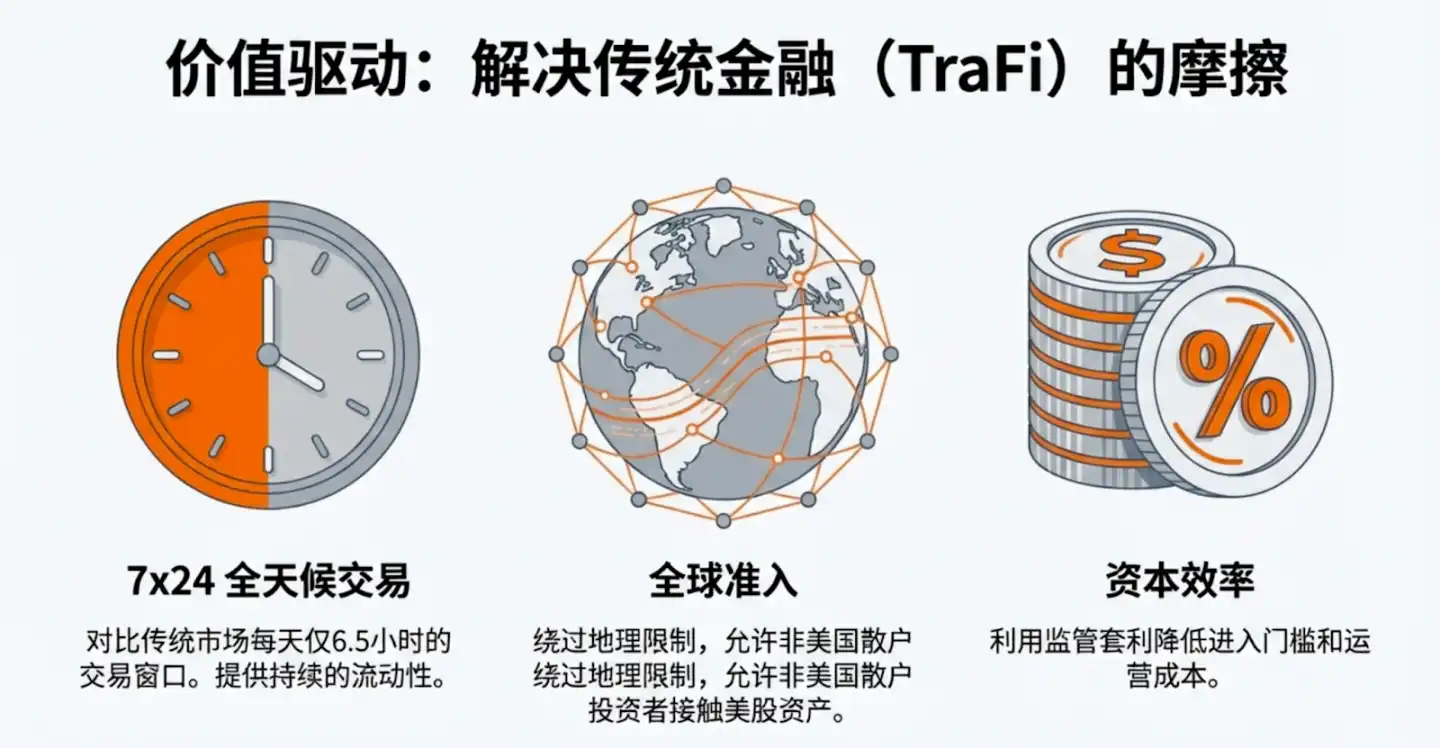
Tokenization is not just an optimization; it bypasses the administrative bottlenecks of traditional securities businesses by providing a global, 24/7 liquidity layer. In an era of 'capital efficiency scarcity', platforms that enable instant settlement and cross-border distribution will hold pricing power.

However, the path to realizing this value driver is not singular; different product architectures determine a platform's long-term moat and risk exposure.

3. Tokenization Architecture Comparative Analysis: Three Core Models

The choice of product architecture is a strategic pivot determining scalability, DeFi composability, and systemic risk characteristics.

Three-Model Framework

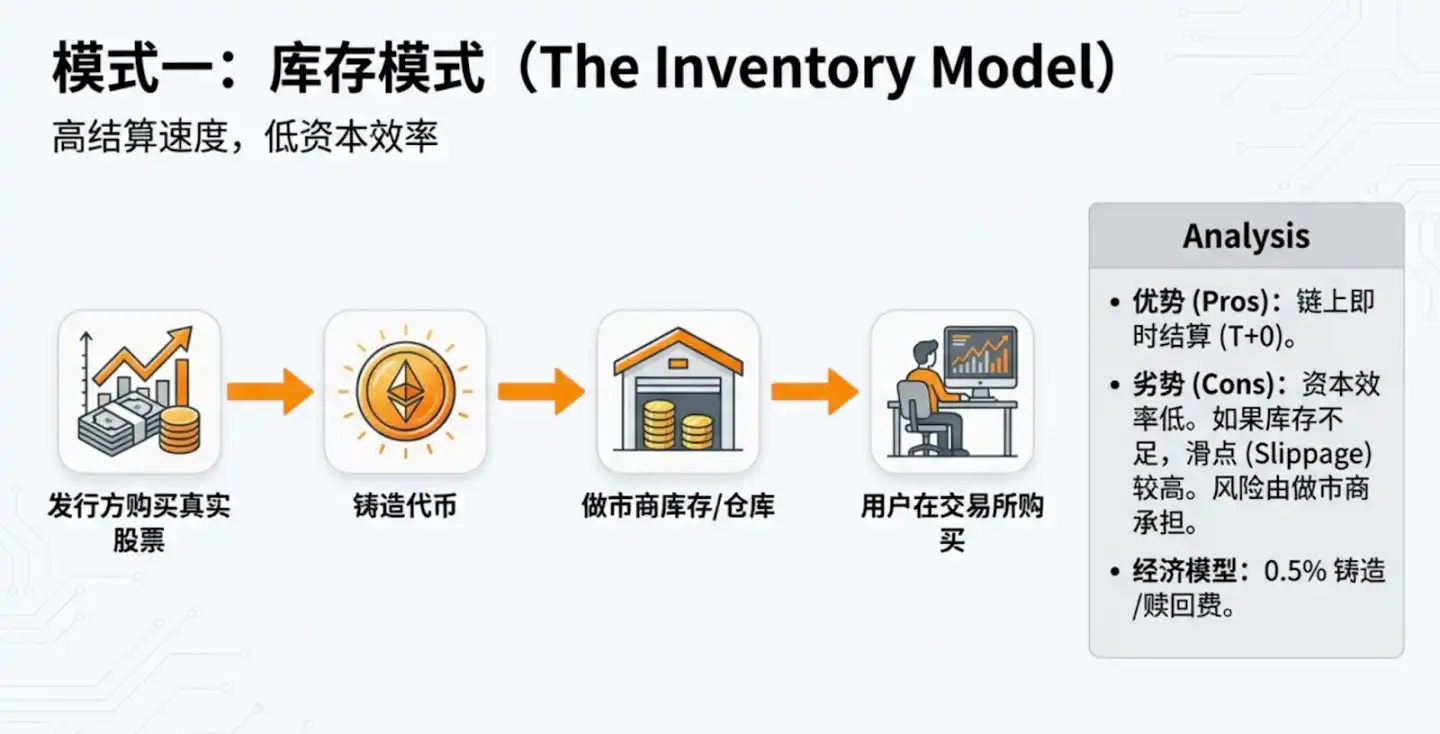
  • Inventory Model (e.g., xStocks, Backed): A 'pre-funded liquidity' solution. The issuer or market maker buys stocks in advance and mints tokens, depositing them in a warehouse ready for sale.
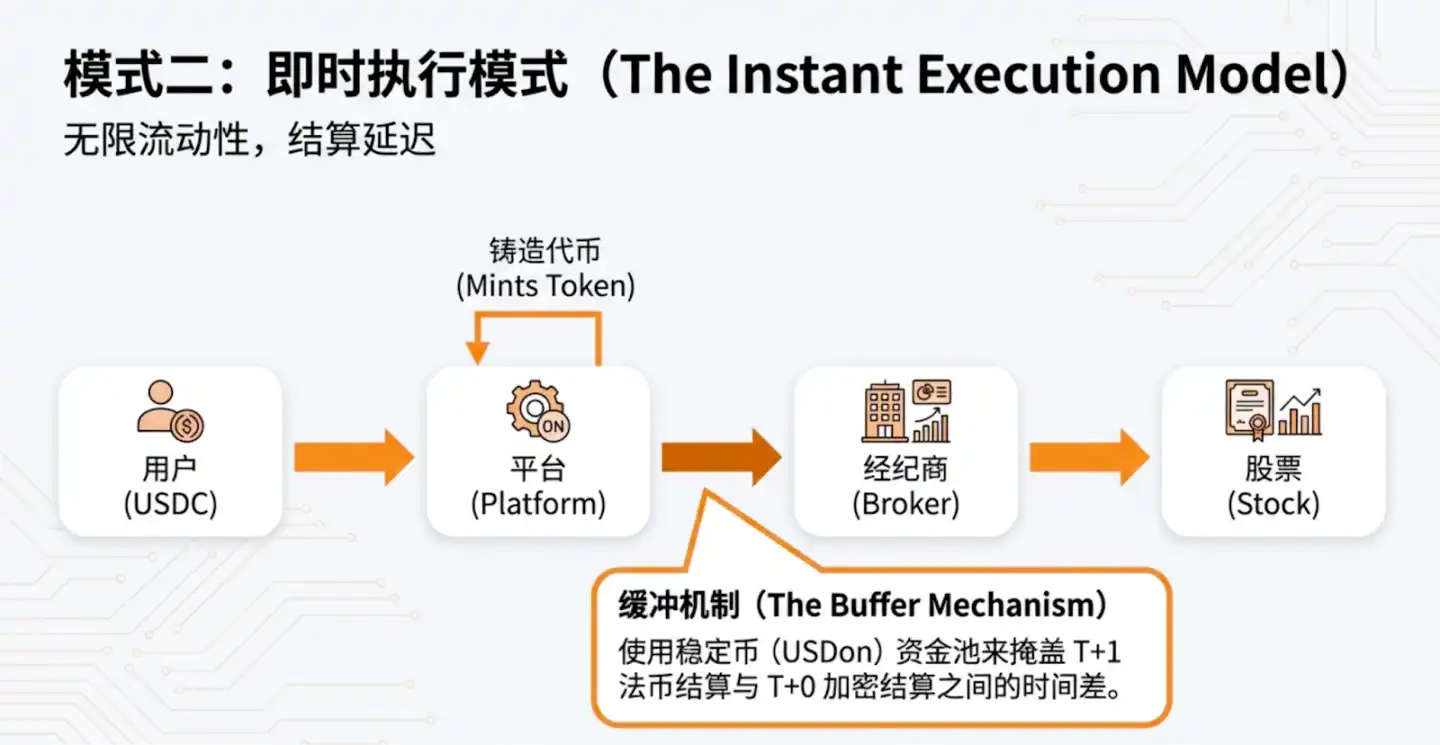
  • Instant Execution Model (e.g., Ondo, CyberAlpha): An 'on-demand liquidity' solution. Stock purchase and token minting are only triggered when a user confirms an order.
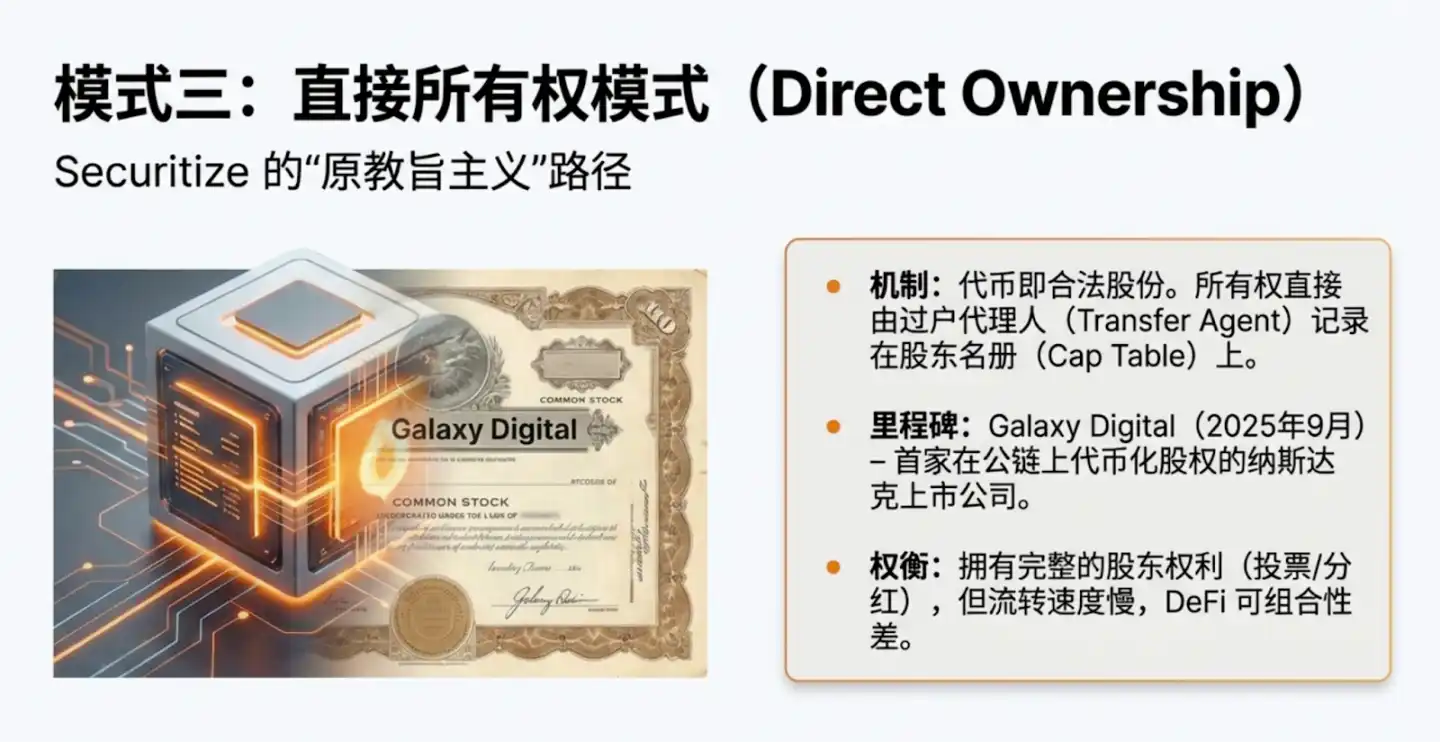
  • Direct Ownership Model (e.g., Securitize, Galaxy Digital): A 'purist' solution where the token *is* the legal share. Ownership is recorded directly on the company's cap table by a transfer agent, granting investors full shareholder rights including voting and dividends, but involves strict transfer restrictions.
Architectural Trade-off Comparison
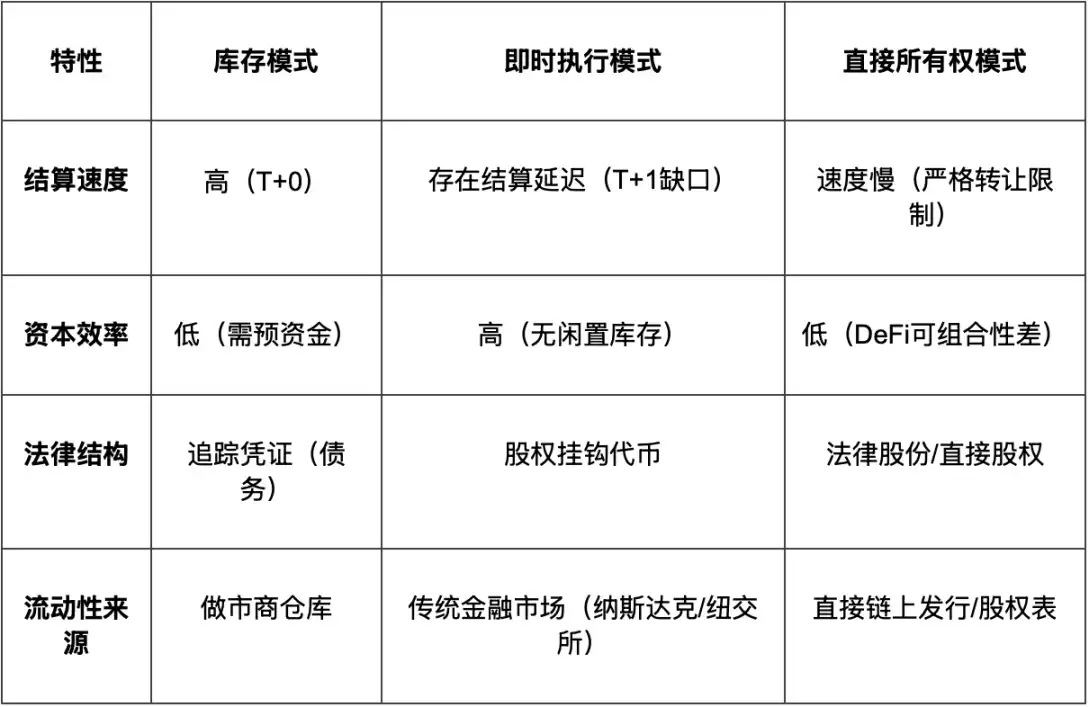
As trading volumes advance to higher levels, the technical challenge shifts to effectively bridging the gap between traditional and digital settlement cycles.

4. Competitive Landscape: Market Leaders and Challengers

The current competitive landscape shows a clear 'duopoly' and 'strategic differentiation'.
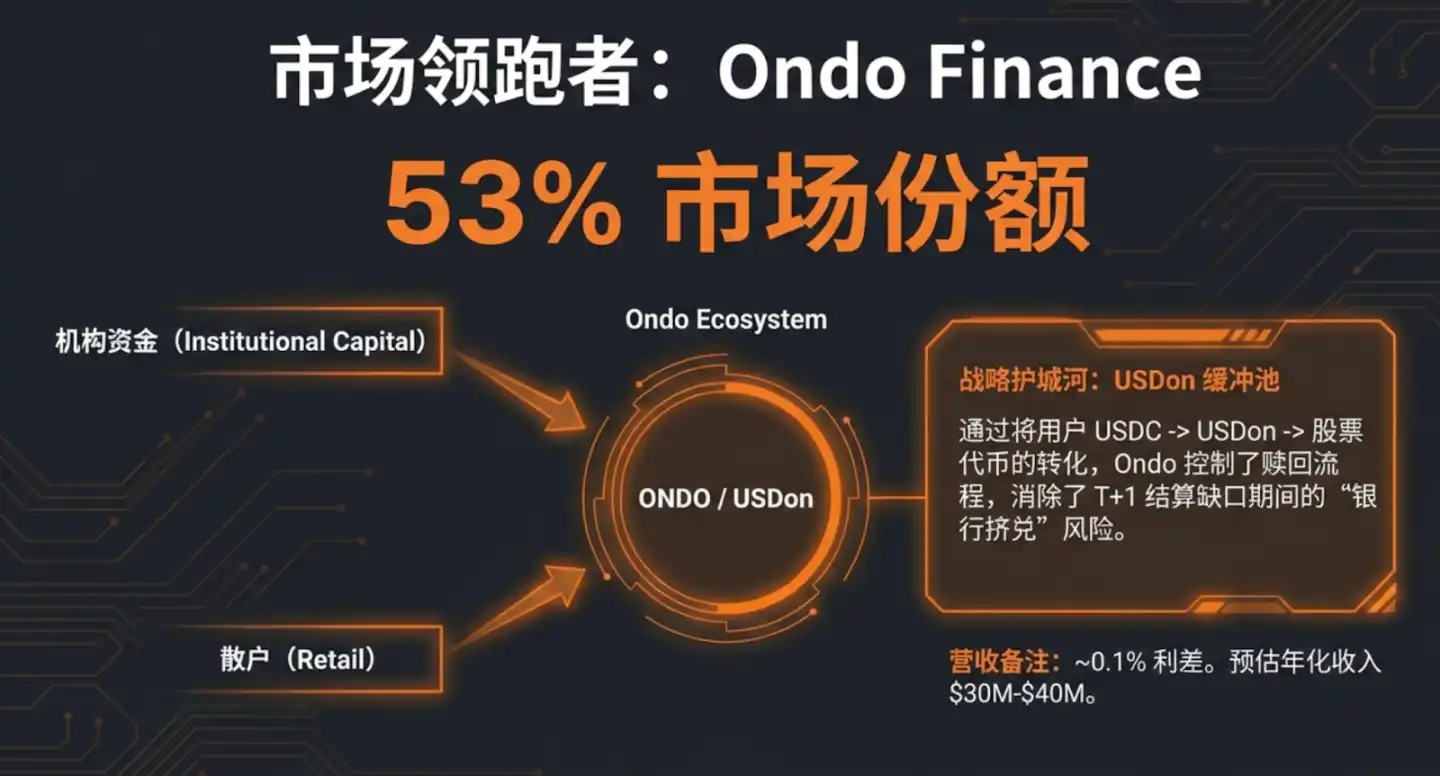
  • Ondo Finance (53% share): The absolute dominator. Its revenue engine relies on a ~0.1% trading fee spread, with estimated annualized revenue of $30M-$40M. Its core moat is a highly sophisticated USDon buffer pool and an extensive network of licensed institutional partners.
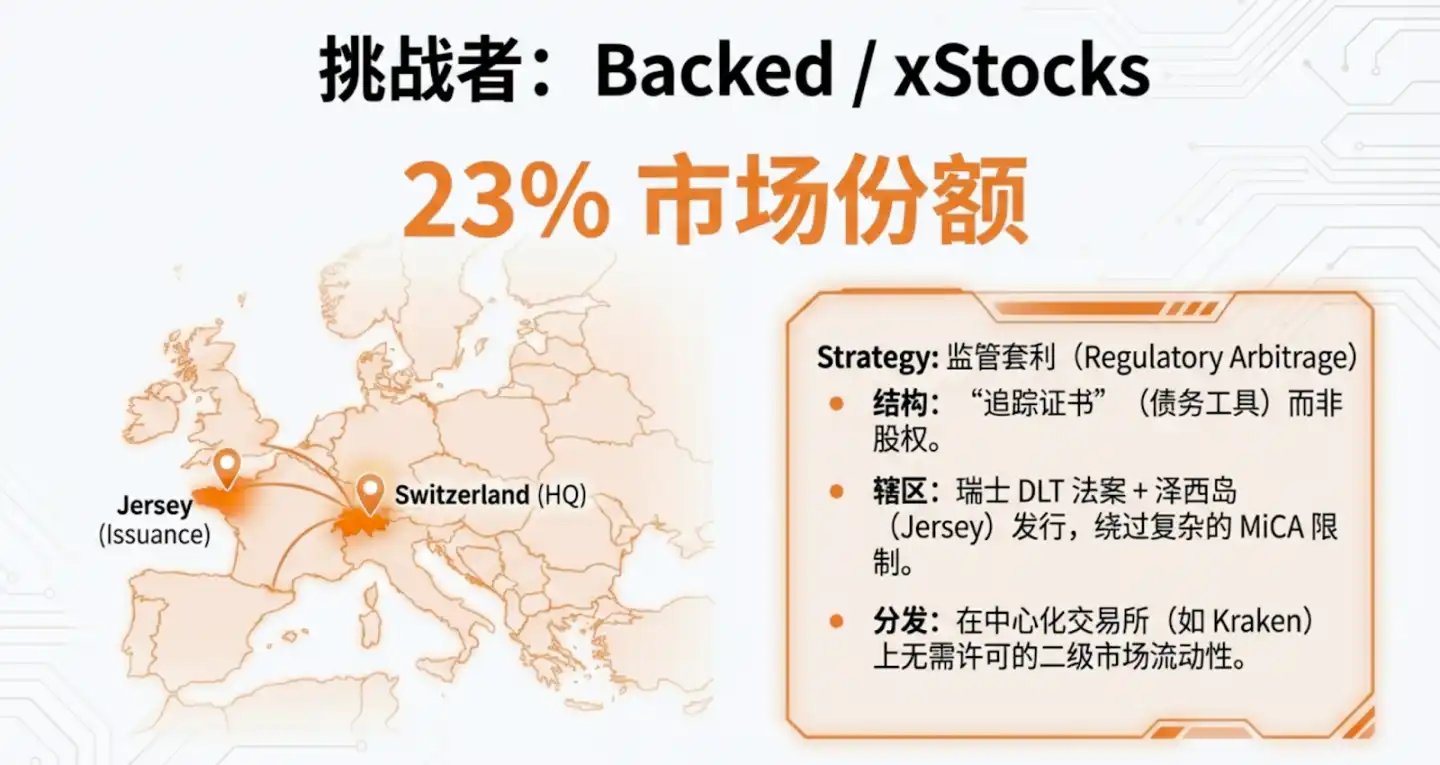
  • Backed / xStocks (23% share): Broke through using 'Legal Alpha'. By structuring products as tracker certificates (debt) under the Swiss DLT Act, they cleverly circumvented MiCA's restrictions on the transfer of direct equity tokens, enabling free flow and composition within the DeFi ecosystem.
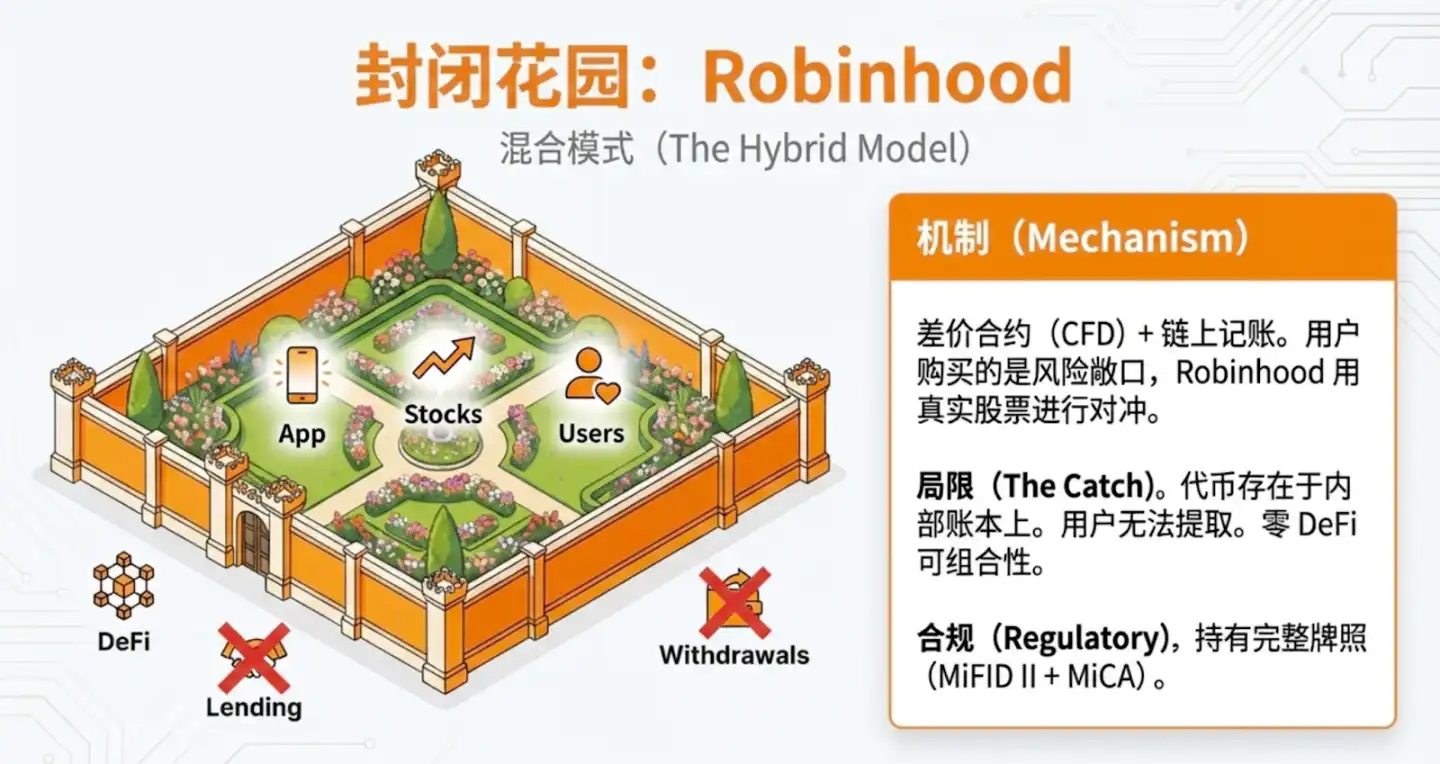
  • Robinhood (Walled Garden): Although it possesses the strongest combination of MiFID II and MiCA licenses, the lack of token extractability creates an isolated ecosystem, missing out on the open premium of DeFi.

'So What?' Level: Competition has shifted from 'user count' to a game of 'regulatory arbitrage' and 'capital efficiency'. Backed sacrificed direct equity rights through its debt structure in exchange for unlimited DeFi interoperability—a precise strategic trade-off.

5. Global Compliance Matrix: Building the Regulatory Moat

In the RWA space, 'license aggregation' is a more formidable moat than technology itself.
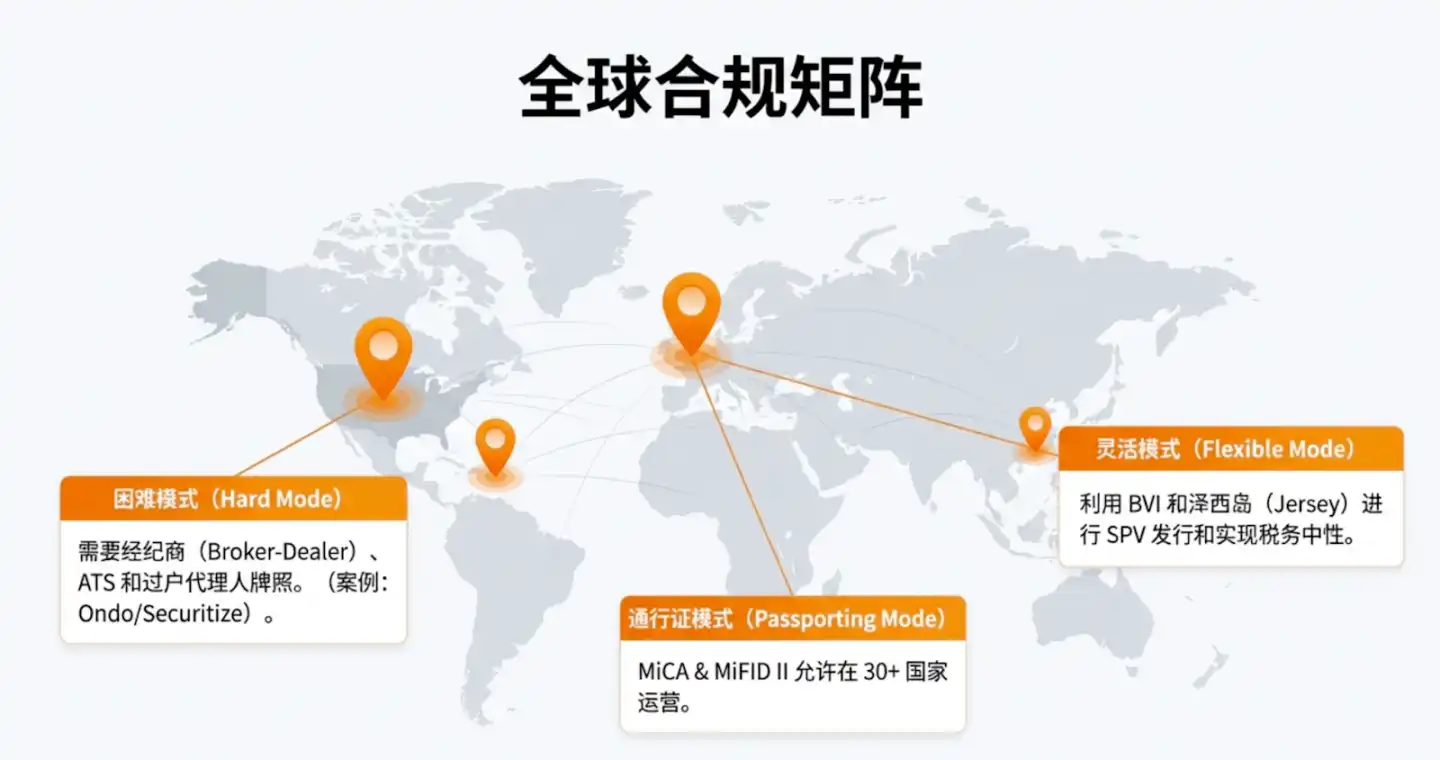
  • US Model (Hard Mode): The cornerstone of success is the 'trident' combination of Broker-Dealer, ATS, and Transfer Agent licenses. Ondo acquired this full suite of capabilities through its acquisition of Oasis Pro, mastering the complete closed loop from onboarding to secondary market matching.
  • EU Model (Passporting Mode): Leveraging the 'passporting' system of MiCA and MiFID II, companies obtaining licenses in Liechtenstein (e.g., Ondo approved by FMA) or Cyprus (e.g., xStocks approved by CySEC) can operate in 30 countries.
  • Specialized Pilots: Securitize, through a DLT pilot license from Spain's CNMV, gained permission to operate as a trading and清算 system, directly challenging the role of traditional CSDs (Central Securities Depositories).

'So What?' Level: Ondo's compliance architecture is a 'masterclass in financial engineering': ensuring tax neutrality through a BVI-based issuing entity, accessing underlying assets through US-licensed entities, achieving bankruptcy remoteness through daily proof of reserves from Ankura Trust, and finally enabling global compliant distribution through **BX Digital (Switzerland)**.

6. Strategic Outlook: Solving the Tokenized Stock 'Impossible Trinity'

The industry must balance the following three elements as it scales:

  • Liquidity / Speed: Exemplified by Ondo, optimized through buffer mechanisms.
  • Regulatory Security / Direct Rights: Exemplified by Securitize, pursuing SEC-compliant underlying direct ownership.
  • DeFi Composability: Exemplified by Backed, achieving on-chain asset flow through debt structures.
The market is currently bifurcating into two paths:

  • Evolutionary Path: Centered on DTCC integration, providing T+0 efficiency increments for incumbent financial institutions.
  • Revolutionary Path: Native on-chain issuance, exemplified by Securitize/Galaxy Digital, aiming for complete disintermediation.
7. Summary and Core Insights

The migration of the global $150 trillion equity market onto the blockchain is now irreversible.

  • Institutional Maturity: The 30x growth and milestones like Galaxy Digital mark the industry's transition from the conceptual phase into the deep waters of licensed competition.
  • Model Superiority: The Instant Execution model, with its极高的 capital efficiency, has gained an early advantage in the current liquidity war.
  • Licenses as Barriers: Platforms capable of navigating both US underlying asset access (ATS/BD licenses) and global (EU MiCA/Offshore BVI) compliant distribution will build an insurmountable long-term moat.

'Financial transformation is never overnight. Direct ownership is the ultimate goal, but integration and optimization with the DTCC is the necessary bridge to the future.'


Preguntas relacionadas

QWhat are the three main product architectures in the tokenized stock market, and which one currently leads in capital efficiency?

AThe three main product architectures are: 1) Inventory Model (e.g., xStocks, Backed), 2) Instant Execution Model (e.g., Ondo, CyberAlpha), and 3) Direct Ownership Model (e.g., Securitize). The Instant Execution Model currently leads in capital efficiency.

QWhat is the core value proposition of tokenized stocks that addresses the pain points of traditional finance (TradFi)?

AThe core value proposition is the 'Efficiency Triple-Threat': enabling 24/7 trading, providing global accessibility to bypass geographical and broker restrictions, and achieving near-instant T+0 settlement to improve capital efficiency and eliminate delays.

QAccording to the report, what has become the most difficult competitive barrier to replicate in the tokenized stock sector, and why?

ARegulatory compliance, specifically building a cross-border licensing system across the US, EU, and offshore jurisdictions, has become the most difficult barrier to replicate. It is harder to obtain the necessary licenses (e.g., US broker-dealer, ATS, transfer agent; EU MiCA/MiFID II passports) than to develop the underlying tech.

QWhat fundamental 'trilemma' do tokenized stock platforms face, and what are the three competing elements?

APlatforms face a trilemma where they can only optimize for two of the following three elements at the same time: 1) Liquidity/Speed, 2) Regulatory Security/Direct Shareholder Rights, and 3) DeFi Composability.

QWhich two platforms currently dominate the market share of tokenized stocks, and what are their respective strategies for maintaining leadership?

AOndo Finance dominates with 53% market share, relying on its sophisticated liquidity engineering (USDon buffer pool) and extensive licensed partner network. Backed/xStocks holds 23% market share, leveraging a 'legal alpha' strategy by structuring products as debt under Swiss law to enable superior DeFi composability and regulatory arbitrage.

Lecturas Relacionadas

As Consensus Accelerates, What Are Young Investors Betting On?

Title: As Consensus Forms Faster, What Are Young Investors Betting On? In the rapid evolution of tech investment, a new generation of young investors is navigating a landscape where AI, robotics, commercial aerospace, and quantum computing are advancing simultaneously. Traditional investment logic based on financial models is giving way to a need for deep technical understanding and the ability to act before industry consensus forms. An analysis of trends from the "WAIC FUTURE TECH" list of young investment leaders reveals key shifts in focus. The first major trend is the movement of AI from the digital screen into the physical world. Investment is shifting from large language models and chatbots towards embodied AI, robotics, AI hardware, and edge computing. While demonstrations generate excitement, the real challenge lies in achieving scalable, reliable, and cost-effective delivery in complex real-world environments like factories and logistics. Success depends not just on algorithms but on the integration of sensors, actuators, and control systems. Second, the competitive focus for large models is moving beyond raw capability toward building an "intelligence flywheel." The goal is to create self-reinforcing systems where user interaction generates data, improving the model, which in turn enhances the user experience and attracts more engagement. Companies that successfully embed AI into workflows to create these closed-loop systems can build lasting value that isn't easily erased by the next model upgrade. Third, facing a potential bottleneck in high-quality human-generated data, investors are looking at new underlying technologies. Reinforcement learning and self-play, as demonstrated by AlphaGo Zero, offer paths for AI to generate its own experience. Scientific foundation models, which aim to build general AI capabilities for fields like life sciences and materials discovery, represent a non-consensus direction that could unlock new frontiers of knowledge and data. Finally, in deep-tech areas like quantum computing, commercial aerospace, and space-based infrastructure, patient capital is essential. These fields have long, uncertain development and validation cycles involving complex engineering, supply chains, and regulations. Investment here requires a long-term view, focusing on foundational team capabilities and the eventual emergence of market demand, even if commercial returns are distant. Collectively, these trends illustrate how young investors are adapting to a new era. They are learning to make earlier, technically-informed judgments, balance hype with real-world viability, and provide the patient capital needed to build the deep-tech foundations of the future.

marsbitHace 27 min(s)

As Consensus Accelerates, What Are Young Investors Betting On?

marsbitHace 27 min(s)

Can Japan Buy Growth with AI? Will the Bond Market Believe It?

Japan's cabinet has introduced the 2026 Basic Policy on Economic and Fiscal Management and Reform, shifting its primary fiscal target. The new framework moves away from the traditional annual primary balance goal and instead prioritizes a stable reduction of the debt-to-GDP ratio. This change is tied to a strategy of increased "responsible proactive fiscal" spending, aiming to boost long-term growth through investments in strategic sectors like AI, semiconductors, energy, and robotics. The government estimates total public and private investment in 62 key technologies could exceed 370 trillion yen by 2040. The market reaction has been mixed and cautious. While equity markets may respond to policy signals, bond markets are focused on fiscal credibility. Concerns center on whether the weakening of the clear primary balance anchor could lead to looser fiscal discipline. If investors doubt that these strategic investments will generate sufficient productivity gains, tax revenue, and nominal growth to outpace rising interest costs, they may demand higher yields on Japanese Government Bonds (JGBs). Recent volatility in the yen and JGB yields, with the 10-year yield briefly reaching 2.9%, reflects this skepticism. The success of this new framework hinges on two factors: whether Japan can achieve a nominal growth rate consistently higher than its long-term interest rates, and whether future budgets demonstrate disciplined control over bond issuance. The government's narrative is that strategic investment is essential to break Japan's cycle of low growth, aging, and labor shortages. However, the bond market will continuously assess the credibility of this plan, pricing the risk that it may represent fiscal expansion rather than a viable growth strategy.

marsbitHace 1 hora(s)

Can Japan Buy Growth with AI? Will the Bond Market Believe It?

marsbitHace 1 hora(s)

Misjudged A-Shares: Resilience, Expectations, and Confidence

China's A-share market recently faced selling pressure, especially in tech sectors, initially triggered by a global tech sell-off that began in South Korea. However, the article argues this is a case of "mistaken injury" and highlights the market's underlying resilience. This resilience stems from three main pillars: **1) Tech Sector Fundamentals:** Unlike Korea's market dominated by a few memory chip stocks, China's tech sector is diversified across computing, communications, electronics, and semiconductors, supported by dual narratives of global AI supply chains and domestic substitution. Core areas like optical modules and fiber optics continue to show strong earnings growth. **2) "National Team" Support:** State-backed institutions and large corporations have made significant market purchases and announced buybacks, providing liquidity and signaling confidence. This is seen as a stabilizing policy signal, often associated with market bottoms. **3) Broader Market Pillars:** Other major sectors are showing endogenous recovery momentum. Consumer stocks benefit from stabilizing CPI and signs of sector recovery (e.g., liquor price hikes). Cyclical sectors like aluminum have high earnings, potential price increases due to tight supply, and low valuations. The financial sector offers stable dividends and low valuations. The conclusion is that the sell-off was driven by external contagion, not a collapse in fundamentals. With strong policy support and recovering momentum across key sectors, the A-share market possesses the toughness to regain stability.

marsbitHace 1 hora(s)

Misjudged A-Shares: Resilience, Expectations, and Confidence

marsbitHace 1 hora(s)

Trading

Spot
活动图片




