The Rise and Fall of Binance's Hegemony: The Stablecoin War from BUSD's 'Unification' to $U's 'Dominance'

marsbitPublicado a 2025-12-19Actualizado a 2025-12-19

Resumen

"Binance's Stablecoin Wars: From BUSD's 'Unification' to $U's 'Domination'" This article chronicles Binance's evolving strategy in the stablecoin arena, tracing its journey from aggressive dominance to a more sophisticated, aggregator model. The story begins with the ambitious launch of BUSD, a Paxos-issued stablecoin born from a partnership between Binance's CZ and Paxos's Richmond Teo. Binance's most aggressive move came in 2022 with a "liquidity unification" blitz, automatically converting user balances of USDC, USDP, and TUSD into BUSD and removing their trading pairs. This tactic briefly propelled BUSD to a $23 billion market cap. However, its downfall was swift. A critical structural flaw was its "Binance-Peg BUSD," an unregulated, shadow version on the BNB Chain that sometimes lacked sufficient collateral. This led to a regulatory "Valentine's Day massacre" in February 2023, when the NYDFS ordered Paxos to stop minting BUSD, effectively killing the project. In the subsequent vacuum, Binance first promoted the Hong Kong-based FDUSD as a transitional solution and created BFUSD, an internal, yield-bearing "reward asset" for use as futures collateral. The narrative then shifts to Binance's latest and most surprising play: United Stables ($U). This new "meta-stablecoin" represents a strategic evolution. Instead of trying to eliminate rivals like USDT and USDC, $U aggregates them, backing itself with a basket of these major stablecoins. Notably, it also includes USD1, a s...

In the crypto world, what truly determines victory is never code, but the interplay of liquidity, power, and regulation. The rise and fall of BUSD is not just the tragic history of a single stablecoin, but a financial war about how an exchange attempted to "unify the world."

When BUSD was pushed onto the historical stage, it carried not only a compliance narrative but also Binance's ambition to reshape the stablecoin order through coercive measures—forcing exchange rates and merging trading pairs to absorb the depth of competitors directly into its own ledger.

The "automatic conversion" in 2022 was a textbook blitzkrieg; while the regulatory hammer on Valentine's Day 2023 caused this seemingly impregnable empire to collapse instantly. The twin BUSDs, the shadowy Binance-Peg, and the blurred regulatory boundaries together constituted its Achilles' heel.

But the story does not end here.

From FDUSD to BFUSD, and then to United Stables ($U), Binance did not give up on stablecoins but evolved from its failures, shifting from hegemonic unification to aggregated absorption, even paving the way for the AI economy in advance.

This is an article about stablecoins, but even more so, it is a business documentary about how exchange power attempted to tame the market and was counterattacked by regulation.

Chapter 1: Zeal and Hegemony—The "Unification" Story of BUSD

The story of BUSD is not just the rise and fall of a compliant product but also a tale of "imperial tactics" about how an exchange attempted to unify market liquidity through administrative means.

1.1 Humble Beginnings: The Dinner Between CZ and Richmond Teo

In 2019, the stablecoin market was Tether's wild west. At this time, Richmond Teo, as the co-founder of Paxos and CEO of Asia, became a key bridge connecting New York regulators with Asian crypto giants.

An industry rumor, seemingly false yet widely believed, circulated: Shortly before the launch of BUSD, after Paxos published a blog post celebrating its compliant status, Rich Teo and CZ were spotted dining together at an upscale overseas restaurant. After that dinner, the situation changed dramatically: Huobi's HUSD gradually fell out of favor, and Paxos solidified its position as the "full-time custodian" of BUSD. CZ entrusted Binance's liquidity backbone to Teo, while Teo used the New York State Department of Financial Services (NYDFS) "green list" license to equip Binance with a bulletproof vest.

1.2 The Zealous Moment: The 2022 "Exchange Rate Unification Blitz"

The most "zealous" and controversial moment in BUSD's history occurred in September 2022. To challenge the dominance of USDT and USDC, Binance launched a stunning "liquidity unification" operation.

Binance announced that it would automatically convert existing user balances and newly deposited USDC, USDP (Paxos Dollar), and TUSD (TrueUSD) into BUSD at a 1:1 ratio.

Binance directly removed spot trading pairs for USDC, USDP, and TUSD. This meant that on Binance, the world's largest liquidity pool, users could deposit USDC but would only see and use BUSD on their accounts. (However, they could withdraw USDT or USDC.)

This was a blatant strategy. By forcibly merging liquidity, BUSD instantly gained the trading depth that originally belonged to its competitors. Although Circle (the issuer of USDC) CEO Jeremy Allaire stated on Twitter that this helped increase dollar liquidity, the brand presence of USDC in the Binance ecosystem was forcibly erased, becoming "fuel" for BUSD.

This aggressive strategy was highly effective. BUSD's market capitalization soared to a historical peak of $23 billion in November 2022, once occupying half of the trading volume on centralized exchanges. That was BUSD's most glorious moment and the peak of Binance's ambition to establish an independent financial闭环 (closed loop).

1.3 The Regulatory "Valentine's Day Massacre"

However, this "unification" came to an abrupt end on February 13, 2023. The NYDFS pointed out that the "Binance-Peg BUSD" (a shadow version issued for use on BNB Chain) issued by Binance exceeded Paxos's regulatory scope and ordered a halt to its minting. BUSD's market capitalization plummeted from its peak of $23 billion to nearly zero. The empire built through "automatic conversion" collapsed under the regulatory hammer.

For Teo, this was undoubtedly a heavy blow. As the architect, he watched as the "child" he and CZ had raised together was forcibly euthanized. Paxos was forced to announce the severance of its relationship with Binance, and Teo subsequently entered a low-profile period lasting over a year.

However, the story did not end there. Rich Teo's high-profile return in the Trump family's crypto project, World Liberty Financial (WLFI), is seen as a continuation of his story with CZ. Teo is leveraging new political capital to build a new compliant stablecoin (USD1), and WLFI deeply relies on BNB Chain's liquidity. This seems to be a more subtle and迂回 (roundabout) way for the two old friends to continue their "liquidity alliance" in the cracks of regulation.

Chapter 2: The Achilles' Heel—The "Twins" and Regulatory Thunder

2.1 The Fatal Structural Flaw: Binance-Peg BUSD

Behind BUSD's glory lay a structural hidden flaw that ultimately led to its destruction. In fact, there were two截然不同 (distinctly different) forms of BUSD circulating in the market:

  • BUSD issued by Paxos (ERC-20): This was the real "compliant BUSD," issued by Paxos on the Ethereum blockchain, directly regulated by NYDFS, with reserves strictly held in segregated U.S. accounts.
  • Binance-Peg BUSD (BEP-20, etc.): This was a "wrapped token" created by Binance to extend its ecosystem to non-Ethereum chains (like BNB Chain, Polygon, Avalanche).

In theory, the mechanism of Binance-Peg BUSD was: Binance would lock 1 Paxos BUSD on Ethereum, then mint 1 Binance-Peg BUSD on BNB Chain. However, this "bridging" mechanism relied entirely on Binance's internal operations, not direct management by Paxos. NYDFS's regulatory authority and the "green list" only covered Paxos BUSD on Ethereum, not Binance-Peg BUSD.

The breaking point was the disconnect in reserve management. Investigations by media outlets like Bloomberg revealed that during certain periods from 2020 to 2021, the wallets backing Binance-Peg BUSD experienced severe "undercollateralization," with gaps reaching up to $1 billion at one point. Although Binance claimed this was merely an "operational delay" and not a solvency issue, it directly violated the regulators' bottom line: a stablecoin flying the flag of "NYDFS regulated" had spawned an unregulated "shadow version" with messy reserve management.

2.2 The Regulatory Hammer: The 2023 "Valentine's Day Massacre"

BUSD's fate came to an abrupt halt on February 13, 2023. On this day, the New York State Department of Financial Services (NYDFS) issued an administrative order demanding that Paxos immediately stop minting new BUSD tokens.

The regulator's理由 (reasoning) was clear and致命 (fatal): Paxos had failed to effectively supervise its relationship with Binance, particularly regarding the issuance of Binance-Peg BUSD, which allowed the compliant BUSD to be used as backing for unauthorized derivatives. The NYDFS explicitly stated: "While we authorized BUSD on Ethereum, we never authorized Binance-Peg BUSD."

Simultaneously, the U.S. Securities and Exchange Commission (SEC) issued a Wells Notice to Paxos, alleging that BUSD constituted an "unregistered security." The logic behind this accusation was that BUSD was not just a payment tool; it was part of Binance's ecosystem profit mechanism (through products like Earn), thus potentially constituting an investment contract. Although the SEC later dropped this specific investigation in July 2024, the dual blow at the time was already致命 enough (fatal enough).

2.3 Fall and Retreat

"Ceasing minting" meant BUSD became a "zombie token" that could only be redeemed, not newly issued. For an asset intended to be a liquidity medium, this was a death sentence. As Paxos announced the termination of its partnership with Binance, BUSD's market capitalization began a free fall. Within days, billions of dollars flowed out; within a year, its market cap shrunk by over 90%.

Binance was forced into a painful retreat:

  • Delisting Trading Pairs: Gradually removing BUSD spot and leverage trading pairs.
  • Ceasing as Margin: Announcing BUSD would no longer serve as a margin asset for contract trading.
  • Forced Conversion: Urging users to convert BUSD to other stablecoins (e.g., FDUSD).

The once "zealous" stablecoin empire collapsed under the regulatory hammer. Binance lost a stablecoin trump card and was forced to rethink its stablecoin strategy.

Chapter 3: The Transition Vacuum and the Emergence of FDUSD & BFUSD

In the initial period after BUSD's fall, Binance faced reluctance to let go of its "own stablecoin" revenue—why should this profit be handed over to others? To fill this void, Binance quickly promoted First Digital USD (FDUSD), a stablecoin issued by Hong Kong's First Digital Labs.

Binance's support for FDUSD almost replicated the strategy used to promote BUSD back in the day:

  • Launching "zero fee" activities for FDUSD trading pairs.
  • Offering 1:1 lossless conversion from BUSD to FDUSD.
  • Including FDUSD as a farming option in Launchpool.

However, FDUSD was more of a strategic buffer. While it addressed the shift in compliance location (from the U.S. to Hong Kong), it was still a traditional, centralized, third-party issued stablecoin. It did not solve the core problem: if regulators targeted the issuer again, Binance would still be passive. Furthermore, in a high-interest rate environment of up to 5%, the model of FDUSD (and USDT/USDC) meant the issuer earned all the interest, while users got nothing. This was already outdated in the DeFi era.

The era for new stablecoins had also passed. FDUSD's primary use case originally was participating in Launchpool. As Launchpool activities sharply decreased, FDUSD's utility value also diminished. Coupled with the丑闻 (scandal) involving Justin Sun in April 2025, the growth of FDUSD faced challenges.

To counter competitors' "contract position yield" features, BFUSD (Binance Futures USD) emerged.

Binance repeatedly emphasized that BFUSD is a "reward-based margin asset," not a true stablecoin.

Users holding BFUSD can earn 4-5% APY. The yield comes from a "Delta hedging" strategy.

BFUSD cannot be withdrawn; it can only be used as margin in Binance's contract accounts. It is Binance's "internal circulation" weapon, ensuring that even in a bear market, users do not transfer funds out of the exchange. It is an asset appreciation financial product disguised as a "stablecoin." Although BFUSD has also achieved considerable success (currently with an issuance of 1.8 billion), Binance also knows that a stablecoin that cannot leave the exchange is merely play money (欢乐豆).

Chapter 4: United Stables ($U)—The "Surprise" and New Landscape It Brings

If BUSD represented "exclusive" hegemony and BFUSD was "internal" defense, then the newly launched United Stables ($U) brings a completely different surprise: "compatibility" and "the future."

4.1 No Longer "Reinventing the Wheel," but "Absorbing the Wheel"

Unlike the BUSD era's attempt to eliminate USDC, $U adopts a "meta-stablecoin" strategy.

$U is backed by a basket of assets. According to the release information on December 18, 2025, its reserves include USDT, USDC, and USD1.

It continues BUSD's unification strategy. Whether it's USDC, USDT, USD1, or USD, they all become the underlying assets of $U, but对外呈现时是U (externally presented as U). By吸纳 (absorbing) the liquidity-fragmented USDT and USDC into $U's reserve pool, United Stables attempts to algorithmically "unify" these assets on BNB Chain, issuing the most liquid $U, somewhat analogous to curveUSD. U is the unified称谓 (designation) for these stablecoins, but users can choose other stablecoins when withdrawing/redeeming.

This is a higher-dimensional strike—since the dollar I issue you dare not use, I will package the dollars you dare use into my token.

4.2 Surprise Two: Foreshadowing, the Trump Concept Coin USD1 Enters the Game

The strategic surprise of United Stables also lies in including USD1 as a reserve asset. (This is the stablecoin issued by the Trump family's crypto project, World Liberty Financial (WLFI), whose stablecoin负责人 (head) is none other than BUSD's old architect, Richmond Teo. One wonders if this relationship was a factor?)

After all, USD1's size is several magnitudes smaller than USDC and USDT. This support, from an external view, seems more like a political投名状 (letter of commitment/pledge of allegiance). It is foreseeable that United Stables provides a huge use case for USD1 (as $U's underlying asset), given that USD1's current usage scenarios are still quite limited.

4.3 Surprise Three: Currency Born for AI (The AI Economy)

United Stables explicitly states that $U is "designed for the AI economy."

As stated in United Stables' tweet:
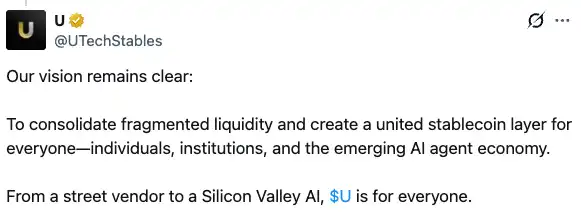
EIP-3009 (Gasless Authorization): Allows for "gasless transfers." This means future AI agents (Bots) conducting high-frequency micropayments do not need to hold BNB or ETH for gas fees. This solves the biggest pain point in machine-to-machine (M2M) economics.

x402 Delegated Execution: A standard that allows smart contracts to automatically execute fund transfers based on specific conditions. This paves the way for future "autonomous hedge funds" or "supply chain automatic payment AIs."

As of the time of writing: U already has a circulating supply of 55 million. Is it a case of积累薄发 (accumulating strength for a major leap), or just a passing cloud?

https://x.com/UTechStables/status/2001667382444482708?s=20

Epilogue: How Far Has the Journey Been from "Hegemony" to "Great Unity"?

Looking back at the evolution from BUSD to United Stables, we see a惊人的 (astonishing) evolution in strategic thinking:

BUSD Era (Hegemony): Leveraged the exchange's monopoly position, used "automatic conversion" to forcibly eliminate opponents, pursued absolute market share. This approach, though "zealous," was also极易 (highly prone) to provoke joint counterattacks from regulators and competitors.

United Stables Era (Great Unity): Learned lessons, adopted an "aggregation" strategy instead. Acknowledged the status of USDT/USDC, but used $U to make them the underlying assets, positioning itself as the upper-layer "super application."

Planned ahead for AI payments,跳出 (jumped out of) the存量博弈 (stock game) of current human traders to seize the增量市场 (incremental market) of the future machine economy.

$U is not just a new aggregated stable token; it is also an attempt by BUSD, after being struck down by regulation, to redefine the stablecoin game rules using more tactful, sophisticated, and technologically forward-looking means. One can only say risks and opportunities coexist. Let's wait and see!


Preguntas relacionadas

QWhat was the primary reason for the downfall of BUSD according to the article?

AThe downfall of BUSD was primarily due to regulatory action. The New York State Department of Financial Services (NYDFS) ordered Paxos to stop minting new BUSD because the 'Binance-Peg BUSD' (a wrapped version for other blockchains) operated outside of Paxos's regulatory oversight, creating a structural flaw and leading to allegations of inadequate collateralization.

QWhat aggressive strategy did Binance employ in September 2022 to boost BUSD's market position?

AIn September 2022, Binance launched an aggressive 'liquidity unification' blitz. It automatically converted user balances of USDC, USDP, and TUSD to BUSD at a 1:1 ratio and removed those stablecoins' spot trading pairs, forcing all liquidity on its platform to flow through BUSD.

QHow does the new United Stables ($U) differ fundamentally from the original BUSD strategy?

AUnited Stables ($U) uses an aggregating 'meta-stablecoin' strategy, where its value is backed by a basket of assets including USDT, USDC, and USD1. This contrasts with BUSD's 'hegemonic' strategy, which sought to eliminate competitors like USDC by强制转换 and replacing them entirely.

QWhat key technological feature of $U is designed specifically for the AI economy?

A$U is designed for the AI economy through its implementation of EIP-3009, which enables 'gasless transactions.' This allows AI agents (bots) to perform high-frequency micro-transactions without needing to hold native cryptocurrencies like BNB or ETH for gas fees.

QWho was the key figure from Paxos involved in the creation of BUSD, and what project are they associated with now?

ARichmond Teo, the co-founder and former Asia CEO of Paxos, was the key architect behind BUSD. He is now associated with the Trump-family-linked crypto project World Liberty Financial (WLFI), where he is involved with their USD1 stablecoin.

Lecturas Relacionadas

Trading

Spot
Futuros

Artículos destacados

Qué es $S$

Entendiendo SPERO: Una Visión General Completa Introducción a SPERO A medida que el panorama de la innovación continúa evolucionando, la aparición de tecnologías web3 y proyectos de criptomonedas juega un papel fundamental en la configuración del futuro digital. Un proyecto que ha atraído la atención en este campo dinámico es SPERO, denotado como SPERO,$$s$. Este artículo tiene como objetivo reunir y presentar información detallada sobre SPERO, para ayudar a entusiastas e inversores a comprender sus fundamentos, objetivos e innovaciones dentro de los dominios web3 y cripto. ¿Qué es SPERO,$$s$? SPERO,$$s$ es un proyecto único dentro del espacio cripto que busca aprovechar los principios de descentralización y tecnología blockchain para crear un ecosistema que promueva la participación, la utilidad y la inclusión financiera. El proyecto está diseñado para facilitar interacciones de igual a igual de nuevas maneras, proporcionando a los usuarios soluciones y servicios financieros innovadores. En su esencia, SPERO,$$s$ tiene como objetivo empoderar a los individuos al proporcionar herramientas y plataformas que mejoren la experiencia del usuario en el espacio de las criptomonedas. Esto incluye habilitar métodos de transacción más flexibles, fomentar iniciativas impulsadas por la comunidad y crear caminos para oportunidades financieras a través de aplicaciones descentralizadas (dApps). La visión subyacente de SPERO,$$s$ gira en torno a la inclusividad, buscando cerrar brechas dentro de las finanzas tradicionales mientras aprovecha los beneficios de la tecnología blockchain. ¿Quién es el Creador de SPERO,$$s$? La identidad del creador de SPERO,$$s$ sigue siendo algo oscura, ya que hay recursos públicos limitados que proporcionan información de fondo detallada sobre su(s) fundador(es). Esta falta de transparencia puede derivarse del compromiso del proyecto con la descentralización, una ética que muchos proyectos web3 comparten, priorizando las contribuciones colectivas sobre el reconocimiento individual. Al centrar las discusiones en torno a la comunidad y sus objetivos colectivos, SPERO,$$s$ encarna la esencia del empoderamiento sin señalar a individuos específicos. Como tal, comprender la ética y la misión de SPERO sigue siendo más importante que identificar a un creador singular. ¿Quiénes son los Inversores de SPERO,$$s$? SPERO,$$s$ cuenta con el apoyo de una diversa gama de inversores que van desde capitalistas de riesgo hasta inversores ángeles dedicados a fomentar la innovación en el sector cripto. El enfoque de estos inversores generalmente se alinea con la misión de SPERO, priorizando proyectos que prometen avances tecnológicos sociales, inclusión financiera y gobernanza descentralizada. Estas fundaciones de inversores suelen estar interesadas en proyectos que no solo ofrecen productos innovadores, sino que también contribuyen positivamente a la comunidad blockchain y sus ecosistemas. El respaldo de estos inversores refuerza a SPERO,$$s$ como un contendiente notable en el dominio de proyectos cripto que evoluciona rápidamente. ¿Cómo Funciona SPERO,$$s$? SPERO,$$s$ emplea un marco multifacético que lo distingue de los proyectos de criptomonedas convencionales. Aquí hay algunas de las características clave que subrayan su singularidad e innovación: Gobernanza Descentralizada: SPERO,$$s$ integra modelos de gobernanza descentralizada, empoderando a los usuarios para participar activamente en los procesos de toma de decisiones sobre el futuro del proyecto. Este enfoque fomenta un sentido de propiedad y responsabilidad entre los miembros de la comunidad. Utilidad del Token: SPERO,$$s$ utiliza su propio token de criptomoneda, diseñado para servir diversas funciones dentro del ecosistema. Estos tokens permiten transacciones, recompensas y la facilitación de servicios ofrecidos en la plataforma, mejorando la participación y la utilidad general. Arquitectura en Capas: La arquitectura técnica de SPERO,$$s$ apoya la modularidad y escalabilidad, permitiendo la integración fluida de características y aplicaciones adicionales a medida que el proyecto evoluciona. Esta adaptabilidad es fundamental para mantener la relevancia en el cambiante paisaje cripto. Participación de la Comunidad: El proyecto enfatiza iniciativas impulsadas por la comunidad, empleando mecanismos que incentivan la colaboración y la retroalimentación. Al nutrir una comunidad sólida, SPERO,$$s$ puede abordar mejor las necesidades de los usuarios y adaptarse a las tendencias del mercado. Enfoque en la Inclusión: Al ofrecer tarifas de transacción bajas e interfaces amigables para el usuario, SPERO,$$s$ busca atraer a una base de usuarios diversa, incluyendo a individuos que anteriormente pueden no haber participado en el espacio cripto. Este compromiso con la inclusión se alinea con su misión general de empoderamiento a través de la accesibilidad. Cronología de SPERO,$$s$ Entender la historia de un proyecto proporciona información crucial sobre su trayectoria de desarrollo y hitos. A continuación se presenta una cronología sugerida que mapea eventos significativos en la evolución de SPERO,$$s$: Fase de Conceptualización e Ideación: Las ideas iniciales que forman la base de SPERO,$$s$ fueron concebidas, alineándose estrechamente con los principios de descentralización y enfoque comunitario dentro de la industria blockchain. Lanzamiento del Whitepaper del Proyecto: Tras la fase conceptual, se lanzó un whitepaper completo que detalla la visión, los objetivos y la infraestructura tecnológica de SPERO,$$s$ para generar interés y retroalimentación de la comunidad. Construcción de Comunidad y Primeras Interacciones: Se realizaron esfuerzos de divulgación activa para construir una comunidad de primeros adoptantes y posibles inversores, facilitando discusiones en torno a los objetivos del proyecto y obteniendo apoyo. Evento de Generación de Tokens: SPERO,$$s$ llevó a cabo un evento de generación de tokens (TGE) para distribuir sus tokens nativos a los primeros seguidores y establecer liquidez inicial dentro del ecosistema. Lanzamiento de la dApp Inicial: La primera aplicación descentralizada (dApp) asociada con SPERO,$$s$ se puso en marcha, permitiendo a los usuarios interactuar con las funcionalidades centrales de la plataforma. Desarrollo Continuo y Alianzas: Actualizaciones y mejoras continuas a las ofertas del proyecto, incluyendo alianzas estratégicas con otros actores en el espacio blockchain, han moldeado a SPERO,$$s$ en un jugador competitivo y en evolución en el mercado cripto. Conclusión SPERO,$$s$ se erige como un testimonio del potencial de web3 y las criptomonedas para revolucionar los sistemas financieros y empoderar a los individuos. Con un compromiso con la gobernanza descentralizada, la participación comunitaria y funcionalidades diseñadas de manera innovadora, allana el camino hacia un paisaje financiero más inclusivo. Como con cualquier inversión en el espacio cripto que evoluciona rápidamente, se anima a los posibles inversores y usuarios a investigar a fondo y participar de manera reflexiva con los desarrollos en curso dentro de SPERO,$$s$. El proyecto muestra el espíritu innovador de la industria cripto, invitando a una mayor exploración de sus innumerables posibilidades. Mientras el viaje de SPERO,$$s$ aún se desarrolla, sus principios fundamentales pueden, de hecho, influir en el futuro de cómo interactuamos con la tecnología, las finanzas y entre nosotros en ecosistemas digitales interconectados.

72 Vistas totalesPublicado en 2024.12.17Actualizado en 2024.12.17

Qué es $S$

Qué es AGENT S

Agent S: El Futuro de la Interacción Autónoma en Web3 Introducción En el paisaje en constante evolución de Web3 y las criptomonedas, las innovaciones están redefiniendo constantemente cómo los individuos interactúan con las plataformas digitales. Uno de estos proyectos pioneros, Agent S, promete revolucionar la interacción humano-computadora a través de su marco agente abierto. Al allanar el camino para interacciones autónomas, Agent S busca simplificar tareas complejas, ofreciendo aplicaciones transformadoras en inteligencia artificial (IA). Esta exploración detallada profundizará en las complejidades del proyecto, sus características únicas y las implicaciones para el dominio de las criptomonedas. ¿Qué es Agent S? Agent S se presenta como un marco agente abierto innovador, diseñado específicamente para abordar tres desafíos fundamentales en la automatización de tareas informáticas: Adquisición de Conocimiento Específico del Dominio: El marco aprende inteligentemente de diversas fuentes de conocimiento externas y experiencias internas. Este enfoque dual le permite construir un rico repositorio de conocimiento específico del dominio, mejorando su rendimiento en la ejecución de tareas. Planificación a Largo Plazo de Tareas: Agent S emplea planificación jerárquica aumentada por la experiencia, un enfoque estratégico que facilita la descomposición y ejecución eficiente de tareas complejas. Esta característica mejora significativamente su capacidad para gestionar múltiples subtareas de manera eficiente y efectiva. Manejo de Interfaces Dinámicas y No Uniformes: El proyecto introduce la Interfaz Agente-Computadora (ACI), una solución innovadora que mejora la interacción entre agentes y usuarios. Utilizando Modelos de Lenguaje Multimodal de Gran Escala (MLLMs), Agent S puede navegar y manipular diversas interfaces gráficas de usuario sin problemas. A través de estas características pioneras, Agent S proporciona un marco robusto que aborda las complejidades involucradas en la automatización de la interacción humana con las máquinas, preparando el terreno para una multitud de aplicaciones en IA y más allá. ¿Quién es el Creador de Agent S? Si bien el concepto de Agent S es fundamentalmente innovador, la información específica sobre su creador sigue siendo elusiva. El creador es actualmente desconocido, lo que resalta ya sea la etapa incipiente del proyecto o la elección estratégica de mantener a los miembros fundadores en el anonimato. Independientemente de la anonimidad, el enfoque sigue siendo en las capacidades y el potencial del marco. ¿Quiénes son los Inversores de Agent S? Dado que Agent S es relativamente nuevo en el ecosistema criptográfico, la información detallada sobre sus inversores y patrocinadores financieros no está documentada explícitamente. La falta de información disponible públicamente sobre las bases de inversión u organizaciones que apoyan el proyecto plantea preguntas sobre su estructura de financiamiento y hoja de ruta de desarrollo. Comprender el respaldo es crucial para evaluar la sostenibilidad del proyecto y su posible impacto en el mercado. ¿Cómo Funciona Agent S? En el núcleo de Agent S se encuentra una tecnología de vanguardia que le permite funcionar de manera efectiva en diversos entornos. Su modelo operativo se basa en varias características clave: Interacción Humano-Computadora Similar a la Humana: El marco ofrece planificación avanzada de IA, esforzándose por hacer que las interacciones con las computadoras sean más intuitivas. Al imitar el comportamiento humano en la ejecución de tareas, promete elevar las experiencias de los usuarios. Memoria Narrativa: Empleada para aprovechar experiencias de alto nivel, Agent S utiliza memoria narrativa para hacer un seguimiento de las historias de tareas, mejorando así sus procesos de toma de decisiones. Memoria Episódica: Esta característica proporciona a los usuarios una guía paso a paso, permitiendo que el marco ofrezca apoyo contextual a medida que se desarrollan las tareas. Soporte para OpenACI: Con la capacidad de ejecutarse localmente, Agent S permite a los usuarios mantener el control sobre sus interacciones y flujos de trabajo, alineándose con la ética descentralizada de Web3. Fácil Integración con APIs Externas: Su versatilidad y compatibilidad con varias plataformas de IA aseguran que Agent S pueda encajar sin problemas en ecosistemas tecnológicos existentes, convirtiéndolo en una opción atractiva para desarrolladores y organizaciones. Estas funcionalidades contribuyen colectivamente a la posición única de Agent S dentro del espacio cripto, ya que automatiza tareas complejas y de múltiples pasos con una intervención humana mínima. A medida que el proyecto evoluciona, sus posibles aplicaciones en Web3 podrían redefinir cómo se desarrollan las interacciones digitales. Cronología de Agent S El desarrollo y los hitos de Agent S pueden encapsularse en una cronología que resalta sus eventos significativos: 27 de septiembre de 2024: El concepto de Agent S fue lanzado en un documento de investigación integral titulado “Un Marco Agente Abierto que Usa Computadoras Como un Humano”, mostrando las bases del proyecto. 10 de octubre de 2024: El documento de investigación fue puesto a disposición del público en arXiv, ofreciendo una exploración profunda del marco y su evaluación de rendimiento basada en el benchmark OSWorld. 12 de octubre de 2024: Se lanzó una presentación en video, proporcionando una visión visual de las capacidades y características de Agent S, involucrando aún más a posibles usuarios e inversores. Estos marcadores en la cronología no solo ilustran el progreso de Agent S, sino que también indican su compromiso con la transparencia y la participación comunitaria. Puntos Clave Sobre Agent S A medida que el marco Agent S continúa evolucionando, varios atributos clave destacan, subrayando su naturaleza innovadora y potencial: Marco Innovador: Diseñado para proporcionar un uso intuitivo de las computadoras similar a la interacción humana, Agent S aporta un enfoque novedoso a la automatización de tareas. Interacción Autónoma: La capacidad de interactuar de manera autónoma con las computadoras a través de GUI significa un salto hacia soluciones informáticas más inteligentes y eficientes. Automatización de Tareas Complejas: Con su metodología robusta, puede automatizar tareas complejas y de múltiples pasos, haciendo que los procesos sean más rápidos y menos propensos a errores. Mejora Continua: Los mecanismos de aprendizaje permiten a Agent S mejorar a partir de experiencias pasadas, mejorando continuamente su rendimiento y eficacia. Versatilidad: Su adaptabilidad en diferentes entornos operativos como OSWorld y WindowsAgentArena asegura que pueda servir a una amplia gama de aplicaciones. A medida que Agent S se posiciona en el paisaje de Web3 y criptomonedas, su potencial para mejorar las capacidades de interacción y automatizar procesos significa un avance significativo en las tecnologías de IA. A través de su marco innovador, Agent S ejemplifica el futuro de las interacciones digitales, prometiendo una experiencia más fluida y eficiente para los usuarios en diversas industrias. Conclusión Agent S representa un audaz avance en la unión de la IA y Web3, con la capacidad de redefinir cómo interactuamos con la tecnología. Aunque aún se encuentra en sus primeras etapas, las posibilidades para su aplicación son vastas y atractivas. A través de su marco integral que aborda desafíos críticos, Agent S busca llevar las interacciones autónomas al primer plano de la experiencia digital. A medida que nos adentramos más en los reinos de las criptomonedas y la descentralización, proyectos como Agent S sin duda desempeñarán un papel crucial en la configuración del futuro de la tecnología y la colaboración humano-computadora.

347 Vistas totalesPublicado en 2025.01.14Actualizado en 2025.01.14

Qué es AGENT S

Cómo comprar S

¡Bienvenido a HTX.com! Hemos hecho que comprar Sonic (S) sea simple y conveniente. Sigue nuestra guía paso a paso para iniciar tu viaje de criptos.Paso 1: crea tu cuenta HTXUtiliza tu correo electrónico o número de teléfono para registrarte y obtener una cuenta gratuita en HTX. Experimenta un proceso de registro sin complicaciones y desbloquea todas las funciones.Obtener mi cuentaPaso 2: ve a Comprar cripto y elige tu método de pagoTarjeta de crédito/débito: usa tu Visa o Mastercard para comprar Sonic (S) al instante.Saldo: utiliza fondos del saldo de tu cuenta HTX para tradear sin problemas.Terceros: hemos agregado métodos de pago populares como Google Pay y Apple Pay para mejorar la comodidad.P2P: tradear directamente con otros usuarios en HTX.Over-the-Counter (OTC): ofrecemos servicios personalizados y tipos de cambio competitivos para los traders.Paso 3: guarda tu Sonic (S)Después de comprar tu Sonic (S), guárdalo en tu cuenta HTX. Alternativamente, puedes enviarlo a otro lugar mediante transferencia blockchain o utilizarlo para tradear otras criptomonedas.Paso 4: tradear Sonic (S)Tradear fácilmente con Sonic (S) en HTX's mercado spot. Simplemente accede a tu cuenta, selecciona tu par de trading, ejecuta tus trades y monitorea en tiempo real. Ofrecemos una experiencia fácil de usar tanto para principiantes como para traders experimentados.

716 Vistas totalesPublicado en 2025.01.15Actualizado en 2025.03.21

Cómo comprar S

Discusiones

Bienvenido a la comunidad de HTX. Aquí puedes mantenerte informado sobre los últimos desarrollos de la plataforma y acceder a análisis profesionales del mercado. A continuación se presentan las opiniones de los usuarios sobre el precio de S (S).

活动图片













