The New Narrative of the $5,000 Era: The 'Old King' Returns, How to Understand the Tokenization Logic of Gold?

marsbitPublicado a 2026-01-29Actualizado a 2026-01-29

Resumen

Amidst global macroeconomic instability and a weakening US dollar, gold has surged past $5,000 per ounce, reasserting its role as a consensus asset independent of sovereign promises. However, traditional gold ownership—either physical bullion with high storage costs and low liquidity, or paper gold/ETFs confined within centralized financial systems—fails to meet the needs of the digital age. Tokenized gold, exemplified by Tether’s XAUt, offers a solution: each token is backed 1:1 by physical gold stored in auditable vaults, combining the security of real gold with the full liquidity and composability of crypto assets. Unlike paper gold, tokenized gold operates on-chain, enabling global 24/7 transfers, fractional ownership, and integration into DeFi protocols, payments, and consumption scenarios. Platforms like imToken Web further enhance accessibility through self-custody and seamless management, allowing users to hold, trade, and even spend gold digitally. This transformation elevates gold from a static store of value to a dynamic, usable asset for the modern era—proving that true value lies in minimizing reliance on external promises.

Author: imToken

If a year ago, someone told you that gold would quickly rise to $5,000 per ounce, most people's first reaction would probably be that it was wishful thinking.

But that's exactly what happened. In just half a month, the gold market has been like a runaway horse, continuously breaking through multiple historical barriers of $4,700, $4,800, and $4,900 per ounce, and heading toward the collective market gaze of the $5,000 moment with almost no looking back.
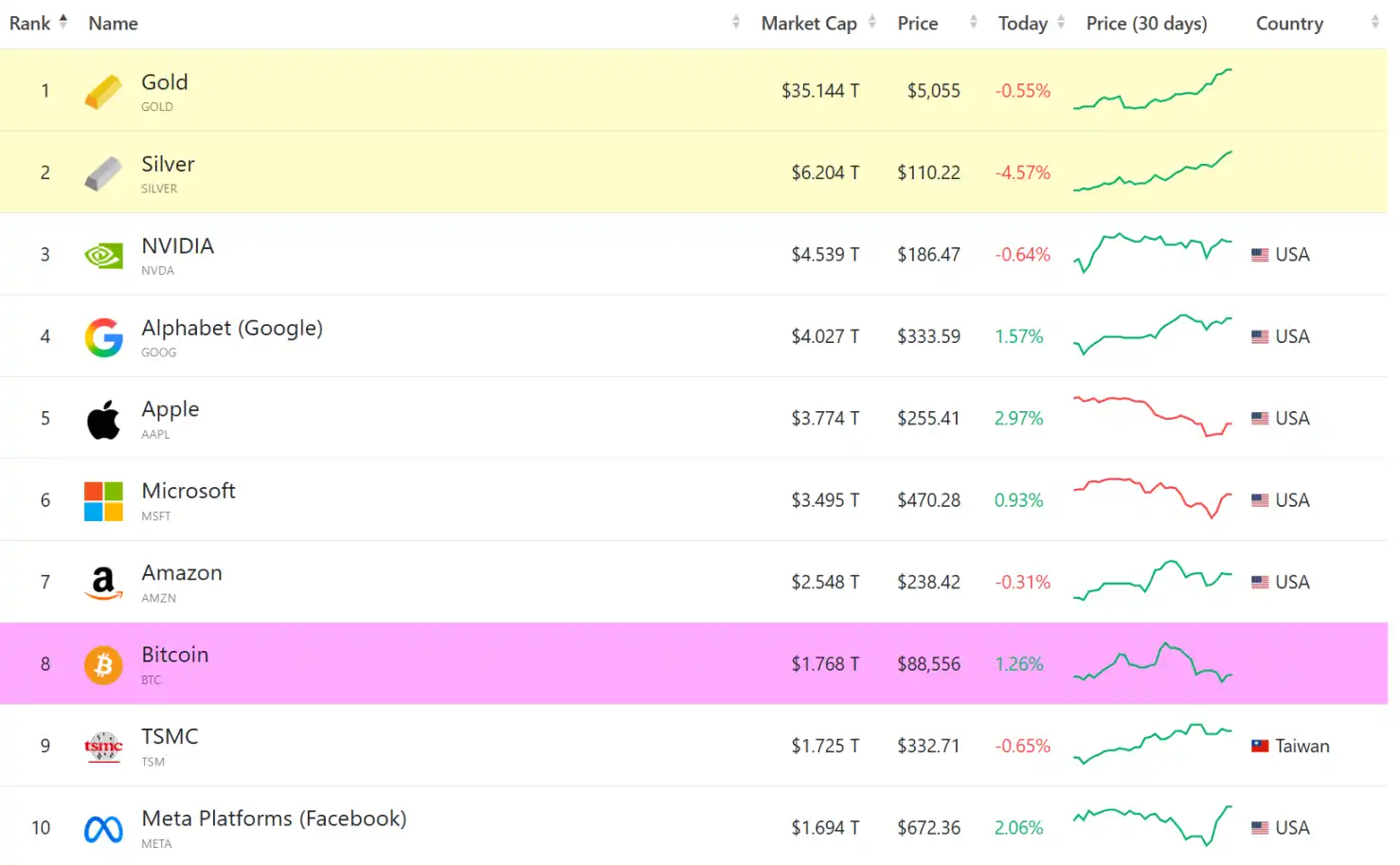
Source: companiesmarketcap.com

It can be said that after global macro uncertainties have been repeatedly verified, gold has returned to its most familiar position—as a consensus asset that does not rely on any single sovereign promise.

But at the same time, a more practical question is emerging: As the gold consensus returns, are traditional holding methods no longer able to meet the needs of the digital age?

I. The Inevitability of the Macro Cycle: The 'Old King' Returns to the Throne

From a longer macro cycle perspective, this round of gold's upward cycle is not short-term speculation but a structural return against the backdrop of macro uncertainty and a weakening U.S. dollar:

Geopolitical risks have extended from Russia-Ukraine to key resource and shipping regions such as the Middle East and Latin America; the global trade system has been repeatedly interrupted by tariffs, sanctions, and policy games; the U.S. fiscal deficit continues to expand, and the long-term stability of the U.S. dollar's credit is being discussed more frequently. In such an environment, the market will undoubtedly accelerate its search for a value anchor that does not rely on any single country's credit and does not require others' endorsement.

From this perspective, gold does not need to prove that it can generate returns; it only needs to repeatedly prove one thing: in an era of credit uncertainty, it still exists.

This also partly explains why, in this cycle, BTC, which was once expected to be 'digital gold,' has not fully assumed the same consensus role—at least in the dimension of macro hedging, the choices of funds have already provided the answer, which will not be elaborated here (extended reading: 'From Trustless BTC to Tokenized Gold: Who Is the Real 'Digital Gold'?').

However, the return of the gold consensus does not mean that all problems have been solved. After all, for a long time, investors have almost had to choose between two imperfect holding methods.

The first is physical gold, which is secure and sovereign but almost illiquid. Locking gold bars in a safe means high storage, anti-theft, and transfer costs, and it also means that it can hardly participate in real-time trading or daily use.

The recent phenomenon of 'one safe-deposit box is hard to find' in many banks恰恰 illustrates that this contradiction is being amplified, meaning that more and more people want to hold gold in their own hands, but现实条件并不总是配合.
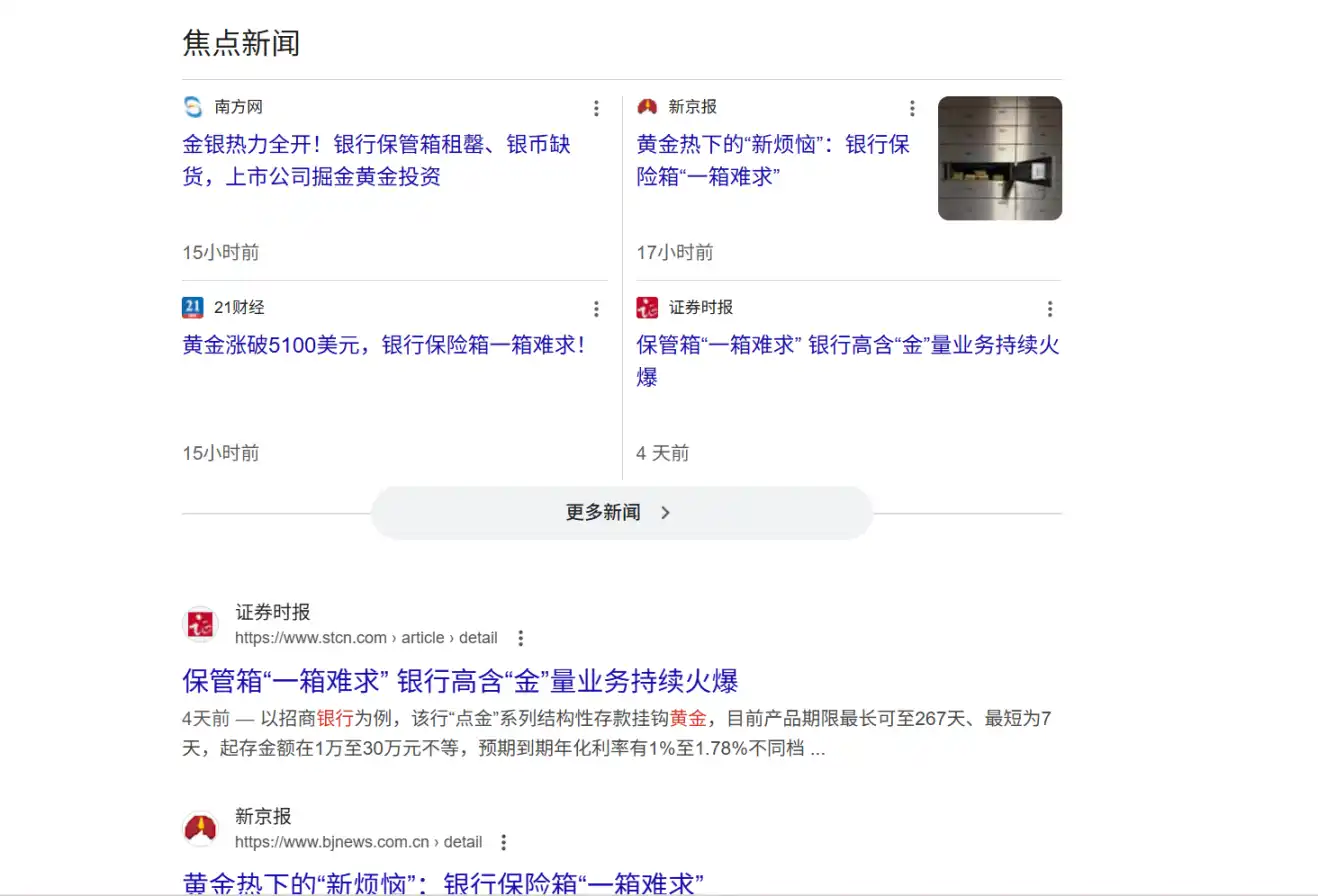
The second is paper gold or gold ETFs, which to some extent make up for the physical holding threshold of physical gold, such as paper gold products issued by bank accounts or brokerage systems. These are essentially a claim on financial institutions, giving you a settlement promise backed by the account system.

But the problem is that this liquidity itself is not complete—the liquidity provided by paper gold and gold ETFs is only locked within a single financial system. It can be bought and sold within a certain bank, a certain exchange, or a certain set of clearing rules, but it cannot freely flow outside this system.

This means it cannot be split, combined, or collaborate with other assets across systems, let alone be directly used in different scenarios. It is only 'in-account liquidity,' not true asset liquidity.

For example, the first gold investment product I owned, 'Tencent Micro Gold,' was like this. From this perspective, paper gold does not truly solve the liquidity problem of gold but only temporarily replaces the physical inconvenience with counterparty credit.

In the end, security, liquidity, and sovereignty have long been in a state where it is difficult to have all three. And in a highly digitalized and cross-border era, such trade-offs are becoming increasingly unsatisfactory.

It is against this background that tokenized gold has begun to enter the视野 of more people.

II. Tokenized Gold: Returning 'Complete Liquidity' to the Asset Itself

Tokenized gold, represented by XAUt (Tether Gold) issued by Tether, attempts to solve not just the surface-level problem of 'making gold easier to hold/trade,' which paper gold can also achieve, but a more fundamental proposition:

How can gold achieve the same complete liquidity and composability as crypto assets that can flow across systems, without sacrificing the 'physical gold endorsement' of gold?

If we take XAUt as an example and拆解 its design logic, we will find that it is not radical but even quite traditional and restrained: each XAUt corresponds to 1 ounce of physical gold in a London vault, and the physical gold is stored in a professional vault, auditable and verifiable. At the same time, tokenized gold holders have the right to claim the underlying gold.

This design does not introduce complex financial engineering, nor does it attempt to amplify gold's attributes through algorithms or credit expansion. On the contrary, it deliberately maintains respect for the traditional gold logic—first ensuring that the physical gold attribute is established, and then discussing the changes brought by digitization.

In the final analysis, tokenized gold like XAUt and PAXG is not 'creating a new gold narrative' but is using blockchain to repackage the oldest asset form. In this sense, XAUt is more like a 'digital physical gold' than a speculative derivative in the crypto world.

But at the same time, the more important change is that the liquidity level of gold has fundamentally shifted. As mentioned above, in the traditional system, whether it is paper gold or gold ETFs, the so-called liquidity is essentially in-account liquidity—it exists within a certain bank, a certain brokerage, or a certain clearing system and can only be bought, sold, and settled within established boundaries.

The liquidity of XAUt is directly attached to the asset itself. Once gold is mapped as an on-chain token, it naturally possesses the basic attributes of crypto assets and can be freely transferred, split, combined, and circulated among different protocols and applications without needing permission from any centralized institution.

This means that for the first time, gold no longer relies on an 'account' to prove its liquidity but circulates freely globally 24/7 in the form of the asset itself (extended reading: 'The 'Gold Godfather' Debates CZ: Who Is the Real 'Digital Gold'? A Trust Battle Across TradFi and Crypto'). In the on-chain environment, XAUt and others are no longer just 'tradable gold tokens' but basic asset units that can be recognized, called, and combined by other protocols:

  • It can be freely exchanged with stablecoins and other assets;
  • It can be incorporated into more complex asset allocation and组合 strategies;
  • It can even be used as a value carrier to participate in consumption and payment scenarios;

This is precisely the part of 'liquidity' that paper gold has never been able to provide.

III. From 'On-Chain' to 'Usable': The True Watershed for Digital Physical Gold

For this reason, if tokenized gold only completes the step of 'going on-chain,' it is far from reaching the finish line.

The real watershed lies in whether this 'digital physical gold' can truly be easily held, managed, traded, and even used as 'currency' for consumption and payment? That is, returning to the point mentioned above, if tokenized gold remains just a string of code on the chain and is ultimately encapsulated in a centralized platform or a single entry point, then it is no different from paper gold.

Against this background, the significance of lightweight self-custody solutions like imToken Web begins to emerge. Taking imToken Web's exploration as an example, it allows users to access through a browser—like opening a webpage, instantly managing their tokenized gold and other crypto assets on any device.

Moreover, in a self-custody environment, the private key is完全 controlled by the user. Your gold does not exist on any service provider's server but is truly anchored in a blockchain address.

Additionally, thanks to the interoperability of Web3 infrastructure, XAUt is no longer a heavy metal sleeping in a safe. It can be purchased flexibly in small amounts, and when needed, its purchasing power can be released in real-time into global consumption scenarios through支付 tools like imToken Card.
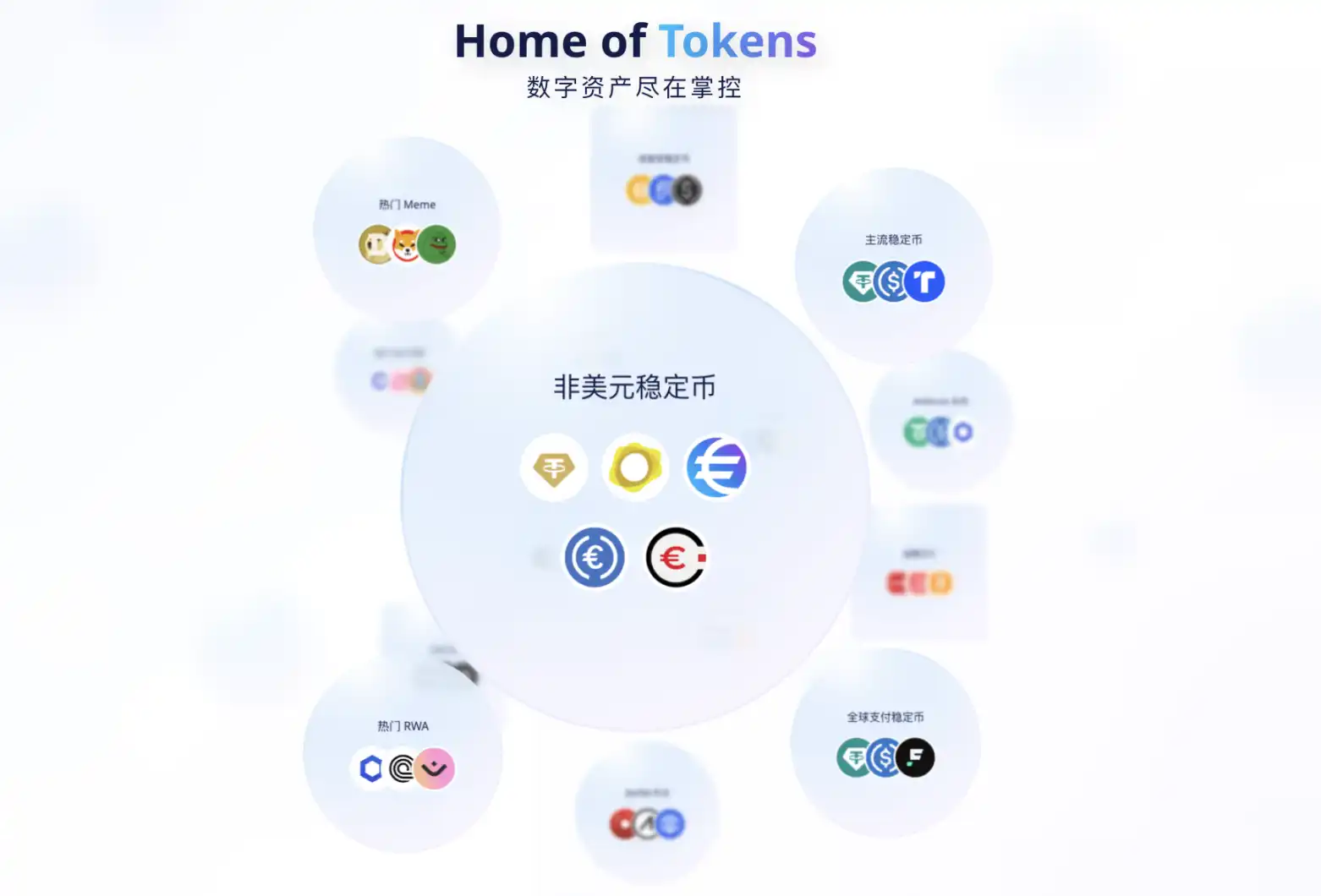
Source: imToken Web

In short, in the Web3 environment, XAUt can not only be traded but also combined with other assets, exchanged, and even connected to payment and consumption scenarios.

And when gold simultaneously possesses extremely high storage certainty and modern usage potential for the first time, it truly completes the leap from an 'old-school避险品' to a 'future currency.'

After all, gold, as a consensus that can span millennia, is not inherently陈旧; what is陈旧 is only the way it is held.

So when gold enters the chain in the form of XAUt and returns to personal control through self-custody environments like imToken Web, what it continues is not a new narrative but a logic that spans eras:

In an uncertain world, true value is to rely as little as possible on the promises of others.

Criptos en tendencia

Preguntas relacionadas

QWhat are the main factors driving the recent surge in gold prices to $5000 per ounce?

AThe surge is driven by global macroeconomic uncertainties, including geopolitical risks in regions like Ukraine, the Middle East, and Latin America, disruptions in global trade systems due to tariffs and sanctions, and concerns about the long-term stability of the US dollar due to expanding fiscal deficits. These factors have increased demand for gold as a consensus asset that doesn't rely on any single sovereign promise.

QWhat are the limitations of traditional gold holding methods like physical gold and paper gold/ETF?

APhysical gold offers security and sovereignty but lacks liquidity due to high storage, security, and transfer costs. Paper gold or gold ETFs provide some liquidity within specific financial systems but are essentially claims on financial institutions, limiting their use to internal account systems. They cannot be freely transferred, split, combined, or used across different platforms or scenarios, offering only 'account liquidity' rather than true asset liquidity.

QHow does tokenized gold, such as XAUt, address the limitations of traditional gold investments?

ATokenized gold like XAUt represents physical gold stored in auditable vaults, with each token backed by one ounce of gold. It combines the security of physical gold with the full liquidity and composability of crypto assets. Unlike paper gold, it can be freely transferred, split, combined, and used across different protocols and applications without relying on centralized institutions, enabling global 24/7 circulation and integration into various financial strategies and payment scenarios.

QWhat role do self-custody solutions like imToken Web play in the adoption of tokenized gold?

ASelf-custody solutions like imToken Web allow users to manage tokenized gold through lightweight, accessible interfaces (e.g., web browsers) while retaining full control of their private keys. This ensures that the gold is truly owned by the user and not held on centralized servers. It enhances usability by enabling easy trading, combination with other assets, and practical applications such as spending via tools like imToken Card, bridging the gap between storage and real-world use.

QHow does tokenized gold transform gold from a 'traditional safe-haven asset' to a 'future currency'?

ATokenized gold merges gold's historical value as a stable store of wealth with modern digital capabilities. By being on-chain, it gains full liquidity, divisibility, and interoperability with other assets and payment systems. This allows it to be used not just for investment but also in daily transactions, consumption, and complex financial strategies, effectively transitioning gold from a passive holding into an active, versatile medium of exchange in the digital economy.

Lecturas Relacionadas

Must-Watch Events Next Week|CLARITY Act Could Face Senate Vote; SpaceX, Circle to Report Earnings (8.3-8.9)

**Summary: Key Events and Developments to Watch (August 3-9)** The upcoming week is marked by significant financial disclosures, key legislative deadlines, and notable product updates. **Major Financial Events:** Several companies are scheduled to release their Q2 2026 earnings. American Bitcoin (ABTC) will report on August 3, followed by SpaceX and Hut 8 Mining Corp. on August 4, and Circle on August 5. Notably, a significant portion of SpaceX shares (up to 12% of total shares) will be unlocked on August 6 following their earnings release. **Key Legislative Deadline:** The U.S. Senate faces an August 7 deadline to secure 60 votes for the CLARITY Act, a bipartisan bill aiming to establish a federal regulatory framework for cryptocurrencies. The Senate may hold a full vote on the bill during the week. **Economic Data:** The U.S. July Non-Farm Payrolls report will be released on August 7, providing crucial labor market data. **Technology & Product Updates:** * **Shutdowns:** DeFi portfolio tracker Zapper and wallet app Ctrl Wallet will cease operations on August 3. * **Upgrades:** LayerZero will deprecate its v1 relayers on August 3. XRP Ledger's new version 3.3.0, featuring five new functions, is expected next week. * **AI:** Elon Musk announced that the advanced Grok 4.6 AI model is set for release around August 7. * **Bitcoin:** The BIP-110 forced signaling for a potential Bitcoin network change is scheduled to begin around August 8. **Other Notable Events:** Chinese robotics firm Unitree Tech has set its preliminary price inquiry for its IPO for August 5. South Korean exchange Upbit will delist AQT and AERGO tokens on August 3.

marsbitHace 1 hora(s)

Must-Watch Events Next Week|CLARITY Act Could Face Senate Vote; SpaceX, Circle to Report Earnings (8.3-8.9)

marsbitHace 1 hora(s)

Stocks Are Plummeting More Sharply Than Cryptocurrencies. Where Has the Money Gone?

Stock Markets Plunge Deeper Than Cryptocurrencies: Where Did the Money Go? In late July, Seoul's Kospi index triggered circuit breakers for two consecutive days, plummeting over 40% from its June high. The collapse was led by heavyweight stocks like SK Hynix, whose record profits still disappointed investors, and devastating leveraged ETFs, with one major product losing over 83% of its value. This signaled a global, forced deleveraging targeting the most crowded trades. Interestingly, while stocks exhibited extreme volatility akin to crypto markets, Bitcoin rose nearly 15% in July after a prior steep drop. Analysis shows the money fleeing equities did not flow into Bitcoin. Instead, Bitcoin had already absorbed its sell-off in May-June, when U.S. spot Bitcoin ETFs saw historic outflows. The true safe-haven beneficiary was gold, whose price rose over 20% year-on-year, highlighting a decoupling between Bitcoin and gold as "digital gold." The sell-off was a targeted unwinding of leveraged positions in tech and semiconductors, accelerated by broker-dealer risk management and shifts in the AI narrative, including new competition from Chinese memory chipmakers. The retreat path was clear: from high-valuation tech stocks to cash and U.S. Treasuries, then to gold. For Bitcoin to attract sustained institutional inflows, conditions like eased global liquidity pressure, a "soft-landing" Fed rate cut, and U.S. regulatory clarity via legislation like the stalled CLARITY Act are needed. Currently, Bitcoin is not a safe haven but an already-cleared asset. Its low correlation with tech stocks, however, makes it a potential diversification play for institutional portfolios once the storm passes. The money isn't here yet, but the positioning is underway.

marsbitHace 1 hora(s)

Stocks Are Plummeting More Sharply Than Cryptocurrencies. Where Has the Money Gone?

marsbitHace 1 hora(s)

In Conversation with Ray Dalio: We Are Currently in an AI Bubble, with 1% of My Portfolio in Bitcoin

Ray Dalio, founder of Bridgewater Associates, warns in an interview that the current AI boom shows classic bubble characteristics, which could lead to significant economic downturns as seen in past cycles like 1929 or 2000. He explains that speculative enthusiasm, fueled by debt and overvaluation, often precedes a crash when rising rates or taxation force asset sales, causing widespread losses and recession. Dalio also outlines his "Big Cycle" theory, describing an approximate 80-year pattern where widening wealth gaps, massive government deficits, and shifting geopolitical power (like China's rise) create internal conflict and global instability. He emphasizes that we are in a late-cycle, transitional phase where traditional powers like the US and UK face decline. For personal wealth protection, Dalio advises diversification beyond cash into assets like stocks, bonds, real estate, and particularly gold, which he prefers over Bitcoin. While he holds about 1% of his portfolio in Bitcoin as a non-printable hard asset, he views gold as more secure from technological or governmental threats. Regarding AI's impact, Dalio believes it will disproportionately benefit capital owners, worsening inequality by replacing both physical and cognitive labor. He suggests that human intuition and emotional intelligence, combined with AI, will be key for future workers. On taxation, Dalio argues that wealth taxes are impractical and risk triggering asset sell-offs, reducing productive investment. He points to the UK as a cautionary example of debt, low productivity, and political strife. Geopolitically, Dalio foresees a more regionalized world, with the US showing weakness in prolonged conflicts like with Iran, akin to past imperial declines. The ideal outcome, he suggests, is coexisting powerful blocs (e.g., Americas, China-Asia Pacific) without major war.

marsbitHace 4 hora(s)

In Conversation with Ray Dalio: We Are Currently in an AI Bubble, with 1% of My Portfolio in Bitcoin

marsbitHace 4 hora(s)

Trading

Spot

Artículos destacados

Cómo comprar ERA

¡Bienvenido a HTX.com! Hemos hecho que comprar Caldera (ERA) sea simple y conveniente. Sigue nuestra guía paso a paso para iniciar tu viaje de criptos.Paso 1: crea tu cuenta HTXUtiliza tu correo electrónico o número de teléfono para registrarte y obtener una cuenta gratuita en HTX. Experimenta un proceso de registro sin complicaciones y desbloquea todas las funciones.Obtener mi cuentaPaso 2: ve a Comprar cripto y elige tu método de pagoTarjeta de crédito/débito: usa tu Visa o Mastercard para comprar Caldera (ERA) al instante.Saldo: utiliza fondos del saldo de tu cuenta HTX para tradear sin problemas.Terceros: hemos agregado métodos de pago populares como Google Pay y Apple Pay para mejorar la comodidad.P2P: tradear directamente con otros usuarios en HTX.Over-the-Counter (OTC): ofrecemos servicios personalizados y tipos de cambio competitivos para los traders.Paso 3: guarda tu Caldera (ERA)Después de comprar tu Caldera (ERA), guárdalo en tu cuenta HTX. Alternativamente, puedes enviarlo a otro lugar mediante transferencia blockchain o utilizarlo para tradear otras criptomonedas.Paso 4: tradear Caldera (ERA)Tradear fácilmente con Caldera (ERA) en HTX's mercado spot. Simplemente accede a tu cuenta, selecciona tu par de trading, ejecuta tus trades y monitorea en tiempo real. Ofrecemos una experiencia fácil de usar tanto para principiantes como para traders experimentados.

467 Vistas totalesPublicado en 2025.07.17Actualizado en 2026.06.02

Cómo comprar ERA

Discusiones

Bienvenido a la comunidad de HTX. Aquí puedes mantenerte informado sobre los últimos desarrollos de la plataforma y acceder a análisis profesionales del mercado. A continuación se presentan las opiniones de los usuarios sobre el precio de ERA (ERA).

活动图片













