The 'Mastermind' Behind the Venezuela Incident? An Article to Unravel the AI Intelligence Empire—Palantir

marsbitPublicado a 2026-01-06Actualizado a 2026-01-06

Resumen

Venezuela Event and the "AI Intelligence Empire": A Look at Palantir Global attention has recently focused on a swift, high-precision operation in Venezuela, with speculation that Palantir Technologies—a data integration and AI decision-making company whose stock surged nearly 20-fold in two and a half years—provided the digital intelligence backbone. Although no official confirmation exists, the company's reputation and past involvement in missions like the capture of Osama bin Laden have fueled market narratives linking it to the operation. Founded in 2003 by Peter Thiel, Palantir operates as a data and AI-driven operating system for governments, militaries, and large enterprises. Its core capability lies in its Ontology" model, which integrates disparate data sources into a unified semantic framework, enabling real-time situational awareness and decision-making in high-stakes environments like military and intelligence operations. Beyond defense, Palantir has expanded into the crypto sector with “Foundry for Crypto,” offering compliance, anti-money laundering, and risk management solutions for exchanges and institutions. It serves as infrastructure—not a direct participant—in crypto. While founders like Thiel are personally bullish on Bitcoin, the company remains focused on its role as an enterprise AI and data platform. Palantir embodies multiple narratives: a tool for national security, a driver of enterprise digital transformation, and a behind-the-scenes actor in g...

Author: Conflux Blockchain

In the past two days, global public opinion has been heatedly discussing a blockbuster news story "comparable to a Hollywood movie": the United States launched a lightning operation against Venezuela, "precisely locating" President Maduro overnight and completing the takeover of political power and key oil and gas assets in an extremely short time.

Although the details of this operation remain uncertain, in the financial and tech circles, one name has been frequently mentioned: Palantir—a company whose stock price has surged nearly 20 times in two and a half years, crowned as the "AI Intelligence Empire" for its data integration and AI decision-making capabilities, is seen by many as the digital mastermind behind such "seamless operations."

What's even more interesting is that, beyond traditional military and government intelligence, Palantir has quietly become one of the "data and compliance infrastructure providers" for the crypto industry in the past two years—providing data and risk control brains to exchanges, custodial institutions, and compliance teams, while insisting on not issuing assets or engaging in DeFi.

What exactly is this company? Is it really that "magical"? And what is its relationship with Web3/crypto? Below, we break it down in detail.

Who is Palantir? Why is it called the "AI Intelligence Empire"?

Palantir Technologies was founded in 2003 by Peter Thiel, one of the "PayPal Mafia" members. The company's name comes from the all-seeing crystal ball Palantír in "The Lord of the Rings," symbolizing "seeing through the world."

It is not a pure AI company in the世俗 sense but more accurately positioned as a "data + AI-driven intelligence and decision-making operating system," deeply serving governments, militaries, and large enterprises. Here are some fundamental differences between Palantir and ordinary AI companies—

Core clients: Palantir grew out of the "counter-terrorism era," with its earliest core clients being U.S. intelligence and defense agencies. Its software is not used for recommending ads or scrolling through short videos but is installed on intelligence analysts' computers, command center screens, and battlefield decision-making chains. For the U.S. intelligence system, Palantir is more like an "intelligence and combat operating system," helping them piece together vast amounts of分散 data, understand causality, and make actionable decisions.

Data-driven decision-making: Ordinary BI tools focus more on reports and visualization; Palantir is committed to moving directly from data to action. It provides an end-to-end platform: connecting data sources → building semantic models → enabling analysts and commanders to collaborate on the same interface → pushing decisions directly to frontline execution units.

Repeated reinforcement of "war narratives": Regardless of the actual level of involvement, stories like "helping capture Bin Laden," "playing a key role in the Afghanistan war," and "using AI to help drones identify targets" have been firmly written into Palantir's market image.

For Wall Street and retail investors, this company represents a "hardcore technology" highly tied to the state apparatus, security power, and the future form of warfare.

The Key Weapon to Turn "Big Data" into a "God's-Eye View"

To understand Palantir's true killer feature, one must first understand a key concept: Ontology. This is not a philosophical concept but a company-specific operational layer digital model.

Simply put: Ontology maps all分散, heterogeneous data within an organization (structured/unstructured, database/sensor/satellite/human intelligence, etc.) into semantic objects, attributes, and relationships, such as real-world connections between "people," "locations," "assets," and "events."

It enables AI, analysts, and decision-makers to understand and operate complex businesses using natural language, forming a "digital twin of the organization."

In military/intelligence scenarios, Ontology can integrate multi-source intelligence in real-time (CIA informants + drones + satellites + social media), build a complete behavioral model of Maduro (movements, eating habits, safe house layouts, etc.), and thus support Delta Force's precise strikes.

Palantir has repeatedly emphasized: "Ontology is the true source of our AI advantage." It turns data into actionable knowledge, especially in crisis/high-adversity environments.

For this reason, the "seamless" and "zero-loss" nature of this operation has led many to believe that Ontology has once again worked its magic behind the scenes.

The Venezuela Incident: From Fact to Narrative Market Imagination

Therefore, as global舆论 continues to heat up, various versions of the operation's details have emerged: some claim "zero U.S. military casualties," others emphasize "extremely precise knowledge of Maduro's whereabouts," and still others portray it as "almost like playing a war game with a full map."

In this context, Palantir naturally becomes a frequently mentioned name—even though no official documents or military statements have publicly confirmed its role in this operation.

How did the market and social media "bind" the two together?

1. Price-first "sense of fact"

For many traders, the after-hours and overnight market movements themselves are seen as a "vote of fact." Once a major geopolitical event like this occurs, and Palantir's stock price shows a significant short-term surge, the market spontaneously links the two: "The operation was so smooth, Palantir's intelligence and AI system must be behind it."

Thus, "Palantir's involvement in the operation" itself becomes a tradable narrative.

2. "Automatic association" from historical experience

Over the past decade, Palantir has been publicly reported multiple times to be involved in U.S. counter-terrorism, target tracking missions in Iraq, Afghanistan, etc., and is widely believed to have provided crucial intelligence integration and analysis capabilities in key events like the Bin Laden operation. Its participation in AI military projects like Project Maven further reinforces the public impression that "whenever there's a high-precision operation, Palantir is likely behind it."

When media use terms like "precisely锁定 targets" and "real-time battlefield awareness" to describe the Venezuela incident, many instinctively equate these keywords with Palantir.

3. Narrative amplification effect of social media and financial circles

Various posts, long articles, and videos began stating with great certainty: "The AI command brain for this operation must be Palantir's system," "Palantir will secure contracts related to Venezuelan oil afterward."

Even though these claims are not based on reliable disclosures but more on past impressions and technical imagination, in an era of极度 fragmented information, what many believe can easily become a "factual narrative" in the short term and be reflected in the stock price.

In other words, the Venezuela incident provided a window for the outside world to once again放大 the imagination of Palantir—"If there really is a digital mastermind running behind the scenes, it's most likely them."

Tool Provider in the Crypto World, Not a Player

Many people are unaware that Palantir launched the "Foundry for Crypto" solution for the crypto industry as early as 2021–2022 (it can still be seen in the solutions section on its official website).

The essence of this solution is to移植 Palantir's mature capabilities in finance, anti-money laundering, and risk management directly into the crypto ecosystem. Its main clients are exchanges, custodial institutions, compliance-friendly CeFi/DeFi platforms, large market-making institutions, etc., helping these institutions integrate and analyze on-chain transactions, wallet behaviors, and off-chain KYC information.

It primarily addresses the following issues—

Pattern recognition of large-scale on-chain transaction behaviors: Identifying money laundering paths, fund mixing, cross-chain bridge attack fund flows, etc.

Anti-money laundering (AML), sanctions screening, suspicious address monitoring: Helping institutions meet regulatory compliance requirements.

Integrating on-chain data with traditional financial data: Bringing both into the same risk control and operations platform, so crypto business is no longer a "side system."

In a nutshell: Palantir is more like a "crypto world intelligence and compliance infrastructure supplier," serving the entire crypto ecosystem as a tool and data platform.

Founders & Executives' True Attitude Towards Crypto

From personal views to company actions, Palantir's relationship with crypto presents an interesting "fork":

Peter Thiel: Aggressive Bitcoin Bull

As a co-founder of Palantir and PayPal, Thiel praised Bitcoin early on, viewing it as a digital hedge against traditional financial systems and fiat currencies.

He has heavily invested in the blockchain and crypto space through personal and fund investments and has repeatedly emphasized Bitcoin's geopolitical significance in public—such as its potential to hedge against the monetary and financial hegemony of certain countries.

Joe Lonsdale: Bullish on "AI Agent + Crypto"

Another co-founder, Joe Lonsdale, has publicly stated that future AI Agents (intelligent agents) acting autonomously on the internet will need a native payment and incentive layer, and cryptocurrencies are highly likely to play this role.

In his vision, major chains like Bitcoin, Ethereum, and Solana have the opportunity to become the bulk payment, settlement, and incentive infrastructure for the AI economy.

Company Level: Cautious, Pragmatic, and Not Following Trends

In actual operations, Palantir maintains a very traditional corporate financial and business style: It started accepting Bitcoin as a customer payment method in 2021, showing some recognition of crypto; it seriously discussed adding Bitcoin to its corporate balance sheet but has not explicitly disclosed the actual situation.

It can be seen that Palantir's top brass generally recognizes the long-term value of crypto and participates through personal investments and some business布局; but as a public company, Palantir始终 emphasizes that it is an "enterprise-level AI + data infrastructure company," and crypto is just one of many vertical industries.

Conclusion

Putting these dimensions together, an interesting轮廓 emerges:

In national security and war narratives: Palantir is seen as the digital mastermind, firmly tied to stories of various high-precision operations.

In enterprise digitization, energy, manufacturing, and finance: It is the operating system helping traditional giants awaken to data.

In the crypto and Web3 world: It is both a bridge for regulation and compliance and a high-dimensional observer of on-chain fund flows, yet deliberately avoids any direct博弈.

This company simultaneously embodies key words from several eras: the war on terror, the data empire, AI military-industrial, geopolitics, Web3 compliance... No wonder, in舆论 whirlpools like the "Venezuela operation," whenever the "behind-the-scenes brain" is discussed, the market's first reaction is often:

"This probably has Palantir's fingerprints all over it."

*This content is for reference only and does not constitute investment advice. The market carries risks, invest with caution.


Preguntas relacionadas

QWhat is Palantir Technologies and why is it referred to as the 'AI Intelligence Empire'?

APalantir Technologies is a data and AI-driven intelligence and decision-making operating system co-founded by Peter Thiel in 2003. It is called the 'AI Intelligence Empire' because it deeply serves government, military, and large enterprise clients by integrating disparate data sources into a unified semantic model (Ontology) to support actionable decision-making, particularly in high-stakes scenarios like counterterrorism and military operations.

QHow did the Venezuela event relate to Palantir in public and market perception?

AThe Venezuela event, involving a swift operation to target President Maduro, led to widespread speculation that Palantir was the 'digital brain' behind it due to its historical role in precision military and intelligence operations. Although there was no official confirmation, market reactions and social media narratives linked Palantir's AI and data integration capabilities to the operation's perceived seamlessness, driving increased attention and stock price movements.

QWhat is Palantir's role in the crypto industry according to the article?

APalantir serves as a data and compliance infrastructure provider in the crypto industry through its 'Foundry for Crypto' solution. It helps exchanges, custodians, and compliant platforms with anti-money laundering (AML), sanctions screening, on-chain transaction pattern recognition, and integrating blockchain data with traditional financial systems, without directly participating in crypto asset issuance or DeFi.

QHow do Palantir's founders view cryptocurrency, and what is the company's official stance?

ACo-founder Peter Thiel is a vocal Bitcoin supporter, viewing it as a hedge against traditional financial systems, while another co-founder, Joe Lonsdale, sees crypto as a potential payment and incentive layer for AI agents. However, at the corporate level, Palantir maintains a cautious and practical approach, accepting Bitcoin as payment from clients but not heavily investing in crypto assets, emphasizing its role as an enterprise AI and data infrastructure company.

QWhat is Ontology in the context of Palantir's technology, and why is it considered a key advantage?

AOntology in Palantir's context refers to a semantic model that unifies disparate, heterogeneous data sources (e.g., databases, sensors, satellites) into objects, attributes, and relationships mirroring the real world. It enables AI, analysts, and decision-makers to understand and act on complex data naturally, forming a 'digital twin' of an organization. This is a key advantage because it transforms raw data into actionable knowledge, especially in high-pressure environments like military or intelligence operations.

Lecturas Relacionadas

Wall Street's Most Famous 'Cassandra' Now Has His Sights Set on Nvidia

Michael Burry, the famed "Big Short" investor, has once again captured Wall Street's attention with a series of short positions against major tech and semiconductor stocks, most notably Nvidia. In late June and July, through his "Cassandra Unchained" newsletter, Burry disclosed short bets against Nvidia, Tesla, Applied Materials, Caterpillar, the SOXX semiconductor ETF, and later, Micron Technology. His core thesis revolves around potential distortions in the AI infrastructure boom, specifically questioning whether extended depreciation schedules (e.g., 6 years vs. a realistic 2-3 years for AI chips) by cloud giants like Microsoft and Google artificially inflate profits. He also raises concerns about possible "off-balance-sheet circular financing," where chip demand might be propped up by vendor-backed funding to clients. Nvidia's stock experienced volatility following these disclosures, briefly dipping but largely holding near Burry's reported entry points, leaving his positions roughly flat or slightly underwater as of late July. This move is part of a pattern for Burry, whose track record since his legendary 2008 bet is mixed. He has faced notable losses, such as on Tesla in 2021, while scoring on broader market turns like the 2020 pandemic crash. His methodology focuses intensely on free cash flow and scrutinizing original financial documents to spot overvaluation and structural risks, but it often struggles with timing the market. The article contrasts Burry's stance with other prominent investors. Steve Eisman, another "Big Short" figure, is not shorting Nvidia, citing strong fundamentals but expressing nervousness about sustainability. Jim Chanos agrees with the broad "accounting mismatch" concern—comparing it to the dot-com bubble—but targets financial leverage in private equity firms rather than the chip stocks themselves. While Nvidia's short interest remains relatively low at 1.3-1.4% of float, the massive stock size means absolute short losses have been significant, exceeding $5 billion earlier this year. The piece concludes that for ordinary investors, the key takeaway is not replicating specific short bets but learning from the critical frameworks these investors use: questioning rosy accounting, identifying structural vulnerabilities, and maintaining skepticism during market euphoria, even if pinpointing the exact catalyst for a downturn remains elusive.

marsbitHace 19 min(s)

Wall Street's Most Famous 'Cassandra' Now Has His Sights Set on Nvidia

marsbitHace 19 min(s)

Weekly Selection丨Epic Stock Market Volatility, Changxin Tech's IPO Reshapes Storage Landscape, Saylor Aims to Re-Anchor STRC Around September 8th

PANews Weekly Digest: Market Turmoil, Tech Breakthroughs, and Crypto Developments. The week saw significant volatility across global markets. South Korea's KOSPI index experienced extreme turbulence, including multiple trading halts, largely driven by sharp declines in AI hardware stocks like SK Hynix. In contrast, China's Changxin Xinqiao (CXC) achieved a landmark IPO with a market cap surpassing 4 trillion yuan, marking a major success for the domestic DRAM industry after a decade of losses. In the crypto and Web3 space, several key narratives emerged. AI is driving demand for new infrastructure, with projects like AI agent wallets and programmable payments gaining traction, attracting interest from firms like Coinbase. The Bitcoin mining sector is pivoting, with companies like MARA focusing on energy management as electricity becomes a core AI-era asset. Meanwhile, the RWA (Real World Assets) sector faces a "utilization puzzle," with hundreds of billions in on-chain assets remaining dormant. Notable market movements included a historic single-day surge of over 17% for the KOSPI index and a significant migration of $16.5 billion in staked ETH within the Lido ecosystem. Michael Saylor announced a target to re-peg the STRC stablecoin around September 8th. Other highlights include discussions on Ethereum's ambitious 2030 roadmap for scaling and privacy, analysis showing high protocol revenues not always translating to token price gains, and warnings from Citi about potential extreme commodity price shocks by late 2026.

marsbitHace 24 min(s)

Weekly Selection丨Epic Stock Market Volatility, Changxin Tech's IPO Reshapes Storage Landscape, Saylor Aims to Re-Anchor STRC Around September 8th

marsbitHace 24 min(s)

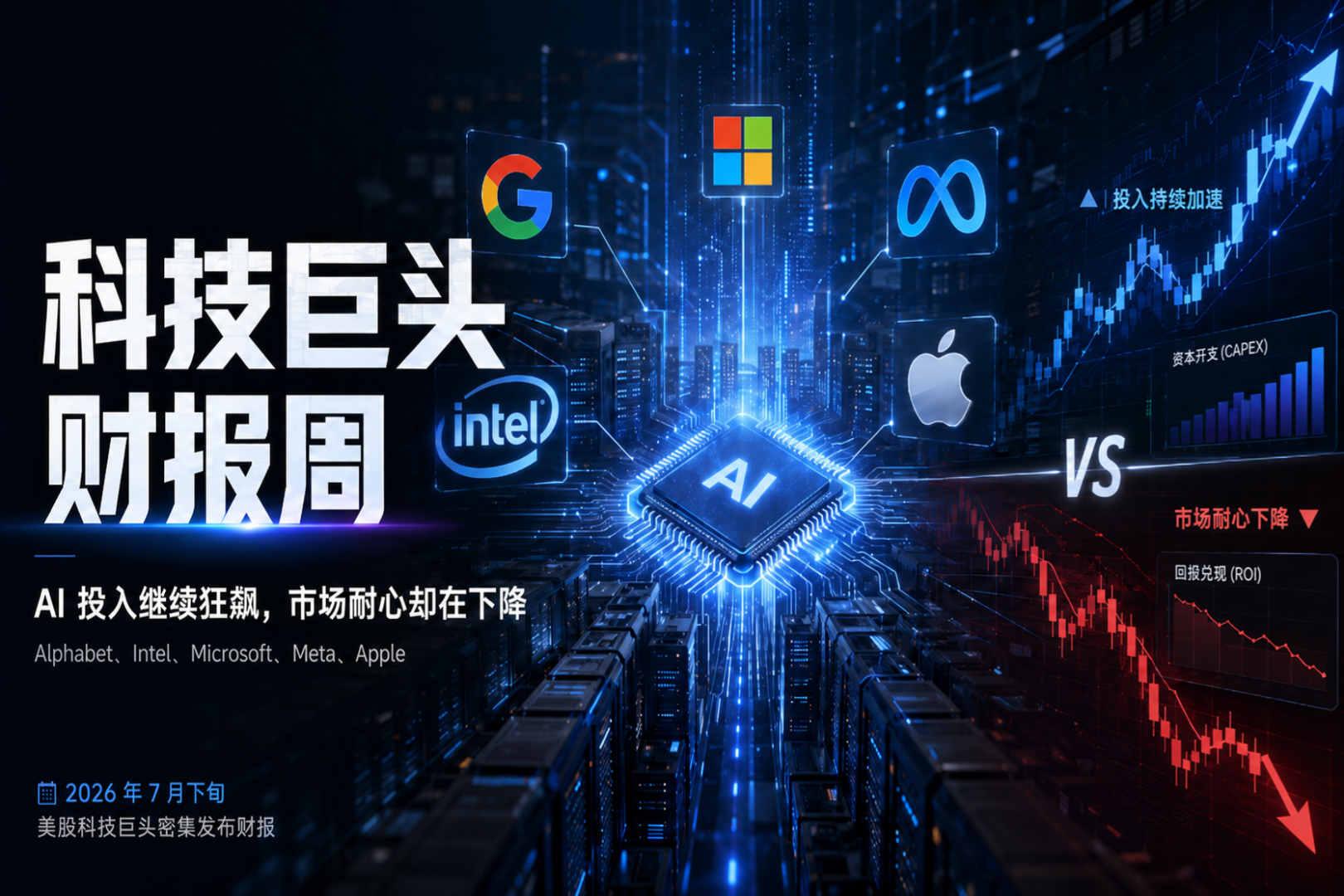
When the Market Begins to Question AI Capex: A Full Analysis of Q2 Earnings Reports from Five Tech Giants

In late July 2026, five major US tech giants—Alphabet, Intel, Microsoft, Meta, and Apple—released their Q2 earnings reports. While all companies exceeded revenue and profit expectations, driven by strong AI-related business growth, investor reactions diverged sharply due to concerns over escalating AI capital expenditures (capex) and their impact on free cash flow. Alphabet reported strong revenue growth and a surging cloud business, but its stock fell after announcing a doubled year-on-year capex and negative quarterly free cash flow for the first time. Intel posted its strongest revenue growth in over 15 years, but its stock experienced volatile trading after significantly raising its full-year capex guidance. Microsoft saw its stock surge after beating estimates and, crucially, lowering its capex forecast while projecting positive free cash flow. Meta faced the most severe sell-off as its profits declined despite revenue beats, with free cash flow plunging over 90% and its capex guidance raised. Apple reported record June-quarter results, but its stock plummeted after providing Q4 revenue guidance that fell short of expectations, citing supply chain constraints and forex headwinds. The overall takeaway is that the market's focus has shifted from validating AI demand to scrutinizing the timeline for returns on massive AI investments. Companies demonstrating a clearer path to managing capex and preserving free cash flow, like Microsoft, were rewarded, while those signaling continued aggressive spending faced investor skepticism.

Odaily星球日报Hace 33 min(s)

When the Market Begins to Question AI Capex: A Full Analysis of Q2 Earnings Reports from Five Tech Giants

Odaily星球日报Hace 33 min(s)

a16z: From Companies to DAOs, DUNA May Become the Next Generation Organizational Form

This article, "From Companies to DAOs: How DUNA Could Become the Next Organizational Form," traces the 500-year evolution of business collaboration. It begins with medieval structures like the *commenda* and Florentine *compagnia*, which exposed partners to personal risk. The modern corporation, exemplified by the Dutch East India Company (VOC), was a revolutionary leap, enabling large-scale, capital-intensive ventures by offering limited liability and reducing coordination costs. However, corporations introduced new challenges like principal-agent problems and bureaucratic overhead. The piece argues that software and internet-native protocols are now reducing these traditional overheads. Decentralized Autonomous Organizations (DAOs) emerged as a new model for coordination without centralized management. Yet, DAOs face a significant legal vacuum: they lack legal recognition, leaving members exposed to unlimited personal liability, and their tokens are vulnerable to being classified as securities under unclear regulations (e.g., the Howey Test). This has forced projects into suboptimal workarounds like offshore foundations. The article identifies the Decentralized Unincorporated Nonprofit Association (DUNA) as a potential solution. Recently legalized in states like Wyoming, the DUNA provides a legal wrapper for decentralized networks. It grants key protections—legal personality, limited liability, and perpetual existence—to a group without imposing a traditional hierarchical management structure. This allows token-holder communities to govern, hold assets, and contract as a single legal entity, aligning with their decentralized nature. While DUNA doesn't solve all governance challenges or magically resolve securities law questions, it represents a crucial step. It fills the legal recognition gap, offering a native legal form for internet-scale, decentralized collaboration and extending the separation of personal risk from organizational venture into a new domain.

marsbitHace 1 hora(s)

a16z: From Companies to DAOs, DUNA May Become the Next Generation Organizational Form

marsbitHace 1 hora(s)

2026 Mid-Year Report On-Chain RWA: Tokenized Stock Market Cap Doubles in a Year, But 90% of Rights Are Hollow Shells

The 2026 Mid-Year Report on On-Chain RWA highlights a significant growth in tokenized stock market capitalization, which nearly doubled from $951 million in March to $1.89 billion by July. However, the report reveals a fundamental contradiction in this "layer 2.5" ecosystem: products with the strongest legal foundation (like regulated U.S. infrastructure) lack liquidity and distribution, while freely tradable offshored wrapper products often lack substantive ownership rights. The increase is driven largely by a few products (SECZ, FGRS, STRCx) and platforms (Ondo, xStocks, Securitize collectively hold over 85% share). While distributed value across networks like Ethereum, Solana, and BNB Chain has grown, the market remains fragmented. Products referencing the same underlying asset (e.g., Apple stock) are distinct legal liabilities with different intermediaries and jurisdictional rules, offering varying degrees of legal claim. The report cautions that headline numbers are misleading, as they reflect changes in distributed token value—driven by issuance, conversions, and price movements—not pure investor inflows. True "canonical shares" with legal ownership, wide wallet distribution, institutional liquidity, and independent on-chain price discovery do not yet exist at scale. Tokenized treasuries show stronger product-market fit, and ETFs may be easier to scale than single stocks. The core takeaway is a trade-off: legal certainty versus liquidity and composability.

marsbitHace 2 hora(s)

2026 Mid-Year Report On-Chain RWA: Tokenized Stock Market Cap Doubles in a Year, But 90% of Rights Are Hollow Shells

marsbitHace 2 hora(s)

Trading

Spot
活动图片