The Man Who Best Promoted SOL Exits the Crypto World

marsbitPublicado a 2026-02-05Actualizado a 2026-02-05

Resumen

Kyle Samani, co-founder and managing partner of Multicoin Capital, has stepped down from his daily operational and management roles at the crypto-focused venture firm and transitioned to an advisory position. Known as one of the most vocal proponents of Solana, Samani was instrumental in Multicoin’s early and heavy investments in the blockchain, famously declaring “Solana is always the answer” and publicly criticizing Bitcoin and Ethereum. Under his leadership, Multicoin achieved extraordinary returns from Solana, though the fund also faced significant losses during market downturns. Despite his exit from Multicoin, Samani remains committed to the crypto space, particularly Solana, and will continue personal investments in the ecosystem. He will retain his role as chairman of Forward Industries, a digital asset treasury company heavily invested in SOL. Samani plans to redeem his Multicoin stake not in cash but in shares and warrants of Forward Industries to increase his exposure. His departure is driven by a growing interest in emerging technologies such as AI, longevity science, and robotics. Samani has indicated he will take time to explore these areas but remains a firm believer in crypto’s potential to reshape global finance.

Original | Odaily Planet Daily (@OdailyChina)

Author | Azuma (@azuma_eth)

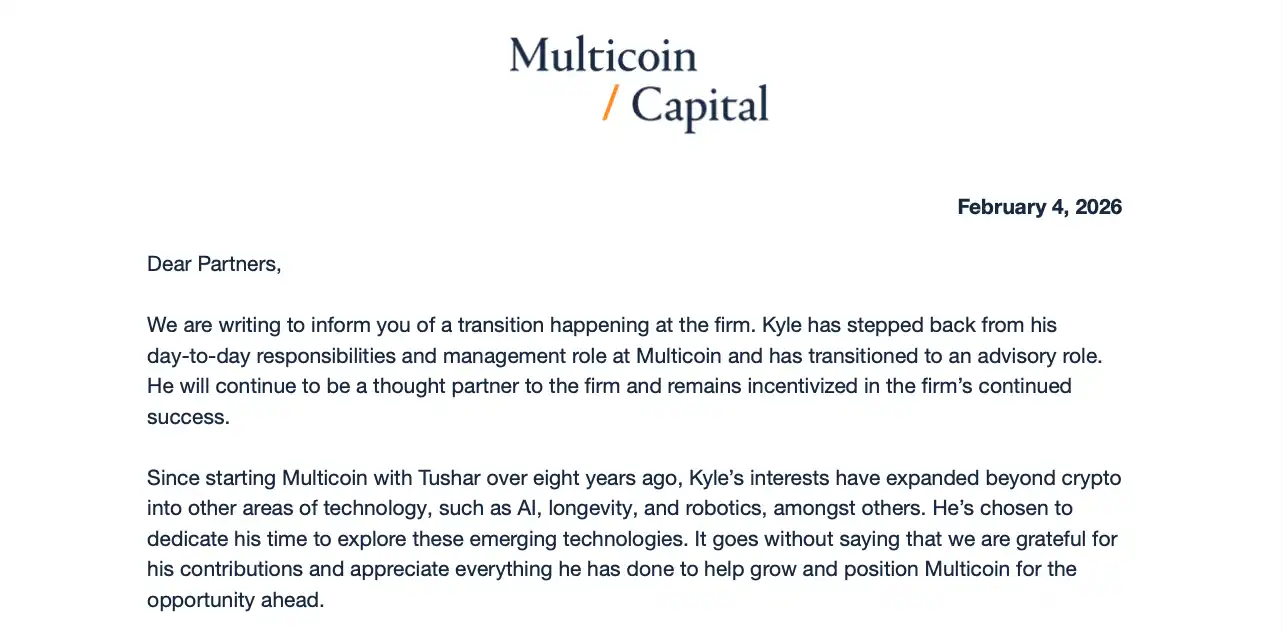
On February 4 local time, the well-known venture capital firm Multicoin Capital wrote to LPs stating that co-founder and managing partner Kyle Samani has stepped down from his daily duties and management role at Multicoin and transitioned to an advisory role.

Tushar Jain, another co-founder of Multicoin, said that Samani's interests have expanded from the cryptocurrency field to cutting-edge directions such as AI, longevity technology, and robotics, and therefore he has decided to devote more time to exploring these emerging technologies.
The Man Who Best Promoted SOL

Since co-founding Multicoin with Tushar in 2017, Samani has been one of the most active investors in the cryptocurrency field. His most classic achievement is his疯狂押注 on Solana.

Multicoin was the first venture capital firm to heavily invest in Solana. Between 2018 and 2021, Multicoin led Solana's first three rounds of financing, and Samani himself took on the role of evangelizing Solana to the crypto world. Samani is extremely adept at promoting Solana in a high-profile and provocative manner. He has publicly criticized Bitcoin for lacking practical utility, criticized Ethereum for being structurally bloated and slow to scale, emphasized that "Solana is always the answer," and firmly believed that SOL would outperform BTC and ETH in the long run.

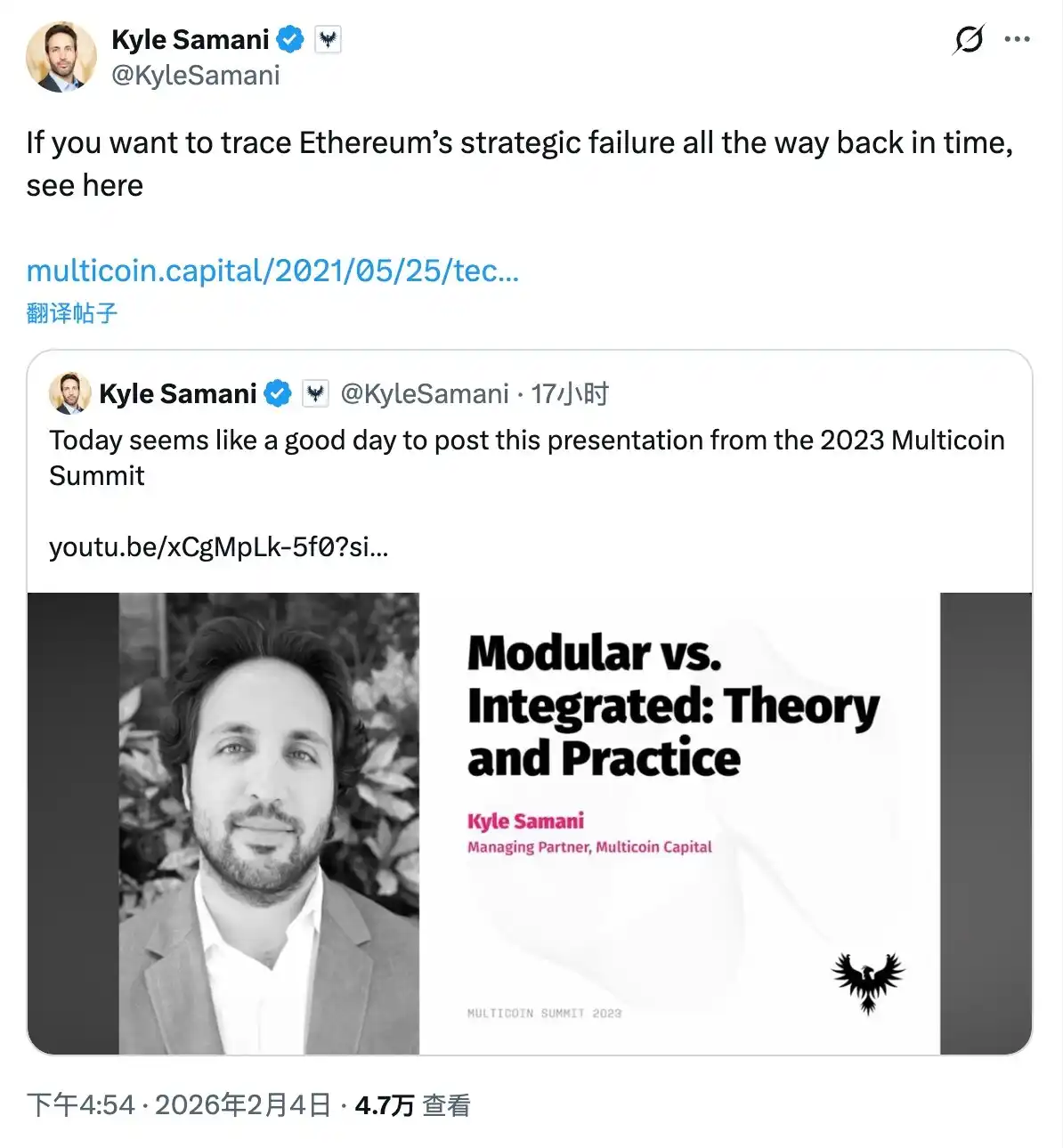
A recent example is that yesterday, Vitalik publicly admitted that Ethereum's Layer2 historical路线 had errors. Samani specifically reposted an article he wrote in 2021 comparing Ethereum and Solana's scaling paths and commented, "This is the beginning and end of Ethereum's strategic failure."
Multicoin's bet on Solana was a huge success. At the end of 2021, Samani said on The Wolf Of All Streets podcast that the firm had made an astonishing profit of 614,000% on Solana.

However, after the collapse of FTX, the entire Solana ecosystem was hit hard, and SOL一度跌至 $8, plunging the project into its darkest moment. Multicoin's profits also experienced a huge drawdown — the fund lost about 91.4% in 2022, its worst performance since inception.

But Samani and Multicoin showed an even more courageous side at this time. Instead of abandoning Solana, they continued to be driven by faith, firmly evangelizing Solana and increasing investment in Solana ecosystem projects. The final result was that Solana achieved the most amazing涅槃重生 in cryptocurrency history, and Samani and Multicoin also "regained lost ground" as SOL recovered.

After the rise of Digital Asset Treasuries (DAT) in 2025, Multicoin, together with Galaxy Digital and Jump Crypto, jointly led a $1.65 billion financing round for the DAT company Forward Industries. Forward Industries is now the largest SOL DAT on the market (holding 6.82 million SOL, worth approximately $626 million). Samani himself serves as the chairman of the board of this company.

A Madman in the Eyes of Ordinary People, the Best Investor in the Eyes of Peers

Because Samani prefers contrarian investments and his言论过于高调且极具煽动性, he is often accompanied by considerable controversy (mainly from the Ethereum ecosystem).

But in the eyes of a few VC peers, Samani is the best investor in the entire cryptocurrency field. Dragonfly Capital partner Hasseb Qureshi once said that as competitors, Dragonfly and Multicoin are always at odds, but experts recognize experts. Investment is like a sport, and Samani is the highest scorer of all time, unmatched by anyone.

Hasseb added: "This doesn't mean you have to like him. I often find him reckless and even annoying. I also often disagree with him... But Samani is a true contrarian thinker. He bets where others are unwilling to bet... Ultimately, this is the reason investors exist—to allocate capital to undervalued ideas, and Samani is one of the few non-consensus investors in our industry."

Personal Statement: Not Completely Leaving the Circle

After Multicoin's letter to LPs was announced, Samani himself also explained his job change on X.

Samani emphasized that his faith in cryptocurrency and Solana remains unchanged — "After nearly a decade of working deeply in the cryptocurrency industry, I am more convinced than ever that crypto technology will fundamentally reshape the financial system. I believe the Clarity Act will attract new participants like a tide,催生 an unprecedented wave of applications. I am still long-term bullish on the crypto field, especially the Solana ecosystem, and plan to continue making personal investments in the field while supporting companies in Multicoin's portfolio."

In addition, although he will gradually step down from Multicoin, Samani will continue to serve as chairman of the board of Forward Industries. Furthermore, Samani also mentioned that he intends to submit a redemption request to the Multicoin main fund on March 31, 2026, but will not request cash. Instead, he will redeem in kind with Forward Industries shares and warrants, to significantly increase his personal exposure to Forward Industries.

Future Direction Exploration

Multicoin's letter to LPs mentioned several new directions Samani is interested in — AI, longevity technology, and robotics.

Although it is not yet clear which specific directions Samani has identified (Samani said he will take a break for now), yesterday he reposted an article by Shayon, another partner at Multicoin, about AI titled "Disrupting the Human-AI Relationship." The core idea of the article is that instead of苦苦思索 "what AI can assist humans with," a more economically efficient direction is "how humans should assist AI," and what new investment opportunities will emerge around this shift in thinking.

Interested readers can read the original article, which may serve as a window into Samani's future thinking.

Preguntas relacionadas

QWho is Kyle Samani and what is his role change at Multicoin Capital?

AKyle Samani is the co-founder and managing partner of Multicoin Capital. He has stepped down from his day-to-day duties and management role at Multicoin and transitioned into an advisory role.

QWhat was Kyle Samani's most notable investment success in the crypto space?

AKyle Samani's most notable investment success was Multicoin Capital's heavy investment in Solana (SOL), which yielded a profit of 614,000% by late 2021.

QWhy did Kyle Samani decide to reduce his role at Multicoin Capital?

AKyle Samani decided to reduce his role because his interests have expanded beyond cryptocurrency to include emerging technologies such as AI, longevity tech, and robotics.

QWhat is Forward Industries, and what is Kyle Samani's involvement with it?

AForward Industries is a Digital Asset Treasury (DAT) company with significant holdings in SOL. Kyle Samani serves as the Chairman of the Board for Forward Industries and plans to increase his personal exposure to the company through in-kind redemptions from Multicoin's main fund.

QDespite stepping back, what does Kyle Samani plan to continue in the crypto space?

AKyle Samani plans to continue his personal investments in the crypto space, particularly in the Solana ecosystem, and will continue to support companies in Multicoin's investment portfolio.

Lecturas Relacionadas

10 Billion Repurchase Fails to Halt HYPE's Decline, Are Core Members and Multicoin Quietly Selling Tokens?

Foresight News reports that despite a massive $1 billion buyback program by the Assistance Fund, the HYPE token has fallen from its July high of $70 to around $52.40. Analyst MLM tracked data showing that since team token vesting began in December 2025, approximately 4.93 million HYPE (worth ~$270M) were allocated to core contributors. Of these, 1.19 million (~$32.5M) were sold on the open market, and 3.14 million (~$132M) were transferred to OTC desks. However, the report argues that direct team selling is not the primary driver of the price decline. In the same period, the protocol's Assistance Fund used 99% of trading fees to repurchase about 9.8 million HYPE for approximately $364 million, a rate more than double the team's selling pressure. The analysis points to other significant factors: major venture capital firms like Multicoin Capital and a16z have been unstaking and moving substantial amounts of HYPE to exchanges, with some confirming sales for portfolio management. Additionally, HYPE spot ETFs have experienced consistent daily net outflows since early July, reversing the strong inflows seen in May and June. The report concludes that while protocol buybacks absorb team selling, declining trading volume reduces this buyback power, and combined selling pressure from large investors and ETFs has significantly impacted the price.

marsbitHace 9 min(s)

10 Billion Repurchase Fails to Halt HYPE's Decline, Are Core Members and Multicoin Quietly Selling Tokens?

marsbitHace 9 min(s)

Wall Street Morning News: V-shaped Rebound at Month-end, but Nasdaq Suffers Worst July in 12 Years; Funds Accelerate Concentration Towards Cloud Giants

Despite a V-shaped rebound at the end of July, the Nasdaq posted its worst July since 2004, while the S&P 500 had its worst July since 2014. Markets were jolted by geopolitical shifts, as President Trump canceled a planned strike on Iran, leading WTI crude to plunge over 8%. This, alongside OPEC+ announcing a supply increase, reversed crude's sharp July gains. Treasury yields surged, with the 10-year yield rising over 30 basis points in July—its largest July increase since 2005. In a rare move, the US and Japan jointly intervened to weaken the USD/JPY, aiming to prevent potential Japanese sales of US Treasuries. While the tech sector faced deleveraging pressure throughout July, cloud giants staged a massive rally on strong earnings. Microsoft, Amazon, and Google collectively added nearly $1.5 trillion in market value last week. Amazon soared over 15% on accelerating AWS growth, Microsoft extended historic gains, Google fully recovered post-earnings losses, and Meta ended an 11-day losing streak. In contrast, Apple tumbled over 7% on supply chain and guidance concerns, ceding its "world's most valuable company" title to Nvidia. The memory and storage sector corrected sharply. Gold edged up 0.91% in July, with analysts viewing the ~30% pullback from January highs as a potential basing period, supported by long-term central bank demand. Key events to watch this week include earnings from Palantir, AMD, SpaceX (its first post-IPO report), and memory giants like Western Digital. The US July non-farm payrolls report on Friday will be critical for gauging the Fed's policy path. SpaceX also faces a significant lock-up expiration, testing market liquidity.

marsbitHace 54 min(s)

Wall Street Morning News: V-shaped Rebound at Month-end, but Nasdaq Suffers Worst July in 12 Years; Funds Accelerate Concentration Towards Cloud Giants

marsbitHace 54 min(s)

Rubin Ultra Makes Major Cuts, Even Nvidia Can't Handle Memory Price Hikes?

NVIDIA's Rubin Ultra, the top-tier variant of the newly announced Rubin AI accelerators, has reportedly seen significant specification downgrades, according to an industry report from SemiAnalysis. Initially designed with four compute dies (4-die), the Rubin Ultra is now said to be reduced to a 2-die design. Key changes highlighted in the report include: * **No increase in peak theoretical compute performance**, remaining at 35 PFLOPs like the standard Rubin. * **Severe reduction in memory capacity** to 192GB using 8-Hi HBM stacks, which is less than the standard Rubin's 288GB using 12-Hi stacks. * **Negligible memory bandwidth improvement** of only 1 TB/s. * **Slightly higher chip-level power consumption**. * The **primary upgrade is a massive increase in scale-up interconnect capacity**, supporting connections for up to 576 GPUs via NVLink, compared to 72 for the standard Rubin. The report suggests the redesign is primarily a cost-optimization move driven by the sharp rise in HBM (High-Bandwidth Memory) prices. By reducing the expensive HBM content and shifting investment towards enhanced system-scale networking, NVIDIA aims to maintain the platform's value for large-scale AI training clusters while managing soaring material costs. The news reportedly triggered a sell-off in South Korean memory stocks, with SK Hynix and Samsung shares falling around 8%, as markets grew concerned that NVIDIA—a major HBM buyer—might be reducing its reliance on high-capacity memory, potentially capping future pricing power for memory makers.

Odaily星球日报Hace 1 hora(s)

Rubin Ultra Makes Major Cuts, Even Nvidia Can't Handle Memory Price Hikes?

Odaily星球日报Hace 1 hora(s)

Trading

Spot
活动图片