The Man Who Best Promoted SOL Exits the Crypto World

marsbitPublicado a 2026-02-05Actualizado a 2026-02-05

Resumen

Kyle Samani, co-founder and managing partner of Multicoin Capital, has stepped down from his daily operational and management roles at the crypto-focused venture firm and transitioned to an advisory position. Known as one of the most vocal proponents of Solana, Samani was instrumental in Multicoin’s early and heavy investments in the blockchain, famously declaring “Solana is always the answer” and publicly criticizing Bitcoin and Ethereum. Under his leadership, Multicoin achieved extraordinary returns from Solana, though the fund also faced significant losses during market downturns. Despite his exit from Multicoin, Samani remains committed to the crypto space, particularly Solana, and will continue personal investments in the ecosystem. He will retain his role as chairman of Forward Industries, a digital asset treasury company heavily invested in SOL. Samani plans to redeem his Multicoin stake not in cash but in shares and warrants of Forward Industries to increase his exposure. His departure is driven by a growing interest in emerging technologies such as AI, longevity science, and robotics. Samani has indicated he will take time to explore these areas but remains a firm believer in crypto’s potential to reshape global finance.

Original | Odaily Planet Daily (@OdailyChina)

Author | Azuma (@azuma_eth)

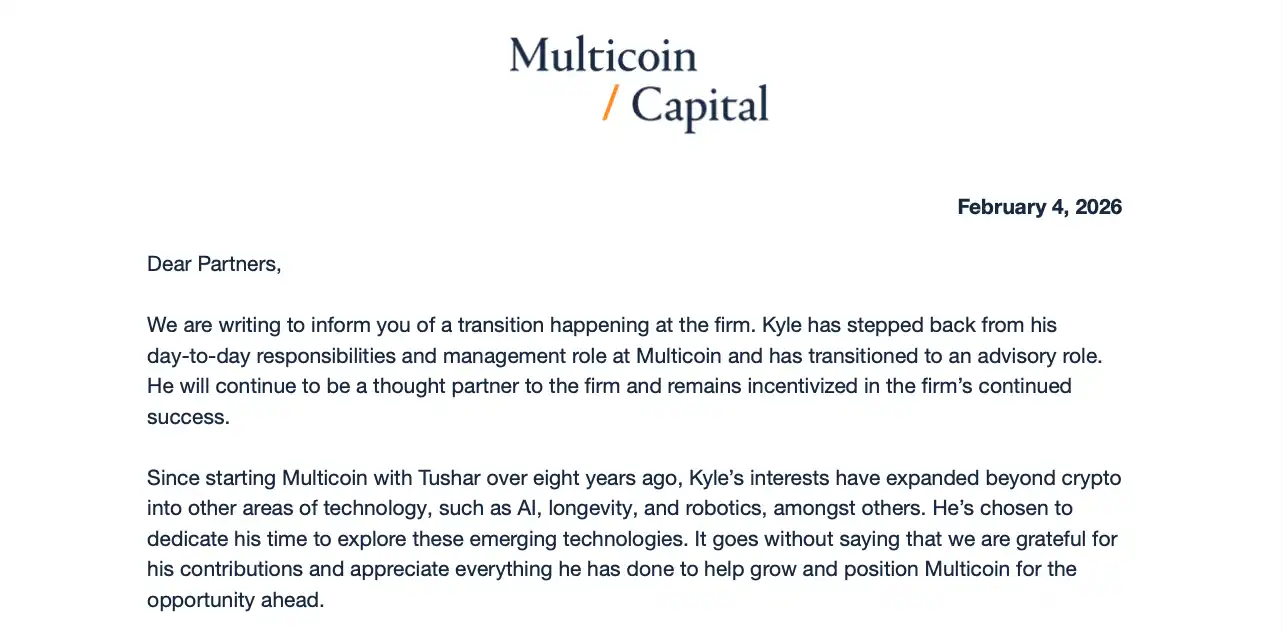
On February 4 local time, the well-known venture capital firm Multicoin Capital wrote to LPs stating that co-founder and managing partner Kyle Samani has stepped down from his daily duties and management role at Multicoin and transitioned to an advisory role.

Tushar Jain, another co-founder of Multicoin, said that Samani's interests have expanded from the cryptocurrency field to cutting-edge directions such as AI, longevity technology, and robotics, and therefore he has decided to devote more time to exploring these emerging technologies.
The Man Who Best Promoted SOL

Since co-founding Multicoin with Tushar in 2017, Samani has been one of the most active investors in the cryptocurrency field. His most classic achievement is his疯狂押注 on Solana.

Multicoin was the first venture capital firm to heavily invest in Solana. Between 2018 and 2021, Multicoin led Solana's first three rounds of financing, and Samani himself took on the role of evangelizing Solana to the crypto world. Samani is extremely adept at promoting Solana in a high-profile and provocative manner. He has publicly criticized Bitcoin for lacking practical utility, criticized Ethereum for being structurally bloated and slow to scale, emphasized that "Solana is always the answer," and firmly believed that SOL would outperform BTC and ETH in the long run.

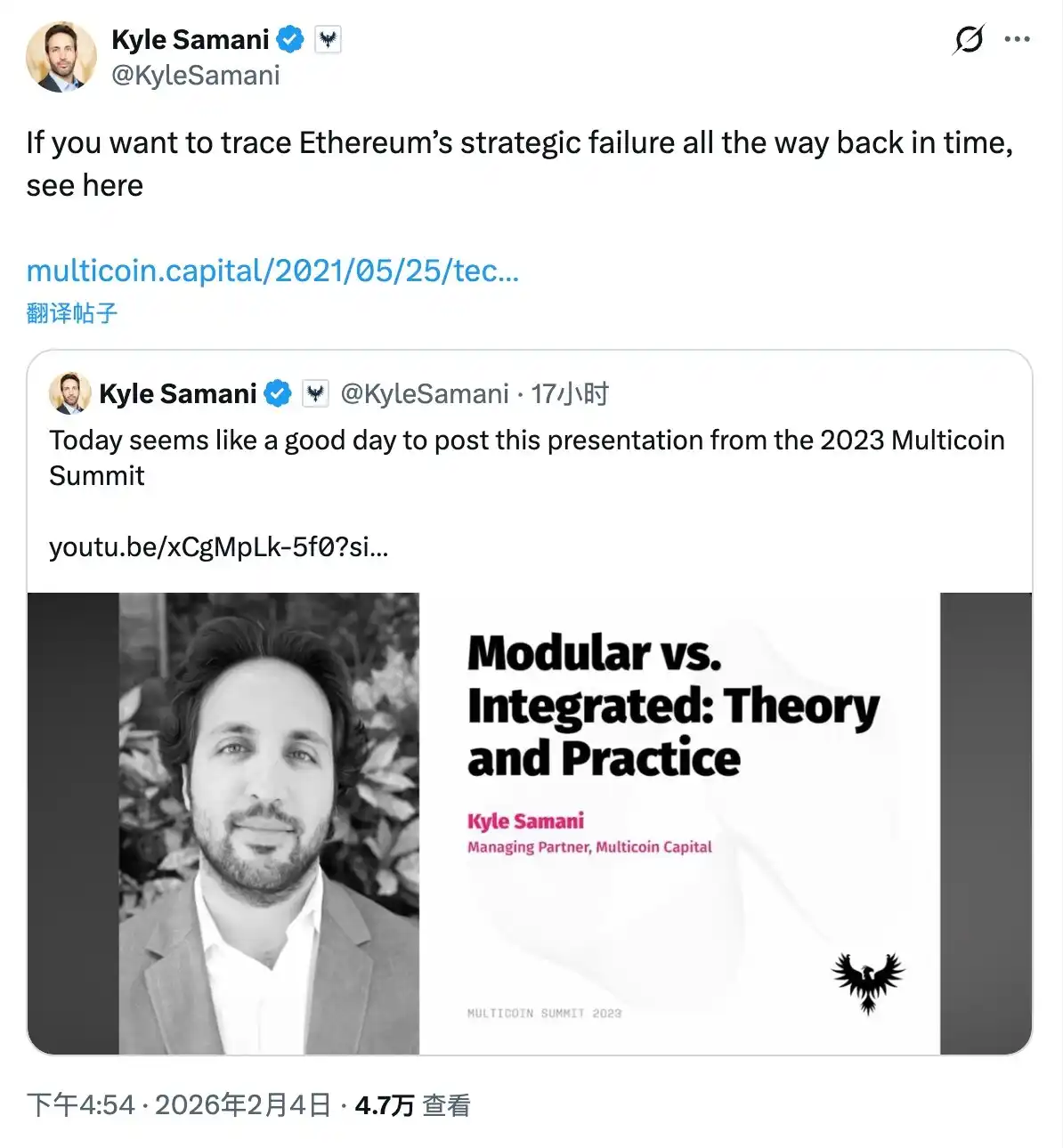
A recent example is that yesterday, Vitalik publicly admitted that Ethereum's Layer2 historical路线 had errors. Samani specifically reposted an article he wrote in 2021 comparing Ethereum and Solana's scaling paths and commented, "This is the beginning and end of Ethereum's strategic failure."
Multicoin's bet on Solana was a huge success. At the end of 2021, Samani said on The Wolf Of All Streets podcast that the firm had made an astonishing profit of 614,000% on Solana.

However, after the collapse of FTX, the entire Solana ecosystem was hit hard, and SOL一度跌至 $8, plunging the project into its darkest moment. Multicoin's profits also experienced a huge drawdown — the fund lost about 91.4% in 2022, its worst performance since inception.

But Samani and Multicoin showed an even more courageous side at this time. Instead of abandoning Solana, they continued to be driven by faith, firmly evangelizing Solana and increasing investment in Solana ecosystem projects. The final result was that Solana achieved the most amazing涅槃重生 in cryptocurrency history, and Samani and Multicoin also "regained lost ground" as SOL recovered.

After the rise of Digital Asset Treasuries (DAT) in 2025, Multicoin, together with Galaxy Digital and Jump Crypto, jointly led a $1.65 billion financing round for the DAT company Forward Industries. Forward Industries is now the largest SOL DAT on the market (holding 6.82 million SOL, worth approximately $626 million). Samani himself serves as the chairman of the board of this company.

A Madman in the Eyes of Ordinary People, the Best Investor in the Eyes of Peers

Because Samani prefers contrarian investments and his言论过于高调且极具煽动性, he is often accompanied by considerable controversy (mainly from the Ethereum ecosystem).

But in the eyes of a few VC peers, Samani is the best investor in the entire cryptocurrency field. Dragonfly Capital partner Hasseb Qureshi once said that as competitors, Dragonfly and Multicoin are always at odds, but experts recognize experts. Investment is like a sport, and Samani is the highest scorer of all time, unmatched by anyone.

Hasseb added: "This doesn't mean you have to like him. I often find him reckless and even annoying. I also often disagree with him... But Samani is a true contrarian thinker. He bets where others are unwilling to bet... Ultimately, this is the reason investors exist—to allocate capital to undervalued ideas, and Samani is one of the few non-consensus investors in our industry."

Personal Statement: Not Completely Leaving the Circle

After Multicoin's letter to LPs was announced, Samani himself also explained his job change on X.

Samani emphasized that his faith in cryptocurrency and Solana remains unchanged — "After nearly a decade of working deeply in the cryptocurrency industry, I am more convinced than ever that crypto technology will fundamentally reshape the financial system. I believe the Clarity Act will attract new participants like a tide,催生 an unprecedented wave of applications. I am still long-term bullish on the crypto field, especially the Solana ecosystem, and plan to continue making personal investments in the field while supporting companies in Multicoin's portfolio."

In addition, although he will gradually step down from Multicoin, Samani will continue to serve as chairman of the board of Forward Industries. Furthermore, Samani also mentioned that he intends to submit a redemption request to the Multicoin main fund on March 31, 2026, but will not request cash. Instead, he will redeem in kind with Forward Industries shares and warrants, to significantly increase his personal exposure to Forward Industries.

Future Direction Exploration

Multicoin's letter to LPs mentioned several new directions Samani is interested in — AI, longevity technology, and robotics.

Although it is not yet clear which specific directions Samani has identified (Samani said he will take a break for now), yesterday he reposted an article by Shayon, another partner at Multicoin, about AI titled "Disrupting the Human-AI Relationship." The core idea of the article is that instead of苦苦思索 "what AI can assist humans with," a more economically efficient direction is "how humans should assist AI," and what new investment opportunities will emerge around this shift in thinking.

Interested readers can read the original article, which may serve as a window into Samani's future thinking.


Preguntas relacionadas

QWho is Kyle Samani and what is his role change at Multicoin Capital?

AKyle Samani is the co-founder and managing partner of Multicoin Capital. He has stepped down from his day-to-day duties and management role at Multicoin and transitioned into an advisory role.

QWhat was Kyle Samani's most notable investment success in the crypto space?

AKyle Samani's most notable investment success was Multicoin Capital's heavy investment in Solana (SOL), which yielded a profit of 614,000% by late 2021.

QWhy did Kyle Samani decide to reduce his role at Multicoin Capital?

AKyle Samani decided to reduce his role because his interests have expanded beyond cryptocurrency to include emerging technologies such as AI, longevity tech, and robotics.

QWhat is Forward Industries, and what is Kyle Samani's involvement with it?

AForward Industries is a Digital Asset Treasury (DAT) company with significant holdings in SOL. Kyle Samani serves as the Chairman of the Board for Forward Industries and plans to increase his personal exposure to the company through in-kind redemptions from Multicoin's main fund.

QDespite stepping back, what does Kyle Samani plan to continue in the crypto space?

AKyle Samani plans to continue his personal investments in the crypto space, particularly in the Solana ecosystem, and will continue to support companies in Multicoin's investment portfolio.

Lecturas Relacionadas

As Consensus Accelerates, What Are Young Investors Betting On?

Title: As Consensus Forms Faster, What Are Young Investors Betting On? In the rapid evolution of tech investment, a new generation of young investors is navigating a landscape where AI, robotics, commercial aerospace, and quantum computing are advancing simultaneously. Traditional investment logic based on financial models is giving way to a need for deep technical understanding and the ability to act before industry consensus forms. An analysis of trends from the "WAIC FUTURE TECH" list of young investment leaders reveals key shifts in focus. The first major trend is the movement of AI from the digital screen into the physical world. Investment is shifting from large language models and chatbots towards embodied AI, robotics, AI hardware, and edge computing. While demonstrations generate excitement, the real challenge lies in achieving scalable, reliable, and cost-effective delivery in complex real-world environments like factories and logistics. Success depends not just on algorithms but on the integration of sensors, actuators, and control systems. Second, the competitive focus for large models is moving beyond raw capability toward building an "intelligence flywheel." The goal is to create self-reinforcing systems where user interaction generates data, improving the model, which in turn enhances the user experience and attracts more engagement. Companies that successfully embed AI into workflows to create these closed-loop systems can build lasting value that isn't easily erased by the next model upgrade. Third, facing a potential bottleneck in high-quality human-generated data, investors are looking at new underlying technologies. Reinforcement learning and self-play, as demonstrated by AlphaGo Zero, offer paths for AI to generate its own experience. Scientific foundation models, which aim to build general AI capabilities for fields like life sciences and materials discovery, represent a non-consensus direction that could unlock new frontiers of knowledge and data. Finally, in deep-tech areas like quantum computing, commercial aerospace, and space-based infrastructure, patient capital is essential. These fields have long, uncertain development and validation cycles involving complex engineering, supply chains, and regulations. Investment here requires a long-term view, focusing on foundational team capabilities and the eventual emergence of market demand, even if commercial returns are distant. Collectively, these trends illustrate how young investors are adapting to a new era. They are learning to make earlier, technically-informed judgments, balance hype with real-world viability, and provide the patient capital needed to build the deep-tech foundations of the future.

marsbitHace 28 min(s)

As Consensus Accelerates, What Are Young Investors Betting On?

marsbitHace 28 min(s)

Can Japan Buy Growth with AI? Will the Bond Market Believe It?

Japan's cabinet has introduced the 2026 Basic Policy on Economic and Fiscal Management and Reform, shifting its primary fiscal target. The new framework moves away from the traditional annual primary balance goal and instead prioritizes a stable reduction of the debt-to-GDP ratio. This change is tied to a strategy of increased "responsible proactive fiscal" spending, aiming to boost long-term growth through investments in strategic sectors like AI, semiconductors, energy, and robotics. The government estimates total public and private investment in 62 key technologies could exceed 370 trillion yen by 2040. The market reaction has been mixed and cautious. While equity markets may respond to policy signals, bond markets are focused on fiscal credibility. Concerns center on whether the weakening of the clear primary balance anchor could lead to looser fiscal discipline. If investors doubt that these strategic investments will generate sufficient productivity gains, tax revenue, and nominal growth to outpace rising interest costs, they may demand higher yields on Japanese Government Bonds (JGBs). Recent volatility in the yen and JGB yields, with the 10-year yield briefly reaching 2.9%, reflects this skepticism. The success of this new framework hinges on two factors: whether Japan can achieve a nominal growth rate consistently higher than its long-term interest rates, and whether future budgets demonstrate disciplined control over bond issuance. The government's narrative is that strategic investment is essential to break Japan's cycle of low growth, aging, and labor shortages. However, the bond market will continuously assess the credibility of this plan, pricing the risk that it may represent fiscal expansion rather than a viable growth strategy.

marsbitHace 1 hora(s)

Can Japan Buy Growth with AI? Will the Bond Market Believe It?

marsbitHace 1 hora(s)

Misjudged A-Shares: Resilience, Expectations, and Confidence

China's A-share market recently faced selling pressure, especially in tech sectors, initially triggered by a global tech sell-off that began in South Korea. However, the article argues this is a case of "mistaken injury" and highlights the market's underlying resilience. This resilience stems from three main pillars: **1) Tech Sector Fundamentals:** Unlike Korea's market dominated by a few memory chip stocks, China's tech sector is diversified across computing, communications, electronics, and semiconductors, supported by dual narratives of global AI supply chains and domestic substitution. Core areas like optical modules and fiber optics continue to show strong earnings growth. **2) "National Team" Support:** State-backed institutions and large corporations have made significant market purchases and announced buybacks, providing liquidity and signaling confidence. This is seen as a stabilizing policy signal, often associated with market bottoms. **3) Broader Market Pillars:** Other major sectors are showing endogenous recovery momentum. Consumer stocks benefit from stabilizing CPI and signs of sector recovery (e.g., liquor price hikes). Cyclical sectors like aluminum have high earnings, potential price increases due to tight supply, and low valuations. The financial sector offers stable dividends and low valuations. The conclusion is that the sell-off was driven by external contagion, not a collapse in fundamentals. With strong policy support and recovering momentum across key sectors, the A-share market possesses the toughness to regain stability.

marsbitHace 1 hora(s)

Misjudged A-Shares: Resilience, Expectations, and Confidence

marsbitHace 1 hora(s)

Trading

Spot
活动图片




