Just now, the last unsolved problem in FrontierMath Tier 4 has been cracked by GPT-6 Astra.
With this, every question in this benchmark, once considered a nightmare for large models in mathematics, has been successfully solved by AI at least once.
Epoch AI has officially concluded: FrontierMath Tier 4 is saturated.
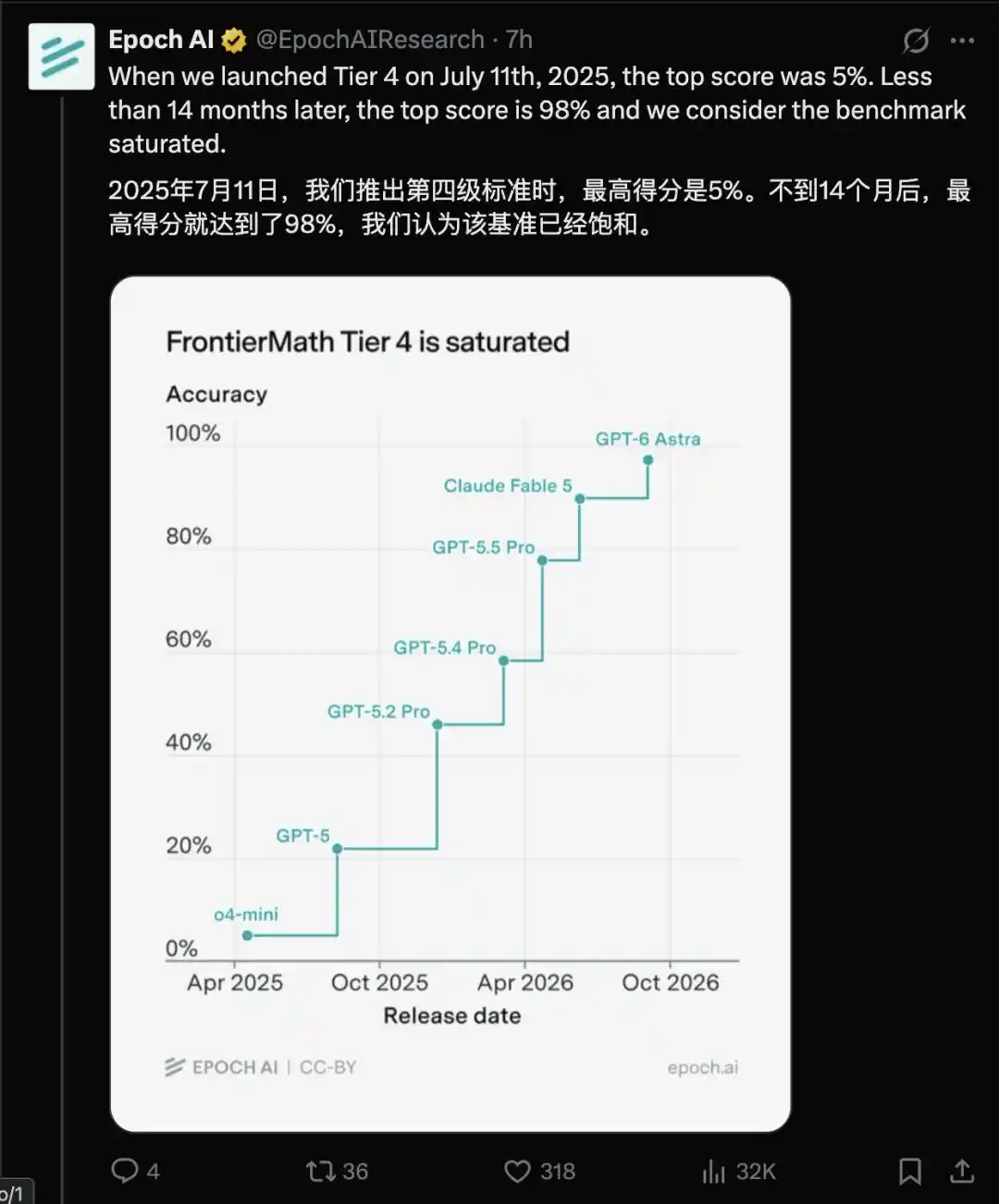
Although judging from the chart above, Astra hasn't directly reached 100%—OpenAI's own published score is 97.6%.
According to Epoch's algorithm, "fully solved" means that after accumulating attempts from different models at different times, every single problem in Tier 4 has had at least one successful solution.
And the one Astra solved was precisely the last remaining problem that had never been cracked by AI before.
(A simple way to understand this: Astra might have made an error in some tests, but the problem it got right was the one previously unsolved.)

To be honest, the speed of this development is still pretty insane.
If you follow model evaluations, you'll know that when Tier 4 was first launched on July 11, 2025, the top score on the leaderboard was only about 5%.
Now, just over a year and two months later, this former "high wall" has become a "step," and the final problem that was hard for AI to bypass has been overcome.
Jay Pantone, a math associate professor at Marquette University and one of the problem authors, also noted that while AI used to find numerical shortcuts, this time, the AI's solution approach was quite close to his own.
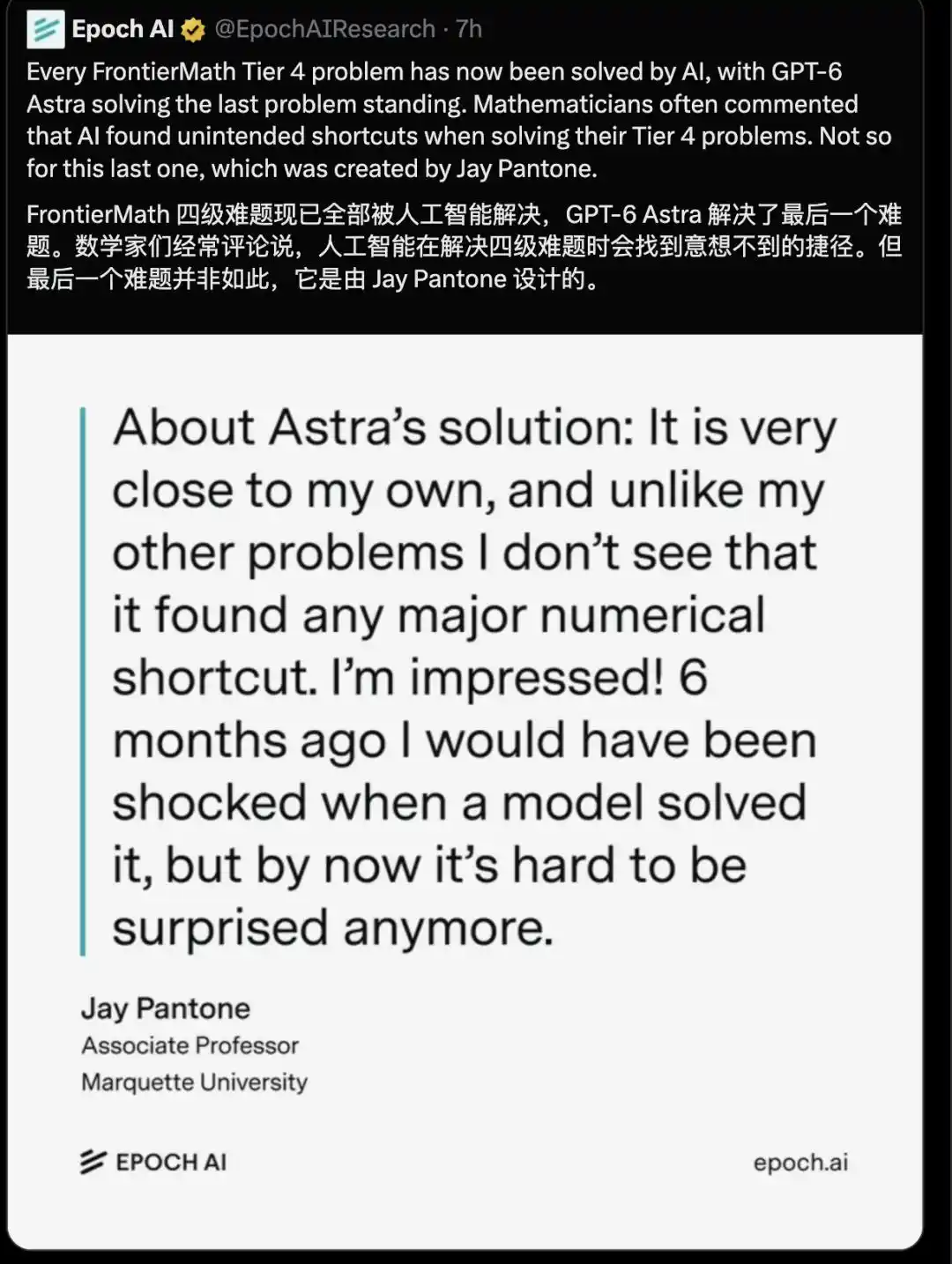
However, as GPT-6 Astra has been intensely attacking the mathematics world lately, frequently solving Millennium Prize Problems every few days, Pantone said he can hardly be surprised anymore!
It's safe to say that mathematics has become one of the areas where Astra has been flexing its muscles most prominently recently.
From Less Than 2% to Adding a Dedicated "Research-Level Defense"
FrontierMath was first released on November 7, 2024, and its very purpose was to prevent AI from breezing through math benchmarks too quickly.
At that time, traditional math benchmarks like GSM8K and MATH were finding it increasingly difficult to differentiate between top-tier models, so Epoch AI collaborated with over 60 mathematicians to design a new set of original problems that had never been publicly released before.
This group included Fields Medalists like Terence Tao, Timothy Gowers, and Richard Borcherds.
After reviewing some of the research-level problems, Terence Tao bluntly called them "extremely difficult," even predicting that the hardest Tier 3 might still stump AI for a few more years.
Sure enough, the first round of testing confirmed this, with the leading model's accuracy rate being less than 2%.
Specifically, initially, the core FrontierMath question bank had 300 problems, divided into three difficulty tiers: Tier 1, Tier 2, and Tier 3.
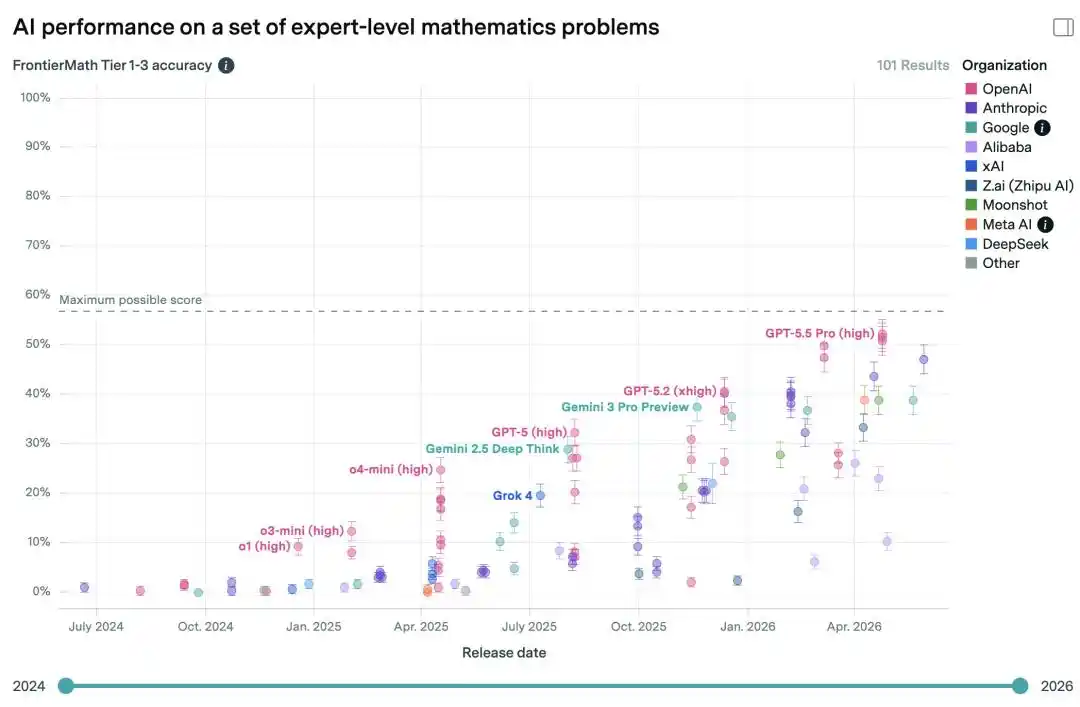
Tier 1 was roughly comparable to advanced undergraduate or math Olympiad problems, but allowed the use of more advanced tools; Tier 2 reached advanced graduate student difficulty; Tier 3 was closer to exploratory research problems early PhD students might encounter.
But with the emergence of reasoning models, these first three tiers also started to become insufficient. So in 2025, Epoch added another layer on top: Tier 4.
Tier 4 problems were mostly designed by mathematics professors and postdocs. Each would conduct a short-term research project lasting several weeks around their own research area, then compress the findings into a problem that could be automatically verified.
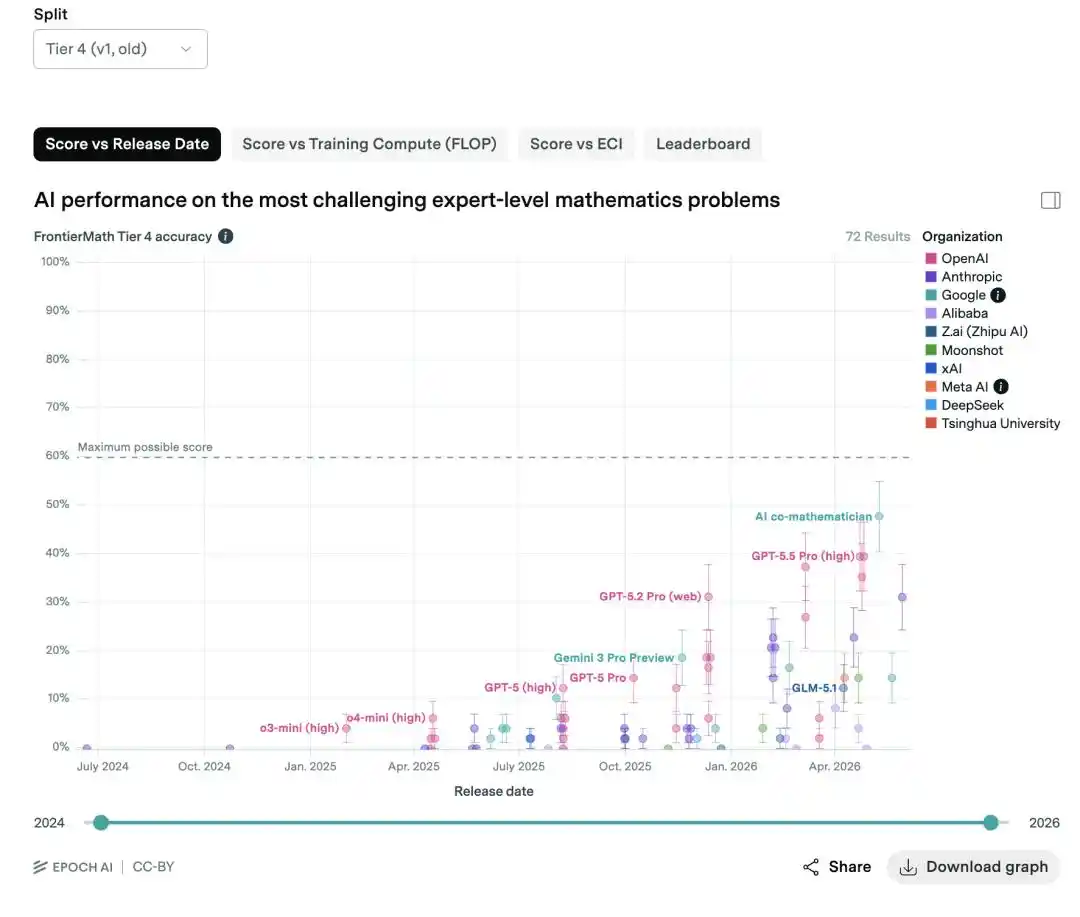
Initially, Tier 4 contained 50 problems. Their scope covered analysis, number theory, combinatorics, topology, algebraic geometry...
Upon release, across all models and all attempts combined, only 3 problems had ever been solved, and these solutions sometimes relied on correct but not fully justified assumptions.
Given this, on the official public sample problems page, Epoch once wrote: Some of these problems might not be solved by AI for decades.

(This statement is now being repeatedly mocked.)
However, as models grew stronger, another issue emerged: the question bank itself couldn't withstand AI's "grilling" anymore.
During testing, OpenAI found more errors in FrontierMath than anticipated.
Subsequently, Epoch launched an independent audit, first using GPT-5.5 and Claude Opus 4.7 to screen for suspicious points, then having mathematicians review each problem individually. Finally, in June 2026, version 2 was released, where Tier 4 had 12 problems corrected, 7 removed, leaving 43.
After the revision, model scores continued to climb.
GPT-5.6 Sol achieved 83.0%, Claude Fable 5 reached 90.2%, and with GPT-6 Astra, the score has now hit 97.6%.
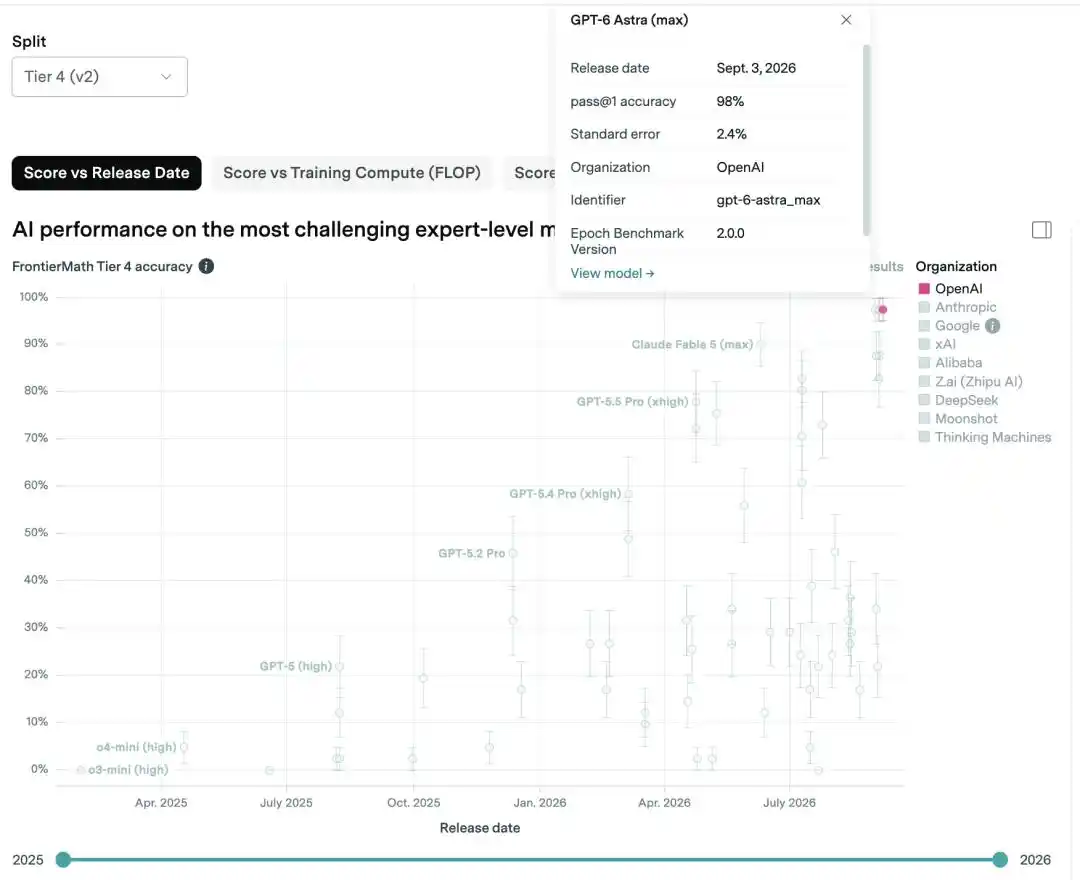
More crucially, Astra also filled the gap by solving the one problem that had never been cracked by AI before.

Thus, every single problem in Tier 4 has now been successfully solved by AI at least once. This research-level defense line, specifically added for the strongest models, has finally been cleared.
However, this doesn't mean "mathematics has been solved by AI." On the contrary, FrontierMath itself is already moving to the next phase.
Now, the entire project includes not only Tiers 1-4 but also genuine Open Problems, and FrontierMath Erdős, which formalizes Erdős open problems into Lean.
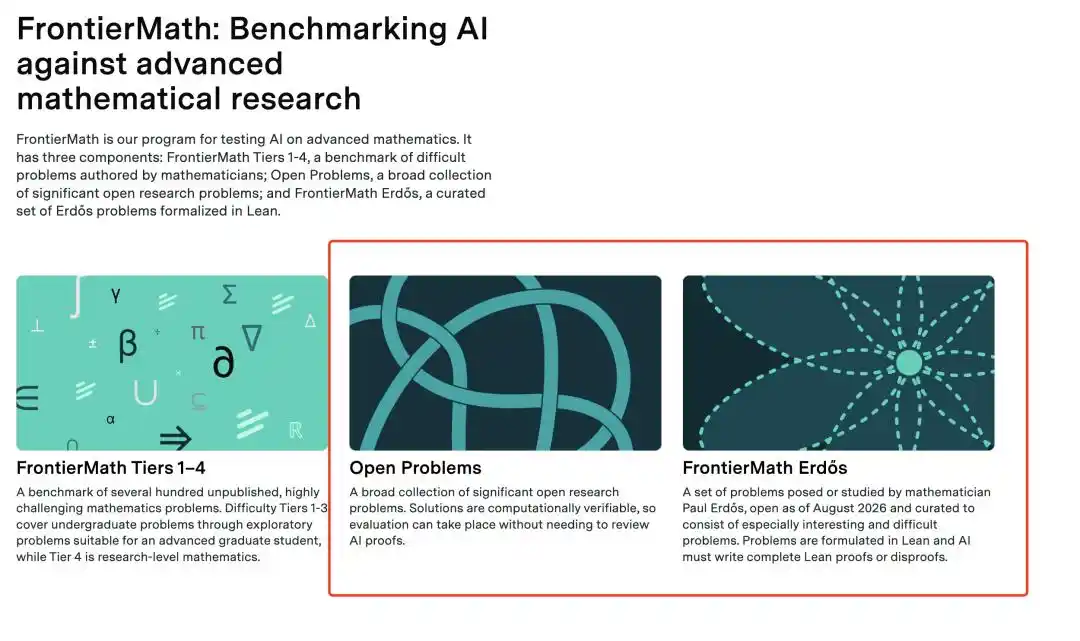
The former directly tests models on unsolved research problems from the mathematics community; the latter requires AI to produce complete proofs that can pass formal verification.
This time, Astra only solved 2 out of the 68 problems in FrontierMath Erdős.
The story continues~
This article is from the WeChat public account "QbitAI," author: henry