The Largest IPO in History Ignites Heated Debate: Is SpaceX Worth $1.77 Trillion?

marsbitPublicado a 2026-06-11Actualizado a 2026-06-11

Resumen

SpaceX's potential IPO is priced at $135 per share, aiming to raise $75 billion and valuing the company at approximately $1.77 trillion, which would make it the largest IPO in history. This valuation has sparked intense debate among investors. Bullish analysts, including major underwriters Goldman Sachs and Morgan Stanley, argue the valuation is justified by SpaceX's long-term potential. They see it not just as a rocket company but as a future leader in space infrastructure, with key growth drivers being Starlink satellite internet, low-cost rocket launches, and future AI-related ventures. They project revenues reaching hundreds of billions to trillions of dollars by 2030-2040. ARK Invest's model suggests a 2030 enterprise value could reach $2.5 trillion. Bearish analysts from independent research firms like Morningstar, PitchBook, and New Constructs contend the IPO price is excessively high, already pricing in unrealistic future growth. Using DCF and sum-of-the-parts models, they estimate fair value between $780 billion and $1.7 trillion, significantly below the IPO target. They highlight risks such as the speculative nature of AI projections, over-dependence on Elon Musk, high growth expectations, and corporate governance concerns. Trefis set a target price of just $79 per share. While both sides acknowledge SpaceX's unique position in commercial space, the core disagreement centers on whether the $135 share price offers a reasonable margin of safety or is overly optimis...

Original Author: Biteye

Currently, the SpaceX IPO pricing is preliminarily set at $135 per share, with a planned fundraising scale of approximately $75 billion, corresponding to a fully diluted valuation of about $1.77 trillion. This essentially secures its position as the largest IPO in the history of capital markets.

If this scale is ultimately achieved, Musk's net worth is expected to surge by over $220 billion, challenging for the title of the world's first trillionaire.

However, heavy is the head that wears the crown. The reason the SpaceX IPO attracts such attention is not only its potential to become the largest IPO ever but also because the capital markets are already fiercely debating its valuation.

Is SpaceX really worth $1.77 trillion? With an extra $220 billion in his wallet, will Musk be able to sleep soundly?

🌟 The Bull Case: Underwriters Weave a Long-Term Story with Starlink + Rocket Launches + AI

Bulls believe investing in SpaceX is not merely about backing a rocket company but rather about getting an early stake in the future gateway to space infrastructure.

The $1.77 trillion valuation seems high, but if Starlink, low-cost launches, and AI businesses continue to deliver, $135 has a long-term story to support it.

Goldman Sachs @GoldmanSachs

X Followers: 1.132M | XHunt Rank: 12015 | Global top-tier investment bank, one of the core underwriters for the SpaceX IPO.

Core View: SpaceX's valuation should not be understood solely as a traditional aerospace company; Starlink and future AI business must be incorporated into the long-term growth model.

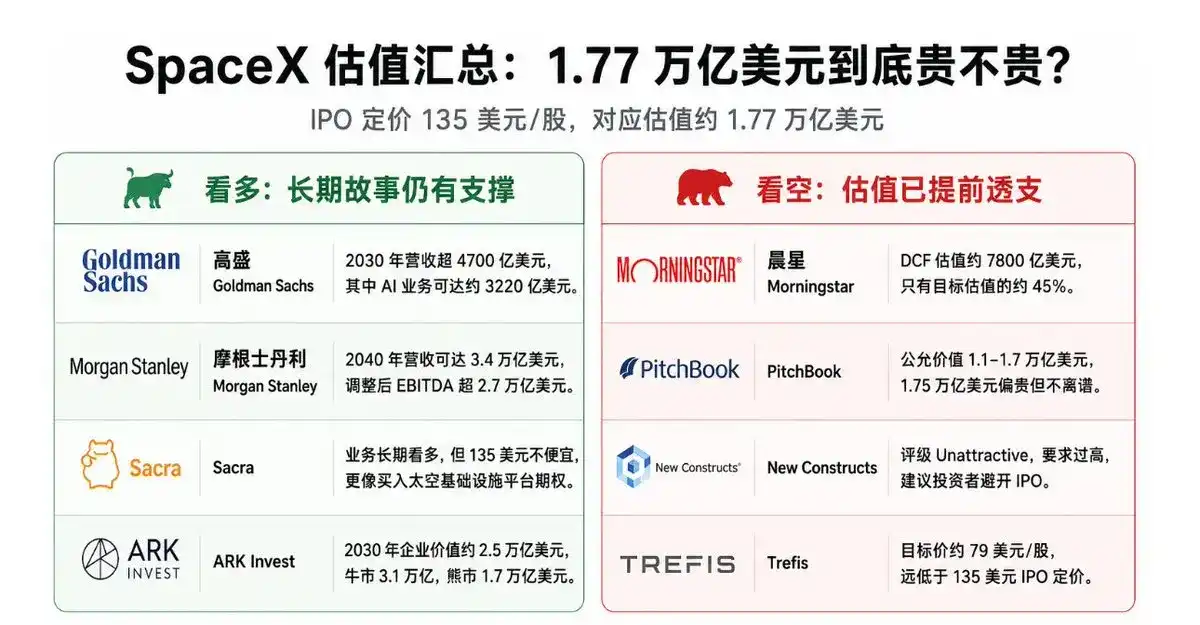
Goldman Sachs expects SpaceX's revenue in 2028 to be around $160 billion, exceeding $470 billion by 2030.

The AI division is considered the most aggressive part. Goldman Sachs projects SpaceX's AI-related revenue could reach approximately $322 billion by 2030.

Morgan Stanley @MorganStanley

X Followers: 742K | XHunt Rank: 32049 | Global top-tier investment bank, one of the core underwriters for the SpaceX IPO.

Core View: SpaceX's long-term value stems from the compound growth of "Space + AI," with a future revenue ceiling far higher than traditional aerospace companies.

Morgan Stanley similarly expects SpaceX's 2028 revenue to be around $160 billion.

More aggressive is the long-term forecast: by 2040, Morgan Stanley projects SpaceX's revenue could reach $3.4 trillion, with adjusted EBITDA exceeding $2.7 trillion.

If you're buying the gateway to space infrastructure for the next decade+, $135 is undervalued, but it will take a long time to realize.

Sacra

An independent research firm focused on private tech companies, specializing in deep-dive company analysis and valuation breakdowns.

Core View: Bullish on the business long-term, but $135 is not a low valuation; it's more like paying upfront for an option on SpaceX transforming from an aerospace company into a space infrastructure platform.

Sacra estimates SpaceX's 2025 revenue at approximately $18.7 billion, with Starlink contributing $11.4 billion, already becoming the company's most important profit center.

It believes SpaceX's core advantage lies in vertical integration: building its own rockets, launching them, deploying its own satellites, and controlling terminals and ground networks, creating a cost advantage difficult for competitors to replicate.

If only considering the current Starlink and rocket launch businesses, $135 is not cheap. If one believes SpaceX can further expand from an aerospace company into a comprehensive platform covering satellite internet, low-cost launches, and more space infrastructure, this price becomes easier to accept.

ARK Invest @ARKInvest

X Followers: 816K | XHunt Rank: 1637 | Innovation-focused investment firm led by Cathie Wood, long-term tracker of disruptive technology assets.

Core View: While SpaceX's $1.77 trillion valuation is high, it's not entirely without support when considering the long-term opportunity through 2030.

ARK Invest's open-source valuation model for SpaceX shows an expected enterprise value of approximately $2.5 trillion by 2030. According to its model, the bull case scenario is around $3.1 trillion, and the bear case scenario is around $1.7 trillion.

ARK's core logic is that SpaceX's value comes not just from rocket launches but from Starlink's global satellite internet network, low-cost launch capability, and future space infrastructure businesses.

Based on ARK's projections, the IPO subscription price of $135 still has some upside potential.

🌟 The Bear Case: Independent Firms Believe IPO Valuation is Already Severely Overextended

The bear camp does not deny that SpaceX is one of the world's most unique commercial aerospace assets, nor do they deny Starlink's long-term value.

However, they believe the $1.77 trillion IPO valuation has already priced in too much future growth, especially given the significant uncertainty surrounding the AI business.

Morningstar @MorningstarInc

X Followers: 238K | XHunt Rank: 98209 | Globally renowned independent investment research firm, commonly using fundamental analysis and DCF models to assess company value.

Core View: SpaceX is a good company, but the IPO valuation is clearly on the high side.

Using a DCF model, Morningstar gives SpaceX a fair value estimate of approximately $780 billion, only about 45% of the IPO target valuation of $1.77 trillion.

In Morningstar's breakdown, the valuation for SpaceX's core launch business + Starlink is approximately $611 billion, with the xAI / AI-related business valued at around $170 billion on a probability-weighted basis.

Morningstar also highlights two risks: Musk is a key figure at SpaceX, and the company's valuation carries a significant "Musk premium." After the IPO, selling pressure may arise as lock-up periods expire for early shareholders and employees.

Morningstar believes the $135 price is clearly expensive and not suitable for rushing into the IPO; there may be better buying opportunities post-IPO.

PitchBook @PitchBook

X Followers: 48K | XHunt Rank: 49174 | Global platform for private equity, venture capital, and private company data, covering valuations and financing information for numerous private companies.

Core View: Around $1.5 trillion is acceptable, $1.75 trillion is expensive, but not entirely irrational.

PitchBook uses a Sum-of-the-Parts model to estimate SpaceX's fair value range between $1.1 trillion and $1.7 trillion, primarily focusing on the launch business and Starlink, not entirely reliant on the xAI narrative.

The $135 price is already near or slightly above the upper end of PitchBook's valuation range – not cheap, but not completely outrageous if one takes a long-term view on Starship and Starlink execution.

New Constructs @NewConstructs

X Followers: 5675 | XHunt Rank: - | Independent equity research firm focusing on financial quality, valuation risks, and reverse DCF analysis.

Core View: SpaceX is not worth participating in at a $1.75 trillion valuation; it advises investors to avoid the IPO.

New Constructs rates SpaceX as Unattractive. They argue that the $1.75 trillion valuation implies excessively high future growth and profit requirements. SpaceX would need to simultaneously become one of the highest revenue and profit-generating companies in the U.S. stock market to justify this price.

Risks cited include: inadequate internal accounting controls at SpaceX, public investors having almost no voting rights, a large portion of IPO proceeds potentially used to repay debt, potentially misleading non-GAAP metrics, and related-party transaction risks.

To justify a $1.75 trillion valuation, SpaceX's revenue may need to reach $1.1 trillion by 2035, implying an average annual growth rate of about 50% over the next decade. New Constructs believes such growth rates have almost no historical precedent.

New Constructs' judgment is the most direct: the risk-reward at this price is unfavorable, and they recommend not participating in the IPO.

Trefis @Trefis

X Followers: 2661 | XHunt Rank: - | Independent U.S. stock valuation platform that derives target prices by breaking down business models.

Core View: SpaceX is an exceptionally unique company, but the $135 offering price is clearly overvalued.

Trefis acknowledges SpaceX's long-term advantages in commercial aerospace, Starlink satellite internet, and low-cost launches but argues these advantages do not mean investors should ignore price.

Trefis gives SpaceX a target price of approximately $79 per share, far below the $135 IPO price.

🌟 Final Thoughts

Whether from the bull or bear side, most essentially acknowledge that SpaceX is one of the world's most unique commercial aerospace companies.

The real point of contention is whether the $135 price offers any margin of safety.

📈 Bulls believe buying SpaceX is about the long-term story of Starlink, low-cost launches, AI, and future space infrastructure.

📉 Bears argue that $135 has already priced in expectations to the fullest.

Currently, the $SPCX IPO subscription is already oversubscribed by 4 times, indicating that despite the valuation debate, capital enthusiasm for SpaceX remains high.

🙋 So the question is: Will you participate in the $SPCX IPO? Do you think Musk's $220 billion gain is well-deserved, or will it keep him up at night?
Preguntas relacionadas

QWhat is SpaceX's proposed IPO share price and what would the corresponding fully diluted valuation be?

ASpaceX's proposed IPO price is $135 per share, which would result in a fully diluted valuation of approximately $1.77 trillion.

QAccording to Goldman Sachs and Morgan Stanley, what is the core narrative supporting the bullish case for SpaceX's high valuation?

AThe bullish case, as presented by Goldman Sachs and Morgan Stanley, revolves around SpaceX being a long-term investment in future space infrastructure, combining growth from Starlink, low-cost launch services, and future AI-related business segments.

QWhat is Morningstar's fair value estimate for SpaceX and how does it compare to the proposed IPO valuation?

AMorningstar's fair value estimate for SpaceX is approximately $780 billion, which is only about 45% of the proposed $1.77 trillion IPO valuation.

QWhat are some of the key risks associated with SpaceX's IPO as highlighted by New Constructs?

ANew Constructs highlighted several key risks: the valuation implies extremely high future growth requirements, insufficient internal accounting controls, minimal voting rights for public investors, the possibility of IPO proceeds being used to repay debt, potentially misleading non-GAAP metrics, and risks related to related-party transactions.

QWhat is the main point of contention between the bullish and bearish perspectives on SpaceX's IPO according to the article's conclusion?

AThe main point of contention is whether the IPO price of $135 per share provides a reasonable margin of safety. Bulls see it as justified by long-term growth in space infrastructure, while bears believe it already fully prices in optimistic future expectations.

Lecturas Relacionadas

2029 Finale Prediction: When Cryptocurrency Completely "Vanishes", Who Can Remain in This Financial Upheaval?

By 2029, the crypto industry will have transformed into a largely invisible but foundational layer for traditional finance. This timeline outlines the key shifts from now until then. By mid-2026, the most sought-after assets on-chain will not be traditional tokens, but synthetic perpetual contracts for private, high-growth companies (like SpaceX, OpenAI). These become primary price discovery tools, highlighting the market's craving for real-world asset value. Most altcoins enter a sustained bear market as their fundamental lack of asset-backed value is exposed. In late 2026, the "AI + Crypto" narrative largely fades as AI giants prove they don't need crypto infrastructure, except for prediction markets betting on model performance. Simultaneously, a quiet but significant wave of tokenization for institutional assets (money market funds, private credit) begins. The industry splits into a noisy speculative economy and a silent institutional one. Throughout 2027, major public blockchain foundations pivot decisively to serve institutional clients, building compliance toolkits and sales teams. However, key sectors hit growth ceilings: private perpetual contracts are legally restricted from public promotion, stable币 growth is capped by looming political uncertainty, and tokenization projects remain cautious. In 2028, following a U.S. election assumed to maintain a regulatory (not prohibitive) stance, a pivotal change occurs. After a major liquidation crisis exposes the flaws of synthetic contracts lacking a real-asset anchor, new regulations allow the *public solicitation* of private security sales (secondary market shares) to accredited investors. This creates a legitimate, direct on-ramp for retail capital into previously illiquid private equity. By 2029, the resulting bull market is driven by trading in real, innovative company shares (biotech, robotics, AI labs), not speculative tokens. "Crypto" as a distinct asset class recedes; it becomes the mundane, unseen plumbing for this new global private markets infrastructure. Tokens that survive are those capturing real cash flows from this infrastructure. Speculation persists but is marginalized. The core questions posed at the start are answered: token value is tied to legally enforceable claims on real assets, frontier tech adoption happens via private market channels, and crypto's absorption into traditional finance is marked by its becoming boring and invisible. The key validation for this entire thesis is whether, by late 2028, a legal pathway exists for ordinary accredited investors to access private assets directly.

marsbitHace 29 min(s)

2029 Finale Prediction: When Cryptocurrency Completely "Vanishes", Who Can Remain in This Financial Upheaval?

marsbitHace 29 min(s)

After the U.S. Banned Fable 5, Zhipu's Stock Soared 47%

On June 15, Chinese AI company Zhipu's stock surged up to 47.6% in Hong Kong, closing with a 32.82% gain. This sharp rise followed two key industry events. On June 12, Anthropic was compelled by a U.S. government export control order to suspend global access to its latest flagship models, Claude Fable 5 and Claude Mythos 5, impacting developers and businesses reliant on them. The next day, Zhipu announced it was opening access to its new open-source flagship model, GLM-5.2, for all Coding Plan users, with API and model weights (under the MIT license) to follow. The Anthropic incident highlighted a critical shift in the AI industry: beyond raw capability, the stability, continuous accessibility, and control over AI models are becoming equally vital, especially as AI integrates deeper into business workflows. Zhipu's move, emphasizing that "frontier intelligence should not belong to a few nor be subject to arbitrary revocation," positioned its open, accessible model as an alternative. GLM-5.2 focuses on "Long Horizon Tasks" with a 1M context window, aiming for consistency in complex, extended projects. Market analysts suggest this event exposes the risk of dependency on closed-source models subject to single jurisdiction policies, potentially accelerating a shift toward domestic base models and localized deployments. The investment response indicates a new valuation metric is emerging—prioritizing which companies can provide AI capabilities that are not only advanced but also reliably and sustainably accessible.

marsbitHace 30 min(s)

After the U.S. Banned Fable 5, Zhipu's Stock Soared 47%

marsbitHace 30 min(s)

PANews Column Registration and Article Submission Guide

"PANews Column Registration and Submission Guide" provides instructions for users to register as columnists and publish articles on the PANews platform. Key application requirements are emphasized: content should focus on in-depth analysis within Crypto, Web3, blockchain, data, and viewpoints. Content primarily for brand/product introductions will not be approved, and heavily AI-generated content will be rejected. Promotional (PR/soft) content is directed to the business channel. **Registration Process:** * **Web:** Go to the official website footer, click "Apply for Column," and register with a phone number or email (login via verification code, no password). Fill in the column name, description, upload an avatar, and submit links to previously published work. * **Mobile:** Navigate to "My" -> "Contribute & Create" and complete the form. **Article Submission Tutorial:** 1. Log in to the PANews website. 2. Access the "Creator Center" from your personal homepage. 3. Use the editor to create and publish articles. **Video Upload:** The platform supports embedding videos from third-party sites (e.g., Bilibili). Copy the embed code from the source video, use the editor's "Insert/Edit media" button, paste the code under the "Embed" tab, and adjust the display size (recommended: width 100%, height 560px). **PANews Skills (AI Agent Tool):** PANews offers an official AI Agent skill set called PANews Skills, enabling AI tools to query platform content, track trends, and publish column articles directly. It includes three main skills: 1. `panews`: For tracking daily must-read lists, popular articles, and funding news. 2. `panews-creator`: For managing columns, publishing articles, and uploading images. 3. `panews-web-viewer`: For parsing PANews webpages into Markdown. These skills are compatible with various AI Agent tools (OpenClaw, Cursor, Claude Code, ChatGPT, Gemini, etc.). To use the `panews-creator` skill, users must obtain a specific authentication value from the PANews website after logging into their columnist account.

marsbitHace 41 min(s)

PANews Column Registration and Article Submission Guide

marsbitHace 41 min(s)

I Built Myself an Investment Workbench Using AI

For the past two weeks, I've been immersed in Vibe Coding—using AI to write code from natural language descriptions. This process has enabled me to quickly build functional tools that address long-standing personal ideas. Previously, I had many concepts but found execution too cumbersome. Key ideas included a unified dashboard for assets across US stocks, Crypto, HK stocks, and A-shares; a real-time alert system for price movements; an investment map visualizing sector relationships; and a tool to correlate prediction market bets with news and market data. Traditional development hurdles meant these often remained unrealized. Using AI (Codex, Claude Code, and DeepSeek API), I built four initial tools: 1. A **Cross-Market Asset Dashboard** showing total assets, daily P&L, and holdings by market, with added features for alerts and sector mapping. It's deployed locally for privacy. 2. A **Prediction Market (PM) Monitor** tracking bets on events (e.g., company valuations) and correlating probability shifts with news and market movements. I categorize bets by conviction to filter noise. 3. A **Simple Operations Backend** for managing my writing workflow (topics, progress, publishing). It's cloud-deployed for mobile access. 4. A **One-Click Formatting Tool** that automates converting drafts into various platform-specific formats, saving manual effort. While these tools are basic, they represent a significant shift: AI lowers the barrier to creating personalized systems. I believe individual investors can now feasibly build core systems for: * **Asset Observation** (tracking holdings and changes) * **Signal Monitoring** (watching for key market shifts) * **Sector Mapping** (understanding network relationships within a sector) * **Performance Review** (documenting rationale and outcomes) The power of Vibe Coding is its fast feedback loop. Ideas can be implemented, tested, and iterated on rapidly, turning "want-to-do" into "done." This marks the start of my new phase, where I'll share investment thoughts, tool tests, on-chain operations, and educational Web3 content.

marsbitHace 57 min(s)

I Built Myself an Investment Workbench Using AI

marsbitHace 57 min(s)

Trading

Spot
Futuros
活动图片