The Largest IPO in History Ignites Heated Debate: Is SpaceX Worth $1.77 Trillion?

marsbitPublicado a 2026-06-11Actualizado a 2026-06-11

Resumen

SpaceX's potential IPO is priced at $135 per share, aiming to raise $75 billion and valuing the company at approximately $1.77 trillion, which would make it the largest IPO in history. This valuation has sparked intense debate among investors. Bullish analysts, including major underwriters Goldman Sachs and Morgan Stanley, argue the valuation is justified by SpaceX's long-term potential. They see it not just as a rocket company but as a future leader in space infrastructure, with key growth drivers being Starlink satellite internet, low-cost rocket launches, and future AI-related ventures. They project revenues reaching hundreds of billions to trillions of dollars by 2030-2040. ARK Invest's model suggests a 2030 enterprise value could reach $2.5 trillion. Bearish analysts from independent research firms like Morningstar, PitchBook, and New Constructs contend the IPO price is excessively high, already pricing in unrealistic future growth. Using DCF and sum-of-the-parts models, they estimate fair value between $780 billion and $1.7 trillion, significantly below the IPO target. They highlight risks such as the speculative nature of AI projections, over-dependence on Elon Musk, high growth expectations, and corporate governance concerns. Trefis set a target price of just $79 per share. While both sides acknowledge SpaceX's unique position in commercial space, the core disagreement centers on whether the $135 share price offers a reasonable margin of safety or is overly optimis...

Original Author: Biteye

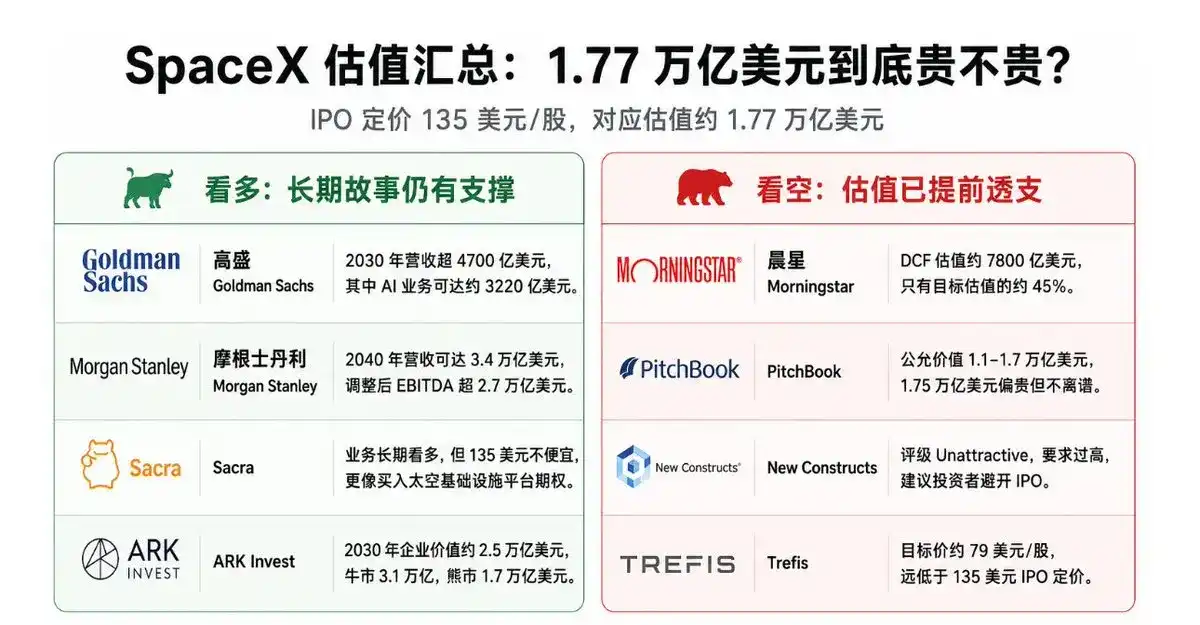
Currently, the SpaceX IPO pricing is preliminarily set at $135 per share, with a planned fundraising scale of approximately $75 billion, corresponding to a fully diluted valuation of about $1.77 trillion. This essentially secures its position as the largest IPO in the history of capital markets.

If this scale is ultimately achieved, Musk's net worth is expected to surge by over $220 billion, challenging for the title of the world's first trillionaire.

However, heavy is the head that wears the crown. The reason the SpaceX IPO attracts such attention is not only its potential to become the largest IPO ever but also because the capital markets are already fiercely debating its valuation.

Is SpaceX really worth $1.77 trillion? With an extra $220 billion in his wallet, will Musk be able to sleep soundly?

🌟 The Bull Case: Underwriters Weave a Long-Term Story with Starlink + Rocket Launches + AI

Bulls believe investing in SpaceX is not merely about backing a rocket company but rather about getting an early stake in the future gateway to space infrastructure.

The $1.77 trillion valuation seems high, but if Starlink, low-cost launches, and AI businesses continue to deliver, $135 has a long-term story to support it.

Goldman Sachs @GoldmanSachs

X Followers: 1.132M | XHunt Rank: 12015 | Global top-tier investment bank, one of the core underwriters for the SpaceX IPO.

Core View: SpaceX's valuation should not be understood solely as a traditional aerospace company; Starlink and future AI business must be incorporated into the long-term growth model.

Goldman Sachs expects SpaceX's revenue in 2028 to be around $160 billion, exceeding $470 billion by 2030.

The AI division is considered the most aggressive part. Goldman Sachs projects SpaceX's AI-related revenue could reach approximately $322 billion by 2030.

Morgan Stanley @MorganStanley

X Followers: 742K | XHunt Rank: 32049 | Global top-tier investment bank, one of the core underwriters for the SpaceX IPO.

Core View: SpaceX's long-term value stems from the compound growth of "Space + AI," with a future revenue ceiling far higher than traditional aerospace companies.

Morgan Stanley similarly expects SpaceX's 2028 revenue to be around $160 billion.

More aggressive is the long-term forecast: by 2040, Morgan Stanley projects SpaceX's revenue could reach $3.4 trillion, with adjusted EBITDA exceeding $2.7 trillion.

If you're buying the gateway to space infrastructure for the next decade+, $135 is undervalued, but it will take a long time to realize.

Sacra

An independent research firm focused on private tech companies, specializing in deep-dive company analysis and valuation breakdowns.

Core View: Bullish on the business long-term, but $135 is not a low valuation; it's more like paying upfront for an option on SpaceX transforming from an aerospace company into a space infrastructure platform.

Sacra estimates SpaceX's 2025 revenue at approximately $18.7 billion, with Starlink contributing $11.4 billion, already becoming the company's most important profit center.

It believes SpaceX's core advantage lies in vertical integration: building its own rockets, launching them, deploying its own satellites, and controlling terminals and ground networks, creating a cost advantage difficult for competitors to replicate.

If only considering the current Starlink and rocket launch businesses, $135 is not cheap. If one believes SpaceX can further expand from an aerospace company into a comprehensive platform covering satellite internet, low-cost launches, and more space infrastructure, this price becomes easier to accept.

ARK Invest @ARKInvest

X Followers: 816K | XHunt Rank: 1637 | Innovation-focused investment firm led by Cathie Wood, long-term tracker of disruptive technology assets.

Core View: While SpaceX's $1.77 trillion valuation is high, it's not entirely without support when considering the long-term opportunity through 2030.

ARK Invest's open-source valuation model for SpaceX shows an expected enterprise value of approximately $2.5 trillion by 2030. According to its model, the bull case scenario is around $3.1 trillion, and the bear case scenario is around $1.7 trillion.

ARK's core logic is that SpaceX's value comes not just from rocket launches but from Starlink's global satellite internet network, low-cost launch capability, and future space infrastructure businesses.

Based on ARK's projections, the IPO subscription price of $135 still has some upside potential.

🌟 The Bear Case: Independent Firms Believe IPO Valuation is Already Severely Overextended

The bear camp does not deny that SpaceX is one of the world's most unique commercial aerospace assets, nor do they deny Starlink's long-term value.

However, they believe the $1.77 trillion IPO valuation has already priced in too much future growth, especially given the significant uncertainty surrounding the AI business.

Morningstar @MorningstarInc

X Followers: 238K | XHunt Rank: 98209 | Globally renowned independent investment research firm, commonly using fundamental analysis and DCF models to assess company value.

Core View: SpaceX is a good company, but the IPO valuation is clearly on the high side.

Using a DCF model, Morningstar gives SpaceX a fair value estimate of approximately $780 billion, only about 45% of the IPO target valuation of $1.77 trillion.

In Morningstar's breakdown, the valuation for SpaceX's core launch business + Starlink is approximately $611 billion, with the xAI / AI-related business valued at around $170 billion on a probability-weighted basis.

Morningstar also highlights two risks: Musk is a key figure at SpaceX, and the company's valuation carries a significant "Musk premium." After the IPO, selling pressure may arise as lock-up periods expire for early shareholders and employees.

Morningstar believes the $135 price is clearly expensive and not suitable for rushing into the IPO; there may be better buying opportunities post-IPO.

PitchBook @PitchBook

X Followers: 48K | XHunt Rank: 49174 | Global platform for private equity, venture capital, and private company data, covering valuations and financing information for numerous private companies.

Core View: Around $1.5 trillion is acceptable, $1.75 trillion is expensive, but not entirely irrational.

PitchBook uses a Sum-of-the-Parts model to estimate SpaceX's fair value range between $1.1 trillion and $1.7 trillion, primarily focusing on the launch business and Starlink, not entirely reliant on the xAI narrative.

The $135 price is already near or slightly above the upper end of PitchBook's valuation range – not cheap, but not completely outrageous if one takes a long-term view on Starship and Starlink execution.

New Constructs @NewConstructs

X Followers: 5675 | XHunt Rank: - | Independent equity research firm focusing on financial quality, valuation risks, and reverse DCF analysis.

Core View: SpaceX is not worth participating in at a $1.75 trillion valuation; it advises investors to avoid the IPO.

New Constructs rates SpaceX as Unattractive. They argue that the $1.75 trillion valuation implies excessively high future growth and profit requirements. SpaceX would need to simultaneously become one of the highest revenue and profit-generating companies in the U.S. stock market to justify this price.

Risks cited include: inadequate internal accounting controls at SpaceX, public investors having almost no voting rights, a large portion of IPO proceeds potentially used to repay debt, potentially misleading non-GAAP metrics, and related-party transaction risks.

To justify a $1.75 trillion valuation, SpaceX's revenue may need to reach $1.1 trillion by 2035, implying an average annual growth rate of about 50% over the next decade. New Constructs believes such growth rates have almost no historical precedent.

New Constructs' judgment is the most direct: the risk-reward at this price is unfavorable, and they recommend not participating in the IPO.

Trefis @Trefis

X Followers: 2661 | XHunt Rank: - | Independent U.S. stock valuation platform that derives target prices by breaking down business models.

Core View: SpaceX is an exceptionally unique company, but the $135 offering price is clearly overvalued.

Trefis acknowledges SpaceX's long-term advantages in commercial aerospace, Starlink satellite internet, and low-cost launches but argues these advantages do not mean investors should ignore price.

Trefis gives SpaceX a target price of approximately $79 per share, far below the $135 IPO price.

🌟 Final Thoughts

Whether from the bull or bear side, most essentially acknowledge that SpaceX is one of the world's most unique commercial aerospace companies.

The real point of contention is whether the $135 price offers any margin of safety.

📈 Bulls believe buying SpaceX is about the long-term story of Starlink, low-cost launches, AI, and future space infrastructure.

📉 Bears argue that $135 has already priced in expectations to the fullest.

Currently, the $SPCX IPO subscription is already oversubscribed by 4 times, indicating that despite the valuation debate, capital enthusiasm for SpaceX remains high.

🙋 So the question is: Will you participate in the $SPCX IPO? Do you think Musk's $220 billion gain is well-deserved, or will it keep him up at night?
Preguntas relacionadas

QWhat is SpaceX's proposed IPO share price and what would the corresponding fully diluted valuation be?

ASpaceX's proposed IPO price is $135 per share, which would result in a fully diluted valuation of approximately $1.77 trillion.

QAccording to Goldman Sachs and Morgan Stanley, what is the core narrative supporting the bullish case for SpaceX's high valuation?

AThe bullish case, as presented by Goldman Sachs and Morgan Stanley, revolves around SpaceX being a long-term investment in future space infrastructure, combining growth from Starlink, low-cost launch services, and future AI-related business segments.

QWhat is Morningstar's fair value estimate for SpaceX and how does it compare to the proposed IPO valuation?

AMorningstar's fair value estimate for SpaceX is approximately $780 billion, which is only about 45% of the proposed $1.77 trillion IPO valuation.

QWhat are some of the key risks associated with SpaceX's IPO as highlighted by New Constructs?

ANew Constructs highlighted several key risks: the valuation implies extremely high future growth requirements, insufficient internal accounting controls, minimal voting rights for public investors, the possibility of IPO proceeds being used to repay debt, potentially misleading non-GAAP metrics, and risks related to related-party transactions.

QWhat is the main point of contention between the bullish and bearish perspectives on SpaceX's IPO according to the article's conclusion?

AThe main point of contention is whether the IPO price of $135 per share provides a reasonable margin of safety. Bulls see it as justified by long-term growth in space infrastructure, while bears believe it already fully prices in optimistic future expectations.

Lecturas Relacionadas

The Value Distribution of Stablecoins

**Summary: The Value Distribution of Stablecoins** The article argues that stablecoins are evolving from mere trading tools into broader channels for dollar access. It divides the stablecoin ecosystem into four layers to analyze how value is distributed: 1. **Issuance Layer:** Mints stablecoins, holds reserve assets, and captures the spread between reserve yield and user costs (e.g., Tether, Circle). This layer currently earns the largest profit margin. 2. **Infrastructure Layer:** Connects stablecoins to the traditional financial system, handling fiat on/off-ramps, banking integration, compliance (KYC/AML), and asset management (e.g., Bridge, BVNK). This is the "unglamorous" but critical work, building the essential bridges between crypto and real-world finance. 3. **Acquiring/Distribution Layer:** Integrates stablecoins into merchant systems, manages payment flows, and provides enterprise financial software (e.g., Stripe, Coinbase). They act as the access point for businesses. 4. **Application Layer:** The end-users and businesses that ultimately use stablecoins for payments, settlements, or as a store of value. They benefit from convenience but have little pricing power. The core thesis is that while the issuance layer currently dominates profits, the often-overlooked **infrastructure layer holds significant long-term potential**. The real challenge and barrier to mass adoption is not the on-chain transfer of stablecoins (which is simple), but the complex "last mile" integration into existing business workflows, banking systems, and regulatory frameworks across different countries. Companies in this layer are currently in a "land grab" phase, investing heavily to build networks, secure bank partnerships, and establish compliance pathways. While their position is currently pressured by the profitable issuers above and distribution platforms below, the article suggests that if stablecoins become a default financial rail for businesses, the infrastructure providers who have done the hard work of integration will ultimately gain strong pricing power and become entrenched, essential players.

marsbitHace 4 min(s)

The Value Distribution of Stablecoins

marsbitHace 4 min(s)

The Value Distribution of Stablecoins

The Value Distribution of Stablecoins The article argues that stablecoins are evolving from a mere trading tool into a broad "dollar channel." It analyzes the industry's value chain through four layers: 1. **Issuance Layer (e.g., Tether, Circle):** The top layer that mints stablecoins, holds reserve assets, and captures the thickest interest rate spread. 2. **Infrastructure Layer (e.g., Bridge, BVNK):** Connects stablecoins to the traditional financial system, handling critical but complex "dirty work" like fiat on/off-ramps, banking integration, compliance (KYC/AML), and cross-border settlement. 3. **Acquiring/Distribution Layer (e.g., Stripe, Coinbase):** Embeds stablecoins into merchant systems, manages payment flows, and integrates with enterprise software. 4. **Application Layer:** End-users and businesses that ultimately use stablecoins for payments, settlement, or storing value. The author posits that while the issuance layer currently captures the most profit, the most overlooked and potentially critical layer is infrastructure. The core challenge for stablecoin adoption isn't the on-chain transfer (which is simple), but bridging the gap between blockchain and the real-world financial system. This involves solving practical problems for businesses: fiat conversion, reconciliation, tax handling, and user onboarding. Infrastructure companies are currently in a difficult "land-grab" phase—building networks, securing banking relationships, and achieving compliance country-by-country. They face pressure from both the profitable issuance layer above and distribution platforms below. However, the author suggests this layer is building a crucial moat. Once stablecoins become a default business rail, the infrastructure players who have done the hard work of integration may gain significant, durable value and pricing power.

链捕手Hace 8 min(s)

The Value Distribution of Stablecoins

链捕手Hace 8 min(s)

How to Do Research Well: Deliberately Practice the Real Skills That Matter

No one truly teaches you how to do research. You're often given a desk, a pre-selected problem, and vague instructions to "create something new." Consequently, many people reverse-engineer the job based on visible outputs—papers, posts, announcements—learning only how to *appear* like a researcher rather than how to *become* one. True research capability is built from stacking small, trainable skills, nearly all of which can be developed through deliberate practice. **Pick Your Own Problem:** Most researchers absorb problems from advisors or trends, lacking the underlying reasoning. Choosing a problem you genuinely care about, as John Schulman advises, leads to original work. Develop "taste" like a muscle: predict experiment outcomes, guess paper results from methods, and track which findings remain important over time. **Upgrade Your Inputs:** Relying on shared reading lists (arXiv hot lists, filtered group chats) leads to unoriginal conclusions. Undervalued old literature often holds crucial insights (e.g., MoE, LSTM, backpropagation). Richard Sutton's "The Bitter Lesson" or Claude Shannon's 1952 talk on creative thinking are more predictive than lengthy modern surveys. Breadth matters as much as depth: draw from neuroscience, mechanism design, hardware knowledge, and honest statistics. Read papers directly, especially appendices and limitations sections. **Write Everything Down:** As Paul Graham noted, writing exposes flaws in seemingly mature ideas. Writing is the cheapest defense against self-deception. Following Feynman's principle, Darwin programmatically wrote down facts contradicting his theory to combat memory bias. Maintain a detailed log of hypotheses, setups, predictions, results, and updated understandings. Reviewing past logs fosters essential humility.

marsbitHace 2 hora(s)

How to Do Research Well: Deliberately Practice the Real Skills That Matter

marsbitHace 2 hora(s)

Trading

Spot
Futuros
活动图片