The Illusion of Zero Fees: How Lighter Extracts Costs Through High Latency

marsbitPublicado a 2025-12-12Actualizado a 2025-12-12

Resumen

"The Illusion of 'Zero Fees': How Lighter Uses High Latency to Hide Costs Lighter DEX promotes 'zero-fee' trading for retail traders, but this comes with a hidden cost: high latency. The platform offers two account types—standard (0% fee) and premium (low fee)—with the standard account imposing a 200–300ms delay on transactions. In crypto markets, where prices move rapidly, this delay allows faster traders to exploit price movements and trade against slower users. Academic research suggests the actual cost due to adverse selection and slippage ranges from 6–12 basis points per trade for standard accounts, compared to just 0.2–2 basis points for premium accounts. This makes the 'free' account effectively 5–10 times more expensive. The model resembles payment for order flow practices seen in traditional finance, where platforms like Robinhood profit by routing orders to market makers. While Lighter discloses latency data, it emphasizes 'zero fees' in marketing while burying latency details, knowing most users won’t understand the implications. For all traders—especially small retail investors—the premium account is unequivocally the better choice."

There's a fundamental truth in business: if a product is free, you are the product.

Lighter DEX is promoting "zero fees" to retail traders. It sounds too good to be true—and it is.

What Lighter doesn't highlight in bold letters is the latency structure behind these "free" trades.
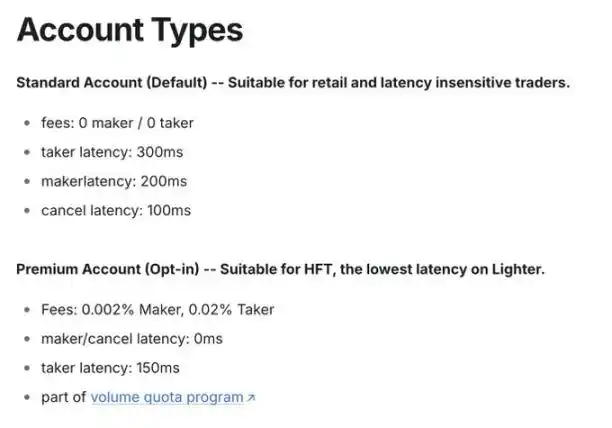
Lighter offers two account types: once you understand how latency works, you realize that the 0% fee tier is actually the most expensive option on the platform.

That 200–300 milliseconds of latency is the entire foundation of their business model.

What Does 300 Milliseconds Really Mean?
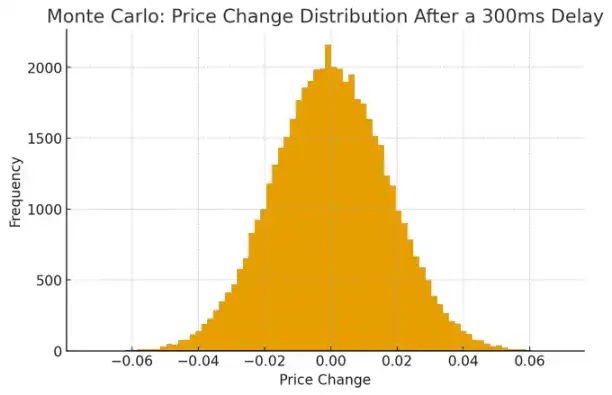
The average human blink takes 100–150 milliseconds. In the time it takes you to blink twice, faster traders have already captured price movements, adjusted their positions, and traded against you.

Crypto markets are highly volatile. At typical volatility levels (50–80% annualized), prices move roughly 0.5 to 1 basis point per second.

This means that within 300 milliseconds, random market fluctuations alone cause prices to move by an average of 0.15–0.30 basis points.

The True Cost of "Free"

If we quantify it:

Academic research on adverse selection costs (Glosten & Milgrom, Kyle's Lambda, etc.) suggests that informed traders typically have an advantage of 2–5 times the magnitude of random price fluctuations.

If the slippage due to randomness over 300 milliseconds is about 0.2 basis points, adverse selection would add an additional 0.4–1.0 basis points.

For active traders and market makers, the actual cost looks something like this:
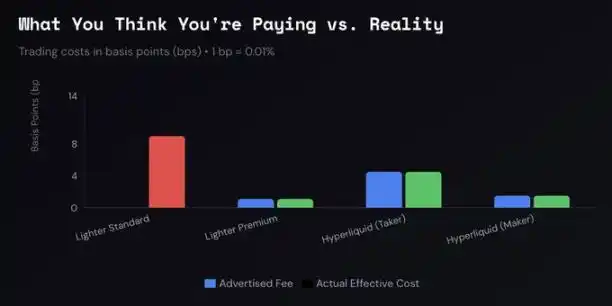
· Standard Account Actual Cost: 6–12 basis points per trade (0.06%–0.12%)

· Premium Account Actual Cost: 0.2–2 basis points per trade (0.002%–0.02%)

The "free" account is 5–10 times more expensive than the paid account.

Zero fees are just a marketing number—the real cost is hidden in the latency.

The Premium Account Is Clearly the Better Deal

Under no circumstances is the Standard Account (0% fee) the better choice.

Not for small retail traders, not for large traders, not for scalpers, swing traders, or even passive investors. Especially not for market makers. Not for anyone.

"I'm just a small retail trader; I don't need a premium setup."

Wrong.

Small retail traders can afford slippage even less. If you trade $1,000 and lose 10 basis points per trade, that's $1 gone each time. After 50 trades, 5% of your account has silently disappeared.

"I don't trade frequently; latency doesn't affect me."

Also wrong.

If you trade infrequently, the fee for a Premium Account is negligible anyway.

But even in those few trades, you're still getting worse execution. Why accept any disadvantage when the cost to avoid it is almost zero?

Just upgrade to the Premium Account.

This Model Isn't New

Traditional financial markets have seen this before—it's called payment for order flow.

@RobinhoodApp popularized this model by attracting retail traders with "free trades," then routing their orders to market makers who profited by trading against the uninformed retail flow.
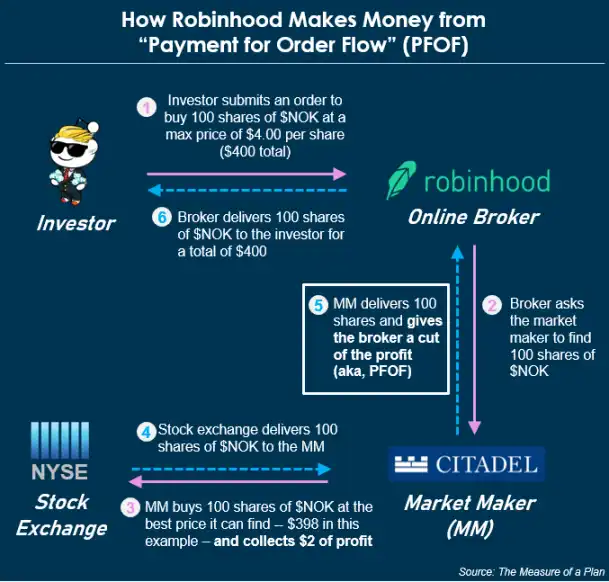
Lighter's model is structurally similar. Standard Account users aren't getting free trades—they're getting slower trades. That latency is being monetized by faster participants.

The exchange doesn't need to charge you a fee because you're paying with execution quality.

What Lighter Is Doing Right and Wrong

Lighter isn't hiding the latency data—it's in the documentation.

But transparency isn't the same as clarity.

Highlighting "0% fees" in headlines while burying "300ms latency" in the fine print is a strategy that prioritizes sign-up conversions over user understanding.

Most retail traders don't understand what latency means, what adverse selection is, or how to calculate the equivalent real cost.

And Lighter knows it.

The Premium Account is a better deal in every way than the "zero-fee" Standard Account—no argument needed.


Preguntas relacionadas

QWhat is the main hidden cost associated with Lighter's 'zero-fee' trading accounts?

AThe main hidden cost is the high latency of 200-300 milliseconds, which allows faster traders to exploit price movements and results in worse execution prices for standard account users.

QHow does the actual cost of Lighter's standard 'zero-fee' account compare to its premium account?

AThe standard account's actual cost (6-12 basis points per trade) is 5-10 times higher than the premium account's cost (0.2-2 basis points per trade.

QWhat traditional market practice is Lighter's business model similar to?

AIt is similar to Payment for Order Flow (PFOF), popularized by Robinhood, where 'free' trades are facilitated by routing orders to market makers who profit from the spread.

QWhy is the premium account a better option even for infrequent traders according to the article?

ABecause the few trades an infrequent trader makes will still get worse execution prices with the standard account, and the cost to avoid this (via the premium account) is negligible.

QWhat does the article claim is the real reason Lighter prominently advertises '0% fees' but buries the latency details?

AIt is a marketing strategy aimed at increasing user sign-up conversions, relying on the fact that most retail traders don't understand the financial impact of latency and adverse selection.

Lecturas Relacionadas

20 Billion Valuation, Alibaba and Tencent Competing to Invest, Whose Money Will Liang Wenfeng Take?

DeepSeek, an AI startup founded by Liang Wenfeng, is reportedly in talks with Alibaba and Tencent for an external funding round that could value the company at over $20 billion. This marks a significant shift, as DeepSeek had previously relied solely on funding from its parent company,幻方量化 (Huanfang Quantitative), and had resisted external investment. The potential valuation would place DeepSeek among the top-tier AI model companies in China, comparable to competitors like MoonDark (valued at ~$18 billion) and ahead of recently listed firms like MiniMax and Zhipu. The funding—which could range from $600 million (for a 3% stake) to $2 billion (for 10%)—is seen as a move to secure resources for model development, retain talent, and support infrastructure needs, particularly as competition in inference models and AI agents intensifies. Both Alibaba and Tencent are eager to invest, not only for financial returns but also to integrate DeepSeek into their broader AI ecosystems. However, DeepSeek’s leadership is cautious about maintaining independence and may prefer financial investors over strategic ones to avoid being locked into a specific tech ecosystem. Alternative options, such as state-backed funds, offer longer-term capital and policy support but may come with slower decision-making and potential constraints on global expansion. With competing AI firms accelerating their IPO plans, DeepSeek’s window for securing optimal terms may be narrowing. The final decision will reflect a trade-off between capital, resources, and strategic independence.

marsbitHace 1 hora(s)

20 Billion Valuation, Alibaba and Tencent Competing to Invest, Whose Money Will Liang Wenfeng Take?

marsbitHace 1 hora(s)

After Losing 97% of Its Market Value, iQiyi Attempts to Use AI to Forcefully Extend Its Lifespan

After losing 97% of its market value since its 2018 peak, iQiyi is aggressively pivoting to AI in a desperate attempt to survive. At its 2026 World Conference, CEO Gong Yu announced an "AI Artist Library" with over 100 virtual performers and a new AIGC platform, "NaDou Pro," promising faster production and lower costs. This shift comes as the company faces severe financial distress: its market cap sits near delisting thresholds at $1.36 billion, with significant losses, declining membership revenue, and depleted cash flow. The AI strategy has sparked controversy. Top actors have issued legal threats against unauthorized digital replicas, while in Hengdian, over 134,000 background actors are seeing their already scarce job opportunities vanish as AI replaces them for background roles. iQiyi's move represents a fundamental shift from being a high-cost content buyer to a landlord" to becoming a "platform capitalist" that transfers production risk to creators. This contrasts with competitors like Douyin (TikTok's Chinese counterpart), which is investing heavily in *real* actor-led short dramas, betting that authentic human connection retains users better than AI-generated content. The article draws a parallel to the 1920s transition to "talkies," which made cinema musicians obsolete but ultimately enriched the art form. In contrast, iQiyi's AI drive is framed not as an artistic evolution but as a cost-cutting measure that could degrade storytelling, replacing genuine human emotion with algorithmically calculated stimulation and potentially numbing audiences' capacity for empathy. The core question remains: can a company focused solely on financial survival preserve the art of storytelling?

marsbitHace 1 hora(s)

After Losing 97% of Its Market Value, iQiyi Attempts to Use AI to Forcefully Extend Its Lifespan

marsbitHace 1 hora(s)

Trading

Spot
Futuros

Artículos destacados

Cómo comprar CFG

¡Bienvenido a HTX.com! Hemos hecho que comprar Centrifuge (CFG) sea simple y conveniente. Sigue nuestra guía paso a paso para iniciar tu viaje de criptos.Paso 1: crea tu cuenta HTXUtiliza tu correo electrónico o número de teléfono para registrarte y obtener una cuenta gratuita en HTX. Experimenta un proceso de registro sin complicaciones y desbloquea todas las funciones.Obtener mi cuentaPaso 2: ve a Comprar cripto y elige tu método de pagoTarjeta de crédito/débito: usa tu Visa o Mastercard para comprar Centrifuge (CFG) al instante.Saldo: utiliza fondos del saldo de tu cuenta HTX para tradear sin problemas.Terceros: hemos agregado métodos de pago populares como Google Pay y Apple Pay para mejorar la comodidad.P2P: tradear directamente con otros usuarios en HTX.Over-the-Counter (OTC): ofrecemos servicios personalizados y tipos de cambio competitivos para los traders.Paso 3: guarda tu Centrifuge (CFG)Después de comprar tu Centrifuge (CFG), guárdalo en tu cuenta HTX. Alternativamente, puedes enviarlo a otro lugar mediante transferencia blockchain o utilizarlo para tradear otras criptomonedas.Paso 4: tradear Centrifuge (CFG)Tradear fácilmente con Centrifuge (CFG) en HTX's mercado spot. Simplemente accede a tu cuenta, selecciona tu par de trading, ejecuta tus trades y monitorea en tiempo real. Ofrecemos una experiencia fácil de usar tanto para principiantes como para traders experimentados.

257 Vistas totalesPublicado en 2026.03.19Actualizado en 2026.03.19

Cómo comprar CFG

Qué es WL

I. Introducción al ProyectoWorldLand es una L2 o cadena lateral de Ethereum, diseñada como una solución de abajo hacia arriba para mejorar el ecosistema de Ethereum.II. Información del Token1) Información BásicaNombre del token: WL (WorldLand)III. Enlaces RelacionadosSitio web:https://worldland.foundation/Exploradores:https://bscscan.com/address/0x8aaB31fbc69C92fa53f600910Cf0f215531F8239Redes Sociales:https://x.com/WorldLand_space Nota: La introducción del proyecto proviene de los materiales publicados o proporcionados por el equipo oficial del proyecto, que es solo para referencia y no constituye asesoramiento de inversión. HTX no se hace responsable de ninguna pérdida directa o indirecta resultante.

134 Vistas totalesPublicado en 2026.03.28Actualizado en 2026.03.28

Qué es WL

Cómo comprar WL

¡Bienvenido a HTX.com! Hemos hecho que comprar WorldLand (WL) sea simple y conveniente. Sigue nuestra guía paso a paso para iniciar tu viaje de criptos.Paso 1: crea tu cuenta HTXUtiliza tu correo electrónico o número de teléfono para registrarte y obtener una cuenta gratuita en HTX. Experimenta un proceso de registro sin complicaciones y desbloquea todas las funciones.Obtener mi cuentaPaso 2: ve a Comprar cripto y elige tu método de pagoTarjeta de crédito/débito: usa tu Visa o Mastercard para comprar WorldLand (WL) al instante.Saldo: utiliza fondos del saldo de tu cuenta HTX para tradear sin problemas.Terceros: hemos agregado métodos de pago populares como Google Pay y Apple Pay para mejorar la comodidad.P2P: tradear directamente con otros usuarios en HTX.Over-the-Counter (OTC): ofrecemos servicios personalizados y tipos de cambio competitivos para los traders.Paso 3: guarda tu WorldLand (WL)Después de comprar tu WorldLand (WL), guárdalo en tu cuenta HTX. Alternativamente, puedes enviarlo a otro lugar mediante transferencia blockchain o utilizarlo para tradear otras criptomonedas.Paso 4: tradear WorldLand (WL)Tradear fácilmente con WorldLand (WL) en HTX's mercado spot. Simplemente accede a tu cuenta, selecciona tu par de trading, ejecuta tus trades y monitorea en tiempo real. Ofrecemos una experiencia fácil de usar tanto para principiantes como para traders experimentados.

223 Vistas totalesPublicado en 2026.03.28Actualizado en 2026.03.28

Cómo comprar WL

Discusiones

Bienvenido a la comunidad de HTX. Aquí puedes mantenerte informado sobre los últimos desarrollos de la plataforma y acceder a análisis profesionales del mercado. A continuación se presentan las opiniones de los usuarios sobre el precio de A (A).

活动图片