After Noxa's unexpected shutdown, Robinhood entered the “Hundred Platforms War” phase on its launchpad. Nearly a week has passed, and while the situation has become somewhat clearer, there is still a lot of uncertainty.
Pons: The Current Frontrunner
Over the past weekend, Pons has taken the lead in both daily new token launches and daily trading volume. Particularly in daily trading volume, Pons has surpassed Noxa for two consecutive days, with an average daily volume of around $45 million over those two days.
Although Noxa is no longer issuing new tokens, early influential projects like $CASHCAT are still contributing significantly to its daily volume data. Pons' lead in daily volume indicates it is currently the preferred choice not only for launching new tokens but also as the primary destination for active liquidity.
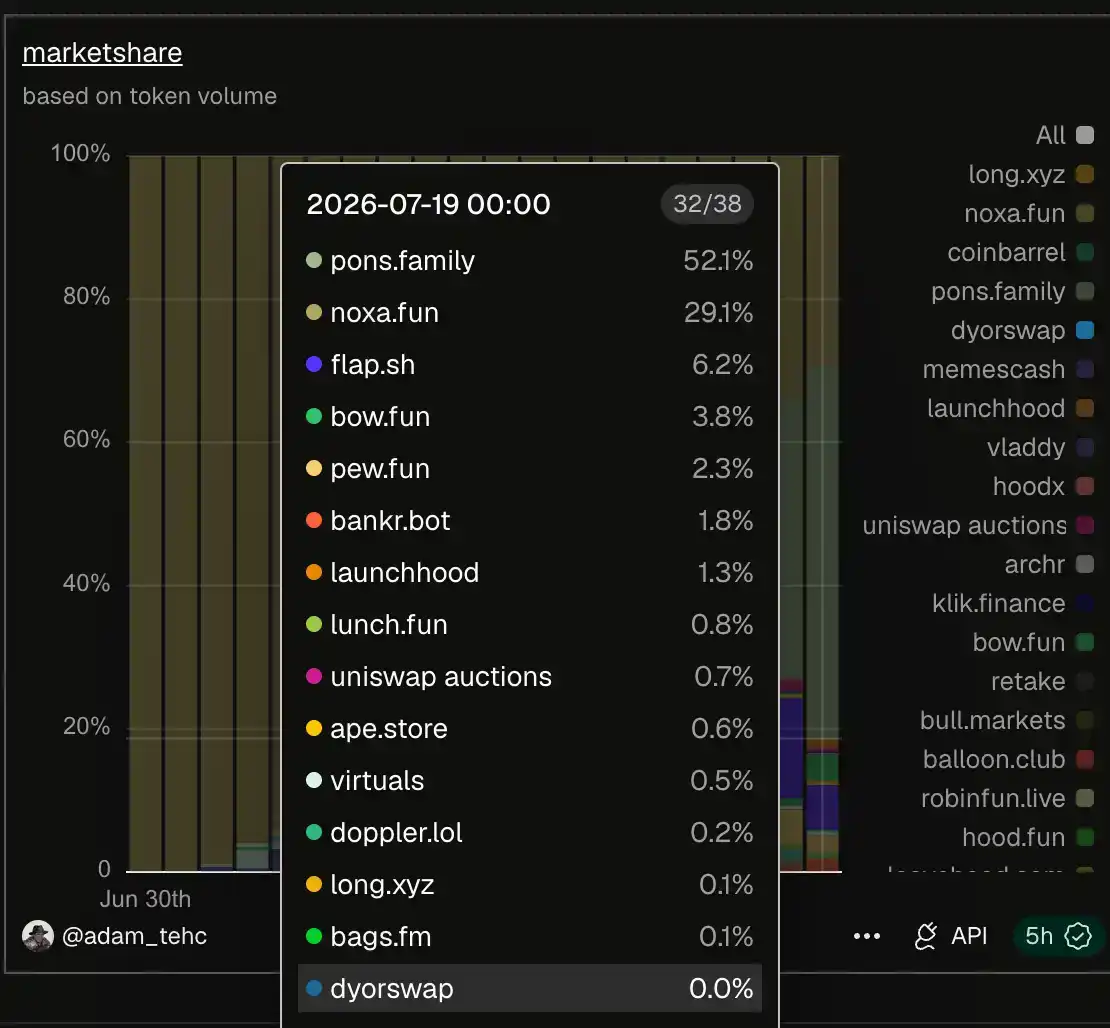
Yesterday, based on calculations of market share by intraday trading volume, Pons reached a 52.1% market share.
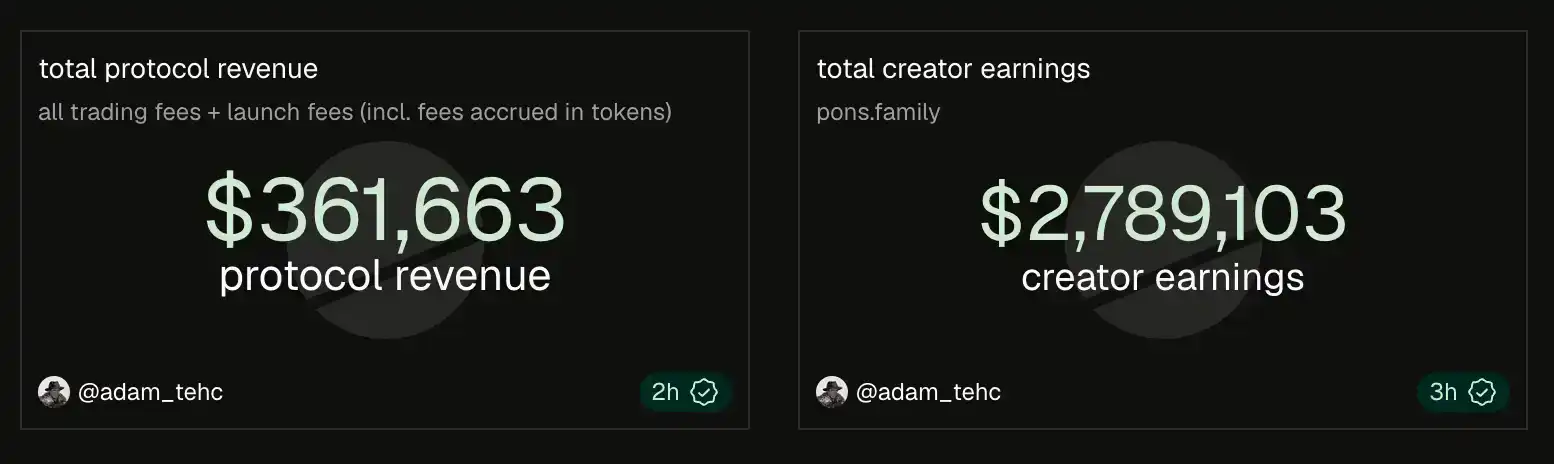
This helped the price of $PONS rebound after once falling to a market cap of approximately $4 million, reaching a new high of around $24 million. We can certainly argue that, based on Pons' revenue since its inception, its annualized estimates, combined with the already burned 20% of tokens, and compared horizontally with $PUMP, the rebound of $PONS from $4 million was to be expected.
However, the logic can be simplified and clearer. Firstly, the market is betting on the huge vacuum left by Noxa's exit from the launchpad sector, and Pons has the best data. Secondly, there needs to be an attention-grabbing event with room for market imagination. Pons also leads in this regard, as bonkguy openly bought in and even increased his holdings once. Additionally, @cryptogle, an advisor to WLFI, has been actively promoting $PONS, fueling market speculation that Pons is backed by the "Bonk gang."
Finally, Pons' lead does not mean it has achieved final victory, as many other platforms are eager to challenge.
Arrow: High Control, Doing Everything
One reason Arrow's token price previously surged to a market cap of $35 million is its high level of control:
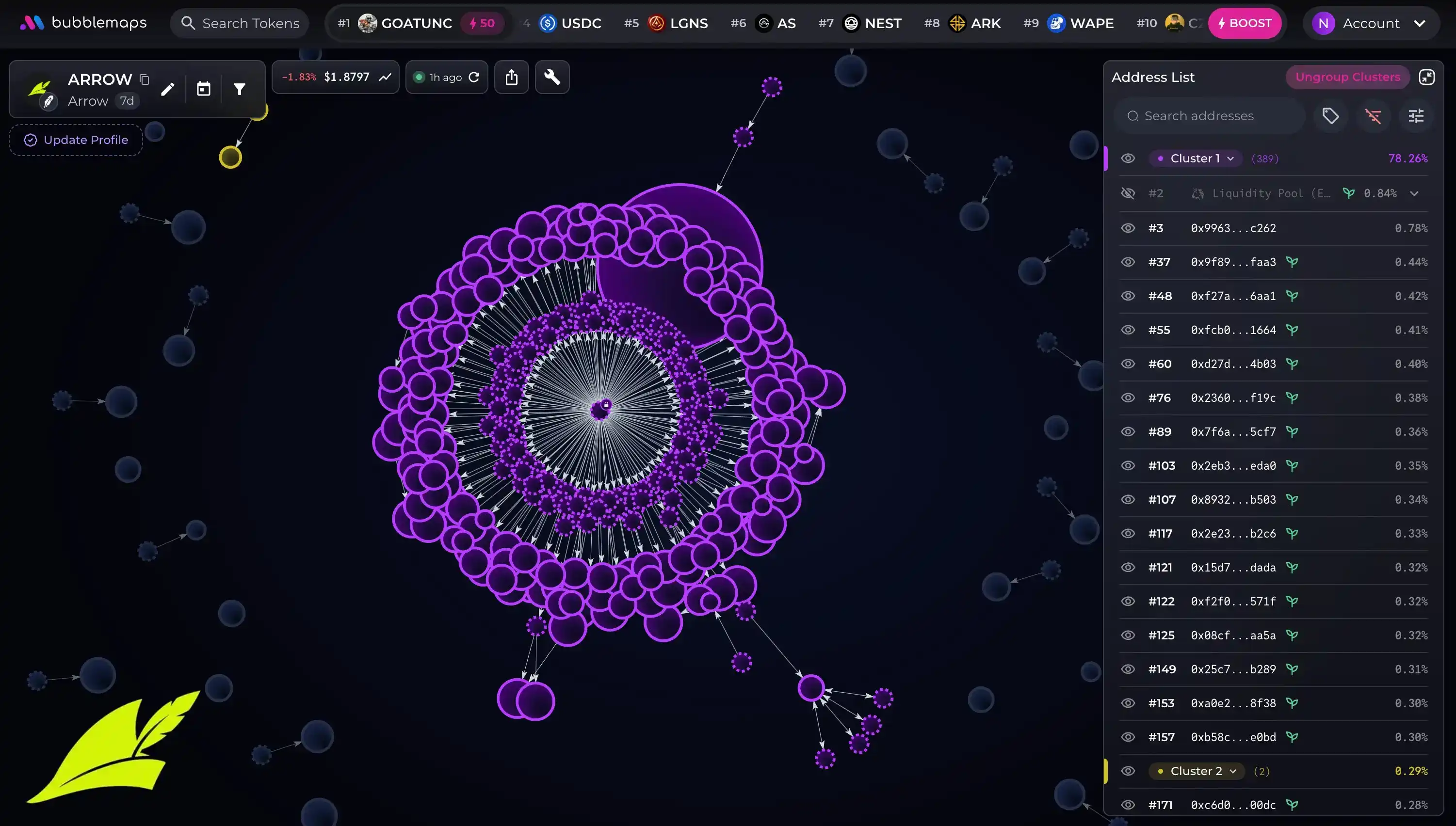
Another reason is that after meme coin $CASHCAT became a leader, people sought opportunities in the RWA narrative, and Arrow happened to be involved in tokenized stock lending and borrowing.
The launchpad business is highly profitable, so Arrow decided to enter this space as well. Its narrative has thus upgraded from tokenized stock lending to a comprehensive DeFi hub on Robinhood. In terms of attention, Pons relies on the Bonk gang, while Arrow's narrative features Ash Manicka, a former Robinhood employee, as the project's strategic advisor.
The platform hasn't officially launched yet, but it's imminent. Keep an eye on it.
Stonkbroker: Platform Not Yet Launched, NFTs Already Soaring
This project planned to launch NFTs before Robinhood's mainnet went live and had already built a launchpad during the testnet phase.
The original idea was to use royalties generated by the project to purchase tokenized stocks on Robinhood and airdrop them to holders. The implementation path involves this NFT series incorporating ERC-6551, where each NFT is also an Ethereum wallet, enabling direct airdrops to NFTs.
The use of ERC-6551, rather than just tracking holder addresses, opens up many possibilities for gameplay. Its platform hasn't officially started, but the NFTs have already been pumped to nearly 2 ETH, and its token surged to a peak market cap exceeding $15 million, making it one of the big winners over the weekend.
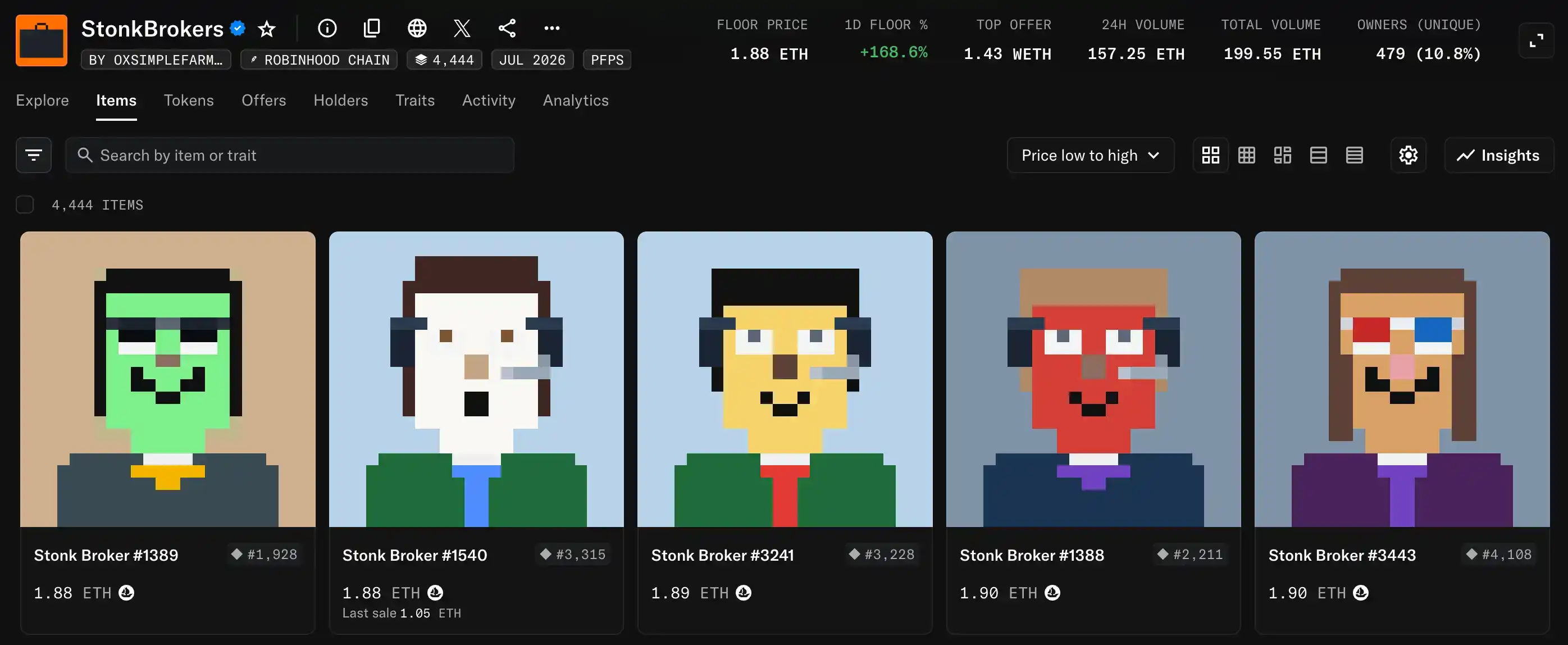
This NFT series has a total supply of 4,444. In the future, 70% of the launchpad's revenue will be used to purchase tokenized stocks on Robinhood and airdropped to NFT holders. However, holders need to spend a portion of $STONKBROKER to activate the NFT for dividend eligibility. The more tokens spent, the greater the multiplier for dividends:
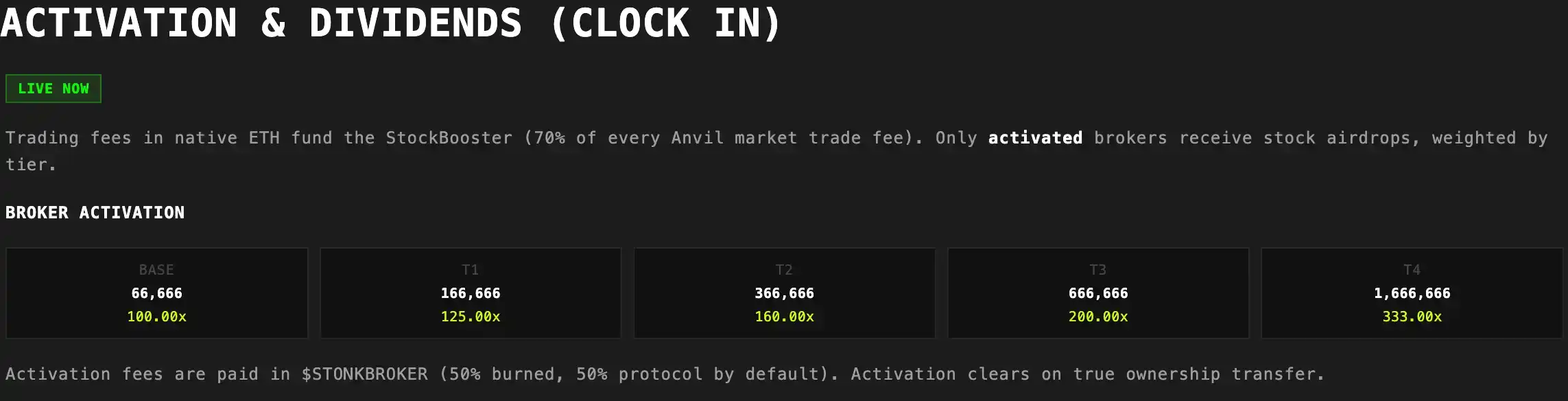
Every time NFT ownership is transferred, the new holder must spend $STONKBROKER to activate dividends again.
This essentially creates a token-NFT flywheel. Holding the image is like being a shareholder of the platform, but you need to spend tokens to acquire dividend rights. The more popular the platform, the higher the dividends for NFTs, and the more expensive the tokens required to activate dividend rights become.
The current situation is that the platform hasn't even launched, but expectations have already been hyped to the max. This is likely due to the novelty of the gameplay and the strong interest from the NFT community. This platform isn't just a launchpad; it will also include a Swap and lending/AMM features tailored to this NFT series.
Bankr: Issuing Meme Coins Paired with Tokenized Stocks
This is indeed a clever approach. Just a few hours ago, Bankr launched a new feature supporting the use of over 90 tokenized stocks like $TSLA, $AAPL, $SPY to form trading pairs with newly launched meme coins, meaning the liquidity pool consists of stocks instead of ETH.
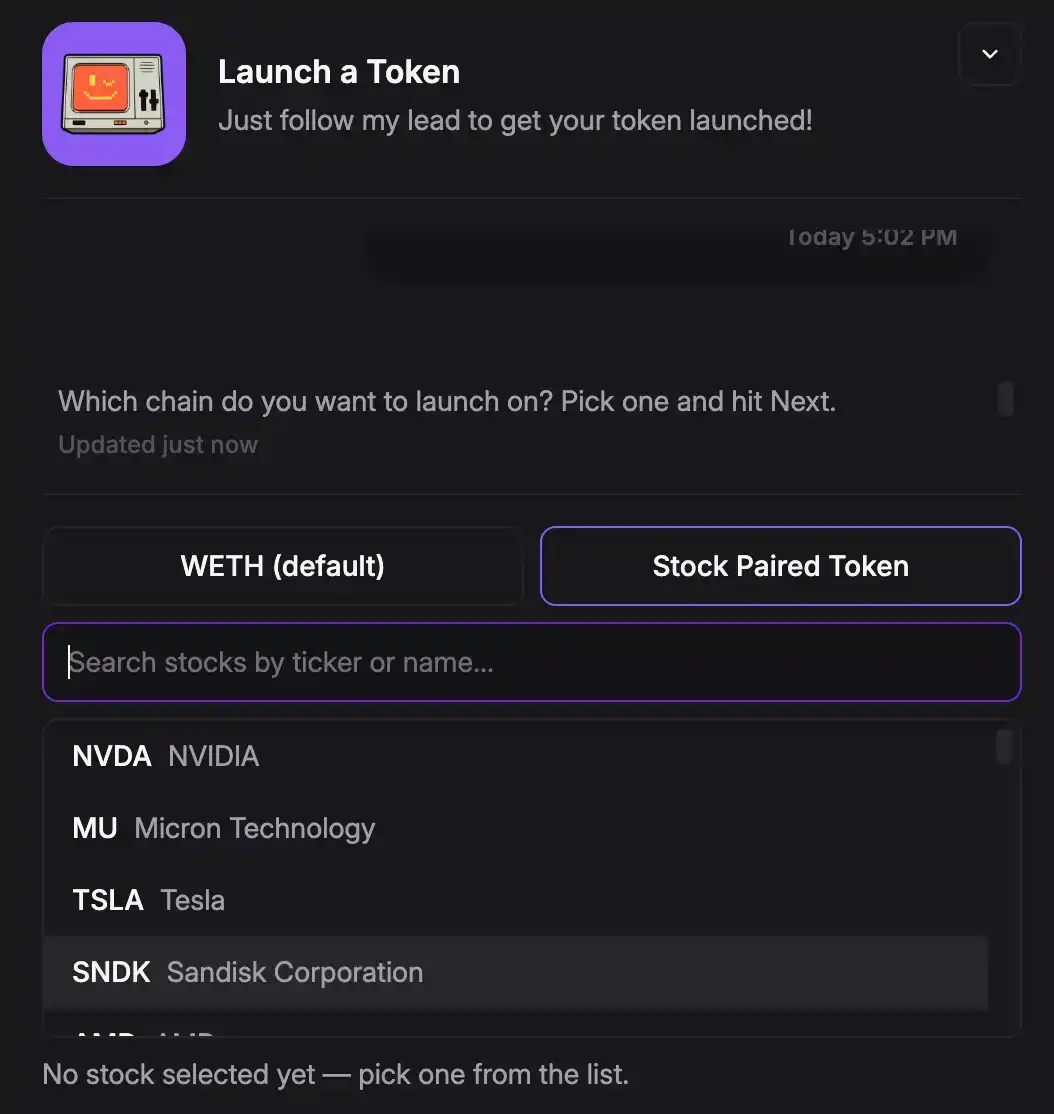
Similar gameplay existed before. For example, about two months ago on HyperEVM, a platform called alt.fun gained popularity for a few days by using contract positions, including stock contracts, to launch meme coins, with its top project reaching a market cap of $9 million.
However, considering Robinhood's CEO has repeatedly emphasized that their chain aims to focus on both RWA and meme coins, this kind of gameplay on this chain seems to have more room for speculation. Moreover, somewhat dramatically, Bankr's founder, @0xDeployer, launched his own token $REAL, paired with Nvidia stock. He even posted on X recruiting a CTO/team for this coin, seeking people who truly know how to operate and promising to provide advice:
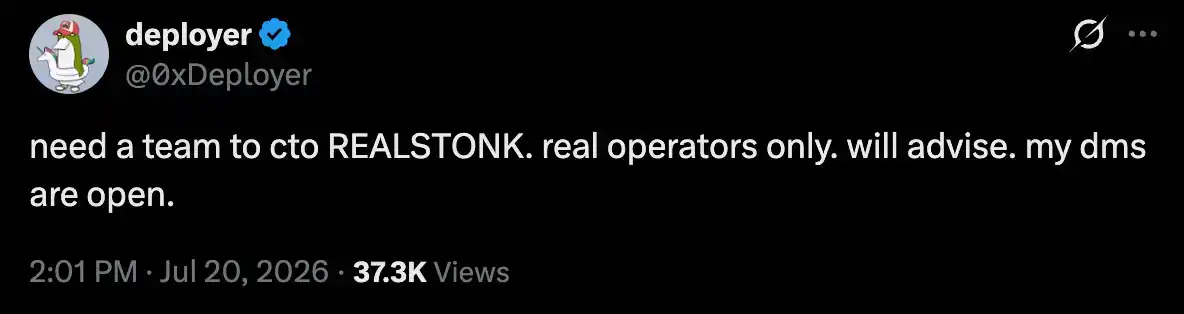
If $REAL takes off, Bankr might use this clever method to overtake competitors in the short term. Meme coins paired with tokenized stocks could potentially become trendy.
Conclusion
The tokens directly related to the platforms mentioned above (excluding $REAL) already have market caps exceeding $10 million. Without a clear winner in this "war," making heavy bets carries relatively high risk. At this stage, the best strategy is to monitor each platform closely. The more fiercely they compete, the more opportunities will likely emerge.