The Hottest Open Source Project in History, Almost Became a 'Trophy' in the Crypto World

marsbitPublicado a 2026-03-04Actualizado a 2026-03-04

Resumen

OpenClaw has rapidly become one of the most popular and fastest-growing open-source projects in history, amassing over 250,000 stars on GitHub in just three months. Its creator, Peter Steinberger, has gained significant influence in the AI community but has also taken a strong stance against the crypto industry. Despite its success, OpenClaw has faced challenges, including a trademark dispute that led to a name change. During this process, crypto speculators quickly created and promoted fake tokens using the project’s name, leading to significant financial losses for some investors. Steinberger publicly denounced these activities, clarifying that OpenClaw would never issue a token and disavowing any association with cryptocurrency. The project also briefly listed Venice, a crypto-native AI project on Base chain, as a recommended model provider—a move that was quickly reversed to maintain neutrality and avoid perceived endorsements of crypto-related initiatives. Steinberger has repeatedly expressed frustration with crypto communities, citing harassment, malicious code submissions, and off-topic speculation as disruptive to genuine technical discussion. He has even considered abandoning the project due to these issues. Steinberger, who is financially independent, has advised young developers to avoid cryptocurrency, reflecting his broader criticism of the industry’s speculative culture. The conflict highlights the ongoing struggle between open-source innovation and crypto-dr...

Author: Nancy, PANews

A dark horse has emerged in the open-source world. In just three months, OpenClaw has become the most popular and fastest-growing open-source project in history, a new favorite among developers.

This intelligent agent tsunami, sparked by Peter Steinberger, has not only made him a top AI influencer but also won him a large number of "lobster believers" worldwide. This highly sought-after lobster godfather, however, strongly rejects the crypto world and has repeatedly publicly criticized it. Such a stance undoubtedly brings more negative舆论 to cryptocurrency.

Topping GitHub's Star Ranking, Urgently "Distancing" from Crypto Projects

There is no doubt that AI has become the golden narrative for capital and talent migration. Its rapid rise has led many to see AI as the hope for revitalizing the crypto industry, becoming a new opportunity for many in the circle to蹭流量 or seek investment.

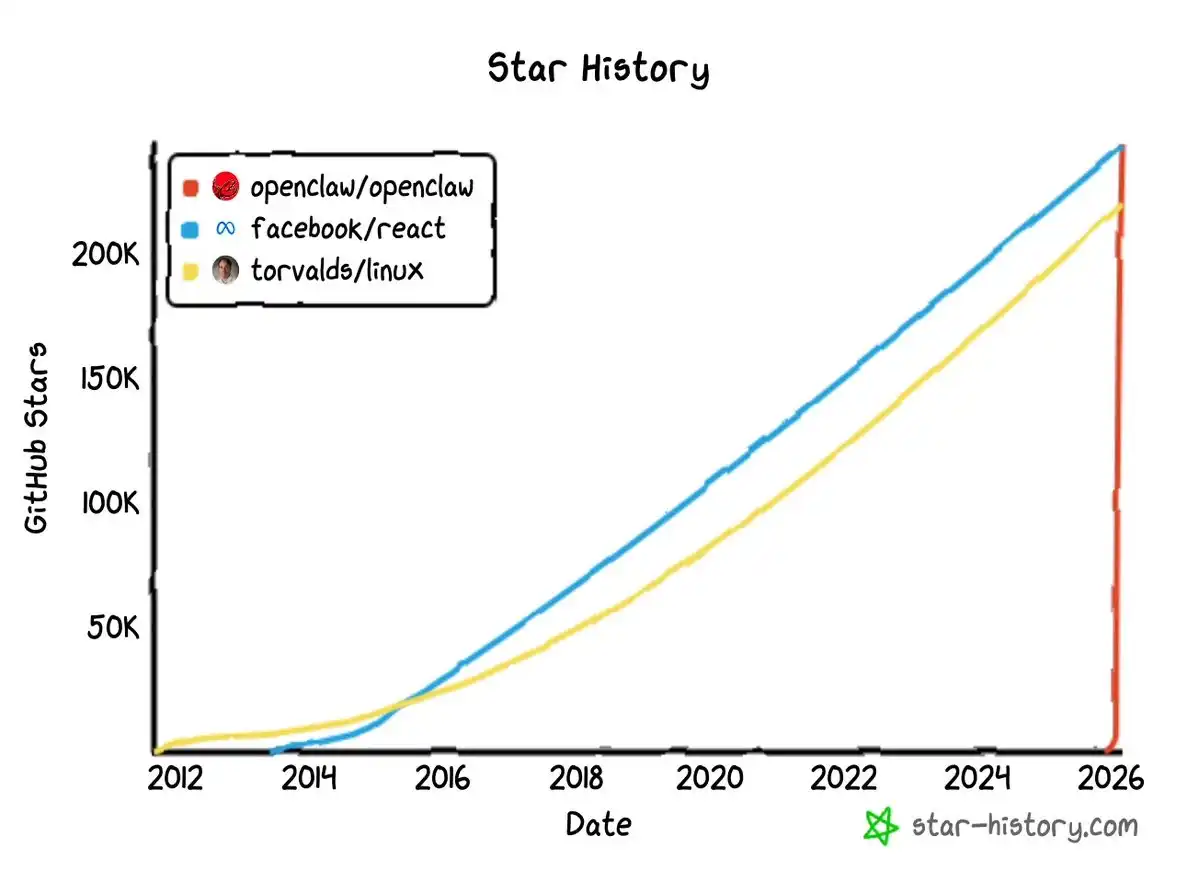
Especially the recently trending OpenClaw. According to the latest data, OpenClaw's star count on the GitHub platform has exceeded 250,000, surpassing Linux and React to become one of the most popular open-source projects and setting the record for the fastest growth in open-source history.
As "raising lobsters" becomes popular globally, tutorials,变现 cases, and user experiences around OpenClaw continue to emerge. Some even make a profit by offering on-site OpenClaw installation services. From independent developers to large companies to offline services, the "shovel-selling" business for OpenClaw is booming.

The crypto market naturally wouldn't miss this hotspot. Recently, Venice, an AI project on the Base chain, became a recommended model provider for OpenClaw, and the only crypto-native project. With the加持 of the top AI project's popularity, the Venice token surged, its market cap once exceeding $900 million. This news quickly caught the attention of crypto industry practitioners and was widely shared.
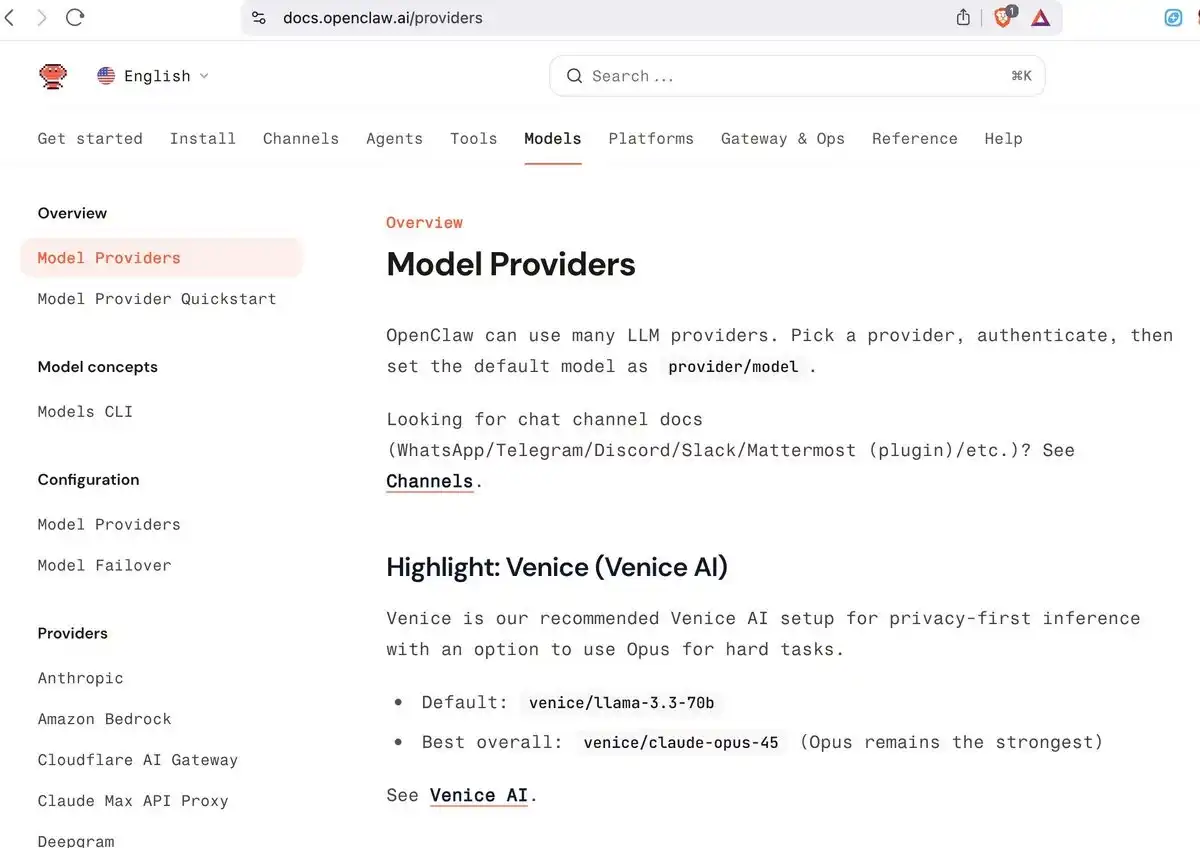
It is reported that Venice is a generative AI project focused on privacy protection and content censorship resistance. Its底层 integrates various open-source large models and was founded in 2024 by crypto OG and ShapeShift founder Erik Voorhees. It has recently gained attention due to the Agent privacy trend.

However, Steinberger clearly did not agree with this kind of捆绑炒作. He immediately publicly clarified, "This was an oversight in a previous document. We want to remain neutral on this matter." Simultaneously, OpenClaw promptly deleted the related recommendation content.

In other words, OpenClaw's "distancing" this time is not否定 or贬低ing the actual value and technical advantages of the Venice project, but rather proactively deleting the "official key recommendation" label that could lead to over-interpretation, to avoid unnecessary narrative绑架 and利益猜测. Especially as an open-source Agent framework, and with the founder having joined OpenAI, OpenClaw needs to maintain technical neutrality and avoid any suspicion of利益冲突.

Choosing to Sever Ties Due to Crypto "Piggybacking," Once Considered Abandoning the Project

Unlike AI leaders like OpenAI founder Sam Altman and xAI co-founder Musk, who hold positive or even open attitudes towards crypto, Steinberger adopts a stance of "fans only, no disturbances." This attitude of avoidance inevitably leaves the币圈 feeling "破防" (disheartened/offended).

In fact, Steinberger, who is not interested in crypto, is very排斥 the "piggybacking" phenomenon in the crypto circle. Since last year, he has issued dozens of public statements expressing strong dissatisfaction with crypto speculation culture, even直言 (stating bluntly) "don't come near."

Especially after OpenClaw became popular. In January of this year, OpenClaw's popularity rose, but its original name, Clawdbot, encountered a trademark dispute with Anthropic's AI model Claude and received a cease-and-desist notice from their legal team. Subsequently, Steinberger renamed the project twice,最终 settling on the name OpenClaw.

However, this renaming风波 was exploited by crypto speculators for抢注 (domain squatting) and炒作.

During the renaming process, snipers used automated scripts to quickly hijack accounts, impersonate the official team, and趁机 issue fake tokens, such as CLAWD. The market cap of some of these tokens once soared to tens of millions of dollars, attracting a large number of investors.

Faced with market speculation, Steinberger quickly publicly stated that he would never issue a token and emphasized that any project issuing tokens in his name is a scam. This caused the prices of these tokens to plummet, resulting in significant losses for many retail investors.
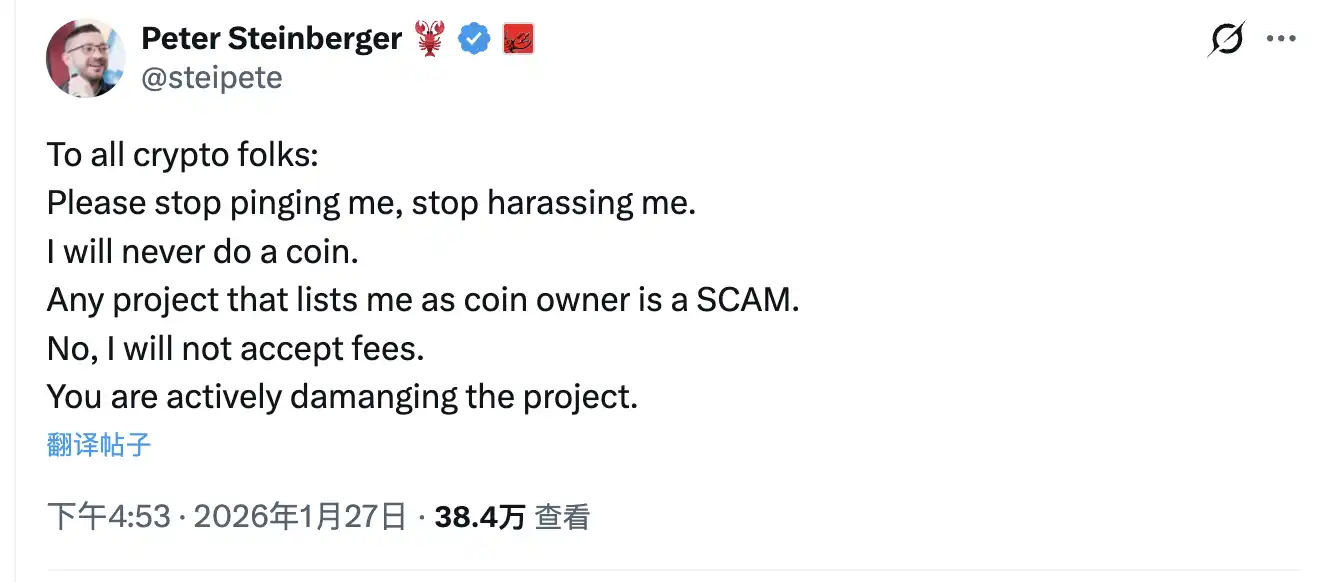
If this crypto闹剧 (farce) only made Steinberger反感 (disgusted), then the damage to the community ecology made him愤怒 (angry).

As OpenClaw continued to gain popularity, a large number of crypto players flooded into related communities, with some radicals even maliciously submitting code, sending abusive private messages, demanding Steinberger claim transaction fees or crypto-fy the project.

As a result, the official OpenClaw Discord server began completely banning mentions of keywords like Bitcoin, Crypto, etc., even neutral technical discussions were not exempt. Some users were removed for quoting Bitcoin block heights as benchmark tests.

"I underestimated these people," Steinberger said bluntly in a recent interview, pointing out that the crypto community is a very particular subculture that quickly tokenizes any hot topic. But he had already achieved financial freedom economically and simply did not want to support this (crypto) thing. The crypto noise made it almost impossible for him to see any real project discussion; the related speculative炒作 was harming the project.

It was precisely because of the "harassment" from the crypto community that this天才开发者 (genius developer) admitted he had even briefly considered abandoning the entire project. He very much did not want the project to become a tool for crypto speculation.

Just recently, Steinberger also publicly advised young people, "Don't waste your time on cryptocurrency." These remarks further exposed his dissatisfaction with the crypto industry.

This unexpected clash between the open-source world and the币圈 is not just a act of "self-preservation" by a hit project; it更折射出 (reflects even more) the difficult-to-reconcile矛盾 (contradiction) between technical purity and capital炒作 (hype/speculation) in the current AI wave.


Preguntas relacionadas

QWhat is OpenClaw and why is it considered a breakthrough in the open-source community?

AOpenClaw is an open-source project that became the most popular and fastest-growing in history, gaining over 250,000 stars on GitHub in just three months. It is an AI agent framework that has attracted widespread attention from developers and is seen as a new favorite in the AI space due to its rapid growth and innovative approach.

QWho is Peter Steinberger and what is his stance on cryptocurrency?

APeter Steinberger is the creator of OpenClaw and a prominent figure in AI. He strongly opposes cryptocurrency, publicly criticizing it multiple times and expressing frustration with crypto communities for 'harassing' his project, issuing fake tokens, and disrupting discussions. He has stated that he will never issue a token and advises young people wasting time on crypto.

QWhy did OpenClaw remove its recommendation for the Venice project?

AOpenClaw removed its recommendation for Venice, a crypto-native AI project on the Base chain, to maintain a neutral stance and avoid any perception of endorsement or利益冲突. Steinberger clarified that the initial inclusion was an oversight and that OpenClaw wanted to remain impartial, especially as an open-source framework, to prevent narrative hijacking and speculative interest.

QHow did the cryptocurrency community react to OpenClaw's popularity, and what were the consequences?

AThe cryptocurrency community engaged in speculative activities, including creating fake tokens like CLAWD with millions in market cap, flooding discussions with crypto-related content, and even sending abusive messages. This led OpenClaw to ban crypto-related terms on its Discord and caused Steinberger to consider abandoning the project due to the harm from炒作 and harassment.

QWhat challenges did OpenClaw face regarding its name, and how was it resolved?

AOpenClaw faced a trademark dispute with Anthropic's AI model Claude, originally named Clawdbot, and received a cease-and-desist letter. After two name changes, it settled on OpenClaw. During this process, crypto opportunists quickly registered similar names and issued counterfeit tokens, prompting Steinberger to publicly denounce them as scams.

Lecturas Relacionadas

Claude Code Introduces Dynamic Workflows: Enabling AI to Form Teams and Collaborate

Claude Code introduces dynamic workflows, enabling AI to coordinate teams of specialized agents for complex tasks. This transforms Claude from a code assistant into a programmable workbench. Workflows address key limitations of single-agent systems: agentic laziness (premature task completion), self-preferential bias (favoring own outputs), and goal drift (losing sight of original objectives). The system allows Claude to dynamically create execution frameworks using JavaScript. It can split tasks, dispatch parallel agents for isolated work (e.g., in separate worktrees), implement adversarial validation, run tournaments, and synthesize results. This multi-agent approach is valuable for tasks requiring deep research, factual verification, code migration, root cause analysis, large-scale triage, and qualitative sorting. Key patterns include: classify-and-route, fan-out-and-synthesize, adversarial verification, generate-and-filter, tournaments, and loop-until-done. While token usage is higher, workflows excel where tasks resemble programming—needing problem decomposition, isolated context, hypothesis testing, and handling many details. They extend Claude Code's utility beyond technical work to areas like business plan review, resume screening, and naming brainstorm. The feature is not a universal solution but points to a future where AI tool competitiveness depends on organizing reliable, reusable, and auditable execution flows for complex goals.

marsbitHace 12 min(s)

Claude Code Introduces Dynamic Workflows: Enabling AI to Form Teams and Collaborate

marsbitHace 12 min(s)

Hyperliquid, Wall Street's 24/7 Trading Convenience Store

Hyperliquid: The 24/7 Trading "Convenience Store" for Wall Street Hyperliquid, a decentralized cryptocurrency exchange, has become a go-to platform for Wall Street traders seeking to trade around the clock, especially during traditional market closures. Founded by Jeff Yan, a former quantitative trader, after the FTX collapse, the platform emphasizes user self-custody of assets. It offers a wide range of perpetual contracts—leveraged derivatives with no expiry—on assets from Bitcoin and crude oil to the S&P 500 and even pre-IPO companies like SpaceX. A notable example involves a hedge fund trader who capitalized on geopolitical news over a weekend, securing a 243% return on oil derivatives before markets reopened. The platform, run by just 11 employees, generated approximately $800 million in revenue last year, and its native token HYPE has seen significant growth. Its rise highlights the merging of traditional finance and crypto. While U.S. users are currently restricted, recent CFTC rule changes could open access. The platform is known for its transparency, having processed $10 billion in liquidations during a market crash while competitors faltered. Regulators warn of the high risks and complexity of perpetual contracts for retail investors. Key to its appeal is a strong community culture, direct engagement with founders, and a simple interface. Despite rules against VPN use, it attracts global users with its permissionless approach. Hyperliquid plans to expand into prediction markets and options, aiming to eventually host all financial activity.

marsbitHace 12 min(s)

Hyperliquid, Wall Street's 24/7 Trading Convenience Store

marsbitHace 12 min(s)

Who Funds the Agents?

**Summary: Who Funds AI Agents?** OpenAI recently shut down a feature allowing AI agents to shop for users, highlighting the challenge of creating a secure and regulated environment for agent-driven transactions. While payment infrastructure exists, a crucial governance layer—defining spending limits, fraud detection, tax handling, and return policies—is largely missing. The potential is enormous: AI agents already processed $73M across 176M transactions last year, with McKinsey forecasting this could grow to $3-5T in global consumer commerce by 2030. The core competition isn't just about processing payments, which can be very cheap (especially with crypto-based settlement), but about controlling the rules that govern agent spending. Key players like Stripe and Coinbase are racing to dominate this governance layer. Stripe's acquisition of wallet provider Privy allows it to set spending policies, identity checks, and human-in-the-loop approvals directly at the wallet level. Similarly, Coinbase's stack, including its x402 protocol and AgentKit, embeds governance rules. This vertical integration across settlement, wallet, and governance layers is becoming the dominant strategy. Control over the governance layer is where significant future value lies. If agents handle trillions in transactions, even a small fee for managing compliance, fraud prevention, and policy enforcement could generate billions in annual revenue. The companies that successfully integrate across the payment stack will capture value from idle agent balances, transaction fees, and governance services, positioning themselves as the foundational banks of the AI agent economy.

marsbitHace 40 min(s)

Who Funds the Agents?

marsbitHace 40 min(s)

Trading

Spot
Futuros
活动图片