The Hometown of 'Brokeback Mountain' Is Issuing a New American Dream

比推Publicado a 2026-01-08Actualizado a 2026-01-08

Resumen

Wyoming, the iconic but sparsely populated American West known for Yellowstone National Park and as the setting of "Brokeback Mountain," is pioneering a new financial future. Facing a severe fiscal crisis as its coal industry collapses, the state is leveraging its libertarian business laws to become a crypto hub. In a landmark move, it launched $FRNT, the first U.S. state-backed dollar stablecoin, issued on Solana and EVM-compatible chains. Backed by 102% reserves in U.S. Treasuries and cash managed by Franklin Templeton, the profits are directed to the state's school fund. This initiative aims to replace lost coal revenue and position Wyoming at the forefront of digital finance. However, the benefits are not evenly distributed, highlighting a stark contrast between the wealthy elite in places like Jackson Hole and the struggling local workforce. The move signifies a shift for stablecoins from private ventures to public financial tools, testing whether digital innovation can heal deep economic and social divisions.

On the map of the United States, Wyoming is an easily overlooked "western asset."

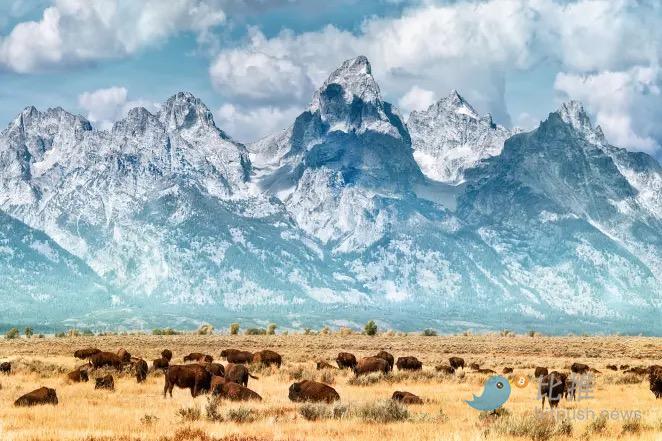
Mention it, and most people's first thought is the erupting Old Faithful geyser in Yellowstone National Park, or the perpetually snow-capped peaks of the Grand Tetons.

This is the least populous state in the U.S. On nearly 260,000 square kilometers of land, fewer than 600,000 people live—a number even smaller than the population of a distant suburban town in Shanghai.

In literary and cinematic memory, this is the cruel wilderness that Annie Proulx described as "unfixable, only to be endured," the mountains that trapped the cowboys for a lifetime in "Brokeback Mountain," and the blood-stained frontier besieged by a blizzard in Quentin Tarantino's "The Hateful Eight."

It is contradictory and distinct: deeply conservative, it is the "deepest red" state in the U.S., where the Republican Party has held a monopoly for forty years. In the 2024 U.S. election, over 70% of voters cast their ballots for Trump. Yet it was also once at the forefront of its time; as early as 1869, it became the "Equality State," the first in the U.S. to grant women the right to vote.

But Wyoming is by no means a financial desert. Every summer, the world's "most powerful" people gather here: at the serene Jackson Hole resort in Wyoming, the Global Central Bankers' Symposium, hosted by the Federal Reserve Bank of Kansas City, is held. From Alan Greenspan (the 13th Chairman of the Federal Reserve) to Jerome Powell, nearly every key turning point in global monetary policy has been set amidst these snow-capped mountains and meadows.

It is this aloof and unique "western spirit" that once again brought Wyoming into the public eye in early 2026.
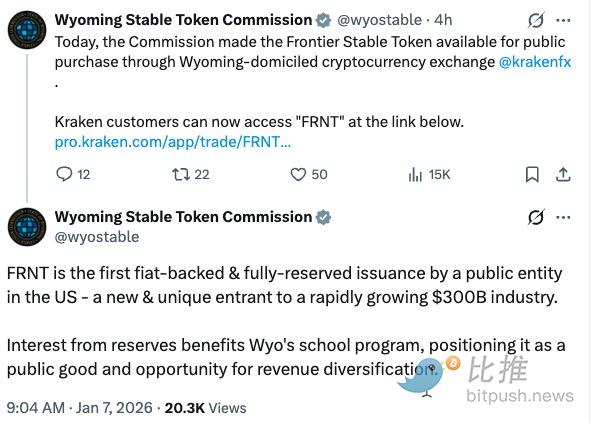
On January 7th local time, the state officially announced the launch of the $FRNT stablecoin, initially issued on the Solana blockchain and supporting six EVM-compatible chains. This is the world's first dollar stablecoin backed by "state government credit."

Finding Light in the Mining Ruins: The Path to Regeneration Through Energy Transition

Wyoming's radical move stems from a deep fiscal anxiety: the "underground wealth" that has supported this land for a century is drying up.

As the energy heartland supplying 40% of the U.S.'s coal, it once created the myth of a "tax-free heaven" through mineral resource taxes: residents pay no personal income tax, and businesses pay no corporate tax.

A key reason is that, thanks to the continuous resource exports from the Powder River Basin, this sparsely populated state created astonishing wealth: its per capita has long ranked among the top ten in the U.S., and in peak energy years, it could even rival New York and California.

This prosperity once gave Wyoming the confidence to refuse to levy personal income tax, corporate tax, and inheritance tax. However, this is a fragile prosperity built on heavy energy.
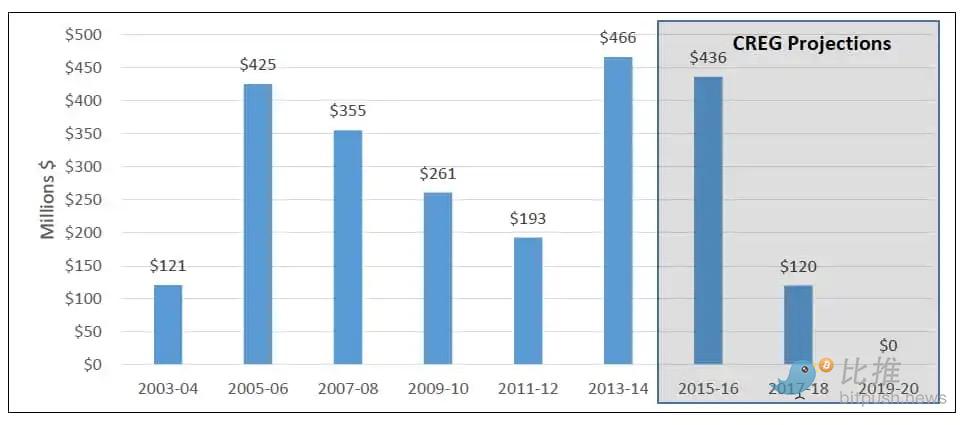
Source: University of Wyoming Center for Energy Economics and Public Policy

Since 2011, Wyoming's pillar industry began a decade-long "avalanche":

  • Ruthless market substitution: The rise of low-cost shale gas and renewable energy delivered a dimensional blow to coal in terms of power generation costs.

  • Tightening environmental constraints: The advancement of U.S. federal carbon emission regulations (such as the Clean Power Plan) led to the closure of coal-fired power plants across the country in batches.

  • A cliff-like fiscal gap: According to CREG official data cited by Wyoming Public Media, the state's coal resource tax plummeted from $290 million in 2011 to $170 million in 2022, with coal production in 2025 expected to fall to the second lowest point in history, only half of the 2008 peak. The "Coal Lease Bonuses," once a crucial source for school infrastructure, have even dropped to zero.
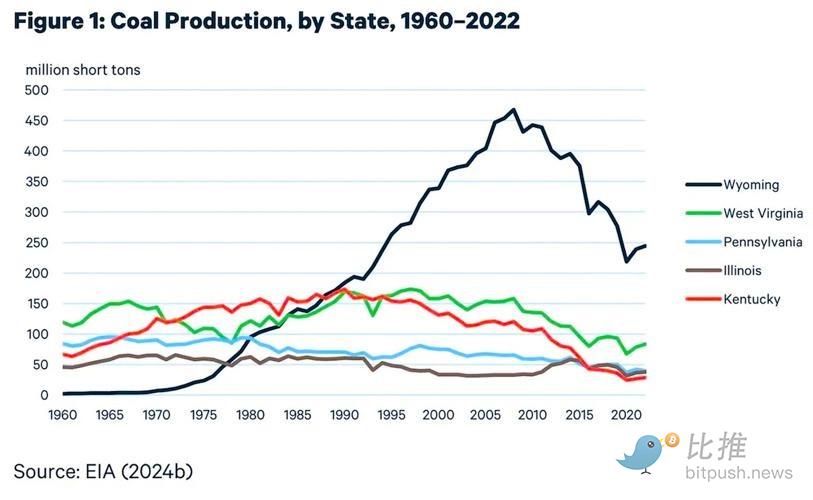
"If we don't stir things up, we'll be the next West Virginia (Note: a traditional mining region in the U.S. that became one of the poorest states after the coal industry declined)." – This visceral pain has created an urgent awareness among the most conservative cowboy politicians locally.

They realized that since they cannot change the trend of energy transition, they must leverage Wyoming's core asset—extremely liberal business legislation. In fact, Wyoming's innovative基因早有先例基因 has precedents. In 1977, it pioneered the LLC (Limited Liability Company), the most popular business entity to this day, nationwide.

Starting in 2018, to save itself, this most "red" conservative state was forced to embark on a long journey of institutional innovation in the crypto world.

In 2019, the Wyoming State Legislature passed House Bill 74 (HB 74), creating a new type of financial entity: the SPDI license (Special Purpose Depository Institution). This is not a traditional bank but an institution that "does not engage in lending业务, only handles custody and settlement." In September 2020, the crypto exchange Kraken obtained the first SPDI license in the U.S. here, establishing Kraken Bank, marking the first time crypto assets received "bank" status加持 under a state legal framework.

In 2021, the state率先 passed the "DAO Act," allowing code-controlled organizations to register as legal LLC entities.

As for the recently launched $FRNT, according to the规划 of the Wyoming Stable Token Commission (WST), the $FRNT stablecoin is over-collateralized by 102% in U.S. Treasury bonds and cash.

Reserve management is handled by investment giant Franklin Templeton, which manages approximately $1.6 trillion in assets, and custody is provided by its affiliate Fiduciary Trust Company International. Its core business logic lies in: the state government absorbs U.S. dollars, buys U.S. Treasury bonds, and the interest generated is directly allocated to the "School Foundation Fund" to support local public education.

Stablecoins: Who Are They Really Serving?

Wyoming's leap actually marks the entry of the stablecoin track into the second half: transitioning from a "credit game" of private companies to a "public good" at the government level.

In the past, discussions about stablecoins focused on the compliance risks of Tether or Circle; but in Wyoming's narrative, stablecoins return to their essence—an extremely efficient, low-cost payment rail (settlement fees are typically below $0.01). They are no longer speculative chips in the hands of geeks but begin to possess public fiscal attributes.

However, this "digital highway" has encountered invisible barriers in the real world.
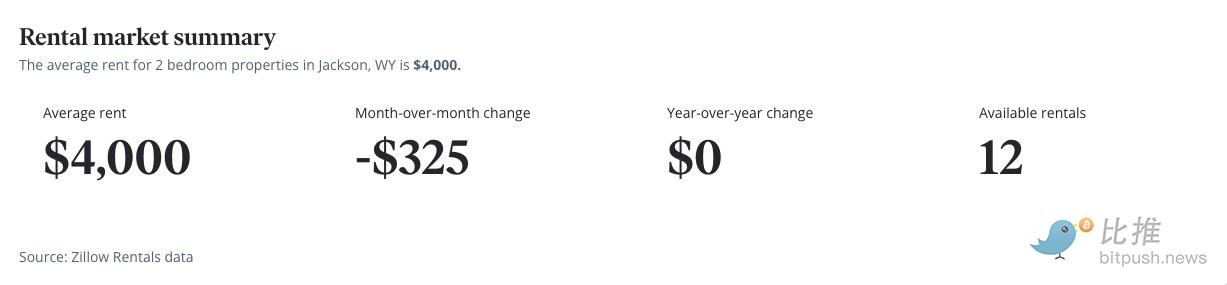
In Wyoming's Jackson Hole resort area, the monthly rent for an ordinary two-bedroom apartment has reached $4,000, 25% higher than in Los Angeles. Although the local per capita GDP ranks among the highest in the U.S., about 10% of residents still face food shortages. For blue-collar workers who catch the early morning commuter bus every day and rely on two or three jobs to make ends meet, "stablecoins" seem more like a distant technological concept.

This divide is somewhat maintained institutionally. A state treasury official told prospect.org that through land acquisition and price thresholds, this resort has been designed to be "invisible to slums." No matter how fast the settlement speed of stablecoins is, their benefits struggle to penetrate the already solidified social structure.

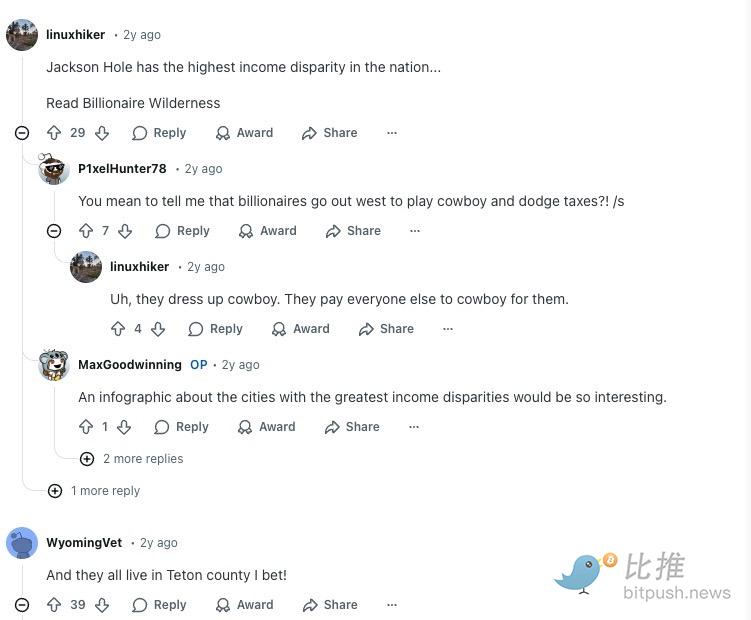
Writer Annie Proulx once described the harshness of the Wyoming land; today, this harshness is folded by technology and capital into two layers of reality that do not penetrate each other. On one side, the wealthy class creates tax havens and pastoral myths amidst the vast mountains and forests; on the other, ordinary Americans who支撑着这一切 but find it difficult to put down roots here—their lives, in both现实 and online narratives, have become the folded side.
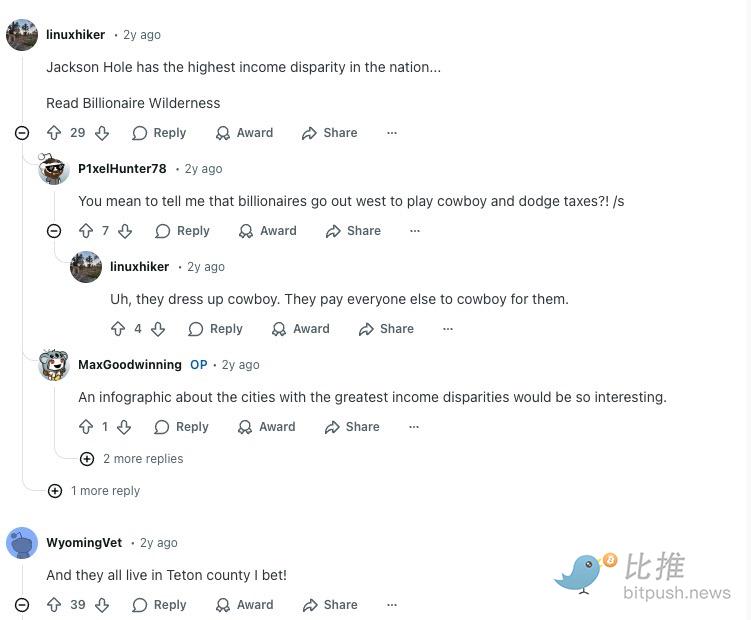
It is against this backdrop that the state government is attempting to build fiscal autonomy for the digital age on the gradually沉寂的煤矿废墟, using law and stablecoin收益. Data shows that Wyoming has 348 limited liability companies per 1,000 adults, surpassing Delaware to become the new institutional洼地 in the United States.

But can this "digital rent" flowing into the "Cowboy State" truly bridge the fissures on that land?

References:

  • Consensus Revenue Estimating Group (2025.10)

  • CNBC: Wyoming is pushing crypto payments and trying to beat the Fed to a digital dollar

  • The American Prospect: Down and Out on the Crypto Frontier

  • wyofile: Clean Power Plan may cut Wyo coal revenue 31-63 percent

Author: Bootly


Twitter:https://twitter.com/BitpushNewsCN

Original article link:https://www.bitpush.news/articles/7600841

Preguntas relacionadas

QWhat is the name of the stablecoin launched by the state of Wyoming, and on which blockchain was it initially issued?

AThe stablecoin is named $FRNT, and it was initially issued on the Solana blockchain with support for six EVM-compatible chains.

QWhat major economic challenge is Wyoming facing that motivated it to launch a state-backed stablecoin?

AWyoming is facing a severe fiscal crisis due to the rapid decline of its coal industry, which has been the state's economic pillar, providing significant tax revenue that previously allowed it to avoid income and corporate taxes.

QHow are the reserves for the $FRNT stablecoin managed and what is their purpose?

AThe reserves for $FRNT are 102% over-collateralized with U.S. Treasuries and cash, managed by the investment giant Franklin Templeton. The interest income generated is directed into the state's 'School Foundation Fund' to support public education.

QWhat significant legal innovation did Wyoming introduce for the crypto industry in 2019?

AIn 2019, Wyoming passed House Bill 74 (HB 74), which created the SPDI (Special Purpose Depository Institution) license, a new type of financial entity for crypto asset custody and settlement, with Kraken becoming the first company to receive this license.

QDespite its economic innovations, what social issue does the article highlight as a challenge within Wyoming, particularly in areas like Jackson Hole?

AThe article highlights a severe wealth gap and social stratification. In places like Jackson Hole, high living costs and rent of $4000 for a two-bedroom apartment create a reality where about 10% of residents face food insecurity, making the benefits of technological innovations like stablecoins inaccessible to many blue-collar workers.

Lecturas Relacionadas

The Waged Worker Driven to Poverty by AI Subscriptions

"AI Membership: The Hidden Cost Pushing Workers Toward 'Poverty'" The widespread corporate push for AI adoption is creating a hidden financial burden for employees. Companies, from giants like Alibaba to small firms, are mandating AI use, often tying token consumption to KPIs, but frequently refuse to cover the costs. Workers are forced to pay for subscriptions out of pocket to stay competitive and avoid being replaced. Front-end developer Long Shen spends up to 2000 RMB monthly on tools like Cursor and ChatGPT Plus, seeing it as a necessary 3% salary investment to handle 90% of his coding tasks. While it boosted his performance and led to promotions, he now faces idle time at work, pretending to be busy. Designer Peng Peng navigates strict company firewalls by using personal devices and accounts for AI image generation tools like Midjourney, spending hundreds monthly without reimbursement, while her boss demands faster, more numerous revisions. The pressure creates workplace anxiety and suspicion. Programmer Li Huahua, after a friend's experience of raised KPIs following AI success, fears being branded a "traitor" for using it yet worries about falling behind if she doesn't. The dynamic allows management to demand results without understanding the tools or covering expenses, treating employees like AI "agents." While some, like entrepreneur Jin Tu, find high value in paid AI, building entire systems and winning competitions, for most, it's a trap. Free tools like Kimi and Doubao are introducing fees, closing off alternatives. The initial efficiency gains individual advantage, but as AI becomes ubiquitous, the personal edge disappears, workloads increase, and a cycle of dependency begins. Workers like Long Shen realize they cannot maintain AI-generated code without AI, making stopping harder than continuing to pay. The tool promising liberation is instead becoming a compulsory, costly chain in the modern workplace.

marsbitHace 37 min(s)

The Waged Worker Driven to Poverty by AI Subscriptions

marsbitHace 37 min(s)

SK Hynix's Trillion-Won Empire: The Successors

"SK Hynix's Trillion-Won Empire and Its Heirs" explores the unconventional succession narrative within SK Group, South Korea's second-largest conglomerate, following SK Hynix's dramatic market rise. Unlike traditional chaebol scripts prioritizing the eldest son, ownership, and political marriages, Chairman Choi Tae-won's three children from his first marriage are charting distinct paths. The eldest daughter, Choi Yun-jeong, is considered the most visible candidate. With a background in biology, consulting, and a PhD, she holds executive roles at SK Bioscience and SK Inc.'s growth strategy unit, focusing on biopharma and new businesses. Her marriage is to an AI infrastructure entrepreneur, not a traditional chaebol heir. The second daughter, Choi Min-jeong, took a unique route by voluntarily serving as a South Korean naval officer, including a tour in the Gulf of Aden. She later worked on policy and strategy for SK Hynix in Washington D.C. before co-founding an AI-driven healthcare startup in San Francisco. She married a former U.S. Marine Corps officer, connecting the family to U.S. defense and policy networks. The son, Choi In-geun, who has Type 1 diabetes, followed a more classic preparatory path with a physics degree and a stint at SK E&S but left to join McKinsey's Seoul office. He remains publicly silent and holds no SK shares, defying the traditional "crown prince" archetype. Their paths unfold against the backdrop of their parents' high-profile, contentious divorce and a record-setting asset division lawsuit. The article argues that as SK Hynix becomes a geopolitical asset in the AI era, the conventional rules of chaebol inheritance are changing. The heirs are being groomed not simply to take over, but to navigate a complex global landscape defined by AI, biotech, geopolitics, and policy, forging legitimacy through their own expertise and networks rather than birth order alone.

marsbitHace 46 min(s)

SK Hynix's Trillion-Won Empire: The Successors

marsbitHace 46 min(s)

BitMart Research Institute Weekly Highlights: A Comprehensive Review of Macro Environment, Crude Oil, AI Tech Stocks, and Crypto Market

**Weekly Market Review: Macro, Oil, AI Tech Stocks & Crypto Market** **Macroeconomic & Traditional Finance** The April U.S. Non-Farm Payrolls report of 115K new jobs exceeded expectations, but the data's quality was questioned. Growth was heavily concentrated in healthcare, while other sectors contracted, and manufacturing employment turned negative. A statistical model accounted for a large portion of the gains, conflicting with household survey data showing a loss of 226K jobs. Meanwhile, AI's impact on jobs is emerging, with information sector roles declining, though overall unemployment remains at ~4.3%. Oil prices hovered near $100 per barrel. Global oil buffer inventories have drawn down significantly, supporting prices, but high costs are suppressing demand. China's recent reduction in crude imports acted as a market stabilizer. Geopolitically, the U.S. and Iran are likely to reach a tentative agreement to keep the Strait of Hormuz open and avoid price spikes. For AI tech stocks, short-term prospects are mixed. A potential SpaceX IPO in June could pressure current index heavyweights like Nvidia, while smaller components might benefit. The mid-term focus shifts to Q2 earnings, emphasizing AI's return on investment. Long-term risks include potential election policy shifts and massive IPOs from companies like OpenAI, which could test the sector's sustainability. **Crypto Market & Ecosystem** Crypto markets rose moderately, with BTC climbing from ~$77K to ~$82K, driven by improved risk sentiment. Spot trading volumes remain low, but buying pressure is evident. ETF inflows continued (~$791M last week). However, institutional purchases of BTC and ETH were more modest than expected. The derivatives market shows lingering bearish bets, particularly on alts and ETH. A key trend is the "dual-track" model where projects pursue public listings for traditional funding while also building their own blockchains/tokens to capture crypto liquidity, as seen with Circle's ARC chain. Stablecoins and institutional chains present significant future opportunities. *Disclaimer: This is market analysis, not investment advice.*

marsbitHace 1 hora(s)

BitMart Research Institute Weekly Highlights: A Comprehensive Review of Macro Environment, Crude Oil, AI Tech Stocks, and Crypto Market

marsbitHace 1 hora(s)

Trading

Spot
Futuros
活动图片