The Hidden Market Makers Behind the Gold Surge: This Crypto Firm Earning Billions Annually Has Amassed 140 Tons of Gold

marsbitPublicado a 2026-01-28Actualizado a 2026-01-28

Resumen

The article reveals that Tether, the issuer of the USDT stablecoin, has accumulated approximately 140 tons of physical gold, valued at around $23 billion, making it one of the largest private holders of gold globally—surpassing many national reserves. Tether’s CEO, Paolo Ardoino, announced ambitions to become one of the world’s top “gold central banks.” The company has been aggressively purchasing gold since 2025, acquiring over 70 tons last year alone, significantly influencing gold's price surge. Tether’s gold is stored in a secure Swiss vault, and the firm is expanding its influence by hiring seasoned metal market executives, investing in gold mining royalties, and launching a gold-backed stablecoin, XAU₮, which dominates the tokenized gold market. The company’s aggressive accumulation is backed by substantial profits—$15 billion in net income in 2025—driven primarily by interest from its vast holdings of U.S. Treasuries and strategic Bitcoin investments. Tether is expanding its reach with a new federally regulated stablecoin, USAT, targeting the U.S. market. Its growing influence in both traditional finance and crypto has positioned it as a major, albeit controversial, force in global markets.

Author: Nancy, PANews

Gold is going crazy. In less than a month since the start of the year, various funds have been frantically buying, pushing gold prices to repeatedly hit new historical highs.

Amid this precious metal狂欢盛宴, an "invisible big player" has unexpectedly come into view: stablecoin giant Tether has quietly accumulated 140 tons of gold reserves.

Holding 140 Tons of Gold, Aiming to Become the World's Largest Gold Central Bank

Tether, which 'has mines at home,' is becoming a major player in the gold market.

"We will soon become one of the world's largest 'gold central banks,' so to speak." Tether CEO Paolo Ardoino recently stated unabashedly in an interview with Bloomberg.

This is not just talk. To date, Tether has accumulated approximately 140 tons of physical gold, worth about $23 billion at current prices. Typically, Tether purchases directly from Swiss refineries and top global financial institutions, with large metal orders often taking months to deliver. Upon arrival, the gold is stored in a nuclear bunker built during the Cold War in Switzerland, protected by multiple layers of heavy steel doors, and Switzerland boasts one of the world's top confidentiality systems.

In terms of scale, Tether has become the largest known holder of physical gold outside the banking systems and nations, ranking among the top 30 global gold holders, with holdings exceeding those of countries like Greece, Qatar, and Australia.

Although Tether began布局 gold assets many years ago, its large-scale entry真正 occurred in 2025. Last year alone, Tether purchased over 70 tons of gold, becoming one of the top three buyers of gold globally this year. Its procurement scale not only surpassed that of almost all single central banks except the Polish central bank but also exceeded that of many large gold ETFs.

It can be said that Tether is also a significant driver behind this year's rise in gold prices.
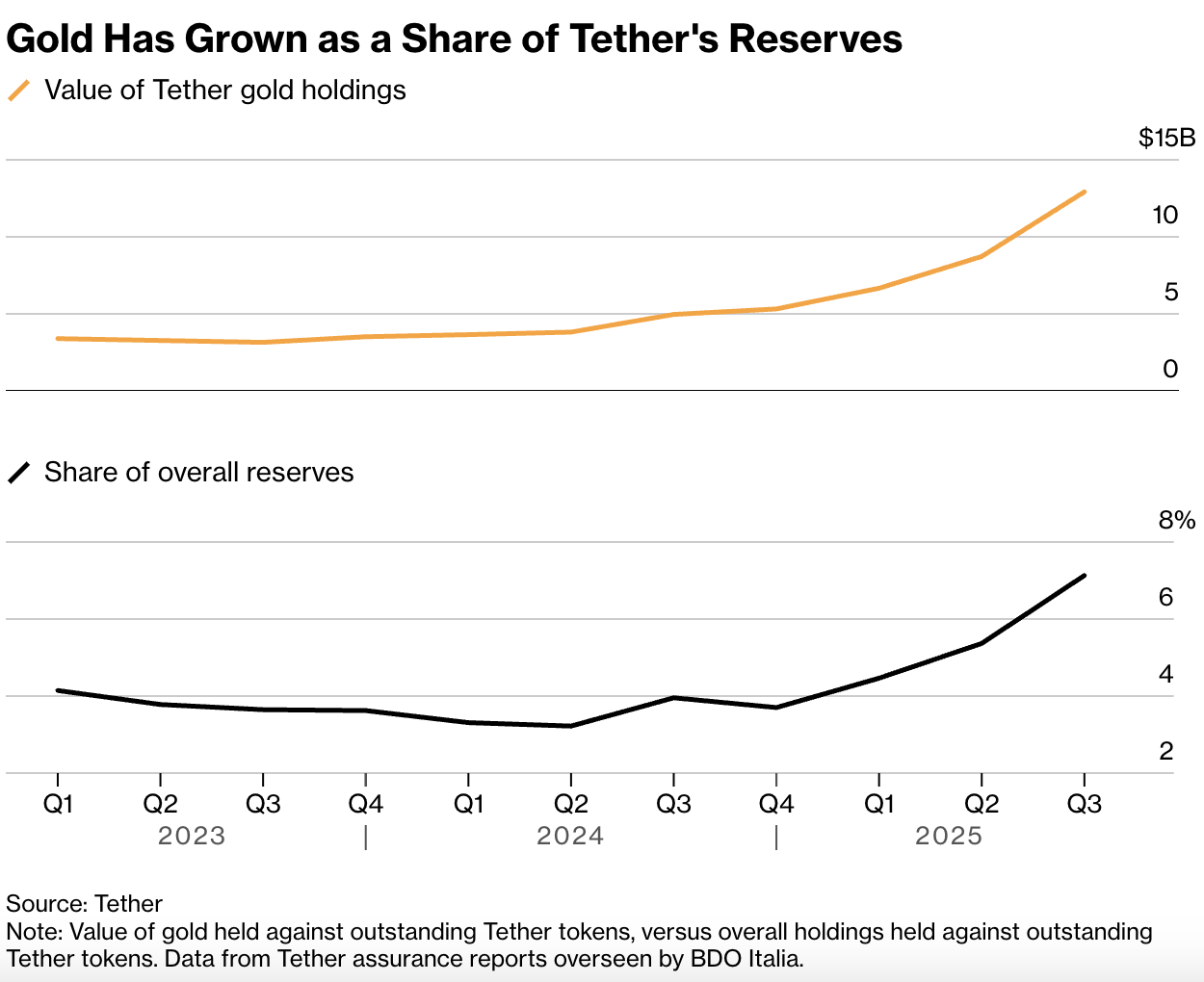
According to Ardoino, Tether's current gold procurement rate is about 1 to 2 tons per week, and it plans to maintain this pace in the coming months, "maybe slowing down, but we will assess gold demand quarterly."

But Tether's ambitions go beyond just hoarding gold. In the Bloomberg interview, Ardoino stated that Tether is evaluating the market and potential trading strategies, planning to actively trade its gold reserves to capture arbitrage opportunities. Simultaneously, the company is working on building "the world's best gold trading floor," aiming to establish stable, long-term channels for gold acquisition and compete with large banks like JPMorgan Chase and HSBC that dominate the global precious metals market.

To this end, Tether last year prominently brought on two heavyweight trading veterans: former HSBC global head of metals trading Vincent Domien, and former head of precious metals procurement for Europe, the Middle East, and Africa, Mathew O’Neill, specifically负责 expanding its gold business landscape. (Related reading: Tether's Gold Empire: The Ambition and Cracks of a 'Borderless Central Bank')

Upstream in the industry chain, Tether has also begun using its financial muscle to secure positions. Tether has successively invested in several Canadian mid-tier gold mining royalty companies, including Elemental Royalty, Metalla Royalty & Streaming, Versamet Royalties, and Gold Royalty, locking in future production capacity and revenue sharing through equity investments.

At the financial product level, Tether launched the gold-pegged stablecoin Tether Gold (XAU₮) as early as 2020. As of the end of last year, this token was backed by 16.2 tons of physical gold. Not long ago, Tether also introduced a new unit of account for XAU₮ called Scudo, where 1 Scudo represents one-thousandth of a troy ounce of gold, aiming to make gold a more usable form of payment.

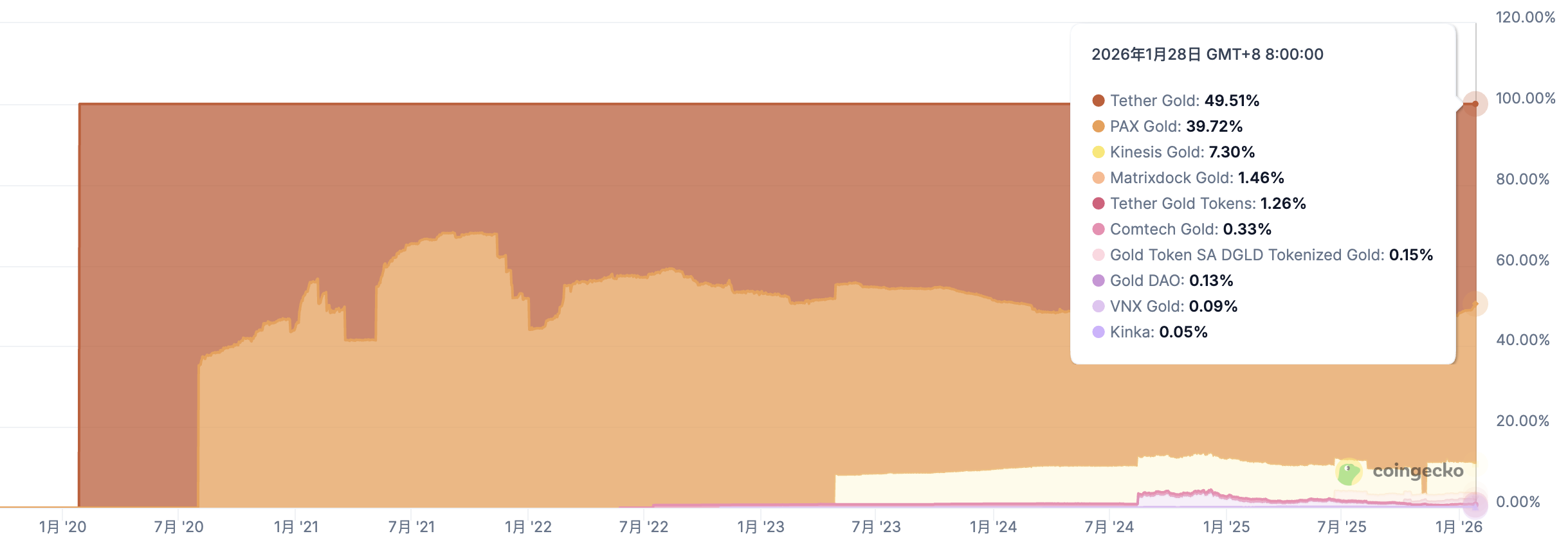
CoinGecko data shows that as of January 28, the circulating market value of XAU₮ had reached $2.7 billion, growing about 91.3% over the past year, capturing 49.5% of the tokenized gold track market share, firmly holding the top position.
From physical gold hoarding to industry chain布局, to financial product innovation, the large-scale investments by this gold enthusiast have even left traditional commodity圈 insiders baffled, with some形容 Tether as "the strangest company they have ever encountered."

But now, as gold prices continue to刷新历史 highs, Tether's bet is yielding惊人的 returns.

Earning $15 Billion Annually, Building a Capital Arsenal

The confidence behind Tether's疯狂囤积 gold comes from a high-speed运转的 "money printing machine."

According to a Fortune report, Tether generated approximately $15 billion in net profit in 2025, a significant increase from the previous year's $13 billion. This百亿 profit is supported by a global workforce of only about 200 people. Roughly calculated, the per capita profit is as high as $75 million, an efficiency level that leaves traditional financial giants in the dust.

The core of this profitability comes from the capital pool沉淀 by its stablecoin business.

Today, the US dollar stablecoin USDT issued by Tether is the most widely used stablecoin globally, with over 500 million users. CoinGecko data shows that as of January 28, 2026, the circulation of USDT issued by Tether was接近 $1870 billion, firmly holding the top spot in the stablecoin赛道. Trading activity is同样领先; Artemis Analytics data shows that in 2025, total stablecoin transaction volume grew 72% to $33 trillion, with USDT contributing $13.3 trillion, accounting for over 33%.

Building on this, Tether is further expanding the scale of its capital沉淀 through合规化.

On January 27, Tether officially launched USAT, a stablecoin regulated by the U.S. federal government. It is issued by Anchorage Digital Bank, the first federally regulated stablecoin issuer in the U.S., with Cantor Fitzgerald serving as the designated reserve custodian and preferred primary dealer, and former White House advisor Bo Hines appointed as CEO. This is seen as a key step for Tether's full-scale entry into the U.S. domestic market.

Simultaneously, leveraging its investments in content platforms like Rumble, Tether is attempting to integrate USAT business into the traffic ecosystem, thereby quickly reaching 100 million U.S. users, with a target of a $1 trillion market cap within five years. If progress is smooth, USAT could become the first真正意义上的 competitor to USDC in the U.S. market.

After obtaining an almost zero-cost liability side, Tether easily套取 interest rate differentials by allocating high-liquidity, low-risk assets.

Among these, U.S. Treasury interest is the core source of Tether's收益. In a high-interest rate cycle, U.S. Treasury interest directly amplifies Tether's profitability. Currently, Tether holds approximately $1350 billion in U.S. Treasury bonds, exceeding the holdings of sovereign nations like South Korea and making it the 17th largest holder of U.S. Treasury bonds globally.

Additionally, Tether is also a super player in Bitcoin. Since 2023, Tether has allocated up to 15% of its monthly net profit to定期 Bitcoin. Its current holdings exceed 96,000 BTC, making it one of the largest institutional holders of Bitcoin globally, with an average cost of about $51,000, far below the current market price.围绕 the Bitcoin ecosystem, Tether has also built its own mining farms, invested in mining companies, and布局 DAT (Crypto Treasury), continuously expanding its industry influence, and has一度 been the subject of overseas conspiracy theories about being a "BTC隐形操盘手." (Related reading: Caught in BTC隐形操盘手 Conspiracy Theories? Unveiling the Full Picture of Tether's Bitcoin Strategy)

Furthermore, to leverage more potential收益, Tether has开启了大撒币 mode over the past few years, extending its investment触角 to areas such as satellite communications, AI data centers, agriculture, telecommunications, and media.

Thus, an arbitrage machine spanning traditional finance and the crypto world has gradually taken shape, continuously supplying Tether with capital ammunition, becoming the chips for its large-scale bets.


Preguntas relacionadas

QHow much gold has Tether accumulated and what is its current value?

ATether has accumulated approximately 140 tons of physical gold, with a current value of about $23 billion.

QWhat is Tether's goal regarding its gold reserves, as stated by its CEO?

ATether's CEO, Paolo Ardoino, stated that the company aims to become one of the world's largest 'gold central banks'.

QWhat was Tether's net profit in 2025 and what is the primary source of this profitability?

ATether's net profit in 2025 was approximately $15 billion, primarily sourced from the interest on U.S. Treasury bonds held from its stablecoin business.

QWhat is the name of the gold-backed stablecoin issued by Tether and what is its market position?

ATether's gold-backed stablecoin is called Tether Gold (XAU₮), and it holds a 49.5% market share in the tokenized gold sector, ranking first.

QHow does Tether store its physical gold reserves and where are they located?

ATether stores its physical gold in a nuclear bunker from the Cold War era in Switzerland, which has multiple layers of heavy steel doors and top-tier confidentiality systems.

Lecturas Relacionadas

Must-Watch Events Next Week|CLARITY Act Could Face Senate Vote; SpaceX, Circle to Report Earnings (8.3-8.9)

**Summary: Key Events and Developments to Watch (August 3-9)** The upcoming week is marked by significant financial disclosures, key legislative deadlines, and notable product updates. **Major Financial Events:** Several companies are scheduled to release their Q2 2026 earnings. American Bitcoin (ABTC) will report on August 3, followed by SpaceX and Hut 8 Mining Corp. on August 4, and Circle on August 5. Notably, a significant portion of SpaceX shares (up to 12% of total shares) will be unlocked on August 6 following their earnings release. **Key Legislative Deadline:** The U.S. Senate faces an August 7 deadline to secure 60 votes for the CLARITY Act, a bipartisan bill aiming to establish a federal regulatory framework for cryptocurrencies. The Senate may hold a full vote on the bill during the week. **Economic Data:** The U.S. July Non-Farm Payrolls report will be released on August 7, providing crucial labor market data. **Technology & Product Updates:** * **Shutdowns:** DeFi portfolio tracker Zapper and wallet app Ctrl Wallet will cease operations on August 3. * **Upgrades:** LayerZero will deprecate its v1 relayers on August 3. XRP Ledger's new version 3.3.0, featuring five new functions, is expected next week. * **AI:** Elon Musk announced that the advanced Grok 4.6 AI model is set for release around August 7. * **Bitcoin:** The BIP-110 forced signaling for a potential Bitcoin network change is scheduled to begin around August 8. **Other Notable Events:** Chinese robotics firm Unitree Tech has set its preliminary price inquiry for its IPO for August 5. South Korean exchange Upbit will delist AQT and AERGO tokens on August 3.

marsbitHace 20 min(s)

Must-Watch Events Next Week|CLARITY Act Could Face Senate Vote; SpaceX, Circle to Report Earnings (8.3-8.9)

marsbitHace 20 min(s)

Stocks Are Plummeting More Sharply Than Cryptocurrencies. Where Has the Money Gone?

Stock Markets Plunge Deeper Than Cryptocurrencies: Where Did the Money Go? In late July, Seoul's Kospi index triggered circuit breakers for two consecutive days, plummeting over 40% from its June high. The collapse was led by heavyweight stocks like SK Hynix, whose record profits still disappointed investors, and devastating leveraged ETFs, with one major product losing over 83% of its value. This signaled a global, forced deleveraging targeting the most crowded trades. Interestingly, while stocks exhibited extreme volatility akin to crypto markets, Bitcoin rose nearly 15% in July after a prior steep drop. Analysis shows the money fleeing equities did not flow into Bitcoin. Instead, Bitcoin had already absorbed its sell-off in May-June, when U.S. spot Bitcoin ETFs saw historic outflows. The true safe-haven beneficiary was gold, whose price rose over 20% year-on-year, highlighting a decoupling between Bitcoin and gold as "digital gold." The sell-off was a targeted unwinding of leveraged positions in tech and semiconductors, accelerated by broker-dealer risk management and shifts in the AI narrative, including new competition from Chinese memory chipmakers. The retreat path was clear: from high-valuation tech stocks to cash and U.S. Treasuries, then to gold. For Bitcoin to attract sustained institutional inflows, conditions like eased global liquidity pressure, a "soft-landing" Fed rate cut, and U.S. regulatory clarity via legislation like the stalled CLARITY Act are needed. Currently, Bitcoin is not a safe haven but an already-cleared asset. Its low correlation with tech stocks, however, makes it a potential diversification play for institutional portfolios once the storm passes. The money isn't here yet, but the positioning is underway.

marsbitHace 20 min(s)

Stocks Are Plummeting More Sharply Than Cryptocurrencies. Where Has the Money Gone?

marsbitHace 20 min(s)

In Conversation with Ray Dalio: We Are Currently in an AI Bubble, with 1% of My Portfolio in Bitcoin

Ray Dalio, founder of Bridgewater Associates, warns in an interview that the current AI boom shows classic bubble characteristics, which could lead to significant economic downturns as seen in past cycles like 1929 or 2000. He explains that speculative enthusiasm, fueled by debt and overvaluation, often precedes a crash when rising rates or taxation force asset sales, causing widespread losses and recession. Dalio also outlines his "Big Cycle" theory, describing an approximate 80-year pattern where widening wealth gaps, massive government deficits, and shifting geopolitical power (like China's rise) create internal conflict and global instability. He emphasizes that we are in a late-cycle, transitional phase where traditional powers like the US and UK face decline. For personal wealth protection, Dalio advises diversification beyond cash into assets like stocks, bonds, real estate, and particularly gold, which he prefers over Bitcoin. While he holds about 1% of his portfolio in Bitcoin as a non-printable hard asset, he views gold as more secure from technological or governmental threats. Regarding AI's impact, Dalio believes it will disproportionately benefit capital owners, worsening inequality by replacing both physical and cognitive labor. He suggests that human intuition and emotional intelligence, combined with AI, will be key for future workers. On taxation, Dalio argues that wealth taxes are impractical and risk triggering asset sell-offs, reducing productive investment. He points to the UK as a cautionary example of debt, low productivity, and political strife. Geopolitically, Dalio foresees a more regionalized world, with the US showing weakness in prolonged conflicts like with Iran, akin to past imperial declines. The ideal outcome, he suggests, is coexisting powerful blocs (e.g., Americas, China-Asia Pacific) without major war.

marsbitHace 4 hora(s)

In Conversation with Ray Dalio: We Are Currently in an AI Bubble, with 1% of My Portfolio in Bitcoin

marsbitHace 4 hora(s)

Daily 7.2 Trillion KRW: Foreign Capital's Record Net Buying on Friday! Wall Street Says Headwinds for Korean Stock Fund Flows Have Subsided

South Korean stock market sees a dramatic shift in fund flows. On July 31, foreign investors made a record net purchase of approximately KRW 7.2 trillion in KOSPI stocks, marking a fundamental reversal from the persistent large-scale net outflows seen in previous months. This contributed to a significant narrowing of foreign net selling in July to KRW 9.8 trillion, down sharply from KRW 48.4 trillion in June and KRW 44.5 trillion in May. Simultaneously, domestic institutional pressure eased. South Korean pension funds and asset managers turned to a net buying position in July, purchasing KRW 1.0 trillion worth of KOSPI shares, contrasting with net sales in May and June. Market volatility is expected to be dampened by new financial regulations. Effective July 31, the Financial Services Commission tightened access for retail investors to single-stock leveraged ETFs by raising the minimum cash deposit requirement. Trading volumes for these products subsequently dropped to about 50% of their monthly average. Citigroup Research maintains its year-end KOSPI target of 10,000 points. The firm cites several supportive factors: the substantial easing of headwinds from capital outflows, a robust fundamental outlook for the semiconductor sector, historically low market valuations, strong economic fundamentals, and the potential for policy support from financial authorities if needed.

marsbitHace 4 hora(s)

Daily 7.2 Trillion KRW: Foreign Capital's Record Net Buying on Friday! Wall Street Says Headwinds for Korean Stock Fund Flows Have Subsided

marsbitHace 4 hora(s)

Trading

Spot
活动图片




