The Governance Struggle Behind the Power Play of Aave DAO and Aave Labs

marsbitPublicado a 2025-12-15Actualizado a 2025-12-15

Resumen

The article details a governance conflict between Aave DAO and Aave Labs, centering on a dispute over revenue generated by the frontend. The controversy began when Aave Labs replaced the integrated ParaSwap with CoW Swap on its frontend and directed the resulting fees to its private address, rather than to the DAO treasury. An anonymous DAO member, EzR3aL, publicly criticized this move, accusing Labs of privatizing protocol value. Aave DAO represents the protocol layer, governed by $AAVE token holders who vote on proposals. Aave Labs is the development team responsible for building and maintaining the frontend, brand, and product partnerships. The core issue is whether Aave is a decentralized protocol owned by the DAO or a project built and controlled by Labs, and how this distinction affects revenue rights. DAO supporters argue that all value generated should benefit token holders, while Labs contends that frontend-related income rightfully belongs to them. The situation highlights a broader industry-wide governance dilemma: the tension between decentralized community control and the need for a centralized, efficient team to drive development and maintain market position. The article suggests that a potential compromise, such as transparent revenue-sharing agreements, may be necessary. It concludes that how Aave resolves this conflict could set a precedent for other DeFi projects facing similar governance challenges.

Author: Chen Mo cmDeFi

The recent heated dispute between Aave DAO and Aave Labs over governance power at the protocol and product layers reflects the broader governance challenges across the industry. Here’s a breakdown of the issue. Who truly owns Aave?

1/6 · The Origin

Aave Labs replaced the frontend integration of ParaSwap with CoW Swap, and the resulting fees were directed to a private address of Labs. An anonymous DAO member, EzR3aL, exposed this on the governance forum, accusing Labs of "privatizing" protocol value. Labs' stance is that this belongs to frontend and product layer revenue, which rightfully belongs to Labs, and is unrelated to the protocol core.

2/6 · First, Let's Break Down Who Aave DAO and Aave Labs Are

  • DAO represents the Protocol (protocol layer)
  • Labs represents the Project (product layer)

The core dispute is whether Aave is a Protocol (managed by the DAO) or a Project (built by Labs)? And the implications for revenue rights.

Aave DAO is straightforward to understand. It is a unique type of governance organization in the Crypto world, composed of $AAVE token holders who exercise power through voting within the DAO. Almost 90%+ of crypto projects follow this structure; the term "governance token" originates from this. Its primary power is to vote on project proposals, deciding whether to implement certain updates and developments, as well as the future direction of the project.

Aave Labs is a development team responsible for building, updating, and maintaining the protocol (e.g., frontend interfaces, mobile apps). Typically, they also maintain the Aave brand and IP, so on social media and in the market, Aave Labs is often defaulted to being Aave. Its founders are also quite influential on social media.

Generally, Aave Labs and Aave DAO need to collaborate. For instance, Labs leads the development of many plans, optimizations of certain features, and even version upgrades like V3 and V4. These proposals are led by Aave Labs but ultimately decided by DAO vote. Usually, when their interests align, they have a mutually supportive relationship, together forming Aave.

3/6 · What Core Resources Do They Respectively Control?

Once conflicts of interest emerge, these two roles can be separated, as they are inherently independent entities. Let’s look at the core resources and power each holds:

Aave DAO controls the underlying core. For example, the smart contracts; treasury control is in the hands of the DAO. Although Labs can propose development plans, they require a DAO vote to be implemented. So it is the Protocol; the upper layer can be any product that operates. Theoretically, multiple frontend products can be built on top of one Protocol—Aave, Bave, Cave, etc.

Aave Labs controls the frontend, brand, product marketing, and partnerships. So it interacts directly with users and represents a quality product.

Therefore, supporters of Labs generally believe that the CoW Swap integration is purely a frontend behavior, unrelated to Aave's underlying architecture. Labs could even unilaterally decide not to integrate it, so any revenue generated should naturally belong to Labs. Conversely, DAO supporters view this as a form of appropriation because, with the existence of the AAVE governance token, all benefits should优先 flow to AAVE holders or remain in the treasury for the DAO to decide. Additionally, previously, ParaSwap revenue consistently flowed into the DAO. The new CoW Swap integration changed this status, further leading the DAO to see this as a grab.

Both sides have their arguments.

4/6 · Governance Dilemma

This highlights a rather awkward governance and power dilemma. From the perspective of $AAVE holders, they typically side with the DAO, because revenue entering the treasury benefits token holders. Although Labs has corresponding annual expenses, these can be reimbursed through the DAO. If a separate channel for profit can be opened, it seems community power is gradually being eroded.

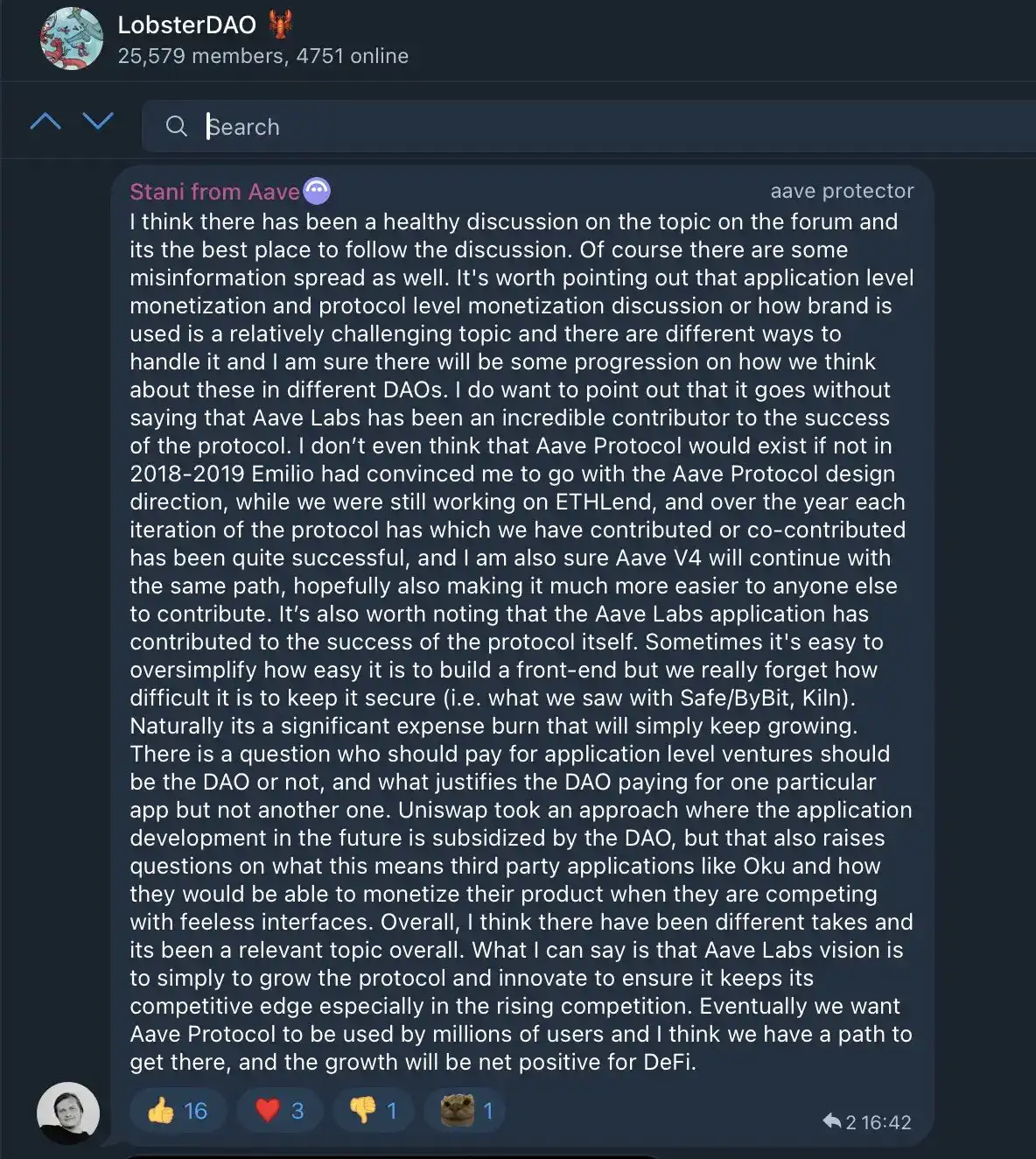
But from Aave Labs' perspective, although the theoretical core control lies with the DAO, and proposals ultimately require a vote to be implemented, from the first version of Aave to now, Labs has played a role in unifying and leading the overall situation, making huge contributions to the project's growth. As Stani said, "If it weren't for Emilio convincing me to adopt the Aave protocol design direction back in 2018-2019, when we were still working on ETHLend, I think the Aave protocol might not have existed at all."

Who is the true owner of Aave?
5/6 · Power Struggle

This governance dilemma exists in most projects. Governance tokens are bought with real money. Ideally, these holders collectively decide the project's future. When the team no longer holds voting power, they could even forcibly replace Labs.

But the reality is far from ideal. Even for projects with a certain market share, when internal team problems and disputes arise, the aftermath often leads to a loss of market position. Sushi is a good example. The DAO can exercise power, and the project can change hands. Although, thanks to smart contract design, even if a project undergoes a major reshuffle, the product functionality can remain perfectly stable. However, judging from past cases, the outcome of splits is usually not good.

The core issue here is that, for now, a DAO is a decentralized organization by nature. Although it has voting power, it struggles to operate efficiently. The community may include independent developers, VCs, and large holders. Once each role begins to exercise its power fully, a proposal can undergo multiple rounds of formulation, modification, and博弈 from the start. The success of a project requires a professional team and continuity. A DAO can hire a new team, but it may be difficult to quickly transition and iterate, easily losing market position. Therefore, the existence of Labs, on the surface,更像 the entity that can "control" the protocol (in collaboration with the DAO).

Personally, I lean towards the two parties eventually reaching a solution to balance the distribution of interests. But currently, everything is under discussion, and no governance vote has appeared. The potential risk behind this is that even if a reconciliation is ultimately reached, this incident has already exposed a divergence in expectations between the founding team and token holders.

Long-term, I remain optimistic about Aave's development because it is one of the few DeFi projects that has been market-verified with a strong moat. The矛盾 of governance power is a problem the entire industry needs to face. How Aave handles this incident may become a benchmark case for the industry in the future.

6/6 · Voices and Discussion

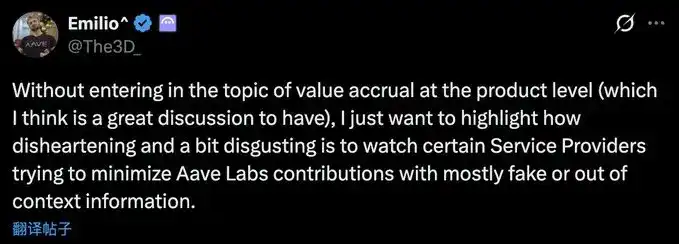
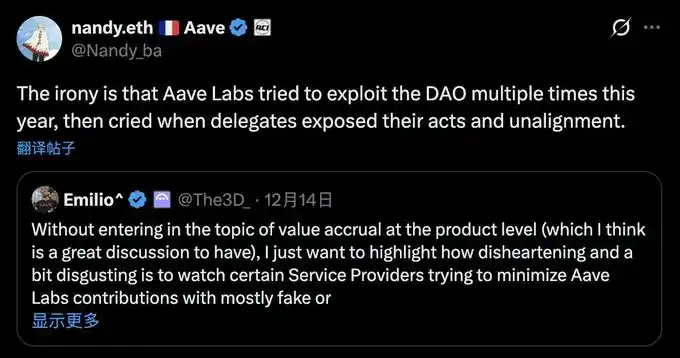
Arguments. Emilio believes someone is maliciously贬低 the contributions and value of Aave Labs. ACI team members pointed out that Aave Labs has repeatedly tried to exploit the DAO and been exposed.
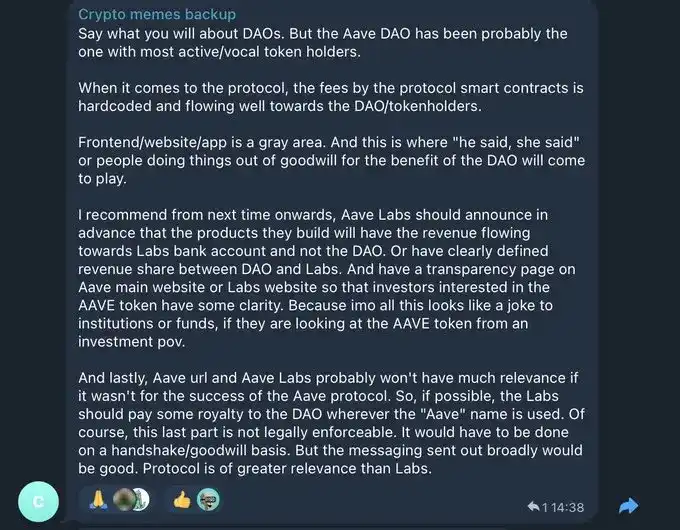
Community suggestions for Labs:

  • Labs should announce in advance that revenue from products they build will flow to Labs, not the DAO.
  • Or clearly define a revenue-sharing ratio between the DAO and Labs.
  • Establish a transparent page on the Aave main website or Labs website providing clear information to help investors interested in the $AAVE token (especially institutions or funds) make judgments.

Although the DAO model is controversial, Aave DAO token holders are among the most active and vocal groups, demonstrating the community's vitality. The frontend, website, and application are focal points of controversy, where "each sticks to their own argument" situations easily arise, lacking clear definition.
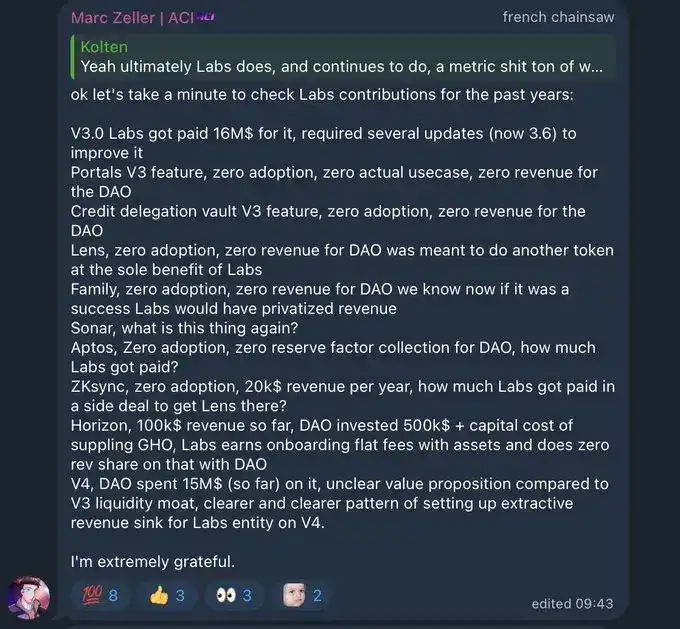
Some of Zeller's accusations against Labs for extracting protocol value:

The listed projects (Portals, Credit Delegation Vault, Lens, etc.) indeed indicate that many of Aave Labs' exploratory initiatives have not directly translated into protocol revenue or significant adoption rates.

It also mentions the V4 version. The DAO has spent $15 million so far. Compared to the liquidity moat of V3, the value proposition is unclear, raising concerns about whether this is a new trap for extracting revenue.

Failure is inevitable in the process of innovation. Not every feature or product can succeed. The DAO is, to some extent, investing in Aave Labs' R&D capability. My understanding is that Zeller is not否定 the contribution but calling for higher standards of accountability, transparency, and value alignment.
Recommended Reading:

Why Isn't Asia's Largest Bitcoin Treasury Company Metaplanet Buying the Dip?

Multicoin Capital: The Era of FinTech 4.0 Has Arrived

a16z's Heavily Funded Web3 Unicorn Farcaster Forced to Pivot, Is Web3 Social a False Proposition?


Criptos en tendencia

Preguntas relacionadas

QWhat was the initial event that sparked the governance conflict between Aave DAO and Aave Labs?

AAave Labs replaced the frontend integration from ParaSwap to CoW Swap, and the fees generated from this new integration were directed to a private address controlled by Labs instead of the DAO treasury.

QWhat is the core dispute regarding the nature of Aave, as described in the article?

AThe core dispute is whether Aave is a Protocol (managed by the DAO) or a Project (built by Labs), and how this definition impacts the rights to revenue generated from its ecosystem.

QAccording to the article, what key resources does Aave DAO control versus Aave Labs?

AAave DAO controls the core protocol layer, including the smart contracts and the treasury. Aave Labs controls the frontend, brand, product marketing, and partnerships.

QWhat is one of the major governance dilemmas highlighted in the Aave case?

AA major dilemma is the tension between the ideal of decentralized governance by token holders (DAO) and the practical need for a centralized, efficient, and continuous development team (Labs) to maintain and grow the project.

QWhat was a community suggestion for Aave Labs to improve transparency and align interests?

AA community suggestion was for Labs to clearly announce in advance when product revenues will flow to Labs instead of the DAO, or to define a clear revenue-sharing ratio between DAO and Labs.

Lecturas Relacionadas

Annual Salary of Millions Competing for Electricians, Meta Rushes to Open Its Own Technical School

The AI boom is facing an unexpected bottleneck: a severe shortage of skilled construction workers and electricians. As tech giants like Meta, OpenAI, and Alphabet race to build massive data centers—such as OpenAI's $16 billion "Stargate" project—they are hitting a critical labor wall. The U.S. needs an estimated 130,000 more electricians, 240,000 construction workers, and 150,000 supervisors by 2030 for AI infrastructure alone, but tens of thousands of electrician jobs go unfilled each year. While AI companies offer high premiums, with electricians earning up to $280,000 annually, worker scarcity still causes massive losses—delays on a single project can cost $14.2 million per month. The complexity of building AI data centers, which require immense power (equivalent to powering hundreds of thousands of homes), sophisticated electrical systems, and advanced liquid cooling solutions, demands highly skilled technicians who are in short supply. To combat this, companies are investing heavily in training. Meta has committed $115 million to a free training school offering tuition, housing, and stipends, targeting 5,000 new workers. OpenAI is partnering with unions to secure skilled labor. These efforts are paying off, with a significant rise in Gen Z interest in trade schools over college. However, the power demands are staggering. AI data centers are driving a rapid surge in electricity consumption, projected to account for up to 12% of U.S. power use by 2028 and raising costs for consumers. Furthermore, the construction boom is project-based, leading to a potential future glut of trained workers once building peaks, which could depress wages industry-wide. The race for AI supremacy now depends as much on skilled hands as on advanced chips.

marsbitHace 28 min(s)

Annual Salary of Millions Competing for Electricians, Meta Rushes to Open Its Own Technical School

marsbitHace 28 min(s)

OpenAI No Longer Sells Its Most Expensive Model for Profit

OpenAI is shifting its business strategy away from promoting its most expensive, flagship models for every task. Recent price cuts—80% for GPT-5.6 Luna and 20% for Terra—signal a deeper change: the company now actively advises users that many tasks don't require the most powerful model. Instead, OpenAI recommends a tiered approach: use the high-end GPT-5.6 Sol for complex planning and analysis, then delegate execution to cheaper models like Luna. This mirrors moves by Anthropic, which recently launched Claude Opus 5 at half the price of its top model, Fable 5. Both companies are de-emphasizing flagship models as primary revenue drivers, using them instead for brand prestige and technological showcases. The industry is entering a "mass-market" phase, similar to automotive, where high-volume, cost-effective models handle daily operations and drive scale. OpenAI's price reductions are partly enabled by AI models themselves optimizing underlying code and infrastructure, creating a self-reinforcing cycle of efficiency gains and cost reduction. Competition is shifting from "who is smartest" to "who offers the best value." The goal is no longer selling individual models but fostering widespread API adoption and ecosystem lock-in. By making AI calls cheap and ubiquitous, companies like OpenAI aim to become the indispensable, utility-like infrastructure powering automated workflows—the "water and electricity" of software, quietly embedded everywhere.

marsbitHace 28 min(s)

OpenAI No Longer Sells Its Most Expensive Model for Profit

marsbitHace 28 min(s)

Will the Fed Definitely Raise Interest Rates in September? How Will Crypto and U.S. Stocks Withstand the Pressure?

The market's expectation for a September Fed rate hike surged dramatically in early August, jumping from under 50% to over 80% within a week. This shift followed a contentious July FOMC meeting, where a 9-3 vote to hold rates revealed growing dissent from hawkish members advocating for an immediate hike to combat persistent inflation. The primary catalyst for this repricing is rising oil prices, driven by renewed geopolitical tensions around the Strait of Hormuz, which threaten global supply. Energy costs directly influence inflation metrics, making the upcoming July CPI report (due August 12th) a critical data point. If it shows inflation reaccelerating, the probability of a September hike will solidify. For Bitcoin and crypto assets, this is typically bearish news. Bitcoin continues to behave as a high-beta, liquidity-sensitive risk asset. A rate hike raises the opportunity cost of holding non-yielding assets and could drive capital toward money markets, pressuring crypto prices in the short term. However, historical patterns suggest that if a hike is perceived as the end of a tightening cycle rather than the start, any negative price impact may be brief. U.S. stocks, particularly crypto-linked equities like Coinbase and growth-oriented tech stocks, are also vulnerable. Higher rates increase discount rates in valuation models, putting pressure on high-multiple companies. This coincides with a pivotal tech earnings season where investor focus has shifted from massive AI capital expenditure to tangible revenue and cash flow generation. Companies with negative cash flow and weak growth narratives could face heightened volatility if borrowing costs rise in September. In summary, a September Fed hike has evolved into a mainstream market scenario. Key factors to watch are oil prices, the July CPI report, and Fed communications, which will determine the final decision and its impact on volatile crypto and equity markets.

marsbitHace 39 min(s)

Will the Fed Definitely Raise Interest Rates in September? How Will Crypto and U.S. Stocks Withstand the Pressure?

marsbitHace 39 min(s)

Trading

Spot

Artículos destacados

Cómo comprar DAO

¡Bienvenido a HTX.com! Hemos hecho que comprar DAO Maker (DAO) sea simple y conveniente. Sigue nuestra guía paso a paso para iniciar tu viaje de criptos.Paso 1: crea tu cuenta HTXUtiliza tu correo electrónico o número de teléfono para registrarte y obtener una cuenta gratuita en HTX. Experimenta un proceso de registro sin complicaciones y desbloquea todas las funciones.Obtener mi cuentaPaso 2: ve a Comprar cripto y elige tu método de pagoTarjeta de crédito/débito: usa tu Visa o Mastercard para comprar DAO Maker (DAO) al instante.Saldo: utiliza fondos del saldo de tu cuenta HTX para tradear sin problemas.Terceros: hemos agregado métodos de pago populares como Google Pay y Apple Pay para mejorar la comodidad.P2P: tradear directamente con otros usuarios en HTX.Over-the-Counter (OTC): ofrecemos servicios personalizados y tipos de cambio competitivos para los traders.Paso 3: guarda tu DAO Maker (DAO)Después de comprar tu DAO Maker (DAO), guárdalo en tu cuenta HTX. Alternativamente, puedes enviarlo a otro lugar mediante transferencia blockchain o utilizarlo para tradear otras criptomonedas.Paso 4: tradear DAO Maker (DAO)Tradear fácilmente con DAO Maker (DAO) en HTX's mercado spot. Simplemente accede a tu cuenta, selecciona tu par de trading, ejecuta tus trades y monitorea en tiempo real. Ofrecemos una experiencia fácil de usar tanto para principiantes como para traders experimentados.

249 Vistas totalesPublicado en 2024.12.11Actualizado en 2026.06.02

Cómo comprar DAO

Discusiones

Bienvenido a la comunidad de HTX. Aquí puedes mantenerte informado sobre los últimos desarrollos de la plataforma y acceder a análisis profesionales del mercado. A continuación se presentan las opiniones de los usuarios sobre el precio de DAO (DAO).

活动图片












