Author: Cailian Press
As global long-term bond yields continue to rise, a concerning sign worth noting is that high debt pressure has already sparked calls in France to cancel some public debt......Regarding this,renowned macro strategist and co-founder of Variant Perception, Simon White, warned in his latest report that such thinking is highly contagious. As governments struggle in the debt mire, coupled with some politicians continuously proposing increasingly radical policies, it is expected that similar heterodox demands will soon emerge in other countries.
However, all these solutions may ultimately lead to the same outcome: intensifying inflation and devaluation of financial assets!
Burn the Bonds?
White points out that the 'classic script' of the global financial crisis is actually replaying itself repeatedly at present.
The latest example is the French left-wing populist politician Mélenchon, who recently called for writing off 18% of the country's public debt—in Mélenchon's words, to 'take the bonds and burn them directly.' Similar rhetoric is actually not unfamiliar: it was heard in Europe during the Eurozone debt crisis in 2009 and also appeared in the US around the same time.
But debt cancellation is essentially just a disguised form of 'monetary financing' and will inevitably trigger severe inflation. White believes this will instead solidify the logic of 'real assets over financial assets.'
White notes that many may remember the 2011 (serious) proposal—which later had to be officially denied—to have the U.S. Treasury mint a $1 trillion face value platinum coin. The Federal Reserve would exchange this coin for $1 trillion in government bonds, after which the Treasury would cancel these bonds. The plan aimed to circumvent the accelerating debt ceiling after the Lehman crisis.
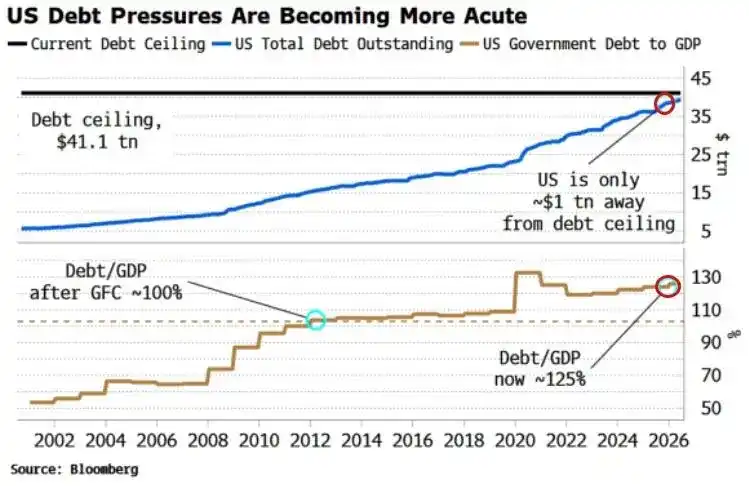
Today, the U.S. is only $1.1 trillion away from hitting the debt ceiling again and is accelerating towards it, with the debt-to-GDP ratio already 25 percentage points higher than 15 years ago. White believes that as interest payments climb to over $1 trillion, if someone domestically in the U.S. echoes Mélenchon's call to cancel or write down part of the national debt, it would hardly be surprising.
Concerns of Political Polarization and Extreme Risks
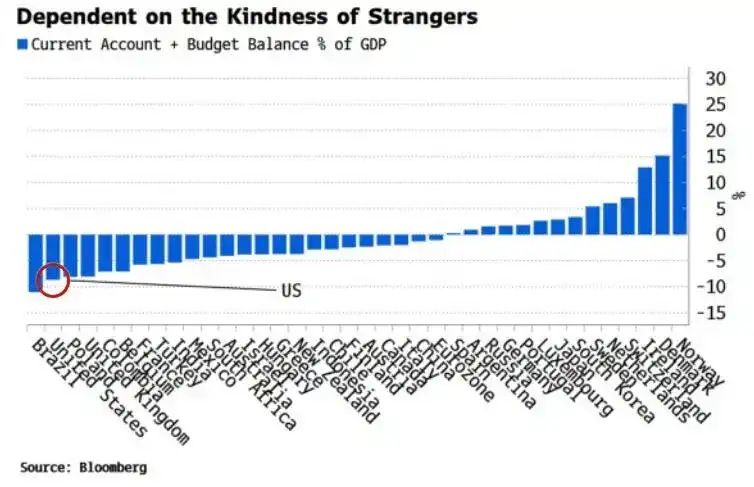
White states that given the complete loss of willingness among Western political circles in recent years to withdraw from fiscal stimulus, with political forces and politicians deviating from the center and leaning towards non-traditional policies, it is not unimaginable for avant-garde measures like debt cancellation to be put on the agenda.
Even if these plans ultimately fail to materialize, low-probability, high-impact 'tail events' have substantially altered the risk distribution, as the probability of tail events occurring is far thicker than previously thought—considering the evident anxiety expressed by the current Trump administration after the U.S. Treasury announced last week an increase in long-term bond buybacks, people must obviously take these possibilities seriously.
Once this anxiety turns into despair—which is not impossible—one must be vigilant against more heterodox debt prescriptions being implemented by policymakers or being pushed to the core of the political agenda by opposition parties.
So, fundamentally, what options are there for reducing government debt? White believes it boils down to the following six: fiscal consolidation, economic growth/inflation, financial repression, sale of government assets, debt default or restructuring, debt cancellation, or other forms of monetary financing.
Examining them one by one reveals why there might ultimately be only 'one path up Mount Hua':
Fiscal consolidation is too risky in elections; Economic growth is hindered by massive government deficits, and inflation has already become a problem due to increased interest payments; Financial repression will eventually come, but it's too late (if counting the Treasury's enhanced buyback operations, it has already begun); Selling government assets (like the gold at Fort Knox) is a one-off measure unlikely to have a substantial impact; and debt restructuring or default does more harm than good.
White says that understanding this clarifies why direct debt cancellation might seem quite attractive—after all, it's relatively easy to implement.
The Methods and Consequences of 'Destroying Bonds'
But confusing 'easy' with 'effective' would be a serious mistake. White points out that debt cancellation is very likely to trigger severe inflation—if France ever goes down this path, it will discover this, as it is merely monetary financing in different packaging.
As mentioned above, the U.S. previously attempted this idea, with its main proponent Ron Paul proposing the 'Debt Crisis Resolution Act' in August 2011. But how would this work in practice?
The U.S. Treasury would simply write down (e.g., reduce by 10%) or directly zero out the Treasury bonds held by the Federal Reserve. Subsequently, the Fed would do what only a central bank can: write down its equity to a negative value.
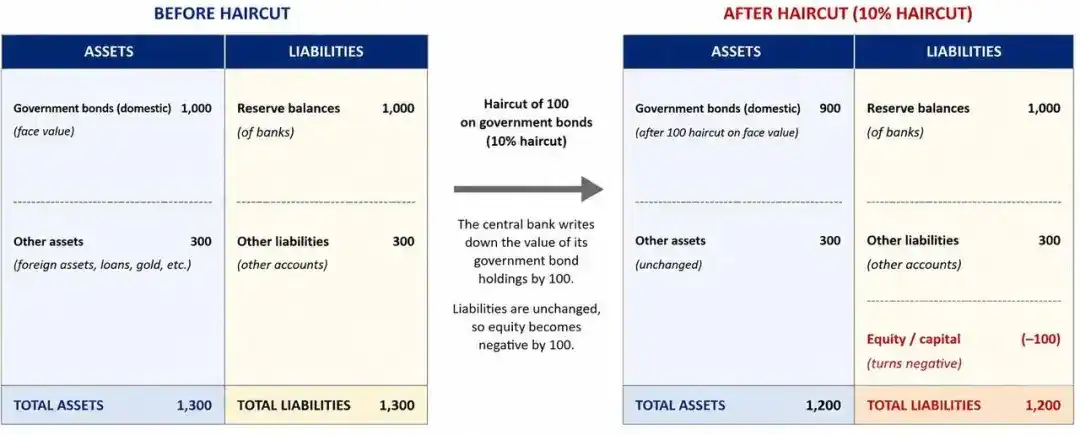
White says this may seem like a one-off solution, but it will leave a fatal hidden danger.
The corresponding reserves initially created out of thin air by the Fed through quantitative easing (QE) were originally supposed to be naturally extinguished when the Treasury repaid principal and interest at maturity; once the debt is directly canceled, this extinguishing point for the reserves no longer exists—they become an explicit and permanent monetary injection. The key reason QE initially did not trigger hyperinflation was the market expectation that these reserves would eventually be withdrawn in the future.
Under normal mechanisms, if the private sector anticipates that deficit spending will ultimately need to be repaid through deferred taxes (i.e., Ricardian equivalence holds), it will proactively reduce consumption. But once monetary financing breaks this balance, the private sector will choose to spend lavishly alongside the government.
Even in today's monetary system with highly abundant reserves, explicitly making the increase in the monetary base permanent is crossing an irreversible red line, and it is highly likely to induce severe inflation. Whether it takes the form of QE accompanied by fiscal expansion, yield curve control, or the central bank directly giving the Treasury an 'unlimited credit card,' all forms of monetary financing will ultimately point to the one-way street of inflation.
White points out that this is precisely the track we are currently on— as long as the more painful but effective fundamental solutions continue to be shelved, replaced by ineffective speculative measures or even absurd tricks like the 'trillion-dollar coin,' the aforementioned tail risks will continue to climb.