The Free Era of the Internet Has Come to an End

marsbitPublicado a 2026-05-29Actualizado a 2026-05-29

Resumen

The free era of the internet is ending. On May 27th, Meta officially announced a global paid subscription rollout, including Instagram Plus ($3.99/month), Facebook Plus ($3.99/month), and WhatsApp Plus ($2.99/month). This follows a major company shift towards AI, marked by recent layoffs and a massive $125-145 billion investment in AI infrastructure. The move aims to create a predictable revenue stream for investors, moving beyond reliance on fluctuating ad income. Unlike the earlier European "pay for no ads" model, these new tiers focus on offering enhanced features—like anonymous Story viewing on Instagram or privacy tools on WhatsApp—to provide "a bit more control." However, a Forrester survey indicates 70% of users are reluctant to pay, questioning the value. The core of Meta's strategy lies in its upcoming AI subscriptions, priced at $7.99 and $19.99, offering advanced reasoning and higher usage limits, mirroring the freemium models of OpenAI and Anthropic. With Meta's billions of users, even a small conversion rate could generate significant revenue. Analysts are optimistic, with some projecting WhatsApp alone could bring in $40 billion annually by 2030. This shift reflects a broader industry trend where the old bargain of "free services for user data" is under pressure from rising privacy regulations and the immense costs of AI development. The success of Meta's subscriptions hinges on whether users find enough value in these premium features to open their wallets, ...

Author|Hua Lin Dance King

Editor| Jing Yu

Once upon a time, the model where users used internet products for free in exchange for watching 'ads' has finally come to an end in the AI era.

On May 27, Meta officially announced the global launch of its paid subscription plans. Instagram Plus is priced at $3.99 per month, Facebook Plus at $3.99 per month, and WhatsApp Plus at $2.99 per month.

At the same time, Meta is also testing a premium AI plan for heavy AI users (with two tiers: $7.99 and $19.99), as well as a professional package for creators ($49.99), all integrated under the 'Meta One' brand.

This is not a simple product update; it is a key card played by Meta in a larger strategic transformation. Behind this may signify the end of the 'free internet era' we were once familiar with.

01 Even the Landlord Is Running Out of Surplus

To understand the significance of today's subscription plans, we need to turn back the clock to a month ago.

On May 20, Meta initiated a massive round of layoffs that shocked Silicon Valley, cutting about 8,000 employees while freezing 6,000 open positions. At the same time, the company announced it would invest $125 billion to $145 billion in AI infrastructure. Laying off people is to concentrate money on AI.

Meta's CTO subsequently stated on May 25 that the company would use AI tools to implement a 'large-scale transformation' of its workforce. 7,000 employees were transferred to AI-related roles. The company's focus is visibly shifting toward AI.

This brings up a core contradiction: How can investors be convinced after pouring so much money into AI?

For Wall Street, the most concerning issue is not how much Meta is spending, but what kind of predictable returns this money can bring. Google has Cloud, Microsoft has Azure, Amazon has AWS—their AI investments can be measured by subscriptions and API calls. But what does Meta rely on?

Ad revenue fluctuates with the market and is not stable enough; the open-source large model Llama has enhanced technical reputation but does not directly generate revenue; AI glasses and AR devices are still in their early stages.

Thus, subscriptions entered Meta's field of vision.

This timing is not coincidental.

02 How to Convince Users to 'Pay'?

Meta's products have long operated under an implicit contract—you use my platform, and I sell your attention to advertisers. This logic has worked well for twenty years, with Facebook boasting over 3 billion monthly active users, Instagram over 2 billion, and WhatsApp users spanning the globe.

However, cracks are beginning to appear in this wall.

European regulators have been the biggest catalyst. To comply with the EU's data privacy regulations, Meta began testing an 'ad-free subscription' option in Europe as early as 2023, offering users a paid choice to avoid data tracking. The globally launched subscription plan is, in a way, an extension and deepening of this European experiment.

This time, however, Meta is playing by a different logic—not 'pay to remove ads,' but 'pay to unlock more.'

The core selling points of Instagram Plus include anonymous browsing of Stories, detailed replay data analysis, extended disappearing post duration, and custom themes and reactions. WhatsApp Plus focuses on enhanced privacy and expanded features.

The common characteristic of these features is that the free version is sufficient, but the paid version allows you to: 'have a little more control.'

From a product design perspective, this is more challenging than 'paying to remove ads.' Removing ads addresses a clear user pain point with a straightforward functional trade-off; but 'unlocking more' requires Meta to prove that these 'more' are truly worth the price.

Forrester's survey data pours cold water on this idea: 70% of respondents indicated they would 'definitely' or 'likely' not pay for a Meta subscription. Reasons vary—some feel the current free version is sufficient, others harbor long-standing resentment toward Meta's privacy practices, and some bluntly ask, 'Why should I give you more money?'

This resistance is real, but it is not insurmountable.

Snapchat+ serves as the best reference point. When Snap introduced its paid subscription in 2022, the general consensus was pessimistic, believing users wouldn't pay for a messaging app. However, to date, Snapchat+ has surpassed 15 million paying users. The key isn't 'whether users are willing to pay,' but whether the product delivers enough concrete, direct value.

X (formerly Twitter), Telegram, and Snap are all increasing their bets on subscriptions. Paid subscriptions are becoming an increasingly important part of social platforms' revenue mix.

03 AI Features: The Real Battlefield for Monetization

If Instagram Plus and WhatsApp Plus are merely test runs, then AI subscriptions are the core of Meta's ambition in this layout.

Meta announced it will test two tiers of AI subscription plans, priced at $7.99 and $19.99, with the main difference being the usage limits for advanced reasoning and 'thinking mode.' The basic version of Meta AI will remain free, but for faster response speeds, stronger reasoning capabilities, and higher usage limits, users will need to pay to unlock them.

This design logic is almost identical to the freemium models of OpenAI and Anthropic.

The difference lies in scale.

OpenAI's user base is in the hundreds of millions, while Meta's monthly active users number in the billions. Even with a conversion rate of just 1%, the numbers would be vastly different. An analyst from Seeking Alpha crunched the numbers: based on WhatsApp Plus's $2.99 price and an estimated 1.5% conversion rate, this single product alone could generate approximately $2 billion in annual revenue, with a gross margin close to 100%.

What excites investors even more is the predictability of such revenue. Ad revenue fluctuates with macroeconomic conditions and privacy regulations, but subscription revenue is predictable, recurring income. This is precisely what Meta has struggled to articulate regarding its AI investments—now, it has a story to tell investors.

On the day of the announcement, Meta's stock price rose nearly 3%, a straightforward and clear market response. Evercore ISI analyst Mark Mahaney gave a buy rating, expressing particular optimism about WhatsApp's long-term monetization potential. He projects that by 2030, WhatsApp alone could generate $40 billion in annual revenue.

This is, of course, the most optimistic scenario, and the real path is fraught with variables. But it at least shows that this road is not a fantasy; it is a business logic supported by numbers.

04 The 'Free Era' Has Ended

Remember that phrase long circulated in the tech world—'If the product is free, you are the product.'

Meta's business model has always been the quintessential footnote to this statement. Users exchange attention and data for free services, and Meta sells this data to advertisers. This logic ran fast during the smartphone era. The rise of Facebook, the explosion of Instagram, and the global expansion of WhatsApp were all built on this foundation.

But the definition of 'free' is quietly changing.

On one hand, heightened privacy awareness is making more and more users wary of the exchange of 'data for services.' EU regulations like GDPR and DMA are tightening step by step, costing Meta billions of dollars annually. On the other hand, competition in the AI era has made the cost of 'free' unprecedentedly high—training an advanced model and maintaining the computing power for an AI assistant is far more expensive than displaying a few ads.

Mark Zuckerberg needs a way to make users who derive real value from Meta AI pay directly for that value.

This is not a betrayal of the original intent of the 'free internet,' but an acknowledgment of a reality—in the AI era, 'free' requires someone else to foot the bill.

The payer can be advertisers, or it can be the users themselves. Meta now wants both to coexist.

The success or failure of the subscription plans ultimately depends on the answer to one question: Are features like anonymous Story browsing, advanced AI reasoning, and creator data analysis truly worth the few dollars you pay each month?

Twenty years ago, when Zuckerberg typed the first line of code in his Harvard dorm room, he probably didn't imagine charging users one day.

But that story is from twenty years ago.

Preguntas relacionadas

QWhat is the main strategic shift behind Meta's recent announcement of paid subscription plans?

AThe main strategic shift is Meta's transition from primarily relying on advertising revenue to actively pursuing a diversified revenue stream through paid subscriptions. This move is a key part of financing their massive investments in AI infrastructure and convincing investors of a predictable return.

QWhat are the core features driving user adoption for Instagram Plus and WhatsApp Plus, according to the article?

AFor Instagram Plus, core features include anonymous Story browsing, detailed replay analytics, extended disappearing message duration, and custom themes/reactions. For WhatsApp Plus, the focus is on privacy enhancement and feature expansion. The common appeal is offering users a greater sense of control beyond the 'good enough' free version.

QHow does the article use the example of Snapchat+ to support its argument about paid subscriptions?

AThe article cites Snapchat+ as a successful reference point. Despite initial skepticism, its paid subscriber base grew to over 15 million. This example demonstrates that users are willing to pay for social apps if the premium features offer clear, tangible value, suggesting Meta's subscription plans have a viable path forward.

QWhy is the AI subscription model particularly important for Meta's financial strategy?

AAI subscriptions are crucial because they provide predictable, recurring revenue (MRR/ARR), unlike the volatile advertising income. This direct monetization from users who gain value from advanced AI features (like faster responses, stronger reasoning) offers a concrete return-on-investment story to Wall Street for Meta's massive AI spending.

QWhat two major factors does the article suggest are ending the 'free internet era' as we knew it?

ATwo major factors are: 1) Growing privacy regulations (like GDPR and DMA in Europe) that challenge the 'data-for-service' advertising model, increasing compliance costs for companies like Meta. 2) The extraordinarily high costs of developing and maintaining advanced AI models, making a purely ad-supported 'free' model unsustainable for cutting-edge AI services.

Lecturas Relacionadas

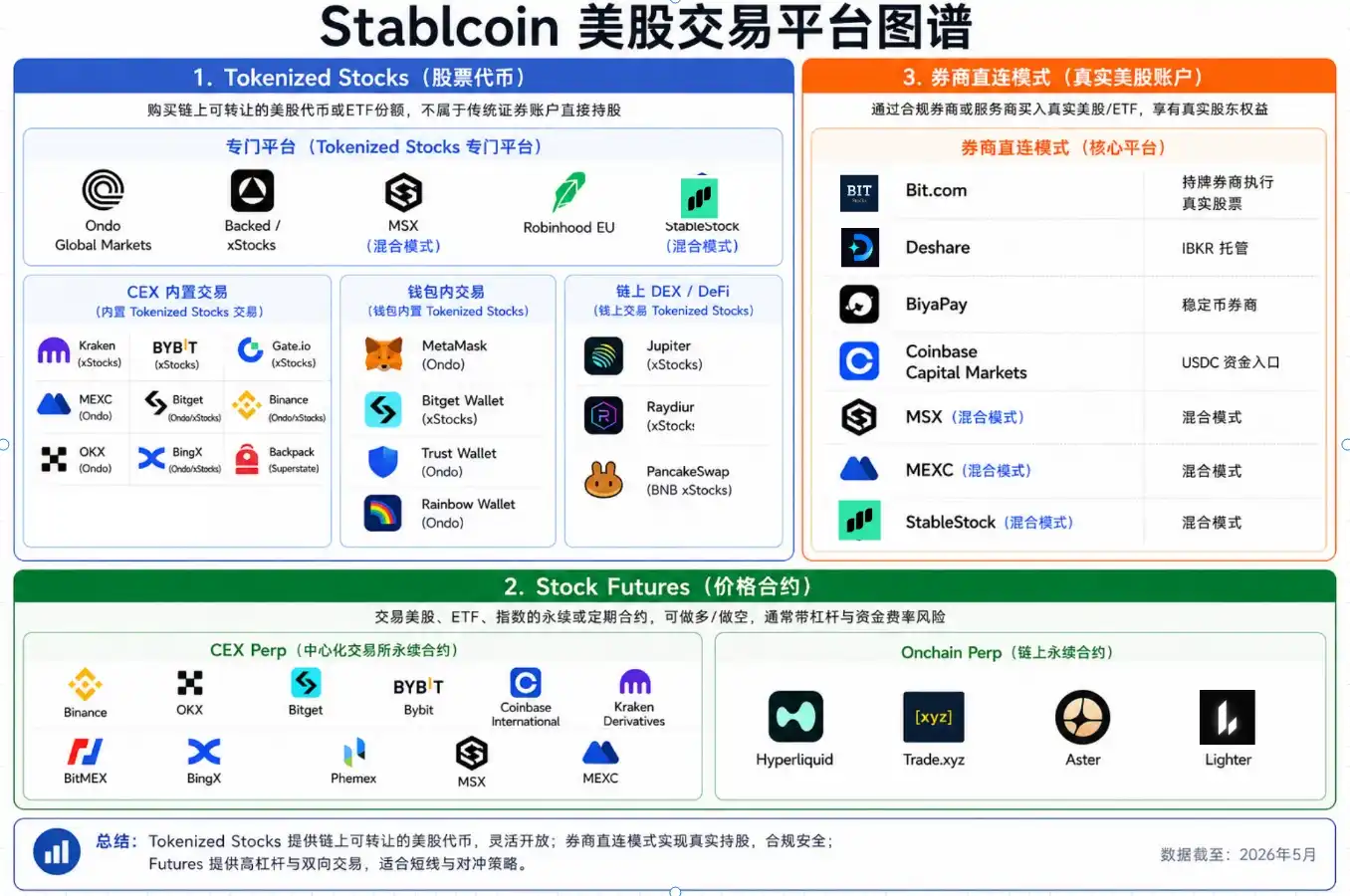
How to Define "Real U.S. Stocks": Differences Between On-Chain Tokens, Price Contracts, and Direct Broker Connections

**Title:** Defining "Real US Stocks": Differences Among On-Chain Tokens, Price Contracts, and Broker-Direct Access **Summary:** In 2026, using stablecoins to purchase US stocks is mainstream, but products marketed as "buying US stocks with USDT" offer fundamentally different assets. This article analyzes three primary models. **1. Tokenized Stocks:** These are on-chain tokens representing economic exposure to underlying stocks, held by an issuer or custodian. They offer benefits like 24/7 trading and DeFi composability (e.g., use as loan collateral). However, users lack direct legal shareholder status; dividends may not be paid in cash, and voting rights are typically non-binding advisory expressions. Examples include platforms like Ondo Finance. **2. Stock Futures / Equity Perpetuals:** These are derivative contracts tracking a stock's price, allowing leveraged long/short positions 24/7, similar to crypto perpetuals. They offer high efficiency and flexibility but involve funding fees, which can be a significant long-term cost, especially during strong trends. Crucially, they confer no ownership rights (dividends, voting) to the holder. **3. Broker-Direct Model:** This model provides access to real securities via licensed broker-dealers. Stocks/ETFs are bought and held within the US clearing and custodial system (e.g., DTCC), making it the only path to genuine stock ownership. Users receive cash dividends and formal proxy voting rights (where applicable). It supports thousands of stocks and ETFs, far exceeding the coverage of the other two models. Key advantages include no funding fees, a clean cost structure for long-term holds, and the potential to transfer holdings to other brokers. Some platforms facilitate stablecoin (USDT/USDC) deposits, reducing reliance on traditional banking. A critical distinction exists *within* the broker-direct model: the underlying brokerage architecture (e.g., Fully Disclosed IB, Omnibus IB, Self-Clearing) determines how client assets are held, protected, and how safeguards like SIPC insurance are conveyed. Users should verify the specific clearing structure and regulatory compliance of any platform. In conclusion, "buying US stocks with USDT" can mean holding an on-chain economic proxy (Tokenized Stocks), trading a price derivative (Stock Futures), or owning the actual security (Broker-Direct). For users seeking full ownership rights and long-term investment, the broker-direct model is the definitive choice, though its implementation details require careful scrutiny.

marsbitHace 58 min(s)

How to Define "Real U.S. Stocks": Differences Between On-Chain Tokens, Price Contracts, and Direct Broker Connections

marsbitHace 58 min(s)

NVIDIA Launches DSX Platform, Expanding into AI Factory Infrastructure

NVIDIA has unveiled the DSX platform at its GTC Taipei event, marking a strategic expansion from GPU sales into comprehensive AI factory infrastructure solutions. The platform addresses challenges like power supply, cooling, and resource orchestration as AI models scale, shifting the industry focus from single-chip performance to overall infrastructure efficiency. DSX integrates NVIDIA's chips, systems, software, and partner technologies to cover the entire AI factory lifecycle—from design and simulation to deployment and operations. It aims to accelerate deployment, improve reliability and operational efficiency, and reduce the cost per generated token in AI inference. The software suite includes DSX MaxLPS, which uses 45°C liquid cooling and rack-level optimization to allow up to 40% more GPUs per megawatt, and DSX OS, an open-source platform for AI factory operations. The platform also encompasses reference designs, digital twin simulation (DSX Sim), dynamic workload adjustment based on grid conditions (DSX Flex), and data exchange between systems. Early adopters include cloud providers like CoreWeave and Lambda. Major hardware partners, including Dell, HPE, Lenovo, and Supermicro, are developing DSX-ready systems. Pilot projects for DSX Flex are underway with energy providers. Strategically, DSX represents NVIDIA's ongoing transition from an AI chip supplier to a full-stack AI infrastructure platform provider, aiming to set industry standards and solidify its market leadership.

marsbitHace 1 hora(s)

NVIDIA Launches DSX Platform, Expanding into AI Factory Infrastructure

marsbitHace 1 hora(s)

After Burning Tens of Billions of Dollars in Tokens, Silicon Valley Giants Start Limiting Employee Token Usage

After burning tens of billions of dollars on AI tokens, major Silicon Valley firms are now restricting employee usage. Companies like Microsoft, Uber, and Salesforce, which heavily promoted AI for "efficiency," are facing a cost crisis. The practice of "tokenmaxxing"—pushing employees to maximize AI tool usage—led to wasteful spending on trivial tasks like checking the weather or writing birthday messages, with studies showing significant hidden costs for bug fixes and code rewrites. The core issue is a misalignment between individual productivity gains and actual business value. While employees use AI to automate tasks they dislike, such as writing reports, this often doesn't translate to increased company revenue or improved core business outcomes. For instance, AI-generated code speeds up development but also sees an 800% increase in "code churn" (code being discarded or rewritten). As a result, only 14% of CFOs report seeing a clear, measurable return on AI investments. Firms are now shifting strategies. Microsoft has revoked most internal licenses for Claude Code, while others are implementing monitoring and cost controls. New tools from companies like Harness and CloudZero aim to track AI spending and tie costs to business results. Some AI vendors, like HubSpot, are moving from token-based pricing to charging based on outcomes, such as "resolved conversations" or "leads generated." This represents a necessary correction in the AI adoption cycle. The challenge now is for companies to move beyond using AI merely to speed up old tasks and instead rethink their workflows and business models fundamentally. The future of enterprise AI depends on proving its value, not just its usage.

marsbitHace 1 hora(s)

After Burning Tens of Billions of Dollars in Tokens, Silicon Valley Giants Start Limiting Employee Token Usage

marsbitHace 1 hora(s)

I've Been a VC in Web3 for Nine Years: Asian Funds Are Experiencing "Hell Mode"

After nine years as a Web3 VC, the author observes a severe downturn in Asia's crypto venture capital scene, with many funds disappearing or pivoting away. The market has cooled dramatically since the 2021-2024 frenzy, leading to fewer deals and active investors. IOSG Ventures, a firm that has endured three market cycles, has adapted its strategy: shifting from 80-90% early-stage investments to a 50% early-stage, 30% post-TGE, and 20% OTC portfolio to find better value and liquidity. The current bear market is described as "hell mode" for Asian funds due to scarce LP capital, forcing extreme precision in targeting only top projects. The author argues the core industry problem has been the disconnect between tokens and real value, where tokens served as fundraising tools without granting holders rights to protocol revenue. A positive shift is emerging where projects like Uniswap and Morpho are programmatically binding token value to protocol profits. Investment focus has moved towards fundamentals: real-yield financial infrastructure (stablecoins, lending) and crypto-native AI infrastructure, while avoiding narrative-driven projects. The conclusion is that true, durable companies are born in pessimistic times when focus shifts to real user needs and sustainable business models. The industry's future will be shaped by those who remain after the泡沫 dissipates.

marsbitHace 1 hora(s)

I've Been a VC in Web3 for Nine Years: Asian Funds Are Experiencing "Hell Mode"

marsbitHace 1 hora(s)

Trading

Spot
Futuros

Artículos destacados

Cómo comprar ERA

¡Bienvenido a HTX.com! Hemos hecho que comprar Caldera (ERA) sea simple y conveniente. Sigue nuestra guía paso a paso para iniciar tu viaje de criptos.Paso 1: crea tu cuenta HTXUtiliza tu correo electrónico o número de teléfono para registrarte y obtener una cuenta gratuita en HTX. Experimenta un proceso de registro sin complicaciones y desbloquea todas las funciones.Obtener mi cuentaPaso 2: ve a Comprar cripto y elige tu método de pagoTarjeta de crédito/débito: usa tu Visa o Mastercard para comprar Caldera (ERA) al instante.Saldo: utiliza fondos del saldo de tu cuenta HTX para tradear sin problemas.Terceros: hemos agregado métodos de pago populares como Google Pay y Apple Pay para mejorar la comodidad.P2P: tradear directamente con otros usuarios en HTX.Over-the-Counter (OTC): ofrecemos servicios personalizados y tipos de cambio competitivos para los traders.Paso 3: guarda tu Caldera (ERA)Después de comprar tu Caldera (ERA), guárdalo en tu cuenta HTX. Alternativamente, puedes enviarlo a otro lugar mediante transferencia blockchain o utilizarlo para tradear otras criptomonedas.Paso 4: tradear Caldera (ERA)Tradear fácilmente con Caldera (ERA) en HTX's mercado spot. Simplemente accede a tu cuenta, selecciona tu par de trading, ejecuta tus trades y monitorea en tiempo real. Ofrecemos una experiencia fácil de usar tanto para principiantes como para traders experimentados.

368 Vistas totalesPublicado en 2025.07.17Actualizado en 2025.07.17

Cómo comprar ERA

Discusiones

Bienvenido a la comunidad de HTX. Aquí puedes mantenerte informado sobre los últimos desarrollos de la plataforma y acceder a análisis profesionales del mercado. A continuación se presentan las opiniones de los usuarios sobre el precio de ERA (ERA).

活动图片