The First SEC-Compliant Tokenized Stock Launches in the US: Ondo Brings S&P 500 ETF and Micron On-Chain

marsbitPublicado a 2026-07-03Actualizado a 2026-07-03

Resumen

On July 2nd, Ondo Finance announced the tokenization of BlackRock's S&P 500 ETF (IVV) and Micron Technology stock on Ethereum. This marks the first practical implementation in the US of the SEC's proposed "third-party custody model" from January. The underlying securities remain within the traditional custodial system, with token holders able to exercise voting rights via Broadridge. Ondo aims to prove that mainstream assets can be compliantly brought on-chain. Unlike synthetic models (like Robinhood's OpenAI-linked tokens), this custody-backed model grants token holders equivalent shareholder rights and protections. While a significant regulatory milestone involving traditional finance infrastructure like Broadridge, the products are currently unavailable to US investors. Furthermore, the SEC's supportive stance is only a staff statement, not a formal rule, leaving some regulatory uncertainty. The direct impact on Ondo's token price was limited, with broader significance contingent on future US investor access and expansion to more assets.

Author: Claude, Deep Tide TechFlow

Deep Tide Introduction: On July 2nd, Ondo Finance announced the tokenization of BlackRock's S&P 500 ETF (IVV) and Micron stock, becoming the first practical implementation of the "third-party custody model" proposed by the SEC in January of this year. The underlying stocks remain within the traditional custody system, and token holders can exercise voting rights through Broadridge. However, the products are not yet available to US investors, and the SEC staff statement does not constitute formal rules.
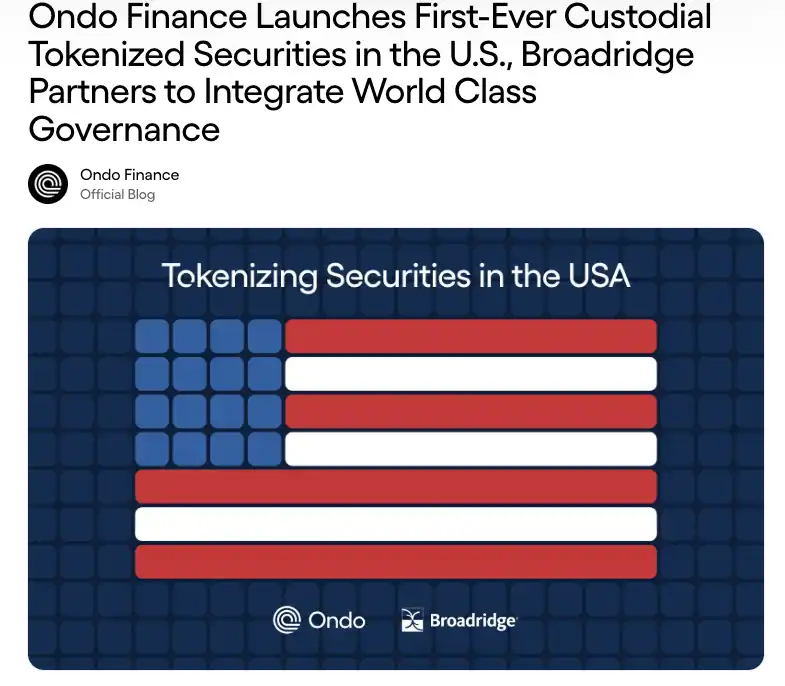
Tokenized stocks in the US finally have a version that received a regulatory nod.

According to CoinDesk, Ondo Finance announced on July 2nd the issuance of tokenized versions of BlackRock's S&P 500 ETF (IVV) and Micron Technology (MU) stock on Ethereum. This is the first production deployment of the "third-party custody model" since the SEC issued a staff statement on tokenized securities in January, and also marks the first time a US-listed security has been tokenized by a third party without leaving the country or circumventing through an offshore structure.

In a statement, Ondo CEO Ian De Bode said, "Today's milestone demonstrates that we can tokenize securities in a way that meets both market and regulatory requirements, serving US and global investors, and laying the groundwork for more US investors to participate in on-chain investments."

The First Batch of Assets Chosen Are Two of the Most Mainstream

The two assets chosen for tokenization are not obscure. IVV is BlackRock's flagship ETF tracking the S&P 500, while Micron is a star stock in the current memory chip cycle. By using a broad-based ETF and a hot tech stock to validate the new model, Ondo's intent is clear: first prove that "mainstream assets can also be brought on-chain in a compliant manner."

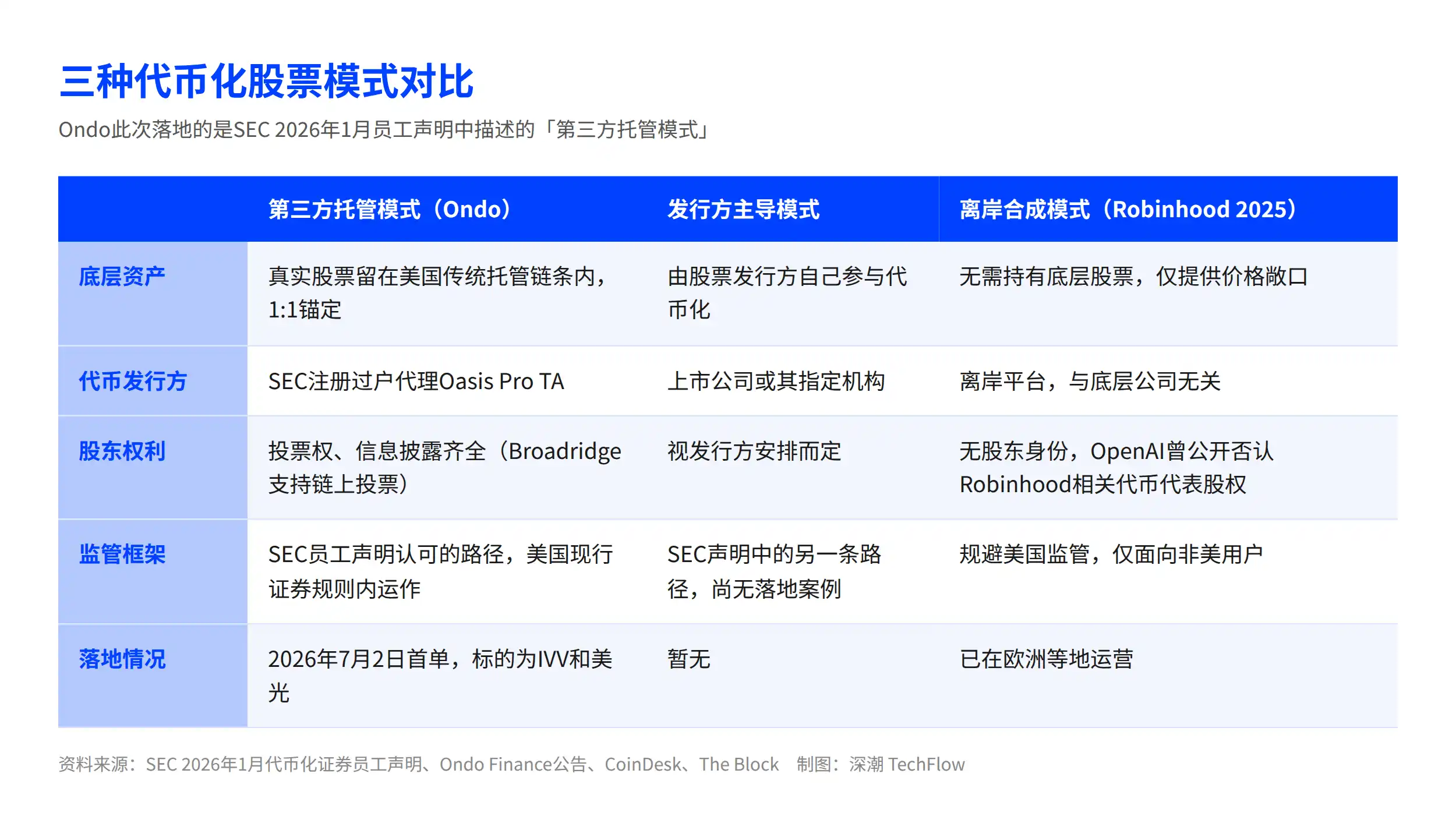
In terms of the specific structure, the underlying IVV and Micron shares remain within the US traditional custody chain, held by regulated custodians. Oasis Pro TA, an SEC-registered transfer agent acquired by Ondo last year, mints corresponding tokens on Ethereum at a 1:1 ratio. Transfer restrictions are enforced jointly by participating broker-dealers, transfer agents, and custodians.

According to Ondo, its overseas Global Markets platform has already tokenized over $1 billion worth of stocks and ETFs, covering more than 430 securities, ranking first in the industry by total value of tokenized securities. This is the company's first extension of its business into the domestic US framework.

Fundamentally Different from the OpenAI-Contradicted Robinhood Model

For the average investor, the real question worth asking about this launch is whether the purchased tokenized stock counts as equity.

Last year, this issue caused controversy. After Robinhood launched tokenized products in Europe linked to OpenAI shares, OpenAI publicly stated it had not authorized the products and warned that the tokens did not represent equity in the company. Those products belonged to a "synthetic model," where the issuer had no relationship with the underlying company, and investors only gained price exposure without shareholder status.

The SEC's staff statement in January offered another path. Under the third-party custody model, a regulated intermediary holds the real stock and issues on-chain tokens representing the holder's rights. According to The Block, Ondo's product is built precisely around this framework, where token holders receive the same shareholder rights and protections as investors in traditional brokerage accounts, including issuer notifications and on-chain proxy voting.

Put in portfolio terms, this difference means that tokens under the custody model have real shares, voting rights, and information disclosure backing them, while the synthetic model only offers a price shadow.
Wall Street Veteran Infrastructure Player Broadridge Steps In to Handle Voting

Another signal from this launch is the deep involvement of traditional financial infrastructure.

Broadridge (NYSE ticker BR) is an infrastructure giant in the US shareholder communication and proxy voting space, with a large portion of shareholder voting for US-listed companies running on its ProxyVote.com platform. In this partnership, Broadridge is responsible for providing proxy voting, regulatory disclosure, and shareholder communication services to Ondo's token holders, who can participate in voting directly on-chain.

In a statement, Doug DeSchutter, President of Broadridge's Investor Communication Solutions business, said, "By providing proxy voting, issuer communications, and regulatory disclosure for Ondo's token holders, we are delivering on our promise to provide complete, trusted governance capabilities to both investors and issuers, regardless of the structure in which assets are held."

The tokenization space has seen frequent moves recently. Robinhood launched its own public blockchain and expanded tokenized stocks beyond Europe on July 1st; the DTCC (Depository Trust & Clearing Corporation) announced in May that it would bring tokenized assets to the Stellar chain; Nasdaq received SEC approval in March to trade tokenized securities; and the NYSE has also announced related plans. According to a Citigroup report cited by CoinDesk in June, the market size for tokenized securities could reach $5.5 trillion by 2030.

Not Open to US Investors Yet; Two Risk Points to Note First

For interested readers, two points require a dose of cold water first.

First, according to CoinDesk, the product is not yet available to US investors. Ondo's current move is more about validating the architecture's feasibility; the actual timeline for opening to US retail investors is undetermined.

Second, the SEC's January statement is a staff statement, representing only the thinking direction of regulatory personnel and does not carry the force of formally adopted rules by the Commission. In other words, the compliance status of this model remains subject to potential modification by subsequent formal rules.

For ONDO token holders, as of the time of writing, ONDO is trading at around $0.33, up about 4% in 24 hours. The direct impact of the news on the token price is limited. The mid-term logic depends on when US investors can actually buy these products and whether the custody model can expand from two assets to the more than 430 securities on Ondo's overseas platform. Until these two milestones are reached, the significance of this launch lies primarily on the regulatory front, rather than the revenue front.

Preguntas relacionadas

QWhat is the core significance of Ondo Finance's recent tokenization of BlackRock's S&P 500 ETF and Micron stock according to the article?

AThe article states that this is the first production deployment of the 'third-party custody model' outlined in the SEC's January staff statement. It represents the first instance of US-listed securities being tokenized by a third party without leaving the US regulatory perimeter or using offshore structures, marking a regulatory-approved version of tokenized stocks in the US.

QHow does the 'third-party custody model' used by Ondo differ fundamentally from the 'synthetic model' used by Robinhood for its OpenAI-linked product?

AIn Ondo's third-party custody model, the underlying real stocks (like IVV and Micron) are held with regulated custodians within the traditional system, and the tokens represent direct ownership rights, including voting and receiving issuer communications. In Robinhood's synthetic model, there is no direct relationship with the underlying company; the tokens only provide price exposure without conferring any shareholder rights or ownership.

QWhich major traditional financial infrastructure company is involved in providing proxy voting services for Ondo's token holders, and what is its role?

ABroadridge (NYSE: BR), a major US shareholder communications and proxy voting infrastructure firm, is involved. It is responsible for providing proxy voting, regulatory disclosures, and shareholder communications services to Ondo's token holders, allowing them to vote directly on-chain.

QWhat are the two main limitations or risks mentioned regarding Ondo's newly launched tokenized products for potential investors?

A1. The products are currently not available to US investors. 2. The SEC's January guidance is a staff statement, not a formally adopted rule by the Commission, meaning the regulatory status of this model could potentially be changed by future official rules.

QBeyond Ondo, what are some other recent significant developments in the tokenization of securities mentioned in the article?

AThe article mentions several: Robinhood launched its own blockchain and expanded tokenized stocks beyond Europe; DTCC announced plans to bring tokenized assets to the Stellar blockchain; Nasdaq received SEC approval in March to trade tokenized securities; and the NYSE has also announced related plans. A Citigroup report estimates the tokenized securities market could reach $5.5 trillion by 2030.

Lecturas Relacionadas

Lost 10 Billion, Yet Valued at 46.7 Billion? The True Value Revelation of Japan's Crypto Exchange 'Doomsday License'

**Summary: The Priceless "Doomsday License" – Why Japan's SBI Paid $289M for a Losing Exchange** In mid-2026, Japanese financial giant SBI Holdings acquired cryptocurrency exchange Bitbank for ¥46.7 billion (~$289 million). This valuation is puzzling on paper: Bitbank, while a long-established, licensed exchange, reported a ¥970 million loss in 2025 on shrinking revenues. The key lies not in profitability, but in a regulatory "franchise scale." SBI's purchase was for Bitbank's scarce, irreplaceable assets: its Japanese FSA license, 960,000 user accounts, and a fully compliant yen on-ramp. This acquisition came just two weeks after Japan passed a landmark amendment reclassifying crypto assets as "financial instruments" under stricter laws, dramatically raising penalties for unlicensed operations. Analysts predict up to half of Japan's ~30 licensed exchanges may exit, transforming existing licenses into non-renewable strategic resources. The deal's ~8x revenue multiple mirrors a global trend of "compliance arbitrage," where acquiring regulated entities is faster and cheaper than navigating complex, years-long licensing processes. The Japanese narrative is part of a worldwide pattern. In 2026 alone, the crypto sector saw $11.8 billion in M&A, with giants like Mastercard and Bullish acquiring regulated digital asset firms. As jurisdictions like the US, Singapore, and Hong Kong solidify frameworks, regulatory compliance shifts from a cost center to the most durable moat. The core lesson is that in maturing markets, the true value shifts from trading volume to "licensed scale." For early, compliant platforms, stringent regulation becomes a defensive asset, not a constraint. SBI's strategy of consolidating licensed Japanese exchanges illustrates this. The window to acquire such "tickets to the future financial world" at a reasonable cost is rapidly closing as global capital recognizes that in the regulated era, the license itself is the ultimate prize.

marsbitHace 6 min(s)

Lost 10 Billion, Yet Valued at 46.7 Billion? The True Value Revelation of Japan's Crypto Exchange 'Doomsday License'

marsbitHace 6 min(s)

Interpreting the Latest Report from the Ethereum Foundation: Why Are Governments and Giants Focusing on Ethereum?

Decoding the Ethereum Foundation's Latest Report: Why Governments and Giants Are Eyeing Ethereum? Authored by Lanhu Notes, this piece unpacks a key report from the Ethereum Foundation's global policy team. The report, released on July 2, makes a case for why governments and institutions should view Ethereum as the optimal platform for deployment. It highlights Ethereum's unique position as the closest existing platform to a "digital public infrastructure" – a neutral, open, and uncontrolled protocol for handling value, contracts, and coordination, akin to TCP/IP for the internet. The core arguments are: 1. **Maximal Neutrality & No Single Control Point**: Ethereum has no central owner, backdoor, or kill switch. It's maintained by thousands of independent nodes and hundreds of thousands of validators globally, making it resistant to unilateral control by any single entity—a critical feature for sovereign and institutional users. 2. **Proven Resilience & Unmatched Security**: Since its 2015 launch, Ethereum has maintained a perfect uptime record. Its security is backed by approximately $76 billion in staked ETH (as of March 2026), making any attack economically irrational and prohibitively expensive (estimated over $50 billion). 3. **Large-Scale Real-World Adoption**: The network hosts over $159 billion in stablecoins. Major financial institutions like BlackRock and JPMorgan are already using it for real-world asset (RWA) tokenization. Governments, including Bhutan and India, are deploying it for applications like national digital identity and tamper-proof land registries. 4. **Comparative Advantages**: Ethereum offers greater transparency and lower costs than traditional intermediaries. It is more open and neutral than permissioned/private chains. Compared to other public blockchains, it boasts superior maturity, the largest developer ecosystem, the biggest economy, and the highest proven security. In summary, the report positions Ethereum, backed by data, real-world use cases, and clear comparisons, as the emerging neutral public layer for global value settlement and coordination.

marsbitHace 7 min(s)

Interpreting the Latest Report from the Ethereum Foundation: Why Are Governments and Giants Focusing on Ethereum?

marsbitHace 7 min(s)

Aave V4 to Move Wall Street Securities Financing On-Chain: Composability Layer Transforms from Risk Point to Backbone

Aave V4 aims to bring Wall Street securities financing on-chain, targeting the massive traditional markets for repo, securities lending, and margin financing. It proposes three core products: securities-backed loans, atomic repo settlements, and securities lending. This shifts the narrative from "RWA as collateral" to building foundational "on-chain securities finance infrastructure." The key innovation lies in its third-layer approach: composability. V4 doesn't alter underlying asset credit but systematically connects all on-chain assets to leverage and liquidation mechanisms, making composability the system's backbone instead of just a risk point. Aave's dominant market share and its relatively prudent engineering for its Horizon institutional RWA lending market support this ambition. However, a critical design choice introduces a new risk dimension. The "centralized liquidity Hub + multiple Spoke" architecture and Horizon's shared liquidity pools prioritize capital efficiency by allowing new assets instant access to deep liquidity. The trade-off is the loss of risk isolation: a problem with one collateral type in a stress period can draw from the same stablecoin pool backing all others, spreading risk across the entire market. This risk is not theoretical, as demonstrated by a 2026 incident where compromised collateral from a bridge attack created bad debt on Aave. As the system scales—with Horizon targeting over $1B—it remains untested in a genuine credit or liquidity crisis. The first significant bad debt or forced liquidation in RWA markets will likely be triggered by a price/net asset value dislocation of a tokenized asset during stress, not by an underlying default. The implications are clear: institutions providing collateral must account for potential NAV-price gaps; liquidity providers must understand they are exposed to all collateral in a shared pool; and protocols must explicitly choose between risk isolation and capital efficiency. The market still focuses primarily on credit risk, while tokenization continues to concentrate new risks in the liquidity and composability layers.

marsbitHace 11 min(s)

Aave V4 to Move Wall Street Securities Financing On-Chain: Composability Layer Transforms from Risk Point to Backbone

marsbitHace 11 min(s)

Ethereum Forms Three Major Power Centers, Commercial Lifeline Held in the Hands of Major ETH Holders

Ethereon has established a new tripartite power structure to separate its core protocol development from commercialization efforts. The Ethereum Foundation, having lost several executives, now focuses solely on maintaining protocol principles like neutrality and censorship resistance. To handle business outreach and technical advancement, two new independent entities have been formed: Ethereum Institutional, which is dedicated to promoting Ethereum's tokenization and stablecoin use to major banks and asset managers, and Ethlabs, a research group focused on improving on-chain settlement and strengthening ETH's monetary narrative. Both organizations are funded by major ETH holders Bitmine and Sharplink, who collectively control over 5.4% of ETH's circulating supply. This structure aims to resolve the conflict between the Foundation's neutral stance and the need for aggressive commercialization. The success of this model is tied directly to ETH's price performance. Bullish prospects rely on Ethereum's dominant position in stablecoins, DeFi, and tokenized assets, with potential growth fueled by institutional adoption facilitated by the new entities. Bearish risks highlight ETH's price volatility and the dependency of the new organizations on their funders' financial health, which is itself linked to ETH's value. The future trajectory of this institutional framework will be largely determined by which of these market trends prevails.

Foresight NewsHace 12 min(s)

Ethereum Forms Three Major Power Centers, Commercial Lifeline Held in the Hands of Major ETH Holders

Foresight NewsHace 12 min(s)

Trading

Spot
活动图片