By Sleepy
AI may redefine the future, but to this day, it cannot replace the dignity inherent in labor.
On May 20th, wage negotiations between Samsung Electronics and its union nearly broke down. The union originally planned to launch an 18-day strike starting May 21st. At the last minute, both sides reached a temporary agreement, pausing the strike for now, pending a vote by union members. However, the underlying issues have not disappeared.
Strikes are not unfamiliar to us.
Those past events were also heavy, occurring in old industrial bases, automotive supply chains, and foreign trade factories reliant on cheap manual labor. The keywords were always low wages and unpaid dues. Initially, people were taken for granted as durable consumables, settled within plans named "the greater good." Only when life became suffocatingly oppressive did people suddenly realize they hadn't devolved into iron components. So, they straightened their backs within that cold order and made a bit of human noise.
But this time is different.
This time, it's the workers of Samsung Electronics who are standing up.
They are not workers left with no retreat in the tide of globalization, but people located at the very heart of the AI supply chain, closest to the "future." Within Samsung's colossal chaebol machinery, this giant controlling the lifeline of global semiconductors is being paused by its own workers.
A Strike That Endangers Global AI
This strike is precisely choking the throat of the global AI industry chain.
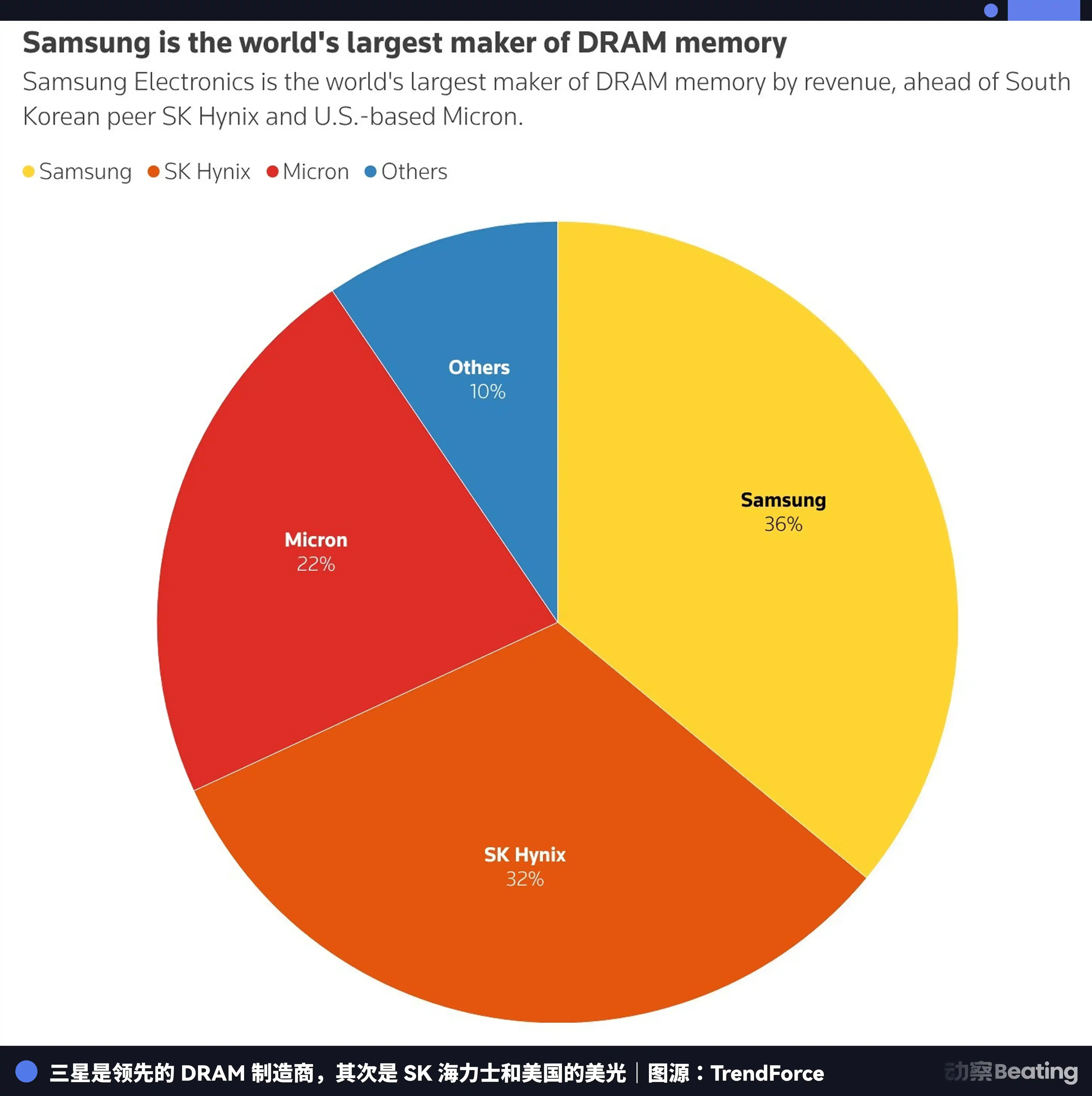
Samsung and SK Hynix together produce roughly two-thirds of the world's memory chips.
Memory chips, while always important, weren't considered a particularly glamorous business. Until AI arrived, and they suddenly became a strategic battleground. Large model training, inference, data center expansion—GPUs alone aren't enough. Data needs to be fed, stored, and retrieved at high speeds, requiring High Bandwidth Memory (HBM) and other solutions.
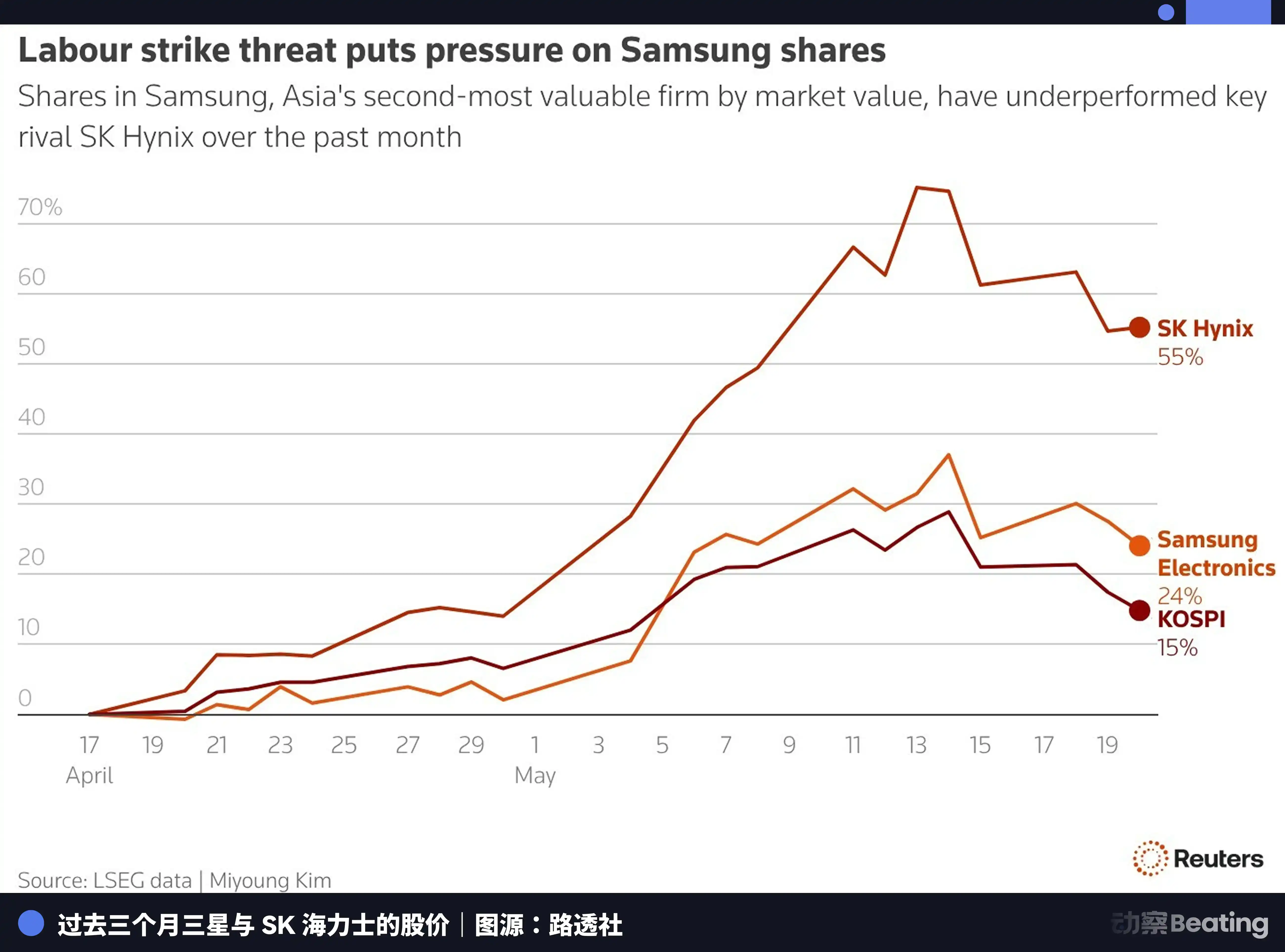
According to estimates by KB Securities analyst Jeff Kim, this 18-day strike could disrupt 3% to 4% of global DRAM supply and 2% to 3% of NAND supply. While not apocalyptic, it's enough to tighten nerves around price expectations, customer production schedules, cloud provider costs, and tech stocks.
The South Korean government is even more on edge. Because Samsung is no ordinary company; it's more like an embodiment of national strength.
Yonhap News reported that semiconductor exports account for about 35% of South Korea's total exports. In Q1 2026, South Korean exports hit a record high of $219.9 billion, with semiconductor exports growing 139% year-on-year to $78.5 billion.
Samsung alone accounts for about a quarter of the KOSPI market capitalization. In other words, a tremor in Samsung's production lines doesn't just shake one company's profit sheet; it shakes South Korea's exports, stock market, currency expectations, and the nation's narrative confidence.
More crucially, AI arrived too suddenly. South Korea's past tech power narrative was about phones, displays, cars, appliances, and semiconductors. Now, the global narrative is reshuffled by large models, with the spotlight on OpenAI, Google, Anthropic, China's batch of large model companies, and compute giants like Nvidia. South Korea naturally wants its own sovereign AI, and the government is promoting national AI infrastructure, with Nvidia announcing plans to deploy over 260,000 AI chips in South Korea. But South Korea knows that relying solely on models, it's hard to exert overwhelming international influence squeezed between the two superpowers, the US and China.
What it truly holds is the harder, heavier, less glamorous path: memory chips, HBM, DRAM, NAND, advanced manufacturing, and the underlying supply chain that feeds AI data centers. This is why Samsung is more important today than ever.
The further AI runs, the more the world realizes that large models aren't magic floating in the cloud. They need electricity, GPUs, and also memory. South Korea might not change the world with one model, but it can make the world's models inseparable from its chips.
The AI industry loves to talk about computing power, models, giants' games, and who disrupts whom.
The Samsung strike suddenly yanks everyone back down to earth. No matter how high the computing power, it ultimately lands on factories, shifts, bonus formulas, and labor negotiations.
The future isn't floating in the cloud. The future also needs to pay wages.
Why Are They Striking?
The union's core demands are several:
A 7% increase in base salary;
Allocating 15% of Samsung's annual operating profit to an employee bonus pool;
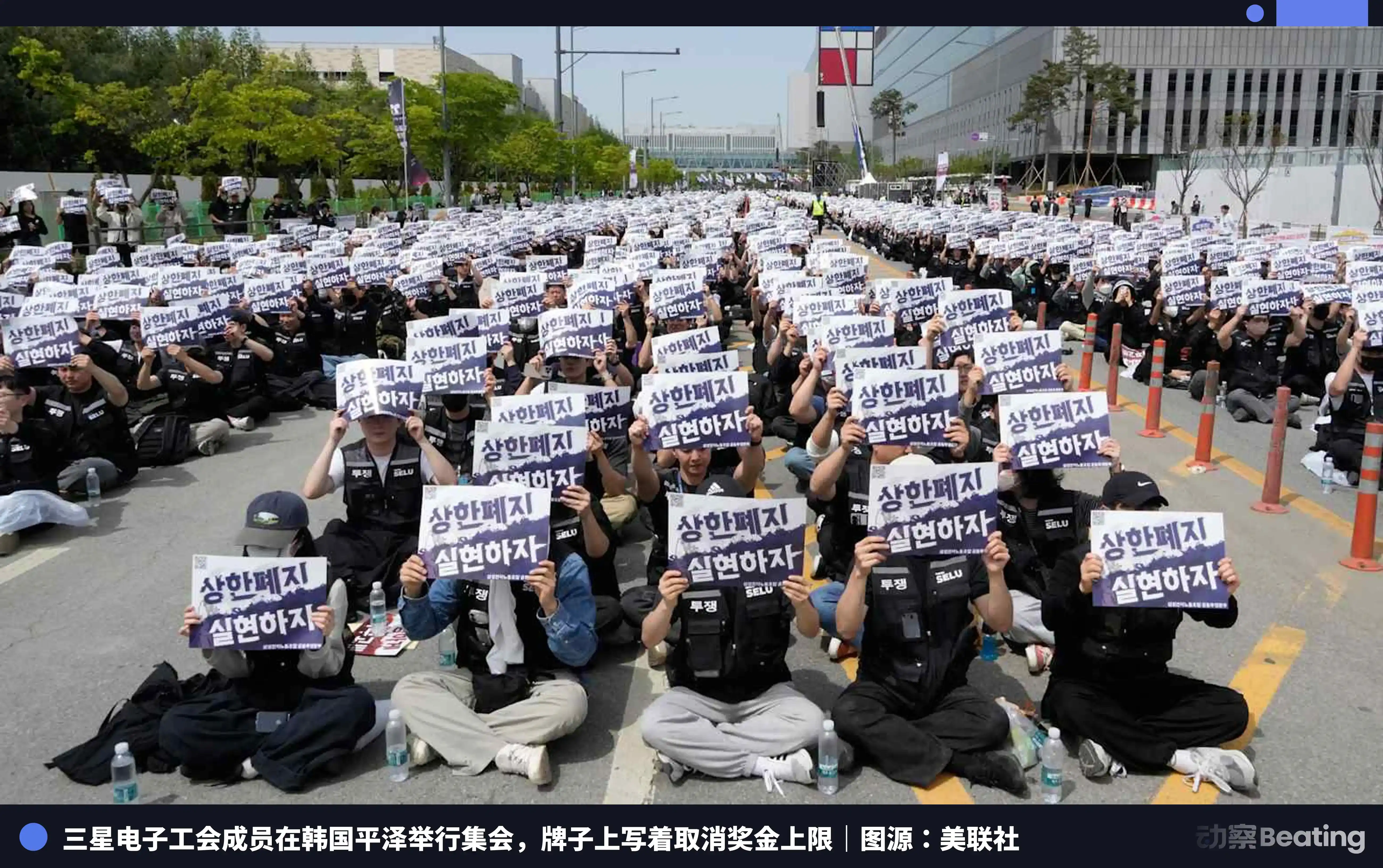
Abolishing the current bonus cap of about 50% of annual salary, and clarifying how bonuses are calculated, when they are paid, and whether they will be counted in the future.
Samsung disagrees. The company considers the union's demands excessive, especially if extending high bonuses to loss-making business divisions, which would break the rule of "those who make profits get more bonuses."
Reportedly, a key point of contention in the final mediation was precisely the issue of profit sharing among different divisions within the semiconductor department. The memory business is profitable, while other businesses are under pressure or even losing money. Should large bonuses also be given to employees in loss-making divisions?
In modern large corporations, ordinary employees less and less negotiate money directly with the boss. Money is tucked into things that seem objective: performance, coefficients, costs, cycles, business units, profit margins, bonus caps.
Samsung's bonuses have long been tied to a complex formula. Korean media repeatedly mention a term called EVA. The gist is that profits must first deduct taxes, investments, and various capital costs, with the remainder counting toward bonuses. The financial logic is fine, but it's hard for people to accept. Employees don't understand: Since company profits are rising, why isn't my bonus moving? Did I lose on performance, or did I lose to this formula? Does my sweat even count as contribution in the company's eyes?
The reason Samsung employees' anger has built up to today's eruption is because they have a mirror beside them: SK Hynix.
SK Hynix secured an excellent position in the AI memory field, shining brightly in the HBM supply chain. More importantly, it knows how to convert this glory into tangible numbers on employees' paychecks.
In September 2025, SK Hynix and its union agreed on new rules: Over the next ten years, the company will allocate 10% of its annual operating profit to employees each year, and the previous bonus cap was abolished.
JoongAng Ilbo reported then that under the new agreement, employees were expected to receive about 100 million won in bonuses that year, approximately 450,000 RMB. By early 2026, Seoul Economic Daily, based on the company's 2025 performance, reported that SK Hynix's approximately 34,500 employees would receive performance bonuses averaging about 140 million won, roughly 630,000 RMB.
Even more exaggerated, Seoul Economic Daily cited an FnGuide prediction that SK Hynix's 2026 operating profit might reach 230.0885 trillion won. Ten percent of that is about 23 trillion won in bonus pool. Simply dividing by 34,549 employees gives an average of about 670 million won per person, approximately 3.04 million RMB.
The neighbor has already served the meat from the pot. At this point, when Samsung employees hear the company talk about EVA, capital costs, and departmental differences, of course they get angry.
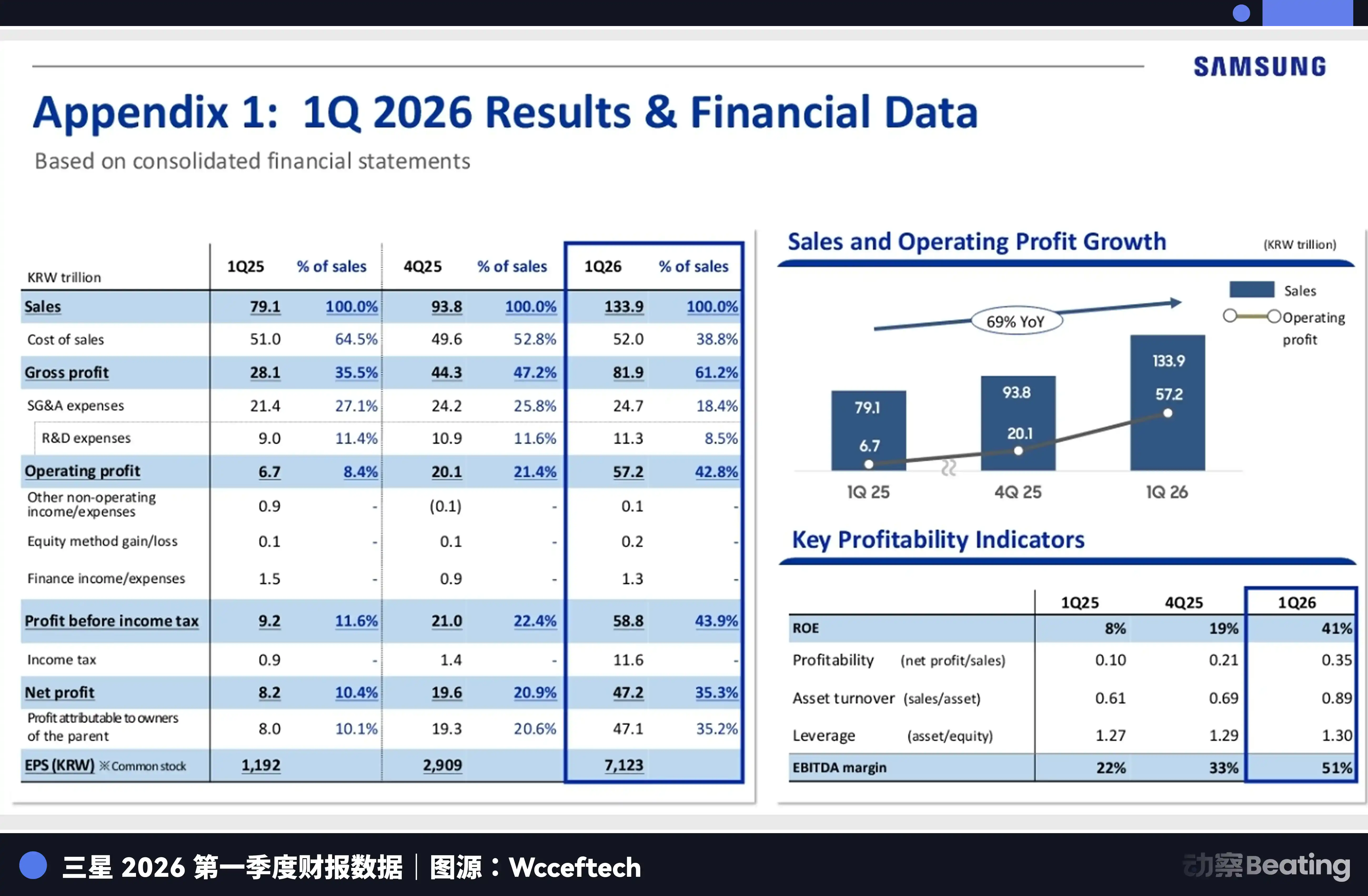
Samsung's official financial report shows that in Q1 2026, consolidated revenue reached 133.9 trillion won, a historic quarterly high; operating profit reached 57.2 trillion won. The semiconductor division's Q1 revenue was 81.7 trillion won, with an operating profit of 53.7 trillion won. The money mainly came from AI-related demand, such as high-value-added AI memory, rising industry memory prices, HBM4, and AI data center expansion.
The awkwardness lies right here.
When the company loses money, people have no leverage. The boss advises everyone to endure, saying the cycle will turn. Employees may not be convinced, but there's indeed no visible profit on the books, so they let it go. But when the company becomes prosperous again, and the fat meat is genuinely served on the table, who gets the chopsticks, who sits at the head, and who can only stand by smelling the aroma—these things can no longer be glossed over with sentiment.
The Root of the Problem
To understand why Samsung has made its employees so angry today, one cannot look only at a payslip. One must look back at the long-tightened line between Korean chaebols and workers.
South Korea's modernization process was more like a forced march led by the state. Large companies were pulled to the front, with workers following, heads down. This vehicle indeed ran fast, but the allocation of seats was never determined through discussion.
Post-war South Korea was destitute. Starting from the Park Chung-hee era, the state became the chief dispatcher of industrialization, vigorously supporting chaebols to seize orders, build factories, and catch up on technology. Samsung, Hyundai, SK—these names gradually became the face of the nation. They were preset as flag-bearers who must win, because South Korea needed this victory. For this, the state handed over resources, banks handed over loans, and society handed over endless endurance, while factories were left with iron-clad discipline.
Within this system, the role of labor was clear: Build the nation first, grow the company first, endure a little. Wages can come later, rights can come later, unions can come later, dignity can be discounted for now. The car isn't moving yet, don't ask if the seat is comfortable.
1987 was a watershed. Cracks appeared in the ironclad order. Workers emerged from factories through the cracks. Unions took root in large enterprises. Workers were no longer willing to be just a blurry background in grand narratives like the "economic miracle." They stepped forward, demanding wages, safety, and, more importantly, to be treated as living creators, not worn-out parts to be casually discarded.
But Samsung was a long-standing exception. Samsung's "no union management" was a long-standing part of its corporate culture. In 2019, Samsung executives and employees were implicated in various ways for interfering with or obstructing legal union activities. Samsung Electronics board chairman Lee Sang-hoon went to prison for union busting. In 2020, Lee Jae-yong publicly apologized, pledging to abolish the chaebol's old ways. Only then did the iron curtain at Samsung crack open a bit.
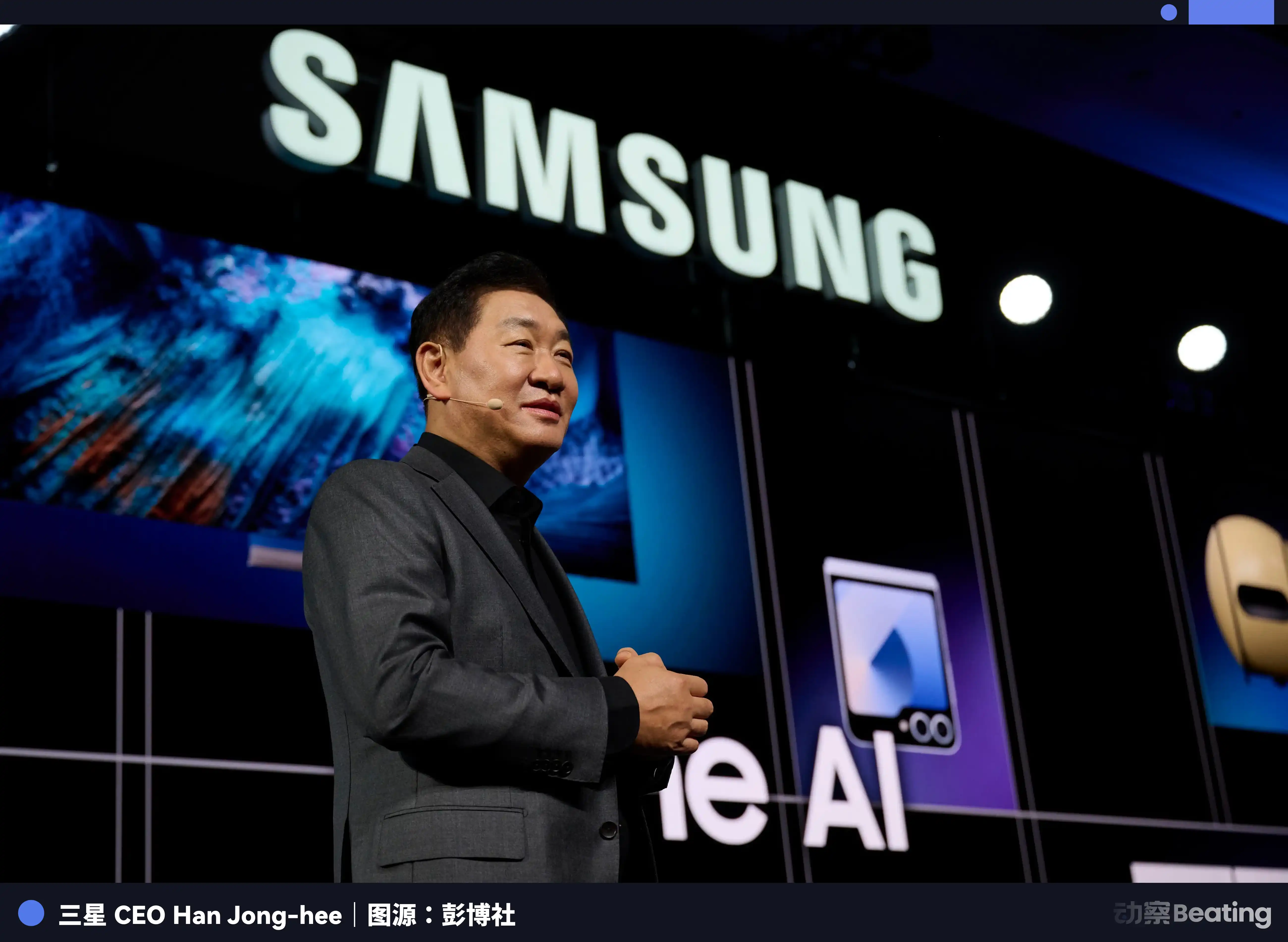
Therefore, this strike is not abrupt. Behind it lies post-war Korean industrialization, the chaebol's old methods, the labor movement after 1987, Samsung's long-standing no-union tradition, and that belated apology in 2020.
The most hurtful part of this whole affair is not the money, but that some capitalists are only willing to "share hardship" but not "share prosperity."
When the company is in difficulty, employees are often asked to be like family. When the company makes money, employees are reminded it's a company. The first sentence speaks of emotion, the second of systems. The problem is, people have emotions not only during hardship.
Writing here, it's no longer just a Korean story.
Weathering difficulties together, reducing costs and increasing efficiency, improving quality and efficiency, embracing AI, enhancing human efficiency, optimizing costs. These are all phrases too familiar to each of us now.
This might be the most unseemly aspect of the AI era.
We thought AI would liberate people from labor. Often, the result is that people must adapt to AI to save the company money; people must learn AI to make departments more efficient; people must accept job reassignments, performance reevaluations, and salary adjustments. As for the dividends, someone always advises you to wait, don't be impatient; the company still needs to invest, needs R&D, needs to withstand cycles, needs to maintain competitiveness.
These reasons might all be true. But the problem is, if they only ever push in one direction, they become a very decent excuse. In reality, many companies often act this way too. Money is earned together, but when it comes to discussing how to divide it, you'd better not interrupt.
Samsung workers are now interrupting.
But their interruption doesn't guarantee victory. The South Korean government might use emergency mediation, courts have already restricted some actions, and Samsung has complex production and legal tools. A semiconductor factory isn't a small workshop that can be easily shut down, and a union cannot stop such a precise system without cost. The real world isn't a satisfying revenge story; labor doesn't easily achieve victory.
Snowpiercer
In Bong Joon-ho's "Snowpiercer," humanity is crammed onto a train that must not stop.
The front is order, technology, the future; the tail is crowded, silent, and preordained fate. The story's sharpest sting isn't the forced segregation of compartments, but that everyone accepts one premise: the train must not stop.
As long as the train must keep moving forward, then in which compartment you suffer, and whether you eat cockroaches, all become "necessary costs" to maintain the system's operation. For that grand momentum, specific living people always seem expendable.
Samsung's strike is similarly trapped on a train that "must not stop."
Wafers must not be damaged, production lines must not stall, AI servers must not wait, South Korea's export data absolutely must not fall, and global tech companies don't want to see memory chip prices pushed higher again. Every reason is so correct it's unarguable, and loudly proclaimed. From the standpoint of the national economy, Samsung must not stop; in the ledger of the global supply chain, Samsung must not stop; in the undecided AI race, Samsung absolutely must not stop.
The more a machine is forbidden to stop, the more the people inside are asked to endure.
Endure the production line, endure the cycle, endure performance reviews, endure company strategy, endure global competition. Enduring to the end, people find they are always making way for something bigger. Bigger like the enterprise, bigger like the industry, bigger like the future.
Ordinary lives seem small before these big words, small like a screw. But screws also have their metal fatigue.
What the Samsung union is doing this time does not negate the benefits AI brings to the world, does not deny the semiconductor industry, and certainly does not say technological progress is unimportant.
It's not the old story of the poor rebelling against the rich, nor is it a small story about high-paid employees getting more bonuses.
It actually touches on one of the most unsettling propositions of the AI era: As technology becomes more advanced, will labor become increasingly silent? As machines become more massive, is ordinary people's bargaining power destined to shrink? As growth becomes more dazzling, will the certainty of our lives become increasingly weak?
We love to talk about the future, and the word "future" is indeed useful. It's like a high-wattage spotlight, always illuminating the blueprints at launch events, the ambition in financing plans, and those fluctuating company valuations. But the future cannot only illuminate the front of the train; it must also move toward the tail, shine on the grueling night shifts, the badges on chests, the resumes in graduates' hands, shine on those who are told all day to "embrace change" but are shown the door when the good fruits are being divided.
The Samsung strike might ultimately end with compromise, arbitration, partial concessions, or a new bonus formula. Labor negotiations often go like this, starting dramatically and ending with a set of ratios, a piece of paper, and a few cautiously worded announcements. The news cycle will pass, stock prices will continue to fluctuate, AI companies will still release new models, and servers will devour more chips.
But some questions won't disappear with the negotiation table.
What most needs questioning in the AI era isn't just how strong the computing power is, how fast the models are, or how expensive the chips are. We need to ponder more: Can those who physically pull the "future" into reality finally receive a share of a certain life from that future?
This sentence may not sound grand enough, but what ordinary people want isn't grand. It's nothing more than work that has value, income with clear terms, a life with hope, and not being easily cast aside when the times take a turn.
The future must certainly move forward. But a train truly headed toward the future cannot have only its front brightly lit.


















