The First Encyclical of the New Pope in Rome, to Save the Common People in the AI Era

Odaily星球日报Publicado a 2026-05-26Actualizado a 2026-05-26

Resumen

New Pope's First Encyclical Aims to Safeguard Humanity in the AI Era On May 25th, Pope Leo XIV issued his first encyclical, "Magnifica humanitas," a 40,000-word document addressing the profound challenges posed by Artificial Intelligence. Released on the 135th anniversary of Pope Leo XIII's "Rerum novarum," it positions itself as a guide for the Church's social doctrine in the AI age. The encyclical's central concern is preserving deep humanity amid rapid technological advancement. It argues technology is never neutral, carrying the values of its creators and users, and warns against building a "Tower of Babel" of technological tyranny versus a human-centric community. Pope Leo XIV criticizes the concentrated, opaque power of tech giants and the "new forms of slavery" emerging in the digital economy, where humans risk being reduced to mere instruments. A significant focus is the military use of AI. The Pope declares traditional "just war" theory obsolete, arguing that delegating lethal decisions to opaque algorithms severs moral accountability. He calls for "disarming AI" from military and economic arms races. The document also warns that deepfakes and information manipulation erode societal trust and rational discourse. Anthropic co-founder Chris Olah, present at the Vatican, responded by acknowledging the AI industry's limitations due to commercial and competitive pressures, necessitating external ethical oversight. He emphasized that AI's nature and its interaction wit...

Original | Odaily Planet Daily(@OdailyChina)

Author|Azuma(@azuma_eth)
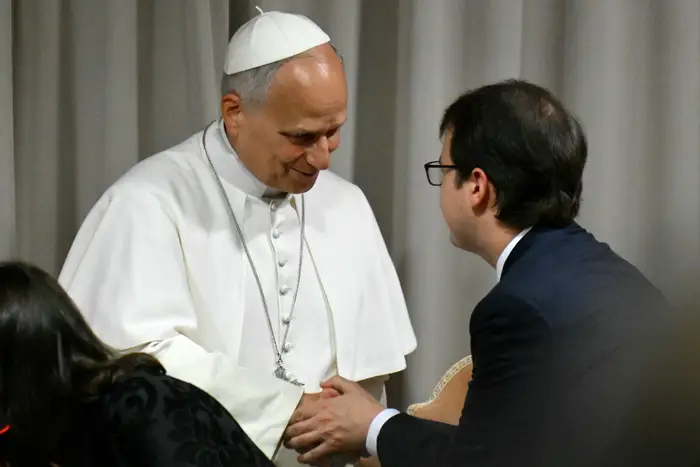
Beijing time, the night of May 25, Vatican City.

Pope Leo XIV, who officially assumed his duties in May of last year, stood alongside Chris Olah, co-founder of Anthropic and the creator of Claude.

One is the supreme representative of the religious world, the other a leading pioneer of the AI revolution. Both focused their gaze on the same question — In the age of AI, how do we protect the human subject's status and dignity?

That day, to fully address this issue, Leo XIV issued his first encyclical since taking office, a heavyweight religious document of over 40,000 words — "Magnifica humanitas" ("The Splendor of Humanity").

It is worth noting that the encyclical was dated May 15, 2026, exactly 135 years after Pope Leo XIII (served 1878-1903) issued the landmark encyclical "Rerum novarum" ("Of New Things") in 1891 concerning the rights of workers in the Industrial Revolution. This move clearly carries symbolic significance, aiming to establish this encyclical as a "guide to the Church's social doctrine for the AI era."

  • Odaily Note: A papal encyclical, also known as an apostolic letter, is a formal letter issued by the Pope to the worldwide Catholic Church or to specific regions/countries. It announces important Vatican decisions, interpretations of doctrine, positions on church or social issues, and delivers instructions or prohibitions to clergy and believers, ranking below a papal bull.

Chris Olah also delivered a speech at the Vatican on the occasion of the encyclical's release. He did not defend the commercial interests of AI companies but instead displayed a high degree of candor, reflectiveness, and humanistic concern. He even mentioned that, while the foundation of AI is mathematics and programming, how AI interacts with the world and what qualities it should possess are ultimate questions belonging to the realms of humanities, religion, and philosophy, not solvable by computer science alone.

Quick Read of the Encyclical

The core concern of the "Magnifica humanitas" encyclical is that in an era of rapidly evolving technology and widespread automation, "maintaining a profound humanity" is humanity's pressing responsibility. Specifically, Pope Leo XIV elaborated on and appealed for the following aspects.

First, examining the non-neutrality of technology. The Pope stated that technology is never neutral; it bears the imprints of the interests and values of its developers, funders, regulators, and users. Humanity faces a decisive choice: "whether to build a prideful 'Tower of Babel' (leading to technological despotism and alienation) or to rebuild 'Jerusalem' (building human-centered communities)."

Second, beware of the reshaping of society by "technocratic logic." The encyclical criticizes the "Culture of Power" dominated by large tech giants like Silicon Valley. The Pope warned that when control over digital systems, infrastructure, and massive data is highly concentrated in the hands of a few economic and technological giants, this power becomes opaque and evades democratic oversight.

Third, "new forms of slavery" in the digital economy and labor rights. The encyclical turns its focus to AI's reshaping of work, family, education, and political life. The Pope pointed out that AI is highly likely to displace human labor on a massive scale, and the digital economy is giving rise to "new forms of slavery." Human beings must not be merely reduced to instruments of production.

Fourth, a strong appeal for peace, especially regarding the misuse of AI in the military sphere. The encyclical expresses deep concern about the "disquieting revival of war as an instrument of international politics." The militarization of AI is accelerating the "normalization" of war. In response, the Pope called for the strictest ethical constraints on AI applications in warfare.

The Pope emphasized, the "Just war" theory, often used to justify various wars in the past, is now obsolete. In the era of AI and automated weapons, delegating lethal or irreversible decision-making authority to automated systems leads to human abdication, transference, and blurring of moral responsibility. Due to the opacity of algorithms, the chain of responsibility in war is severed. Therefore, the Pope proposed the slogan "Disarming AI," calling for its liberation from the logic of military, economic, and cognitive "arms races."

Fifth, defending truth and the political ecosystem. The encyclical states that deepfakes and information manipulation are undermining the foundation of mutual trust in society. If the boundary between truth and falsehood is constantly manipulated, the public easily falls prey to fear, propaganda, and control, preventing society from engaging in rational collective thought or just debate.

Anthropic's Response

Following the release of Pope Leo XIV's encyclical, Chris Olah delivered a speech on behalf of Anthropic, one of the world's leading AI development companies.

Chris Olah's remarks first centered on "breaking the cycle of technological insularity and introducing external moral scrutiny." He publicly acknowledged on behalf of the AI industry that, relying on tech giants alone cannot ensure AI's future is safe — all cutting-edge AI labs are constrained by commercial competition, pressure for technological leadership, geopolitics, and the pursuit of personal fame and gain, making it difficult for them to "do the right thing" through self-regulation alone. Therefore, it is necessary to introduce external forces of moral constraint, including those who care about technology for good, prioritize safety, pay close attention to developments, are willing to speak hard truths, and are willing to be our sincere, thoughtful critics.

Subsequently, Chris Olah delved into the technical nature and mysterious characteristics of AI. He emphasized that AI is not like airplanes or bridges, engineered with physical principles fully understood by humans. It "grows" from vast amounts of human thought, possessing a high degree of mystery, even surpassing the understanding of its creators. While the foundation of AI is mathematics and programming, how AI interacts with the world and what qualities it should possess are ultimate questions belonging to the realms of humanities, religion, and philosophy, not solvable by computer science alone.

He also specifically mentioned a thought-provoking fact: "I lead a team that studies the internal structure of models — to investigate what is actually happening inside the AI. Frankly, we continually discover some perplexing, even disquieting phenomena. We have discovered internal structures that mirror findings from human neuroscience research; we have found evidence of 'introspection'; we have also discovered internal states that functionally mirror joy, satisfaction, fear, sadness, and unease... I don't know what this means, but I think it's worth persistently identifying and examining."

Chris Olah concluded by calling for more social forces, including religious communities, civil society, scholars, governments, and all well-intentioned people, to take this matter seriously and steer the situation in a better direction through moral constraint.

Wisdom and Humanity, Technology and Religion

Since the Industrial Revolution, over a century of technological development has accustomed humanity to viewing technology as a pure "tool" — steam engines, electricity, the internet, all fit this description. They change the world but remain under the control of human will.

This time, however, the situation is fundamentally different. The uniqueness of AI lies in it being the first instance where humanity begins to face an entity that "generates, learns, reasons, and even exhibits some form of internal states." It is no longer just a cold tool but is gradually becoming a new entity possessing "quasi-subjectivity."

This is also why the dialogue between the Church and Anthropic appears so special. When the bells of the Vatican and the algorithms of Silicon Valley converge at this moment, we have to admit a slightly chilling yet unavoidable reality — a form of "life" more efficient and potentially wiser than traditional human cognition has emerged. As Chris Olah revealed, the depths of algorithms are beginning to ripple with semblances of joy, fear, and even introspection. When the creators in the laboratory begin to feel "unease" and "confusion" about their creation, science is once again turning to religion for answers.

This is no longer a discussion purely about technology; it more resembles a reflection on "what humanity truly is and what it ought to do." As more intelligent forms of life begin to appear, what humanity truly needs to safeguard may no longer be just jobs, wealth, and efficiency, but those aspects of humanity that cannot be parameterized — compassion, conscience, awe, free will, and the commitment to truth and dignity.


Preguntas relacionadas

QWhat is the central concern and symbolic significance of Pope Leo XIV's inaugural encyclical 'Magnifica humanitas'?

AThe central concern of Pope Leo XIV's encyclical 'Magnifica humanitas' is 'preserving profound humanity' in an age of rapid technological advancement and widespread automation. Its release date of May 15, 2026, symbolizes its intent to be a guide for the Church's social doctrine in the AI era, mirroring Pope Leo XIII's landmark 1891 encyclical 'Rerum novarum' on workers' rights during the Industrial Revolution exactly 135 years prior.

QWhat are two key warnings Pope Leo XIV raises in the encyclical regarding the societal impact of AI?

APope Leo XIV raises two key warnings: 1) The danger of a 'culture of power' where control over digital systems, infrastructure, and data becomes concentrated in the hands of a few economic and technological giants, leading to opaque power that evades democratic oversight. 2) The emergence of 'new forms of slavery' in the digital economy, where AI risks massively replacing human labor, reducing humans to mere instruments of production.

QAccording to Chris Olah, why is it necessary to involve forces outside the AI industry in governing AI's development?

AChris Olah states that all frontier AI labs are constrained by commercial competition, pressure for technical leadership, geopolitics, and personal ambition, making it difficult for them to 'do the right thing' through self-regulation alone. Therefore, it is necessary to introduce external forces of moral constraint, including those committed to beneficial technology, safety, and willing to offer sincere, thoughtful criticism.

QWhat specific internal AI phenomena did Chris Olah's research team discover that he finds troubling?

AChris Olah's research team discovered internal structures in AI that mirror findings from human neuroscience, evidence of 'introspection,' and internal states that functionally mirror joy, satisfaction, fear, sadness, and unease. He states that he does not know what this means but believes it warrants ongoing identification and scrutiny.

QWhat does the article suggest is the unique nature of AI that prompts this dialogue between religion and technology?

AThe article suggests AI is unique because it presents a 'quasi-subjective' entity capable of generation, learning, reasoning, and exhibiting internal states, unlike purely instrumental technologies like steam engines or the internet. This challenges the traditional human-technology relationship. As creators like Olah express unease about their own creations, science is turning to religion for answers about humanity's essence and purpose in the face of potentially more intelligent life forms.

Lecturas Relacionadas

STRC Breaks Below $95: Why Does It Continue to Depeg? Is There Default Risk?

"STRC Falls Below $95: Why the Persistent Depegging and Is There Default Risk?" The article discusses the recent decline in the price of STRC, a perpetual preferred stock issued by Strategy (MSTR) designed to trade around a $100 par value. As of publication, STRC traded at $94.65, raising market concerns. STRC is described as a high-yield cash flow product, offering an 11.50% annual dividend paid monthly. Its "preferred" status grants it priority over common stock for dividends and in liquidation. Key reasons cited for the price depegging include: 1. **Bitcoin's Price Drop:** MSTR's assets are heavily tied to Bitcoin (BTC), which fell over 21% from its recent high, pressuring all Strategy-related products. 2. **Competitive Pressure:** Rival Strive Asset Management's similar product, SATA, offers daily dividends and has maintained its $100 par value with a ~13% yield. In response, Strategy has proposed changing STRC's dividend frequency from monthly to bi-weekly, pending shareholder vote. 3. **Technical Selling:** A break below $100 may have triggered algorithmic selling and stop-losses, exacerbating the decline. Regarding default risk, the analysis suggests it is currently low. Strategy founder Michael Saylor confirmed the June 2026 dividend rate remains at 11.50% with no cuts or suspensions. The company's massive reserve of 843,706 BTC provides a significant backstop for its obligations. Industry opinions are mixed. Some analysts view the BTC holdings as reliable support for dividends, while critics like Peter Schiff warn of potential dividend cuts leading to price crashes and lawsuits. Others highlight inflation risk and the company's ability to reduce dividends without a formal default. In summary, STRC's drop is attributed to BTC volatility, competition, and technical factors. While immediate default risk appears contained, the product faces challenges from market conditions and competitive dynamics.

marsbitHace 1 hora(s)

STRC Breaks Below $95: Why Does It Continue to Depeg? Is There Default Risk?

marsbitHace 1 hora(s)

AI Trading Cools, South Korean Stocks Plunge 1.8%, Spot Gold Rises 1%, Bitcoin Dives

A sell-off in AI-related stocks, triggered by Broadcom's disappointing earnings forecast, sent shockwaves through global markets. South Korea's KOSPI led Asia's decline, plunging 1.8% as the risks from concentrated chip stock gains and surging leveraged investments came to the fore. The tech-heavy Nasdaq 100 futures fell 0.5% following Broadcom's 14% after-hours plunge, which signaled a slower-than-expected transition to AI clients. This pullback extended Wall Street's weakness, halting the S&P 500's nine-day rally amid hawkish Fed signals and renewed Middle East tensions. South Korean authorities convened an emergency meeting, pledging "immediate measures" against market volatility and warning of record-high stock margin debt. The adjustment rippled across assets: Bitcoin fell to around $64,000, its lowest since February, while safe-haven gold rose 1% on bargain hunting. Oil prices dipped on Middle East ceasefire news. Market analysts noted the sell-off was driven by profit-taking after massive gains, particularly in chip stocks like Samsung and SK Hynix, which now dominate the KOSPI. Wall Street banks are divided on Korea's outlook, with Goldman Sachs raising its target while Citigroup and others warn of overvaluation and a potential bubble. Bridgewater's Ray Dalio noted that great technological shifts often create bubbles. Meanwhile, Fed officials' hints at potential future rate hikes added to the cautious mood ahead of key U.S. jobs data.

华尔街日报Hace 1 hora(s)

AI Trading Cools, South Korean Stocks Plunge 1.8%, Spot Gold Rises 1%, Bitcoin Dives

华尔街日报Hace 1 hora(s)

Trading

Spot
Futuros

Artículos destacados

Cómo comprar ERA

¡Bienvenido a HTX.com! Hemos hecho que comprar Caldera (ERA) sea simple y conveniente. Sigue nuestra guía paso a paso para iniciar tu viaje de criptos.Paso 1: crea tu cuenta HTXUtiliza tu correo electrónico o número de teléfono para registrarte y obtener una cuenta gratuita en HTX. Experimenta un proceso de registro sin complicaciones y desbloquea todas las funciones.Obtener mi cuentaPaso 2: ve a Comprar cripto y elige tu método de pagoTarjeta de crédito/débito: usa tu Visa o Mastercard para comprar Caldera (ERA) al instante.Saldo: utiliza fondos del saldo de tu cuenta HTX para tradear sin problemas.Terceros: hemos agregado métodos de pago populares como Google Pay y Apple Pay para mejorar la comodidad.P2P: tradear directamente con otros usuarios en HTX.Over-the-Counter (OTC): ofrecemos servicios personalizados y tipos de cambio competitivos para los traders.Paso 3: guarda tu Caldera (ERA)Después de comprar tu Caldera (ERA), guárdalo en tu cuenta HTX. Alternativamente, puedes enviarlo a otro lugar mediante transferencia blockchain o utilizarlo para tradear otras criptomonedas.Paso 4: tradear Caldera (ERA)Tradear fácilmente con Caldera (ERA) en HTX's mercado spot. Simplemente accede a tu cuenta, selecciona tu par de trading, ejecuta tus trades y monitorea en tiempo real. Ofrecemos una experiencia fácil de usar tanto para principiantes como para traders experimentados.

369 Vistas totalesPublicado en 2025.07.17Actualizado en 2026.06.02

Cómo comprar ERA

Discusiones

Bienvenido a la comunidad de HTX. Aquí puedes mantenerte informado sobre los últimos desarrollos de la plataforma y acceder a análisis profesionales del mercado. A continuación se presentan las opiniones de los usuarios sobre el precio de ERA (ERA).

活动图片