The 'Final Battle' of Crypto Treasuries: The Myth of Buying the Dip Is Collapsing

比推Publicado a 2025-12-08Actualizado a 2025-12-08

Resumen

Amid a recent crypto market downturn, crypto treasury companies—previously major buyers that fueled market rallies—have significantly slowed or halted their purchases, despite prices reaching potential bottom. This inaction is not due to depleted funds or panic but stems from a structural paralysis in their funding mechanisms, which rely heavily on stock premiums. These companies, exemplified by industry leader Strategy, primarily fund crypto acquisitions through convertible notes and At-The-Market (ATM) equity offerings. The ATM mechanism allows issuing new shares at a premium to net asset value (NAV) to raise capital for buying more crypto. However, when their stock price falls below the NAV per share (mNAV < 1), selling shares becomes dilutive and economically unfeasible, effectively locking their "ammunition." Strategy, for instance, still has over $30 billion in ATM capacity but cannot utilize it while trading at a discount. Other crypto treasury firms face similar constraints. Many have mNAV ratios below 1, rendering their ATM plans unusable. While some, like BitMine (a major Ethereum holder), continue buying using cash reserves, overall effective purchasing power is limited. The sector is shifting focus from leveraged accumulation to earning yield through staking (e.g., Ethereum staking yields ~8%) to cover interest costs and ensure survival. This reflects a broader move away from "infinite bullet" theories dependent on perpetual premiums, underscoring that these com...

During the brief uptrend that began in April, crypto treasury companies, as the main force of market accumulation, provided a continuous stream of ammunition for the market. However, when both the crypto market and stock prices fell simultaneously, these crypto treasury companies seemed to collectively fall silent.

When prices hit a阶段性 bottom, it should theoretically be the perfect time for these treasury companies to buy the dip. But the reality is that buying activity has slowed or even stalled. The reason behind this collective silence is not simply because "ammunition" was exhausted at high points or due to panic, but rather because the highly premium-dependent financing mechanism has become mechanically paralyzed during the downturn, leading to a situation where "funds are available but unusable."

Hundreds of Billions in "Ammunition" Locked Up

To understand why these DAT companies are facing the dilemma of "having money but being unable to use it," we need to conduct an in-depth analysis of the sources of ammunition for crypto treasury companies.

Taking Strategy, the first listed crypto treasury company, as an example, its funding has primarily come from two sources: "convertible notes," which involve borrowing money at very low interest rates to buy cryptocurrencies, and the At-The-Market (ATM) issuance mechanism, where Strategy can sell additional shares when its stock price trades at a premium to the value of its held crypto assets, using the proceeds to buy more Bitcoin.

Before 2025, Strategy's main funding source was "convertible notes." As of February 2025, Strategy had raised $8.2 billion through convertible notes to purchase additional Bitcoin. Starting in 2024, Strategy began large-scale use of its At-The-Market (ATM) equity program. This issuance method is more flexible: when the stock price is higher than the market value of the held crypto assets, the company can issue additional shares at market price to raise funds for purchasing more crypto assets. In Q3 2024, Strategy announced a $21 billion ATM equity offering program, and in May 2025, it established a second $21 billion ATM program. To date, the total remaining capacity of these programs is still $30.2 billion.
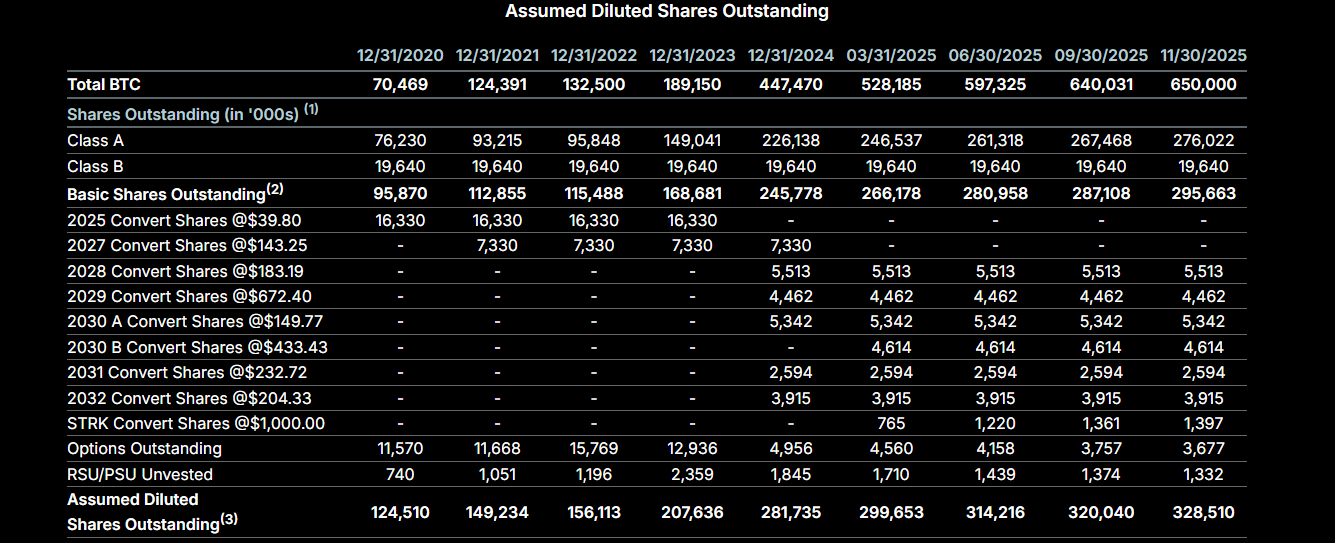
However, these capacities are not cash; they are quotas for the sale of Class A preferred shares and common shares. For Strategy to convert these quotas into cash, it needs to sell these shares on the market. When the stock price is at a premium (e.g., the stock price is $200, and each share represents $100 worth of Bitcoin), selling shares allows Strategy to exchange the newly issued shares for $200 in cash, which can then be used to buy $200 worth of Bitcoin, thereby increasing the Bitcoin backing per share. This was the logic behind Strategy's "perpetual motion machine" of seemingly infinite ammunition. However, when Strategy's mNAV (mNAV = market capitalization / value of held coins) falls below 1, the situation reverses. Selling shares now means selling at a discount. Since November, Strategy's mNAV has remained below 1 for an extended period. This is why, despite having a large number of shares available for sale recently, Strategy has been unable to use them to purchase Bitcoin.

Furthermore, not only has Strategy been unable to raise funds to buy the dip recently, but it also chose to raise $1.44 billion by selling shares at a discount to establish a dividend reserve pool to support preferred share dividend payments and existing debt interest payments.

As the standard template for crypto treasuries, Strategy's mechanism has been adopted by most treasury companies. Therefore, we can see that when crypto assets fall, the reason these treasury companies fail to enter the market to buy the dip is not unwillingness but rather because their stock prices have fallen too much, effectively "locking" their ammunition depots.

Nominal Firepower Ample, Actually "Guns Without Bullets"

So, besides Strategy, how much purchasing power do other companies have? After all, there are now hundreds of crypto treasury companies in the market.

From the current market perspective, although there are many crypto treasury companies, their potential for future purchases is not very large. There are mainly two situations. One type consists of companies that were originally crypto asset holding enterprises. Their crypto asset holdings mainly come from their existing holdings rather than new purchases financed by debt issuance. Their ability and motivation to raise funds through debt are not strong. For example, Cantor Equity Partners (CEP), ranked third in Bitcoin holdings, has an mNAV of 1.28. Its Bitcoin holdings primarily resulted from a merger with Twenty One Capital, and it has had no purchase records since July.

The other type consists of strategy companies similar to Strategy. However, due to the recent severe decline in stock prices, their mNAV ratios have generally fallen below 1. The ATM capacities of these companies are also effectively locked and cannot be utilized until their stock prices recover above 1.

Beyond issuing debt and selling stock, there is another, more direct "ammunition depot": cash reserves. Taking BitMine, the largest DAT company for Ethereum, as an example, although its mNAV is also below 1, the company has maintained its purchase plan recently. According to data from December 1st, BitMine stated it still has $882 million in unencumbered cash on its books. BitMine Chairman Tom Lee recently stated, "We believe Ethereum's price has bottomed. BitMine has resumed accumulating, purchasing nearly 100,000 ETH last week, double the amount of the previous two weeks." BitMine's ATM capacity is also substantial. In July 2025, the total capacity of its program was increased to $24.5 billion, and it currently has nearly $20 billion remaining.
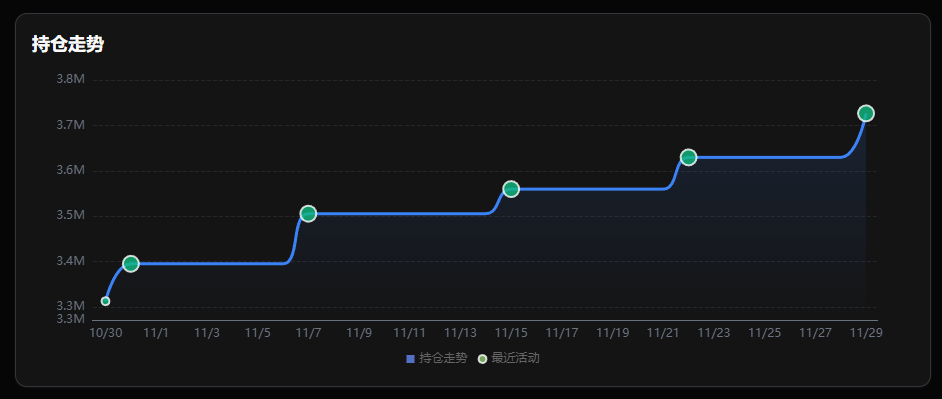
BitMine Holdings Change

Additionally, CleanSpark proposed issuing $1.15 billion in convertible bonds before the end of the year to purchase Bitcoin. The Japanese listed company Metaplanet has been a relatively active Bitcoin treasury company recently, raising over $400 million through Bitcoin-collateralized loans or share issuance since November to purchase Bitcoin.

In terms of total volume, the "nominal ammunition" (cash + ATM capacity) on the books of various companies amounts to tens of billions of dollars, far exceeding the previous bull market. However, in terms of "effective firepower," the actual number of bullets that can be fired has decreased.

Shifting from "Leveraged Expansion" to "Yield Generation for Survival"

Besides having their ammunition locked, these crypto treasury companies are also exploring new investment strategies. During the market uptrend, most companies' strategy was straightforward: buy relentlessly, obtain more financing as the price of coins and stocks rose, and then continue buying. As the situation reversed, many companies not only found it harder to raise funds but also faced the challenge of paying interest on previously issued bonds and covering operational costs.

Consequently, many companies are turning their attention to "crypto yield"—participating in crypto asset network staking activities to obtain relatively stable staking rewards. These rewards can then be used to pay the interest on their financing and operational costs.

For instance, BitMine plans to launch MAVAN (a US-based validator network) in Q1 2026 to initiate ETH staking. This is expected to generate approximately $340 million in annualized revenue for BitMine. Similar approaches are seen with Upexi, Sol Strategies, and other Solana network treasury companies, which can achieve around 8% annualized yield.

It is foreseeable that as long as mNAV cannot return above 1.0, hoarding cash to meet debt maturities will become the main theme for treasury companies. This trend also directly influences asset selection. Since Bitcoin lacks native high yield, the accumulation by pure Bitcoin treasuries is slowing down. In contrast, Ethereum treasuries, which can generate cash flow through staking to cover interest costs, have maintained more resilient accumulation speeds.

This shift in asset preference is essentially a compromise by treasury companies in the face of liquidity difficulties. When the channel for obtaining cheap funds through stock price premiums is closed, finding yield-generating assets becomes their only lifeline for maintaining a healthy balance sheet.

Ultimately, the "infinite ammunition" was merely an illusion built on stock price premiums during a positive cycle. When the flywheel locks up due to trading at a discount, the market must face a stark reality: these treasury companies have always been amplifiers of trends, not saviors against them. Only when the market sentiment recovers first can the funding valves be reopened.


Twitter:https://twitter.com/BitpushNewsCN

Bitpush TG Discussion Group:https://t.me/BitPushCommunity

Bitpush TG Subscription: https://t.me/bitpush

Original link:https://www.bitpush.news/articles/7593906

Preguntas relacionadas

QWhy have crypto treasury companies like Strategy slowed down or stopped buying cryptocurrencies during the recent market downturn, despite having large available funds?

AThey have slowed or stopped buying because their funding mechanism relies heavily on stock issuance at a premium to their net asset value (mNAV > 1). When their stock price falls below the value of their crypto holdings (mNAV < 1), selling stock to raise cash becomes dilutive and economically unfeasible, effectively locking their 'ammunition'.

QWhat are the two primary funding sources for Strategy, the leading crypto treasury company, and which one became less effective in the downturn?

AStrategy's two primary funding sources are 'convertible notes' (low-interest debt) and 'At-The-Market' (ATM) equity offerings. The ATM mechanism became less effective during the downturn because it requires the stock to trade at a premium to the net asset value (mNAV > 1) to work profitably, which was not the case.

QWhat is mNAV and why is it a critical metric for crypto treasury companies?

AmNAV (market NAV) is the ratio of a company's market capitalization to the value of its cryptocurrency holdings. It is critical because a value above 1 indicates the stock is trading at a premium, allowing the company to profitably issue new shares via ATM offerings to fund more crypto purchases. A value below 1 makes such issuance dilutive and impractical.

QHow are some crypto treasury companies adapting their strategy from pure accumulation to generating yield?

ACompanies are shifting towards generating crypto-native yield, such as through staking cryptocurrencies like Ethereum or Solana. This provides a steady income stream to help cover interest payments on their debt and operational costs, especially when their primary funding mechanism (ATM offerings) is impaired.

QWhich crypto treasury company was cited as an example of one that continued buying during the downturn, and what was its advantage?

ABitMine, the largest Ethereum treasury company, continued buying. Its advantage was a significant reserve of unencumbered cash ($882 million), which allowed it to purchase assets independently of the impaired ATM equity issuance mechanism that other companies relied on.

Lecturas Relacionadas

Stablecoins Finally Find Real Yield: An In-Depth Look at On-Chain Reinsurance Re | A Conversation with Re Founder Karan Saroya

Stablecoin Real Yield Found: A Deep Dive into On-Chain Reinsurance with Re's Karan Saroya As stablecoin supply exceeds $170 billion, the search for sustainable, non-speculative yield intensifies. Re, an on-chain reinsurance platform, provides an answer: connecting stablecoin capital to the trillion-dollar traditional reinsurance market. Re operates as a regulated reinsurer, accepting stablecoin deposits as collateral to back US insurance companies. These insurers pay premiums, generating yield that flows back to on-chain depositors. Currently supporting 35 insurers and underwriting $500 million, Re projects scaling to over $1 billion soon. Key insights from a Bankless podcast with founder Karan Saroya and investor Avichal of Electric Capital: 1. **Uncorrelated, Real-World Yield:** Re offers stablecoin holders access to reinsurance returns (targeting 12-14%+), an asset class entirely separate from crypto or equity markets. 2. **Operational Efficiency via Smart Contracts:** Re replaces traditional, labor-intensive capital fundraising with smart contracts, allowing a ~12-person team to compete with industry giants. 3. **Regulatory Leverage:** For every $1 of collateral, regulations allow backing $5-7 in written premiums. This leverage amplifies returns from the underlying risk-free rate. 4. **DeFi Integration:** Depositors receive receipt tokens, which can be used in protocols like Morpho for "looping," potentially pushing yields to 18-20%+. 5. **The "DeFi Mullet" Model:** A compliant front-end (regulated reinsurer) paired with a decentralized back-end (smart contracts, DeFi capital markets). 6. **RE Governance Token:** Modeled on Lloyd's of London, the token governs the central capital pool's allocation, counterparty acceptance, and parameters. 7. **Real Economic Impact:** Capital funds real-world productivity (factories, clinics, businesses) via insurance, moving beyond crypto's internal loops. The discussion highlights a pivotal moment: DeFi's supply-side infrastructure is now met by real demand for productive yield, potentially kickstarting a flywheel where vast on-chain stablecoin capital seeks these real-world returns.

链捕手Hace 34 min(s)

Stablecoins Finally Find Real Yield: An In-Depth Look at On-Chain Reinsurance Re | A Conversation with Re Founder Karan Saroya

链捕手Hace 34 min(s)

1996 or 1999? Walsh's First Test is 'How to View AI'

"1996 or 1999? Wall's First Big Test Is 'How to View AI'" Federal Reserve Chairman Wall's initial challenge is not whether to raise or cut rates, but a more fundamental judgment: what kind of boom is the current AI boom? This will determine the Fed's policy path and define his legacy. Economics is split between two opposing views, according to reporter Nick Timiraos. One sees imminent productivity gains that will increase supply and cool inflation, allowing the Fed to hold steady. The other argues that while productivity benefits are distant, demand shocks are here now, and waiting for data confirmation risks missing the intervention window, forcing sharper rate hikes later. Wall has signaled a leaning toward the first view, echoing 1996-era Alan Greenspan, who embraced strong, productivity-driven growth without fear of inflation. However, Wall faces a different macro environment than Greenspan did, with tariff pressures, expanding fiscal deficits, and diminishing globalization benefits, which could force more significant inflation pressures even if AI benefits materialize. Wall's logic, expressed before taking office, is that AI-driven productivity gains won't show in official data for years. If the Fed waits for confirmation, it might mistakenly tighten policy and choke off the very growth that could suppress inflation. This argues for using forward-looking narratives over lagging data. Chicago Fed President Austan Goolsbee presents a key counter-argument. He distinguishes between expected and unexpected productivity booms. A widely anticipated boom, like the current AI wave, can cause people to spend future wealth gains in advance, overheating the economy before productivity actually rises, thus requiring preemptive rate hikes. He cites rising costs for AI data centers as evidence of such overheating. Fed Governor Christopher Waller offers a rebuttal to Goolsbee, noting the "expected spending" mechanism only works if people can borrow against future income, which many households cannot do due to borrowing constraints. Wall also faces a paradox related to his desire to reduce the Fed's use of "forward guidance" (pre-announcing policy moves). This practice was established in 1999 when Greenspan began signaling hikes to avoid market shocks. If the economy follows a less optimistic path, Wall may be forced to choose between using the guidance he wants to abolish or risking market volatility by staying silent. The ultimate question defining Wall's first major test remains: Is this 1996 or 1999?

marsbitHace 1 hora(s)

1996 or 1999? Walsh's First Test is 'How to View AI'

marsbitHace 1 hora(s)

Ethereum Q1 2026 Report: Fees Decline, Users and Transaction Volume Hit New Highs

Ethereum Q1 2026 Report: Fees Down, Users & Transactions Hit New Highs Token Terminal's Q1 2026 report on Ethereum presents a pivotal development: the network achieved record highs in monthly active users (13.2M, +85.9% YoY), total transactions (200.4M, +81.5% YoY), and throughput (25.78 TPS), while transaction fees on the mainnet plummeted by 47.9% quarter-over-quarter. This shift is attributed to the network's strategic move into a "low fees for scale" phase, exemplified by the Fusaka upgrade which increased data capacity and lowered block space costs, releasing pent-up demand (a manifestation of Jevons's Paradox). The report highlights a core narrative shift for Ethereum: from a DeFi-centric blockchain to a global financial settlement layer. It maintains a dominant position in tokenized assets, holding majority market shares among top chains in stablecoins (61.8%), tokenized funds (73.0%), and tokenized commodities (84.0%). Growth in tokenized funds (+73.1% YoY) and commodities (+325.9% YoY) was particularly strong, driven by institutions like BlackRock and JPMorgan entering the space. Contrasting these usage gains, several USD-denominated value metrics declined in Q1: fully diluted market cap fell 30.3% QoQ, total value locked (TVL) dropped 11.0%, and ecosystem transaction volume decreased 24.0%. The report interprets this as Ethereum prioritizing long-term network expansion and cementing its role as the default settlement layer for finance over short-term fee capture. The commentary from Etherealize argues that, much like the early internet, Ethereum's open, permissionless model is poised to win over closed alternatives as institutional tokenization accelerates.

marsbitHace 3 hora(s)

Ethereum Q1 2026 Report: Fees Decline, Users and Transaction Volume Hit New Highs

marsbitHace 3 hora(s)

He Just Raised 2.7 Billion, and Li Fei-Fei Also Invested

Pete Florence, a former senior research scientist at Google DeepMind and a key contributor to the Vision-Language-Action (VLA) model architecture, is deliberately distancing his startup, Generalist AI, from the trendy "world model" label. He argues that the industry should prioritize concrete goals over buzzwords. His goal is to create robots that can perform a vast range of unseen tasks with high speed and success rates, without needing task-specific training data. Recently, his company raised $400 million (¥2.7 billion) at a $2 billion valuation. Notable investors include NVIDIA's NVentures, Bezos Expeditions, NFDG, as well as Xiaomi co-founder Lin Bin, Zoom founder Eric Yuan, and renowned AI scientist Fei-Fei Li. Florence's approach stems from his academic background at MIT under Professor Russ Tedrake, focusing on understanding the physical world. After joining DeepMind, he developed models like Transporter Network and co-created the VLA framework. He left in 2025 to found Generalist AI. The company has launched two models: GEN-0, which demonstrated that scaling laws apply to physical motion, and GEN-1. GEN-1 was trained on over 500,000 hours of physical interaction data collected via a specialized wearable device. It achieves a 99% success rate on precise mechanical tasks like folding boxes and maintains performance three times faster than its predecessor. Florence believes GEN-1 is reaching a commercial utility threshold similar to the GPT-3 inflection point. The substantial funding round, following GEN-1's release, signifies strong investor confidence in Generalist AI's practical, goal-driven path to creating versatile, useful robots, regardless of the "world model" terminology.

marsbitHace 3 hora(s)

He Just Raised 2.7 Billion, and Li Fei-Fei Also Invested

marsbitHace 3 hora(s)

Trading

Spot
Futuros
活动图片