The Evolution of Latin America's Stablecoin Market: From Survival to Growth

marsbitPublicado a 2025-12-11Actualizado a 2025-12-11

Resumen

Latin America's stablecoin market is evolving from a survival tool into a growth engine, driven by hyperinflation, financial exclusion, and inefficient remittances. With Argentina's 178% inflation and Brazil's $300B crypto trading volume, stablecoins like USDT and USDC are becoming essential for value storage and daily transactions. The region is witnessing the rise of Crypto Neobanks, which leverage zero-fee networks (e.g., Tether’s Plasma) and DeFi yields to offer dollar-based accounts with higher returns, challenging traditional fintech giants like Nubank. Brazil leads in institutional adoption, with 90% of crypto flows in stablecoins, while Argentina shows retail-driven growth. Key trends include the emergence of local currency-pegged stablecoins, integration of yield-bearing assets, and regulatory divergence across countries. The market, valued at $1.5T in trading volume, presents a significant alpha opportunity, with Crypto Neobanks poised to capture market share by offering faster settlements, dollar-denominated accounts, and superior yields. The window for investment and innovation is narrow, with the next 12-18 months critical for dominance.

Author: @BlazingKevin_, the Researcher at Movemaker

Latin America is undergoing a financial infrastructure revolution forced by currency failure. This article provides a panoramic analysis of the region's stablecoin market based on macroeconomic data from 2024 to 2025, on-chain behavior analysis, and regulatory policy texts. The research finds that the Latin American market has moved beyond the early stage of passive dollarization and is undergoing a deep transformation towards Web3 financial infrastructure-ization.

At the macro level, Argentina's 178% inflation rate and Brazil's $300 billion crypto trading volume form the dual backdrop of stablecoins as both a survival tool and an efficiency tool. At the micro level, the market is breeding a new species—Crypto Neobank. Compared to traditional fintech giants like Nubank, Crypto Neobanks, utilizing zero-fee networks like Tether-supported Plasma and DeFi yields, are filling the vast vacuum between traditional banking and pure crypto speculation. This report points out that the next alpha opportunity in Latin America's crypto market lies in how Web3 infrastructure can leverage this $1.5 trillion trading volume to replicate and surpass the growth miracle of traditional fintech.

1. Macro Narrative Restructuring

To understand the uniqueness of the Latin American market, one must abandon the "technological innovation theory" perspective of North America or Europe. In Latin America, the explosion of stablecoins is an inevitable product of macroeconomic structural imbalances. The core drivers here are survival and efficiency, and the intervention of Web3 technology is transforming this passive survival need into an active financial upgrade.

1.1 Currency Failure and the Loss of Store of Value Function

Inflation is the strongest catalyst for the crypto-dollarization process in Latin America. Argentina and Venezuela are typical examples of this phenomenon.

Despite the Milei government's radical economic therapy, Argentina's annual inflation rate remained as high as 178% between 2024 and 2025, with the peso depreciating by 51.6% against the US dollar within 12 months. In this environment, stablecoins are no longer investment products but de facto units of account. On-chain data shows that stablecoins account for up to 61.8% of trading volume in Argentina, far exceeding the global average. The market's demand for stablecoins exhibits extremely high immediate price elasticity: whenever the exchange rate falls below key psychological barriers, monthly stablecoin purchases on exchanges surge to over $10 million.

In Venezuela, as the bolivar's value continues to evaporate, Tether has penetrated microeconomic activities such as supermarket shopping and real estate transactions. Data shows a strong negative correlation between the local fiat exchange rate and cryptocurrency reception volume, with stablecoins providing a parallel financial system immune to government monetary policy interference.

1.2 Banking Exclusion and the Financial Vacuum of 122 Million People

Besides fighting inflation, financial exclusion is another major pain point. In Latin America, 122 million adults (26% of the population) are unbanked. This massive group is excluded from the traditional banking system due to minimum balance requirements, cumbersome compliance documents, and geographical isolation.
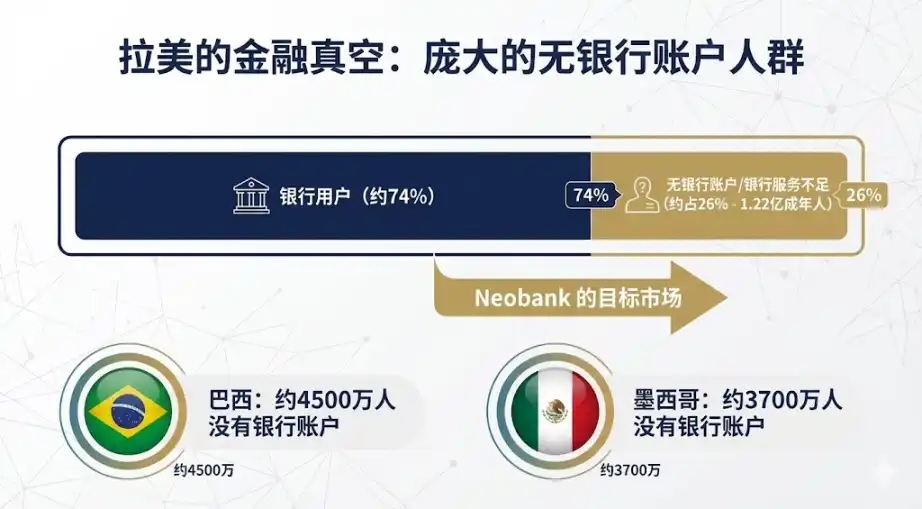
This is precisely the soil for the rise of new banks. Nubank's success proves this logic: through a branchless, low-fee mobile banking model, Nubank captured 122 million users within a decade, reaching a market capitalization of $70 billion and covering 60% of Brazil's adult population.

However, Crypto Neobanks are upgrading this logic for a second time. While Nubank solved the accessibility problem, the accounts are still denominated primarily in local fiat, and savings yields often underperform inflation. In contrast, Web3 neobanks can provide USD stablecoin-based accounts without needing a banking license, and through DeFi protocol integration, can offer 8% to 10% USD-denominated annualized yields, which is致命ly attractive to users in inflationary economies.

1.3 The Cost-Reduction and Efficiency Revolution in the Remittance Economy

Latin America is one of the world's largest remittance reception regions, receiving over $160 billion in remittances annually. Traditional cross-border remittances typically charge 5% to 6% in fees and take days to settle. This means nearly $10 billion in wealth is lost annually in the form of fees.

In the US-Mexico corridor, the world's largest single remittance channel, Bitso has processed over $6.5 billion in remittances, accounting for 10%. Blockchain-based cross-border transfers can reduce costs to $1 or even a few cents, shortening settlement time from 3-5 days to seconds. This hundredfold efficiency improvement constitutes a dimensional打击 against the traditional financial system.

2. Market Depth and On-Chain Behavior

Data from 2024 to 2025 indicates that the Latin American region has developed a unique Latin American model for cryptocurrency adoption: high-frequency, large-volume, and highly institutionalized.

2.1 Trading Volume and Growth Resilience

According to comprehensive data, between July 2022 and June 2025, the Latin American region recorded nearly $1.5 trillion in cryptocurrency trading volume, with a year-on-year growth of 42.5%. Notably, even during global market volatility, Latin America's growth baseline remained solid. In December 2024, the region's monthly trading volume soared to a record $87.7 billion. This indicates that the growth of the Latin American market is not merely beta收益 following the global bull market cycle but has an endogenous logic of rigid demand.

2.2 Brazil's Institutional Hegemony and Argentina's Retail Frenzy

Market structures vary significantly by country:

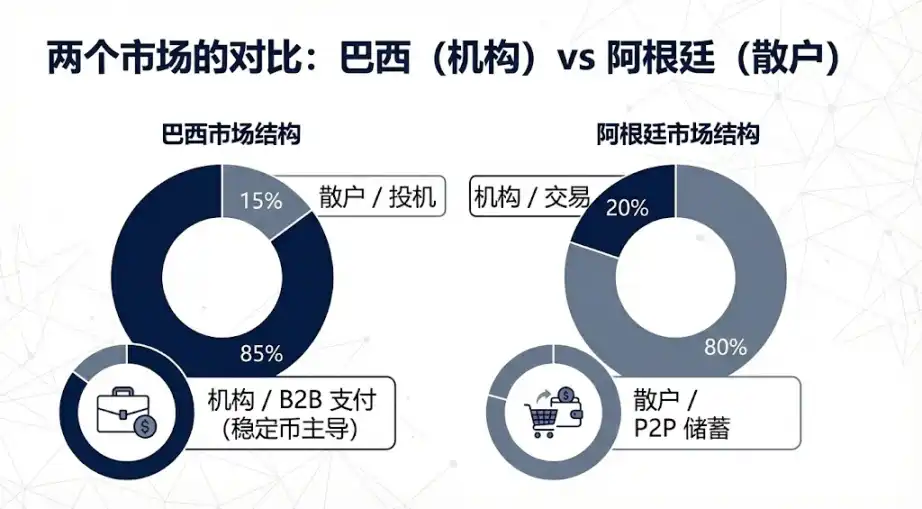
Brazil is the undisputed leader in the region, receiving approximately $318.8 billion in crypto assets, nearly one-third of the regional total. Stunning data from the Brazilian Central Bank shows that about 90% of the country's cryptocurrency fund flows are conducted through stablecoins. This extremely high比例 reveals the high degree of institutionalization in Brazil—stablecoins are primarily used for inter-enterprise payments, cross-border settlements, and liquidity transfers, rather than retail speculation.

Argentina ranks second with a trading volume of approximately $91.1 to $93.9 billion. Unlike Brazil, Argentina's growth comes mainly from the retail end, reflecting the general public's adoption of crypto dollarization as a daily lifestyle to combat inflation.
2.3 Platform Preference: The Dominance of Centralized Exchanges

Latin American users heavily rely on centralized exchanges. Data shows that about 68.7% of trading activity occurs on centralized exchanges, the second-highest proportion globally.

This phenomenon has important strategic significance for Web3 projects entering Latin America. "Borrowing a ship to go to sea" is the best strategy. Since local exchanges like Mercado Bitcoin and Bitso have compliant fiat channels and deep user trust, Crypto Neobanks should not try to directly compete with their fiat on-ramp/off-ramp business but should penetrate their vast user base through cooperation.

3. Asset Evolution

The Latin American market presents a landscape where globally universal stablecoins coexist with local innovative assets and is undergoing a generational leap from holding for保值 to holding for增值.

3.1 The Duopoly of Tether and USDC

With first-mover advantage and deep liquidity, Tether remains the hard currency in Latin American peer-to-peer markets and the informal economy. In the over-the-counter markets of Venezuela and Argentina, Tether is the absolute unit of account. Brazilian tax data also shows that Tether accounts for about two-thirds of declared trading volume. Its censorship resistance and普及度 make it the preferred choice for circumventing capital controls.

USDC is making inroads through compliance. Circle's partnerships with giants like Mercado Pago and Bitso have made it the preferred choice for institutional settlements. Bitso's report指出 that by the end of 2024, USDC had become the most purchased asset on its platform, accounting for 24%, surpassing Bitcoin.

3.2 The Bridging Role of Local Fiat Stablecoins

In 2024-2025, stablecoins pegged to local Latin American fiat currencies began to emerge, aiming to solve the friction between local payment systems and blockchain.

The launch of Meli Dólar by e-commerce giant Mercado Libre in Brazil was a milestone event. Through Mercado Pago, it is embedded in the daily shopping of tens of millions of users, used as a credit card cashback vehicle, significantly lowering the user barrier. Furthermore, Num Finance's issuance of peso and real-pegged stablecoins primarily serves cross-exchange arbitrage and enterprise-level DeFi operations, helping local businesses manage liquidity on-chain without bearing exchange rate risk.

3.3 Trend Mutation: Yield-Bearing Assets and DeFi Integration

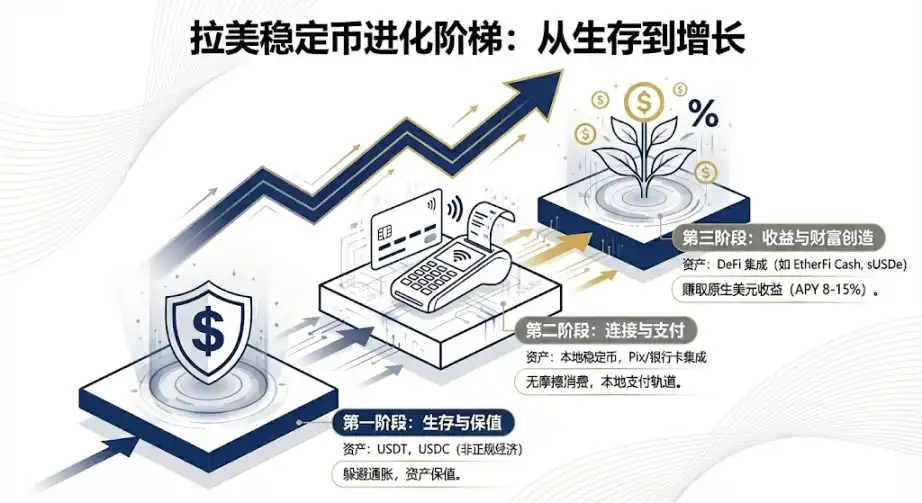
This is the next alpha opportunity in the Latin American market. Traditional banks in Latin America typically offer very low interest rates on USD accounts. Web3 neobanks, by integrating DeFi protocols, are redefining savings.

Take EtherFi as an example. As a DeFi protocol, it leveraged its multi-billion dollar Total Value Locked (TVL) to launch a credit card product. Users can stake crypto assets to earn yield while spending with the card. This model allows users to consume through borrowing without selling assets, preserving upside exposure while solving liquidity issues.

In high-inflation countries, the native yield of 10% to 15% offered by synthetic dollar stablecoins like USDe is highly attractive. Compared to the real-denominated deposits offered by Nubank, a 10% USD-denominated annualized yield is a dimensional打击 against traditional savings products.
4. Divergent National Directions

The vastly different political and economic environments across Latin American countries lead to截然不同的 development paths for stablecoins.

4.1 Brazil: A Duet of Compliance and Innovation

Brazil is Latin America's most mature and compliant market. The Brazilian Central Bank's digital currency project, Drex, underwent a strategic shift in 2025, focusing instead on the wholesale端, leaving a huge retail market space for private stablecoins.

In the same year, Brazil implemented a unified crypto tax rate and clarified the foreign exchange regulatory status of stablecoins. While this increased costs, it also赋予 the industry legitimacy. The local innovation project Neobankless is a paradigm of this trend. Built on Solana, its front end completely abstracts blockchain complexity, directly integrating with Brazil's national payment system PIX. Users deposit reais, which are automatically converted into interest-bearing USDC in the backend. This "Web2 experience, Web3 backend" model directly challenges the user habits of traditional fintech.

4.2 Argentina: A Liberalization Testing Ground

The Virtual Asset Service Provider (VASP) registration system established by the Milei government, while adding compliance thresholds,实质上默许了 the monetary competitive status of USD stablecoins. The asset regularization plan further brought a large amount of gray market stablecoins to the surface.

Lemon Cash solved the "last mile" payment problem by issuing crypto debit cards. Users hold USDC to earn yield, converting to pesos only at the moment of swiping the card. This model is highly sticky in a high-inflation environment because it minimizes the time holding fiat currency.

4.3 Mexico and Venezuela: Polarization

Due to the "Fintech Law" and central bank restrictions, Mexico has formed a landscape where banks and crypto companies are segregated. Companies like Bitso have therefore vigorously developed business-to-business (B2B) operations, using stablecoins as an intermediate bridge to optimize US-Mexico cross-border fund transfers, bypassing the inefficiencies of the traditional banking system.

In Venezuela, against the backdrop of reinstated sanctions, Tether has even become a settlement tool for oil exports. Among the populace, Binance's peer-to-peer trading remains a lifeline for obtaining foreign exchange, with the market彻底 voting with its feet for private USD stablecoins over the failed official Petro coin.

5. From Traditional Finance to Crypto Neobank

The Latin American market is undergoing a critical turning point, evolving from traditional fintech to Crypto Neobank. This is not only a technological upgrade but also a generational leap in business models.

5.1 The Valuation Gap and Alpha Opportunity

Currently, Nubank has a market cap of approximately $70 billion, and Revolut is valued at $75 billion; they validate the commercial viability of digital banks in Latin America. In contrast, the entire Web3 neobank赛道 has a combined valuation of less than $5 billion, only 7% of Nubank's market cap.

This is a huge value洼地. If Crypto Neobanks can capture even 10% of Nubank's market share, utilizing a superior unit economics model, their valuation has the potential for a 10x to 30x increase.

5.2 Next-Generation Infrastructure: The Zero-Fee Revolution

One of the biggest obstacles to the widespread adoption of crypto payments is gas fees. Plasma and its flagship product Plasma One brought a breakthrough. As a blockchain officially supported by Tether, Plasma enables zero gas fees for Tether transfers. This removes the biggest psychological and economic barrier for users using cryptocurrency for payments.

The data showing Total Value Locked (TVL)突破 $5 billion within 20 days of launch proves that when infrastructure directly provides bank-level services, the inflow of funds is惊人. This vertically integrated model of "infrastructure + neobank" could become the mainstream in the future.

5.3 Dimensional打击 of the Business Model

Crypto Neobanks have a triple moat compared to traditional banks:

  • Settlement Speed: Reduced from 3-5 days with SWIFT to seconds on the blockchain.
  • Account Currency: Upgraded from depreciating local fiat to anti-inflation USD stablecoins.
  • Revenue Source: Shifted from earning存贷利差 to allowing users to share the native yield of DeFi protocols.
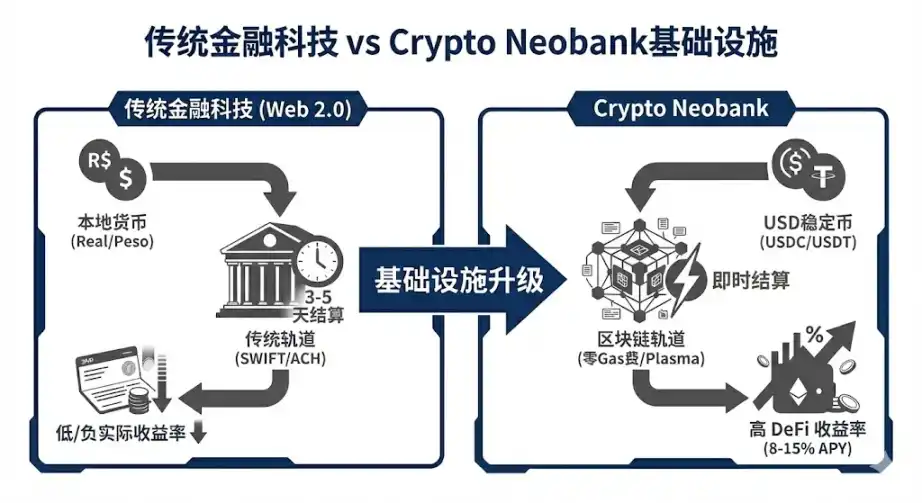
For Latin American users, this is not just a better experience but a rigid demand for asset保值.

6. Challenges, Strategies, and Endgame Predictions

6.1 Challenges and Breakout Strategies

Despite the bright prospects, events where banks关闭 crypto company accounts out of compliance fears still occur occasionally in Mexico and Colombia. Furthermore, Latin American regulation is highly fragmented, resulting in extremely high compliance costs for跨国 operations.

Targeting the Latin American market, Web3 projects need to follow a specific winner's playbook:

Brazil First: Given that Brazil accounts for 31% of Latin American crypto trading volume and has a完善的 payment system, it must be the primary battlefield.

Niche First: Don't try to be a bank for everyone from the start. The successful path is to first capture a细分 community and then扩散.

Viral Marketing: 90% of Nubank's growth came from word of mouth. Crypto Neobanks should leverage on-chain incentives to achieve low-cost裂变 in social networks like WhatsApp.

6.2 Market Predictions

Based on the above analysis, we make the following predictions for the short-to-medium term development of stablecoins:

Private Stablecoins Replacing CBDCs: Given the retreat of Brazil's Drex on the retail端, privately issued compliant stablecoins will de facto assume the role of digital fiat currency.

Mainstreaming of Yield-Bearing Assets: Stablecoins that do not generate interest may face competition from yield-bearing assets like tokenized US Treasuries. Latin American users will increasingly prefer to hold assets that are both anti-inflationary and yield-generating.

Market Stratification: The market will bifurcate into two camps: one highly compliant, bank-integrated whitelisted market, and another gradually shrinking but still existing gray peer-to-peer market.

Conclusion

Latin America's stablecoin market is the world's most cutting-edge laboratory for fintech. Here, stablecoins are not a nice-to-have technology but a must-have necessity. From the digital lifebuoy in the hands of Argentinians to the cross-border settlement tool in the hands of Brazilian financial giants, stablecoins are reshaping the financial arteries of this continent.

With the landing of regulatory frameworks in 2025 and the rise of the new species Crypto Neobank, Latin America is expected to become the first region in the world to achieve large-scale commercial adoption of stablecoins. For investors, the current window of opportunity is only 12 to 18 months. Whoever can leverage Web3 rails to replicate Nubank's user experience before 2026 will become the next hundred-billion-dollar giant. The race has already begun, and Latin America is the untapped gold mine.

Preguntas relacionadas

QWhat are the two primary drivers behind the explosive growth of stablecoins in Latin America, according to the article?

AThe two primary drivers are survival (as a hedge against hyperinflation and currency devaluation) and efficiency (addressing financial exclusion and high remittance costs).

QHow does the market structure of Brazil differ from that of Argentina in terms of cryptocurrency adoption?

ABrazil's market is highly institutionalized, with about 90% of crypto flows in stablecoins used for corporate payments and cross-border settlements. Argentina's market is primarily retail-driven, with individuals using crypto for dollarization in daily life to combat inflation.

QWhat is a 'Crypto Neobank' and how does it differ from a traditional neobank like Nubank?

AA Crypto Neobank is a new type of financial institution that leverages Web3 infrastructure, offering dollar-based stablecoin accounts and integrating with DeFi protocols to provide high USD-denominated yields. Unlike traditional neobanks like Nubank, which primarily offer accounts in local fiat currencies with low savings rates, Crypto Neobanks do not require a banking license and offer superior returns that outpace inflation.

QWhat technological breakthrough does the article highlight as a key enabler for crypto payments, and which project exemplifies it?

AThe article highlights zero-fee transactions as a key technological enabler. The Plasma blockchain, specifically its flagship product Plasma One which is supported by Tether, exemplifies this breakthrough by enabling USDT transfers with no gas fees, removing a major barrier to crypto payment adoption.

QWhat is the article's prediction regarding the competition between private stablecoins and Central Bank Digital Currencies (CBDCs) in Latin America?

AThe article predicts that privately issued, compliant stablecoins will de facto assume the role of digital fiat currency in the retail space, as evidenced by the strategic retreat of Brazil's CBDC project, Drex, from the retail market.

Lecturas Relacionadas

Trading

Spot
Futuros

Artículos destacados

Qué es $S$

Entendiendo SPERO: Una Visión General Completa Introducción a SPERO A medida que el panorama de la innovación continúa evolucionando, la aparición de tecnologías web3 y proyectos de criptomonedas juega un papel fundamental en la configuración del futuro digital. Un proyecto que ha atraído la atención en este campo dinámico es SPERO, denotado como SPERO,$$s$. Este artículo tiene como objetivo reunir y presentar información detallada sobre SPERO, para ayudar a entusiastas e inversores a comprender sus fundamentos, objetivos e innovaciones dentro de los dominios web3 y cripto. ¿Qué es SPERO,$$s$? SPERO,$$s$ es un proyecto único dentro del espacio cripto que busca aprovechar los principios de descentralización y tecnología blockchain para crear un ecosistema que promueva la participación, la utilidad y la inclusión financiera. El proyecto está diseñado para facilitar interacciones de igual a igual de nuevas maneras, proporcionando a los usuarios soluciones y servicios financieros innovadores. En su esencia, SPERO,$$s$ tiene como objetivo empoderar a los individuos al proporcionar herramientas y plataformas que mejoren la experiencia del usuario en el espacio de las criptomonedas. Esto incluye habilitar métodos de transacción más flexibles, fomentar iniciativas impulsadas por la comunidad y crear caminos para oportunidades financieras a través de aplicaciones descentralizadas (dApps). La visión subyacente de SPERO,$$s$ gira en torno a la inclusividad, buscando cerrar brechas dentro de las finanzas tradicionales mientras aprovecha los beneficios de la tecnología blockchain. ¿Quién es el Creador de SPERO,$$s$? La identidad del creador de SPERO,$$s$ sigue siendo algo oscura, ya que hay recursos públicos limitados que proporcionan información de fondo detallada sobre su(s) fundador(es). Esta falta de transparencia puede derivarse del compromiso del proyecto con la descentralización, una ética que muchos proyectos web3 comparten, priorizando las contribuciones colectivas sobre el reconocimiento individual. Al centrar las discusiones en torno a la comunidad y sus objetivos colectivos, SPERO,$$s$ encarna la esencia del empoderamiento sin señalar a individuos específicos. Como tal, comprender la ética y la misión de SPERO sigue siendo más importante que identificar a un creador singular. ¿Quiénes son los Inversores de SPERO,$$s$? SPERO,$$s$ cuenta con el apoyo de una diversa gama de inversores que van desde capitalistas de riesgo hasta inversores ángeles dedicados a fomentar la innovación en el sector cripto. El enfoque de estos inversores generalmente se alinea con la misión de SPERO, priorizando proyectos que prometen avances tecnológicos sociales, inclusión financiera y gobernanza descentralizada. Estas fundaciones de inversores suelen estar interesadas en proyectos que no solo ofrecen productos innovadores, sino que también contribuyen positivamente a la comunidad blockchain y sus ecosistemas. El respaldo de estos inversores refuerza a SPERO,$$s$ como un contendiente notable en el dominio de proyectos cripto que evoluciona rápidamente. ¿Cómo Funciona SPERO,$$s$? SPERO,$$s$ emplea un marco multifacético que lo distingue de los proyectos de criptomonedas convencionales. Aquí hay algunas de las características clave que subrayan su singularidad e innovación: Gobernanza Descentralizada: SPERO,$$s$ integra modelos de gobernanza descentralizada, empoderando a los usuarios para participar activamente en los procesos de toma de decisiones sobre el futuro del proyecto. Este enfoque fomenta un sentido de propiedad y responsabilidad entre los miembros de la comunidad. Utilidad del Token: SPERO,$$s$ utiliza su propio token de criptomoneda, diseñado para servir diversas funciones dentro del ecosistema. Estos tokens permiten transacciones, recompensas y la facilitación de servicios ofrecidos en la plataforma, mejorando la participación y la utilidad general. Arquitectura en Capas: La arquitectura técnica de SPERO,$$s$ apoya la modularidad y escalabilidad, permitiendo la integración fluida de características y aplicaciones adicionales a medida que el proyecto evoluciona. Esta adaptabilidad es fundamental para mantener la relevancia en el cambiante paisaje cripto. Participación de la Comunidad: El proyecto enfatiza iniciativas impulsadas por la comunidad, empleando mecanismos que incentivan la colaboración y la retroalimentación. Al nutrir una comunidad sólida, SPERO,$$s$ puede abordar mejor las necesidades de los usuarios y adaptarse a las tendencias del mercado. Enfoque en la Inclusión: Al ofrecer tarifas de transacción bajas e interfaces amigables para el usuario, SPERO,$$s$ busca atraer a una base de usuarios diversa, incluyendo a individuos que anteriormente pueden no haber participado en el espacio cripto. Este compromiso con la inclusión se alinea con su misión general de empoderamiento a través de la accesibilidad. Cronología de SPERO,$$s$ Entender la historia de un proyecto proporciona información crucial sobre su trayectoria de desarrollo y hitos. A continuación se presenta una cronología sugerida que mapea eventos significativos en la evolución de SPERO,$$s$: Fase de Conceptualización e Ideación: Las ideas iniciales que forman la base de SPERO,$$s$ fueron concebidas, alineándose estrechamente con los principios de descentralización y enfoque comunitario dentro de la industria blockchain. Lanzamiento del Whitepaper del Proyecto: Tras la fase conceptual, se lanzó un whitepaper completo que detalla la visión, los objetivos y la infraestructura tecnológica de SPERO,$$s$ para generar interés y retroalimentación de la comunidad. Construcción de Comunidad y Primeras Interacciones: Se realizaron esfuerzos de divulgación activa para construir una comunidad de primeros adoptantes y posibles inversores, facilitando discusiones en torno a los objetivos del proyecto y obteniendo apoyo. Evento de Generación de Tokens: SPERO,$$s$ llevó a cabo un evento de generación de tokens (TGE) para distribuir sus tokens nativos a los primeros seguidores y establecer liquidez inicial dentro del ecosistema. Lanzamiento de la dApp Inicial: La primera aplicación descentralizada (dApp) asociada con SPERO,$$s$ se puso en marcha, permitiendo a los usuarios interactuar con las funcionalidades centrales de la plataforma. Desarrollo Continuo y Alianzas: Actualizaciones y mejoras continuas a las ofertas del proyecto, incluyendo alianzas estratégicas con otros actores en el espacio blockchain, han moldeado a SPERO,$$s$ en un jugador competitivo y en evolución en el mercado cripto. Conclusión SPERO,$$s$ se erige como un testimonio del potencial de web3 y las criptomonedas para revolucionar los sistemas financieros y empoderar a los individuos. Con un compromiso con la gobernanza descentralizada, la participación comunitaria y funcionalidades diseñadas de manera innovadora, allana el camino hacia un paisaje financiero más inclusivo. Como con cualquier inversión en el espacio cripto que evoluciona rápidamente, se anima a los posibles inversores y usuarios a investigar a fondo y participar de manera reflexiva con los desarrollos en curso dentro de SPERO,$$s$. El proyecto muestra el espíritu innovador de la industria cripto, invitando a una mayor exploración de sus innumerables posibilidades. Mientras el viaje de SPERO,$$s$ aún se desarrolla, sus principios fundamentales pueden, de hecho, influir en el futuro de cómo interactuamos con la tecnología, las finanzas y entre nosotros en ecosistemas digitales interconectados.

72 Vistas totalesPublicado en 2024.12.17Actualizado en 2024.12.17

Qué es $S$

Qué es AGENT S

Agent S: El Futuro de la Interacción Autónoma en Web3 Introducción En el paisaje en constante evolución de Web3 y las criptomonedas, las innovaciones están redefiniendo constantemente cómo los individuos interactúan con las plataformas digitales. Uno de estos proyectos pioneros, Agent S, promete revolucionar la interacción humano-computadora a través de su marco agente abierto. Al allanar el camino para interacciones autónomas, Agent S busca simplificar tareas complejas, ofreciendo aplicaciones transformadoras en inteligencia artificial (IA). Esta exploración detallada profundizará en las complejidades del proyecto, sus características únicas y las implicaciones para el dominio de las criptomonedas. ¿Qué es Agent S? Agent S se presenta como un marco agente abierto innovador, diseñado específicamente para abordar tres desafíos fundamentales en la automatización de tareas informáticas: Adquisición de Conocimiento Específico del Dominio: El marco aprende inteligentemente de diversas fuentes de conocimiento externas y experiencias internas. Este enfoque dual le permite construir un rico repositorio de conocimiento específico del dominio, mejorando su rendimiento en la ejecución de tareas. Planificación a Largo Plazo de Tareas: Agent S emplea planificación jerárquica aumentada por la experiencia, un enfoque estratégico que facilita la descomposición y ejecución eficiente de tareas complejas. Esta característica mejora significativamente su capacidad para gestionar múltiples subtareas de manera eficiente y efectiva. Manejo de Interfaces Dinámicas y No Uniformes: El proyecto introduce la Interfaz Agente-Computadora (ACI), una solución innovadora que mejora la interacción entre agentes y usuarios. Utilizando Modelos de Lenguaje Multimodal de Gran Escala (MLLMs), Agent S puede navegar y manipular diversas interfaces gráficas de usuario sin problemas. A través de estas características pioneras, Agent S proporciona un marco robusto que aborda las complejidades involucradas en la automatización de la interacción humana con las máquinas, preparando el terreno para una multitud de aplicaciones en IA y más allá. ¿Quién es el Creador de Agent S? Si bien el concepto de Agent S es fundamentalmente innovador, la información específica sobre su creador sigue siendo elusiva. El creador es actualmente desconocido, lo que resalta ya sea la etapa incipiente del proyecto o la elección estratégica de mantener a los miembros fundadores en el anonimato. Independientemente de la anonimidad, el enfoque sigue siendo en las capacidades y el potencial del marco. ¿Quiénes son los Inversores de Agent S? Dado que Agent S es relativamente nuevo en el ecosistema criptográfico, la información detallada sobre sus inversores y patrocinadores financieros no está documentada explícitamente. La falta de información disponible públicamente sobre las bases de inversión u organizaciones que apoyan el proyecto plantea preguntas sobre su estructura de financiamiento y hoja de ruta de desarrollo. Comprender el respaldo es crucial para evaluar la sostenibilidad del proyecto y su posible impacto en el mercado. ¿Cómo Funciona Agent S? En el núcleo de Agent S se encuentra una tecnología de vanguardia que le permite funcionar de manera efectiva en diversos entornos. Su modelo operativo se basa en varias características clave: Interacción Humano-Computadora Similar a la Humana: El marco ofrece planificación avanzada de IA, esforzándose por hacer que las interacciones con las computadoras sean más intuitivas. Al imitar el comportamiento humano en la ejecución de tareas, promete elevar las experiencias de los usuarios. Memoria Narrativa: Empleada para aprovechar experiencias de alto nivel, Agent S utiliza memoria narrativa para hacer un seguimiento de las historias de tareas, mejorando así sus procesos de toma de decisiones. Memoria Episódica: Esta característica proporciona a los usuarios una guía paso a paso, permitiendo que el marco ofrezca apoyo contextual a medida que se desarrollan las tareas. Soporte para OpenACI: Con la capacidad de ejecutarse localmente, Agent S permite a los usuarios mantener el control sobre sus interacciones y flujos de trabajo, alineándose con la ética descentralizada de Web3. Fácil Integración con APIs Externas: Su versatilidad y compatibilidad con varias plataformas de IA aseguran que Agent S pueda encajar sin problemas en ecosistemas tecnológicos existentes, convirtiéndolo en una opción atractiva para desarrolladores y organizaciones. Estas funcionalidades contribuyen colectivamente a la posición única de Agent S dentro del espacio cripto, ya que automatiza tareas complejas y de múltiples pasos con una intervención humana mínima. A medida que el proyecto evoluciona, sus posibles aplicaciones en Web3 podrían redefinir cómo se desarrollan las interacciones digitales. Cronología de Agent S El desarrollo y los hitos de Agent S pueden encapsularse en una cronología que resalta sus eventos significativos: 27 de septiembre de 2024: El concepto de Agent S fue lanzado en un documento de investigación integral titulado “Un Marco Agente Abierto que Usa Computadoras Como un Humano”, mostrando las bases del proyecto. 10 de octubre de 2024: El documento de investigación fue puesto a disposición del público en arXiv, ofreciendo una exploración profunda del marco y su evaluación de rendimiento basada en el benchmark OSWorld. 12 de octubre de 2024: Se lanzó una presentación en video, proporcionando una visión visual de las capacidades y características de Agent S, involucrando aún más a posibles usuarios e inversores. Estos marcadores en la cronología no solo ilustran el progreso de Agent S, sino que también indican su compromiso con la transparencia y la participación comunitaria. Puntos Clave Sobre Agent S A medida que el marco Agent S continúa evolucionando, varios atributos clave destacan, subrayando su naturaleza innovadora y potencial: Marco Innovador: Diseñado para proporcionar un uso intuitivo de las computadoras similar a la interacción humana, Agent S aporta un enfoque novedoso a la automatización de tareas. Interacción Autónoma: La capacidad de interactuar de manera autónoma con las computadoras a través de GUI significa un salto hacia soluciones informáticas más inteligentes y eficientes. Automatización de Tareas Complejas: Con su metodología robusta, puede automatizar tareas complejas y de múltiples pasos, haciendo que los procesos sean más rápidos y menos propensos a errores. Mejora Continua: Los mecanismos de aprendizaje permiten a Agent S mejorar a partir de experiencias pasadas, mejorando continuamente su rendimiento y eficacia. Versatilidad: Su adaptabilidad en diferentes entornos operativos como OSWorld y WindowsAgentArena asegura que pueda servir a una amplia gama de aplicaciones. A medida que Agent S se posiciona en el paisaje de Web3 y criptomonedas, su potencial para mejorar las capacidades de interacción y automatizar procesos significa un avance significativo en las tecnologías de IA. A través de su marco innovador, Agent S ejemplifica el futuro de las interacciones digitales, prometiendo una experiencia más fluida y eficiente para los usuarios en diversas industrias. Conclusión Agent S representa un audaz avance en la unión de la IA y Web3, con la capacidad de redefinir cómo interactuamos con la tecnología. Aunque aún se encuentra en sus primeras etapas, las posibilidades para su aplicación son vastas y atractivas. A través de su marco integral que aborda desafíos críticos, Agent S busca llevar las interacciones autónomas al primer plano de la experiencia digital. A medida que nos adentramos más en los reinos de las criptomonedas y la descentralización, proyectos como Agent S sin duda desempeñarán un papel crucial en la configuración del futuro de la tecnología y la colaboración humano-computadora.

367 Vistas totalesPublicado en 2025.01.14Actualizado en 2025.01.14

Qué es AGENT S

Cómo comprar S

¡Bienvenido a HTX.com! Hemos hecho que comprar Sonic (S) sea simple y conveniente. Sigue nuestra guía paso a paso para iniciar tu viaje de criptos.Paso 1: crea tu cuenta HTXUtiliza tu correo electrónico o número de teléfono para registrarte y obtener una cuenta gratuita en HTX. Experimenta un proceso de registro sin complicaciones y desbloquea todas las funciones.Obtener mi cuentaPaso 2: ve a Comprar cripto y elige tu método de pagoTarjeta de crédito/débito: usa tu Visa o Mastercard para comprar Sonic (S) al instante.Saldo: utiliza fondos del saldo de tu cuenta HTX para tradear sin problemas.Terceros: hemos agregado métodos de pago populares como Google Pay y Apple Pay para mejorar la comodidad.P2P: tradear directamente con otros usuarios en HTX.Over-the-Counter (OTC): ofrecemos servicios personalizados y tipos de cambio competitivos para los traders.Paso 3: guarda tu Sonic (S)Después de comprar tu Sonic (S), guárdalo en tu cuenta HTX. Alternativamente, puedes enviarlo a otro lugar mediante transferencia blockchain o utilizarlo para tradear otras criptomonedas.Paso 4: tradear Sonic (S)Tradear fácilmente con Sonic (S) en HTX's mercado spot. Simplemente accede a tu cuenta, selecciona tu par de trading, ejecuta tus trades y monitorea en tiempo real. Ofrecemos una experiencia fácil de usar tanto para principiantes como para traders experimentados.

783 Vistas totalesPublicado en 2025.01.15Actualizado en 2025.03.21

Cómo comprar S

Discusiones

Bienvenido a la comunidad de HTX. Aquí puedes mantenerte informado sobre los últimos desarrollos de la plataforma y acceder a análisis profesionales del mercado. A continuación se presentan las opiniones de los usuarios sobre el precio de S (S).

活动图片