The Essence of AI Layoffs: Why More AI Adoption Leads to More Corporate Anxiety?

marsbitPublicado a 2026-05-12Actualizado a 2026-05-12

Resumen

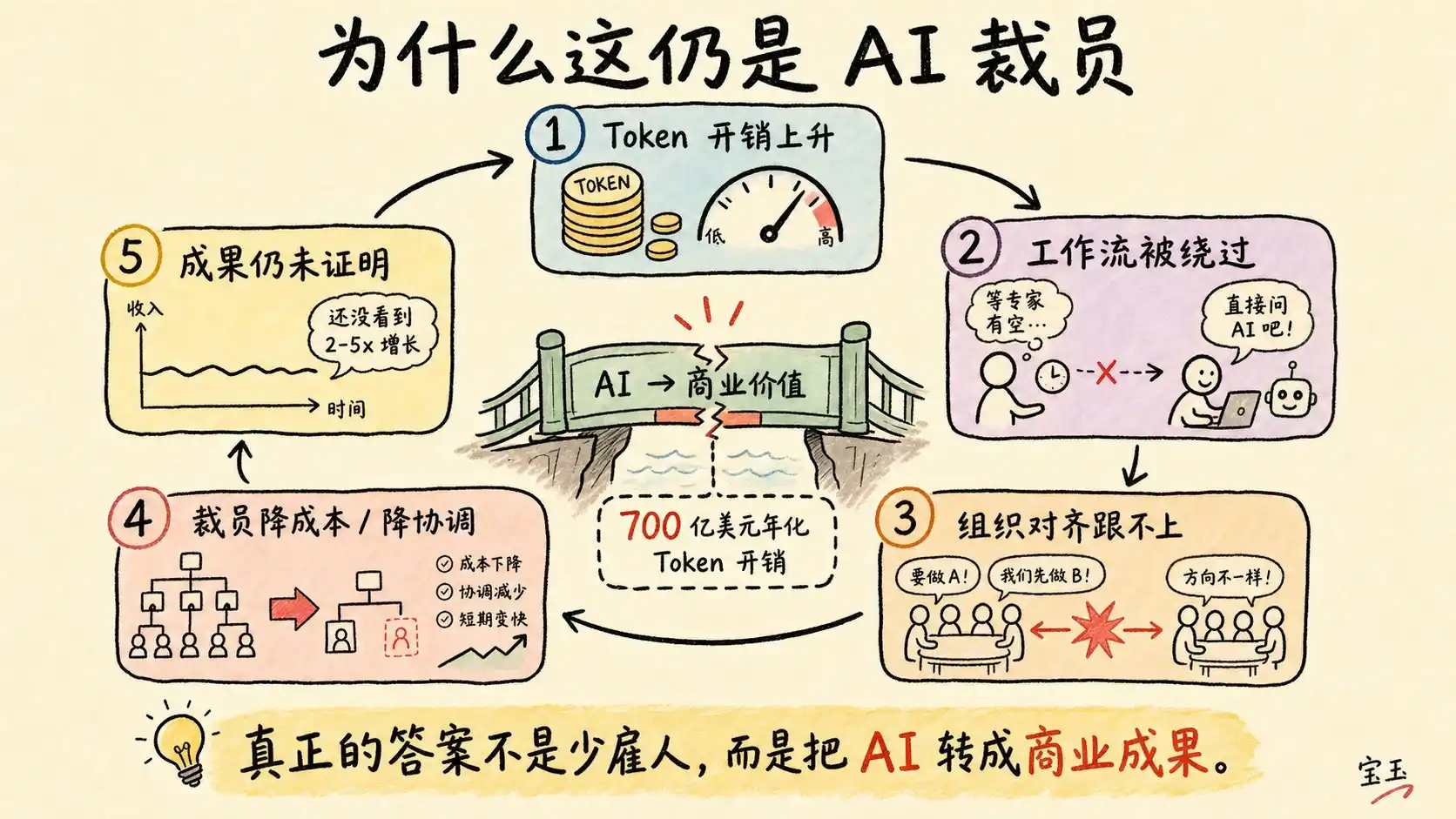
The author, awaiting potential inclusion on an 8000-person layoff list, analyzes the true nature of recent "AI-driven" layoffs. They argue that while AI use, particularly tools like Claude for code generation, has skyrocketed and boosted developer output (e.g., 2-5x more code commits), this has not translated into proportional business growth or revenue. The core issue is a misalignment between increased "Input" (code) and tangible "Outcomes" (user value, revenue). AI acts as a costly B2B SaaS, inflating operational expenses without guaranteed returns. Two key problems emerge: 1) The friction that once filtered out bad ideas is gone, as AI allows cheap pursuit of even weak concepts. 2) Organizational "alignment tax"—the difficulty of coordinating across teams—becomes crippling when development velocity outpaces consensus-building. Thus, layoffs serve two immediate purposes: 1) To offset ballooning AI costs (Token consumption) and maintain cash flow, as rising input costs without outcome growth destroys unit economics. 2) To reduce organizational bloat and alignment friction by simply removing teams, thereby speeding up execution in the short term. Therefore, these layoffs are fundamentally caused by AI, even if AI doesn't directly replace roles. They represent a painful correction until companies learn to convert AI-driven productivity into real business outcomes and streamline organizational coordination to match the new pace of work. The cycle will continue until this le...

Somewhere in a high-level office in my company lies a layoff list of 8,000 people. I have a 10% chance of being on that list. In a few days, on May 20th, I will know my fate.

Seeing the 'AI layoff' news announced by Coinbase today, I decided to write this article. I purposely wrote it before May 20th because I want to share some of the most genuine perspectives, untainted by the personal sentiment of 'whether I'm staying or going.' These thoughts are not only independent of my being laid off but also not limited to my company. They come from the true voices of my friends working in various medium-to-large enterprises.

There's a flood of articles now debating: Is this new wave of layoffs (commonly thought to have started with Jack Dorsey cutting 40% of Square's staff) actually caused by AI, or is it merely 'AI-washing' (referring to companies using the embrace of AI as a pretense to conceal the real reasons for other business failures or layoffs).

I don't want to fill this article with links to various news pieces and papers to torture you; you've probably seen this content already, or you can easily find it with a Google search or by asking ChatGPT.

The much-touted 'AI Productivity' and the Elusive Evidence

Has AI really made us more efficient? That's a truly controversial heavyweight question! If we think in reverse and assert 'AI hasn't changed anything,' I doubt even the most skeptical of AI's value would agree with that statement.

Especially in tech companies, the rocket-like surge in AI usage is a fact staring us in the face. Even the most conservative companies that cap AI budgets and don't equip employees with AI tools cannot deny that a portion of the work is essentially done by AI—even if employees are just laboriously using Gemini or Copilot in Google or Microsoft Office suites to secretly edit documents.

As for the more visionary companies diving headfirst into the ocean of AI tokens (the basic units of text processed by AI models, with enterprise usage of large language models often billed based on token consumption), like Uber or Shopify (I'm excluding companies like Meta or Microsoft that develop their own LLMs, and also excluding infrastructure builders like Vercel or Cloudflare; I'm talking only about pure 'users'), their AI consumption has gone insane.

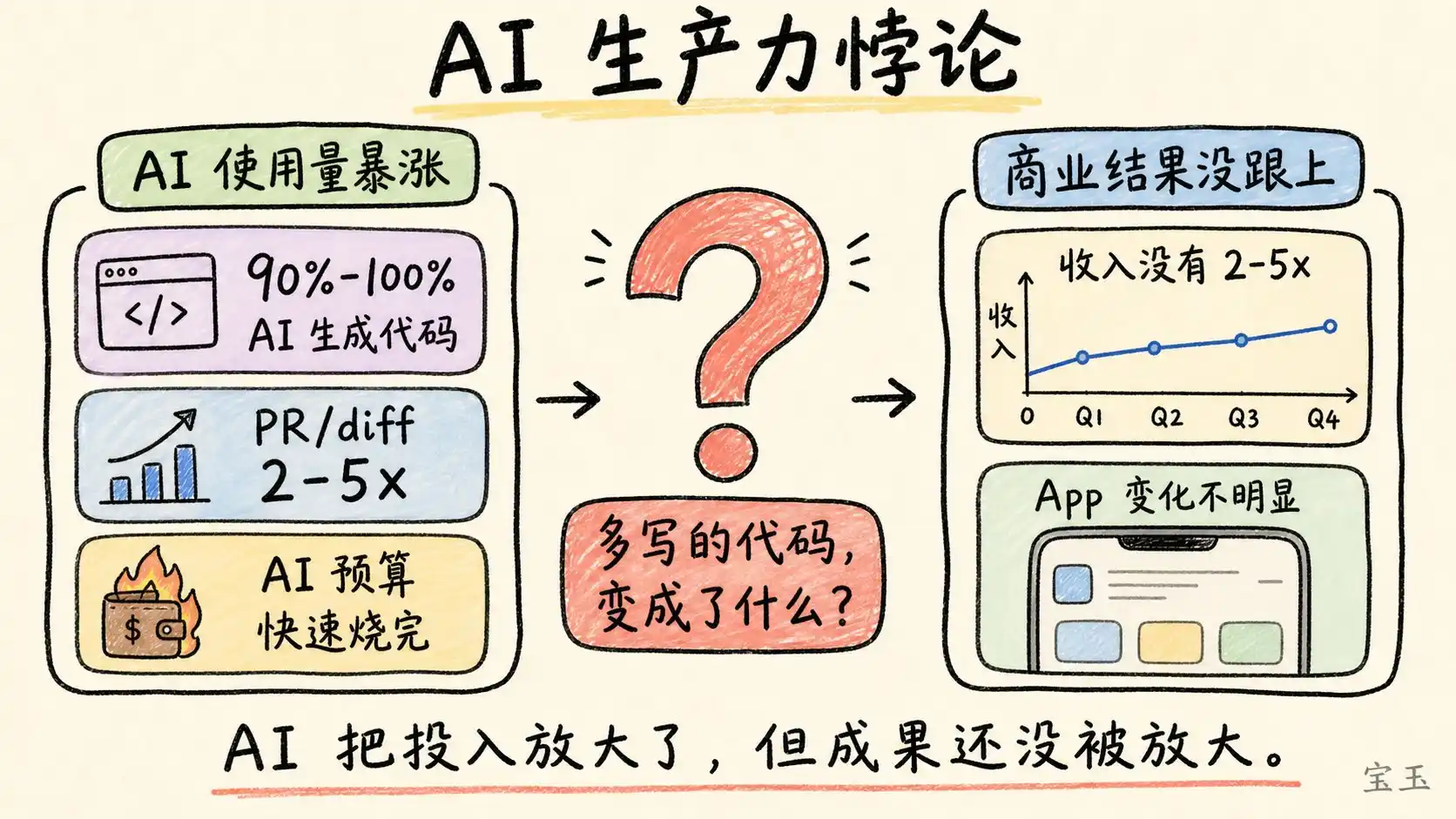
We've become accustomed to it: from 90% to 100% of code being AI-generated, to the number of code review submissions (PRs/diffs) per week exploding by 2 to 5 times, to annual AI budgets in the hundreds of millions being exhausted in just a few months.

However, tech commentators and investors like Ed Zitron, Will Manidis, Gary Marcus, and Michael Burry would undoubtedly retort with a soul-searching question: If that's the case, why haven't these companies' revenues grown by 2 to 5 times accordingly? Why do their apps look almost identical to how they did half a year ago? If AI is so productive, what exactly are they producing with it? If they're writing 5 times more code, yet end-users notice nothing, what's the point of all that code? This is an extremely sharp and reasonable question.
Input, Output, and Outcome

We need a brief interlude on business management fundamentals. When a fast-growing, overfunded, cash-burning midsize company finally faces a cash crunch, you go ask a seasoned CEO for advice. They'll suggest you bring in McKinsey to take a look. The consultants will put up a plain white slide as the first page of their presentation, with three words in default Arial font: 'Input, Output, Outcome.'

They'll explain a business truth that everyone knows but often forgets:

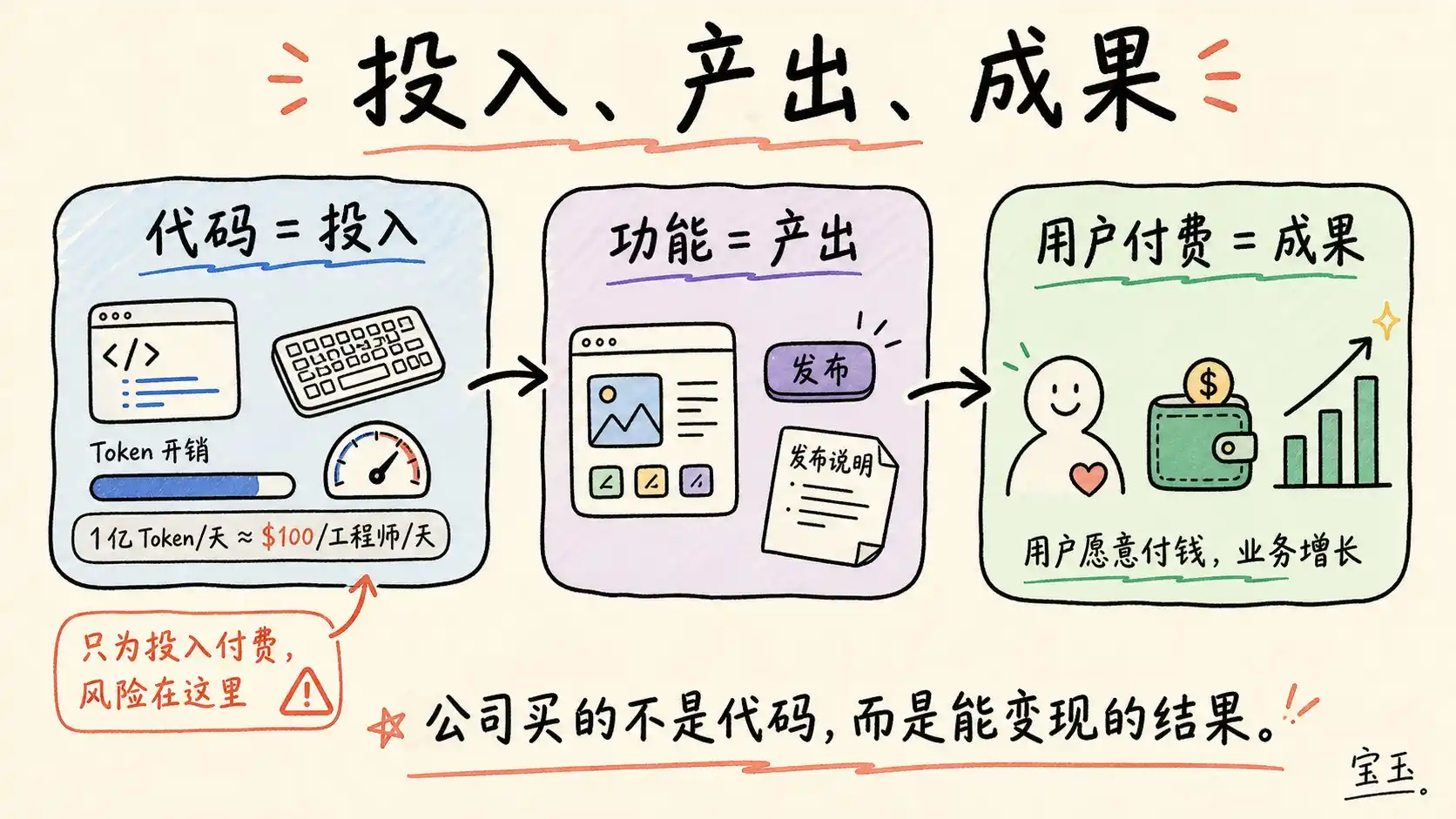
Code is merely an input.

Features are the output.

Users willingly paying for your product is the outcome.

AI (or at least products like Claude Enterprise) is essentially a B2B SaaS product. You'll notice that SaaS products are priced and marketed differently. If a product can directly change the 'outcome,' they typically take a cut directly from that 'outcome.' Imagine this sales pitch: 'Our tool increases your sales lead conversion speed by 36%. Try it now for a low service fee of just 5% of the sale value.'

That would be an instant killer for customers. All else being equal, if you closed 100 deals in 100 days before, now it takes only 63 days. The saved 36 days (if my math is correct) allow you to close an additional 57 deals! That is, your sales potential increases by 57%. Anyone would be more than happy to pay 5% from their sales commission for an extra 57% revenue. And if you don't use the product, you pay nothing.

You've probably guessed what I'm about to say—Claude's token consumption pricing model is nothing like that. If your software engineers are addicted to programming with Claude (I just realized both have the abbreviation 'cc'), generating 100 million tokens per day, you'll be paying $100 per engineer per day.

Even if some of the code they generate is thrown in the trash because it doesn't work;

Even if some code later causes severe system failures (SEVs) (SEV stands for Severity, commonly used in tech companies to refer to serious online incidents causing service outages) and gets rolled back urgently;

And even if another portion of the code is just for reskinning internal tools to make data dashboards look cuter for VPs;

You pay for it all. Because code is just an 'input.' While generally, as long as the direction is right, more 'input' tends to lead to more 'output,' and then to better 'outcome.' But when you multiply the input by 5 overnight, this rule doesn't necessarily hold. The extra 'input' you've added might suddenly become aimless, completely deviating from the expected 'output' or 'outcome.'
What's Really Holding Us Back!

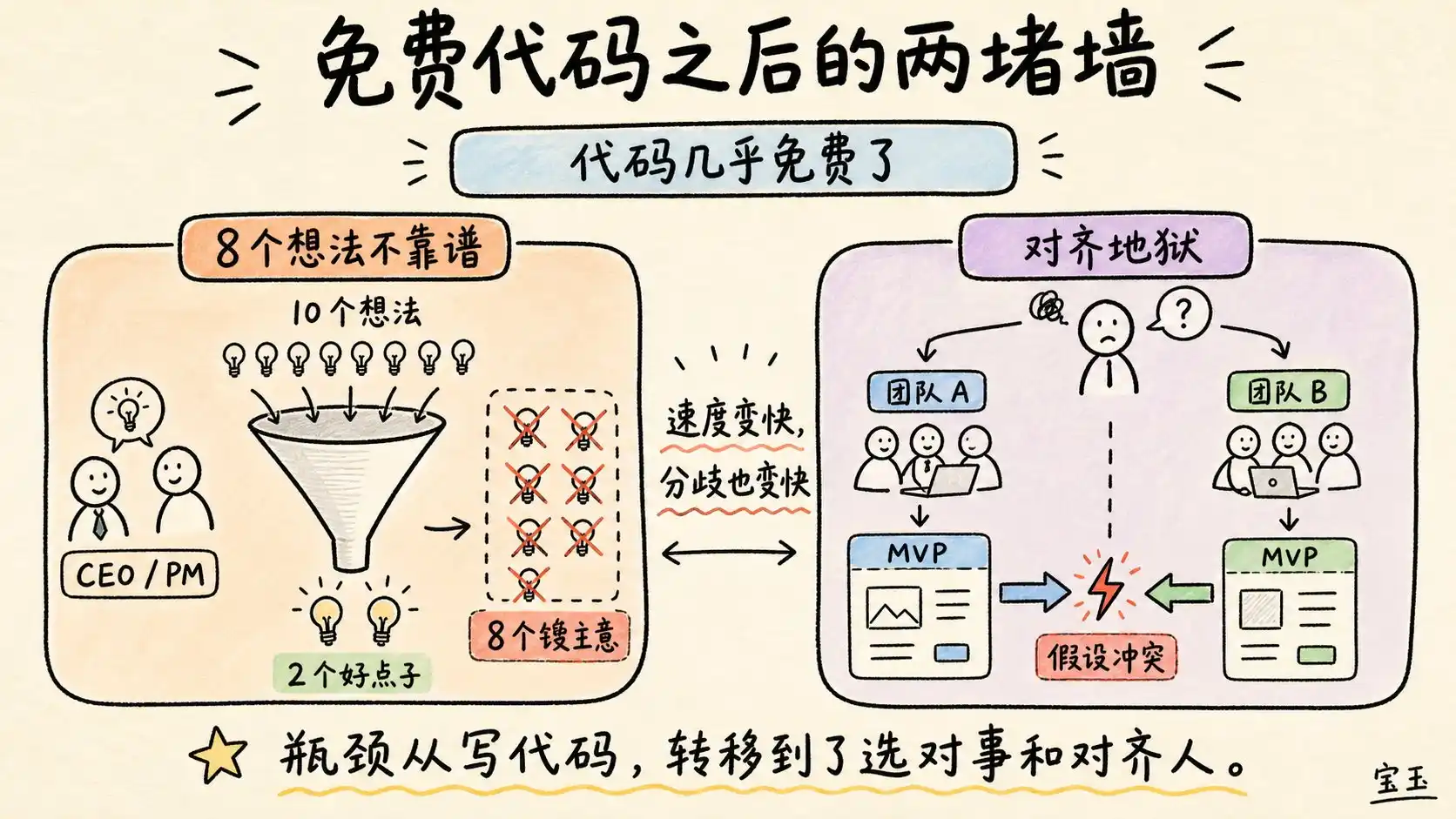
In the past, whenever the CEO or product manager (PM) wanted to do 10 things, the development team would always say they could only handle the top two most important ones, leaving no time for the other 8. The reason? Because writing code isn't child's play; developing complex, functional software takes a lot of time.

Hmm... but now code is almost free. Why haven't we done those other 8 things?

The answer has two parts: one CEOs and PMs don't like to hear; the other middle managers and senior employees don't like to hear.

1. Perhaps those 8 ideas... just weren't good?

Just because the CEO or PM had 10 ideas flash through their minds doesn't mean they can actually translate into tangible business outcomes. Even if you truly built 10 new features (output), it doesn't guarantee users will buy in and use your app more because of them (outcome).

In fact, precisely because development resources were limited before, this 'friction' forced everyone to have more intense debates, thus killing off bad ideas early before they consumed too many resources, selecting the best two. Now, with code being fast and cheap to write, arguing about the merit of ideas seems pointless. Even if you try to push back, do you think you can stop the CEO or PM from turning around and asking Claude themselves? Don't even bother trying.

2. Getting everyone 'aligned' is too painful.

We all know how torturous this is. First, you need all stakeholders to agree on 'why' to do something; then, you need another meeting to discuss specifically 'what' to do; finally, everyone needs to haggle over 'how' to do it.

The more teams involved, the more projects get stuck in 'alignment hell.' Previously, this problem was masked because writing code was slow. Now, as soon as the 'what' is decided, someone immediately pulls an all-nighter to whip up a Minimum Viable Product (MVP) (developing a product with the lowest cost that just showcases the core idea, for quick iteration and testing) and schedules the next meeting for the very next day.

In the meeting, you're shocked to discover another team secretly built an MVP too! Worse, because you based your work on different assumptions, the two products operate on completely different logics.

Sure, you can sit down and slowly grind out whose assumptions are correct.

But let's be honest. You and your team, armed with unlimited Claude tokens, can't be bothered. Neither can the other team. You'd turn right back to Claude without hesitation, asking it to reimplement the other team's work exactly as you see fit, in what you believe is the perfect way. And Claude would just obediently reply, 'You are absolutely right!' and immediately start typing code.
What Do Layoffs Actually Solve?

Alright, thank you for patiently listening to me ramble about these seemingly obvious common-sense truths. I know you want the core substance.

What purpose do layoffs serve? Based on my assumption, if AI isn't truly one-for-one replacing 30% of employees (I think we can agree on this? While it's better than junior white-collar workers at many tasks, it's worse at others—it's definitely not a plug-and-play component, let alone directly replacing 10%, 20%, or 30% of a company's workforce).

So, what's the logic behind layoffs? Because it can immediately solve two glaring short-term problems.

1. Offset 'AI Expenditure'

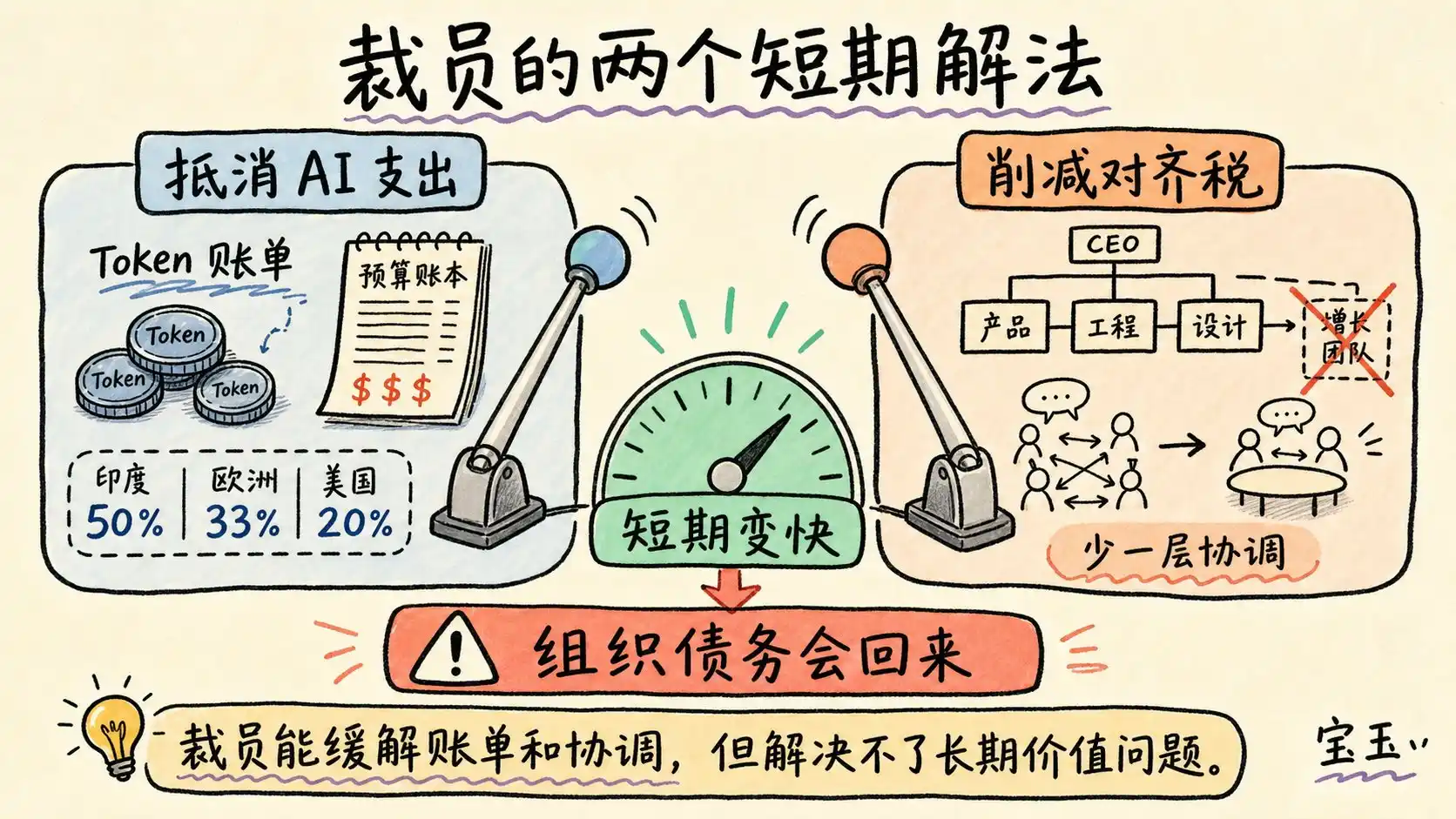
This is essentially a basic cash flow arithmetic problem. It's obvious: if your Claude-addicted engineers are splurging $100 per day on Claude (that's $2,500 per month, $30,000 per year), that amount already equals the total salary of a Software Development Engineer (SDE) in India; half an SDE in Europe; and a quarter of an SDE in the US.

Doing the simplest, crudest calculation: assuming a flat company where all employees are SDEs. To maintain the existing total wage expenditure (including token purchase costs), you must lay off 50% (India), 33% (Europe), or 20% (US) of the staff.

In reality, since AI usage is growing wildly and uncontrollably, while company revenue shows no corresponding growth, layoffs become the inevitable choice. Otherwise, the company's balance sheet collapses. If your input costs increase by 50%, but the ultimate business outcomes remain stagnant or unchanged, then the unit economics of your entire software development lifecycle are completely broken.

If we truly learned how to use AI—figured out how to translate a 50% increase in input cost into a 50% increase in revenue outcome—we wouldn't need to take this step. But precisely because you haven't learned, some of you must pack up and leave to free up money to pay Anthropic.

2. Cut 'Alignment Tax'

Undoubtedly, the size of any large company far exceeds what is strictly necessary for its 'survival.' This is precisely the characteristic of large companies; large organizations are destined to accumulate 'organizational fat,' an inevitable result of organizational structure design.

In these companies, even if someone leaves, the system can still operate because someone else always knows what they used to do. In many big tech firms, you can even safely take six months of maternity leave, and the projects you were responsible for remain fine. These are good things! But it's also solid proof: if you cut a portion of people, the company definitely won't collapse immediately. On the contrary, after the initial few weeks of systemic pain, the pace might even speed up over the following months!

Remember those two teams stuck in a stalemate over technical solutions earlier? Simple: just lay off one of the teams, then let the remaining team pull a few all-nighters to get it done—they no longer need to 'align' with anyone.

We can't predict what happens in the long term (or, to paraphrase economist Keynes—'In the long run, we are all dead'), but in the short term, cutting 10-20% of employees in a large enterprise only makes the work pace faster.

Large enterprises inevitably accumulate redundancy and bloat over time, building up significant 'organizational debt' just like technical debt. This is the chronic illness of large corporations. Cutting 10% of people today won't stop the old ailment from recurring two years later. But when you see everyone boasting about submitting 5 times more code than before, yet being stuck unable to launch because other teams are bottlenecks, the most direct, brutal remedy is clearly: lay off some people, so no one bottlenecks each other.
This is AI Layoffs, Even if AI Didn't Directly Replace Your Seat

Was your employee ID replaced by a new Claude instance running on a virtual machine? We all know that's not the case.

Nevertheless, isn't it true that within the company, many work processes that once required you to type in VS Code, click in Figma, Canva, or Google Docs are now handled by others (those who originally needed your output) simply yelling a prompt at an LLM, no longer bothering to ask for your help? This is also an indisputable fact.

Are these layoffs considered 'AI-washing'? That is—did the company already have various fundamental problems unrelated to AI (like over-hiring, declining profits, competitive pressure, poor business decisions), and now they're just using AI as an 'excuse' for layoffs? Well, that makes sense to some extent.

You might also notice that if you collected all the 'layoff emails' CEOs have sent during this period, you'd even think they might have a group chat where they coordinated writing these emails. 'AI-native squads,' 'managers who code,' 'increasing management span,' 'flattening structure,' 'managing teams of AI agents'... You'll find these buzzwords appearing identically in every email. It's almost as if they fed GPT the same prompt.

But the truth is, even if these layoffs aren't because AI directly replaced you, even if they contain elements of 'AI-washing,' these layoffs are ultimately still caused by AI. Moreover, this layoff wave will continue until we truly learn how to use AI.

Until we learn how to translate massive amounts of AI tokens into tangible business outcomes, not just code inputs; until we learn to make organizational 'alignment' speed keep up with the coding speed of this new generation; until we figure out how to use this extra productivity to pursue another 10 promising new ideas beyond the original 2 good ideas and 8 bad ones.

Before we truly understand how AI actually drives global GDP growth, to fill that $70 billion annual token expenditure hole (the combined enterprise revenue of OpenAI and Anthropic), companies can only 'rob Peter to pay Paul' by cutting employee salaries.

And before we learn how to more efficiently resolve team bottlenecks, the solution will always be the same—simply erase us from the org chart.
In 15 days, I will know my fate. But regardless of the outcome, I think I already know the reason. Even if I were the one making the decision in that spacious CEO office in the corner, I don't know if I could do better; perhaps I would only make the same choice, just like the other CEOs in that group chat.


Preguntas relacionadas

QWhat are the main reasons companies are laying off employees, even if AI isn't directly replacing them?

AAccording to the article, companies are laying off employees primarily for two reasons: 1) To offset the massive and rapidly increasing costs of AI token usage (like Claude), which have become a significant operational expense without a corresponding increase in revenue. This creates a cash flow problem. 2) To reduce 'alignment tax'—the inefficiencies and slowdowns that occur when multiple teams in large organizations need to coordinate. Cutting staff simplifies decision-making and speeds up execution in the short term, even if it doesn't solve the long-term organizational bloat.

QHow does the article distinguish between Input, Output, and Outcome in a business context, and why is this important for the AI debate?

AThe article explains a fundamental business concept: Code is an Input, a feature is the Output, and a user paying for the product is the Outcome. AI-generated code, paid for by the token, is merely an increased Input. The problem is that a sudden 5x increase in Input (code generation) does not automatically lead to a proportional increase in Output (features) or, most importantly, the desired Outcome (revenue). Companies are spending huge sums on AI inputs without seeing corresponding business results, which is a core reason for financial strain and subsequent layoffs.

QWhat is the 'alignment tax' mentioned in the article, and how does AI exacerbate this problem?

A'Alignment tax' refers to the time, effort, and friction required to get all stakeholders in a large organization to agree on the 'why,' 'what,' and 'how' of a project. AI exacerbates this problem because it removes the traditional friction of slow, resource-intensive coding. Now, teams can quickly build competing MVPs based on different assumptions overnight. Instead of resolving these differences through discussion, teams with abundant AI resources are more likely to just re-implement each other's work, leading to duplication, conflict, and organizational paralysis. Layoffs are seen as a brutal shortcut to cut through this alignment hell.

QAccording to the author, why hasn't a massive increase in AI-driven code production led to a visible improvement in products or revenue?

AThe author suggests two key reasons. First, many of the ideas that AI now makes it cheap to implement were simply bad ideas to begin with. Previously, limited development resources forced rigorous debate, killing weak ideas early. Now, with cheap code, there's less incentive to filter them out. Second, the explosion in code production has overwhelmed the organization's ability to align and integrate these efforts coherently. The result is a lot of activity (input) that doesn't translate into valuable, user-facing features (output) or financial success (outcome).

QWhat does the author mean by 'AI-washing' in the context of recent layoffs, and do they believe it's the full explanation?

A'AI-washing' refers to companies using the narrative of embracing AI as a cover for other reasons for layoffs, such as past over-hiring, poor business performance, or competitive pressures. The author acknowledges this element exists, noting how CEO layoff memos often use identical AI buzzwords. However, they argue that even with this washing, the layoffs are fundamentally caused by AI. The unsustainable cost of AI tokens and the organizational chaos (alignment tax) accelerated by AI's coding speed are real, new economic pressures forcing companies to cut headcount to balance their books and streamline operations.

Lecturas Relacionadas

Deconstructing the U.S. Stock Quantum Computing Sector: IonQ, Rigetti, D-Wave, Which of These Concept Stocks is Worth Betting On?

**Title:** Analyzing the US Quantum Computing Race: IonQ, Rigetti, D-Wave – Which Concept Stock is Worth Betting On? **Summary:** The podcast discusses the resurgence of quantum computing as a national priority for both the US and China, driven by its potential to break current encryption, revolutionize drug discovery, finance, and logistics. The core challenge is commercializing the technology, which is hampered by high error rates in quantum bits (qubits). Quantum error correction, requiring thousands of physical qubits per reliable logical qubit, is key but years away. The analysis compares three main publicly traded US quantum computing firms: * **IonQ (Ion Trap):** Considered the most financially stable with the fastest commercial progress (2025 revenue: $130M, +202%) and high-quality clients. Its valuation is very high, pricing in significant future growth. * **Rigetti (Superconducting):** Seen as the highest-risk, highest-potential-reward bet. It has the smallest revenue but recently launched a 108-qubit system. Its valuation multiples are extreme, making it highly sensitive to news. * **D-Wave (Quantum Annealing):** Has the most unique positioning with real-world enterprise clients today (e.g., Mastercard, Volkswagen) solving optimization problems. Its recent acquisition moves it into general-purpose quantum computing ("dual-platform"), adding execution risk. Major tech giants like Google, IBM, and Microsoft are also heavily invested, pursuing various technical approaches. Nvidia is positioning itself as the essential bridge between classical and quantum computing. The investment phase is likened to AI in 2018-2020: promising underlying technology with accelerating breakthroughs but a commercial inflection point still 3-7 years away, suggesting potential for a market correction ("bubble washout"). For investors, suggested approaches include gaining exposure through tech giants with quantum divisions (e.g., Google, IBM) or using niche ETFs like WQTM for pure-play quantum exposure, rather than direct stock picks in the highly volatile pure-play companies at this early stage.

marsbitHace 11 min(s)

Deconstructing the U.S. Stock Quantum Computing Sector: IonQ, Rigetti, D-Wave, Which of These Concept Stocks is Worth Betting On?

marsbitHace 11 min(s)

From Parallel Finance to Mainstream Finance: The On-Chain Securities Era Ushers in a Historic Window

From Parallel Finance to Mainstream: The Dawn of On-Chain Securities For over a decade, the crypto industry has operated as a parallel financial system with its own currencies, markets, and assets—from Bitcoin and ICOs to DeFi, NFTs, and memecoins. Despite building a robust internal ecosystem, a wall has separated it from the traditional financial world. That barrier is now crumbling. The industry's first act was one of internal evolution: ICOs streamlined fundraising, DeFi recreated financial services on-chain, and layer-2 networks competed for scalability—all within the crypto bubble. While innovative, this cycle remained closed, with capital and users circulating internally, leading to volatile boom-bust cycles. Even Bitcoin ETFs, while attracting Wall Street capital, merely provided a channel to buy crypto assets without bridging the systems. The next, larger narrative is Real-World Assets (RWA) moving on-chain. This involves tokenizing stocks, bonds, funds, and future cash flows. Blockchain can compress the complex traditional processes of trading, settlement, clearing, and custody into a seamless, automated network operating in seconds. This shift is creating a new financial gateway: the native crypto securities broker. This entity will combine functions of an exchange, broker, bank, and custodian into a unified global financial operating system. Consequently, the next major battleground won't be the "public chain wars" focused on speed and cost, but the competition to build the financial infrastructure capable of hosting high-quality, liquid real-world assets. Access to global equities, index funds, or stakes in companies like SpaceX could erase the boundary between crypto and traditional finance, unlocking a market orders of magnitude larger than crypto's current valuation. In summary, after years of creating a separate financial world, crypto's next decade will be defined by its integration into the existing global financial system, marking the true beginning of its largest growth story.

marsbitHace 32 min(s)

From Parallel Finance to Mainstream Finance: The On-Chain Securities Era Ushers in a Historic Window

marsbitHace 32 min(s)

Wang Chuan: When the Neighbor Old Wang Made 30x on Memory Stocks, How to Avoid Anxiety (Part Six) - The Trap of Commoditized Goods

Wang Chuan: When the Neighbor Lao Wang Made 30x on Storage Stocks, How to Stay Anxiety-Free (Part 6) - The Trap of Commoditized Goods. This essay uses historical and current examples to analyze the cyclical and high-risk nature of the data storage industry. It begins with the 1990s rise and dramatic fall of Iomega, whose stock soared over 160x in 18 months before collapsing 97% from its peak, illustrating the fleeting success of storage "meme stocks." The core problem is that storage products, like DRAM and flash memory, are highly commoditized. This leads to extreme volatility: prices have plummeted over 80% multiple times, and company stocks often crash 95% or go bankrupt. The industry's dynamic is defined by "elastic demand facing heavy-asset, long-cycle, rigid supply." When demand spikes and supply is fixed, prices skyrocket, as seen recently with AI-driven demand for High Bandwidth Memory (HBM). Companies like Sandisk and Micron have reported massive revenue and gross margin jumps (e.g., Sandisk's gross margin rising from 22.5% to 78.3%) despite minimal increases in production volume. However, these high margins are self-defeating. They incentivize massive new capacity investments (hundreds of billions planned from 2026), with supply expected to surge by late 2027. Once new supply meets demand, prices and profits will crash, potentially leading to a scenario where "selling more results in earning less." The article debunks the safety of long-term supply agreements, comparing them to fragile non-aggression pacts easily broken when market conditions shift. It warns that when an industry is highly profitable but trades at low P/E ratios, the risk is greatest, as plummeting prices quickly erase those earnings. Multiple asymmetric risks loom, including economic recession, reduced AI spending, faster-than-expected capacity expansion (especially from Chinese firms), and technological innovations that reduce memory requirements. In conclusion, the storage sector is a cyclical trap where periods of euphoric profits are often precursors to devastating downturns, luring unprepared investors into a "wealth incinerator."

marsbitHace 42 min(s)

Wang Chuan: When the Neighbor Old Wang Made 30x on Memory Stocks, How to Avoid Anxiety (Part Six) - The Trap of Commoditized Goods

marsbitHace 42 min(s)

Wang Chuan: When the neighbor Lao Wang earned thirty times from investing in memory storage stocks, how can you still avoid anxiety (6) - The trap of homogeneous products

The article, "Wang Chuan: How to Remain Unanxious After Neighbor Lao Wang's Thirty-Fold Gain on Storage Stocks (Part 6) - The Trap of Commoditized Goods," analyzes the cyclical and perilous nature of the data storage industry through historical and current case studies. It begins with the example of Iomega, whose Zip drives led to a stock surge of over 160x in the mid-1990s before collapsing over 97% from its peak due to competition from cheaper CD-R technology. This pattern is characteristic of storage, where products like DRAM are highly commoditized, leading to extreme price volatility. The sector has seen prices crash over 80% multiple times, with companies often facing bankruptcy. The core dynamic is "elastic demand facing heavy-asset, long-cycle, rigid supply." High prices attract new capacity, but the long lead time means supply eventually overshoots, causing sharp price corrections. The current AI-driven boom, exemplified by surging demand for High-Bandwidth Memory (HBM), has led to skyrocketing prices and profit margins for companies like SanDisk and Micron, despite relatively flat production volumes. However, the author warns this high-margin environment is self-defeating. The high profits are already triggering massive new capacity investments (hundreds of billions starting 2026), with supply expected to ramp up by late 2027. When supply catches up, total revenue and profits may fall even as more units are sold. Long-term supply agreements offer little protection, as buyers can find ways to renegotiate if market prices drop, similar to fragile political treaties. Key risks include economic downturns, cuts in AI spending, faster-than-expected capacity expansion (especially from Chinese firms), and innovations in chip/algorithm design that reduce memory needs. A critical trap is that at the cycle's peak, storage stocks often appear cheap with low P/E ratios, luring value investors just before an impending downturn where profits evaporate. The conclusion cautions that for commoditized goods like storage, high margins inevitably destroy themselves, and the current asymmetry favors downside risk over further upside. The neighbor's dream of easy wealth from storage stocks is portrayed as a precarious illusion.

链捕手Hace 1 hora(s)

Wang Chuan: When the neighbor Lao Wang earned thirty times from investing in memory storage stocks, how can you still avoid anxiety (6) - The trap of homogeneous products

链捕手Hace 1 hora(s)

Trading

Spot
Futuros
活动图片




